
In my extensive experience working with mechanical transmission systems, I have found that screw gears, specifically worm gears consisting of a worm and worm wheel, are indispensable components for transmitting motion and power between non-intersecting, perpendicular shafts. These screw gears offer significant advantages, including high transmission ratios and compact design, making them prevalent in applications such as machine tools, metallurgical equipment, mining machinery, and lifting devices. Additionally, their inherent self-locking特性 has led to the widespread use of worm gear reducers as standalone systems. Given their critical role, the wear and tear or unexpected failure of screw gears necessitate timely replacement to ensure machinery operates smoothly and to prevent premature asset retirement. Therefore, rapid measurement and design of cylindrical screw gears are paramount in maintenance and repair sectors, extending the lifecycle of fixed assets, reducing costs, and enhancing productivity. This practice holds substantial practical significance. Through years of总结, research, and practical application, I have developed a set of effective techniques, which I will elaborate on here for discussion with peers.
The process begins with measuring geometric parameters for common Archimedean spiral worm drives. Archimedean screw gears are frequently encountered in industrial settings, and their standard design calculations, material selection, drawing specifications, and manufacturing processes are well-documented in mechanical design handbooks; thus, I will not reiterate those here. Instead, I focus on the rapid surveying methodology.
To systematically acquire the necessary parameters, I follow a structured flowchart procedure, which can be summarized in the table below. This approach ensures accuracy and efficiency in field measurements.
| Step | Parameter | Symbol | Measurement Method |
|---|---|---|---|
| 1 | Number of worm threads | \(Z_1\) | Direct visual count |
| 2 | Number of worm wheel teeth | \(Z_2\) | Direct visual count |
| 3 | Worm tip diameter | \(D_1\) | Precision vernier caliper measurement |
| 4 | Worm wheel tip diameter | \(D_2\) | Measurement using appropriate gauge blocks |
| 5 | Worm thread height | \(h_1\) | Direct measurement with depth gauge or calculated from \(D_1\) and root diameter \(D_0\) |
| 6 | Axial pitch of worm | \(t_a\) | Measure multi-thread span with caliper and divide by number of threads |
| 7 | Tooth profile angle | \(\alpha\) | Checked with profile gauge or trial with gear hobbing |
| 8 | Center distance | \(A\) | Derived from shaft measurements and distance between shafts |
The measurement techniques are straightforward yet require precision. For instance, the worm tip diameter \(D_1\) is obtained using a high-quality vernier caliper, while the worm wheel’s outer diameter \(D_2\) may involve gauge blocks for indirect measurement due to accessibility issues. The worm thread height \(h_1\) can be directly measured with a depth gauge; alternatively, if the root diameter \(D_0\) is measurable, it is computed as:
$$h_1 = \frac{D_1 – D_0}{2}$$
The axial pitch \(t_a\) is critical for defining the lead of the screw gear. By measuring the distance across multiple threads, say \(n\) threads, the axial pitch is:
$$t_a = \frac{\text{Measured span}}{n}$$
Center distance \(A\) is often derived from shaft diameters and the distance between shafts. If \(d_1\) and \(d_2\) are the shaft diameters of the worm and worm wheel, respectively, and \(L\) is the measured distance between shaft centers, then:
$$A = L – \frac{d_1 + d_2}{2}$$
These parameters form the foundation for rapid design. Once acquired, I proceed with calculations to determine module, lead angles, and other essential dimensions. For screw gears, the module \(m\) is related to axial pitch and number of threads:
$$m = \frac{t_a}{\pi}$$
However, in practice, I often cross-reference standard values to ensure compatibility. The lead angle \(\gamma\) of the worm is given by:
$$\tan \gamma = \frac{Z_1 \cdot m}{D_1 – 2m}$$
This angle influences efficiency and self-locking properties of the screw gear assembly. Additionally, the pitch diameter of the worm \(d_1\) and worm wheel \(d_2\) can be estimated as:
$$d_1 \approx D_1 – 2m$$
$$d_2 \approx D_2 – 2m$$
To validate measurements, I compare the calculated center distance with the measured one. For standard screw gears, the theoretical center distance is:
$$A_{\text{theoretical}} = \frac{d_1 + d_2}{2}$$
Discrepancies may indicate wear or non-standard design, requiring adjustments in the redesign phase. In such cases, I prioritize functionality and interchangeability, often opting for nearest standard module values.
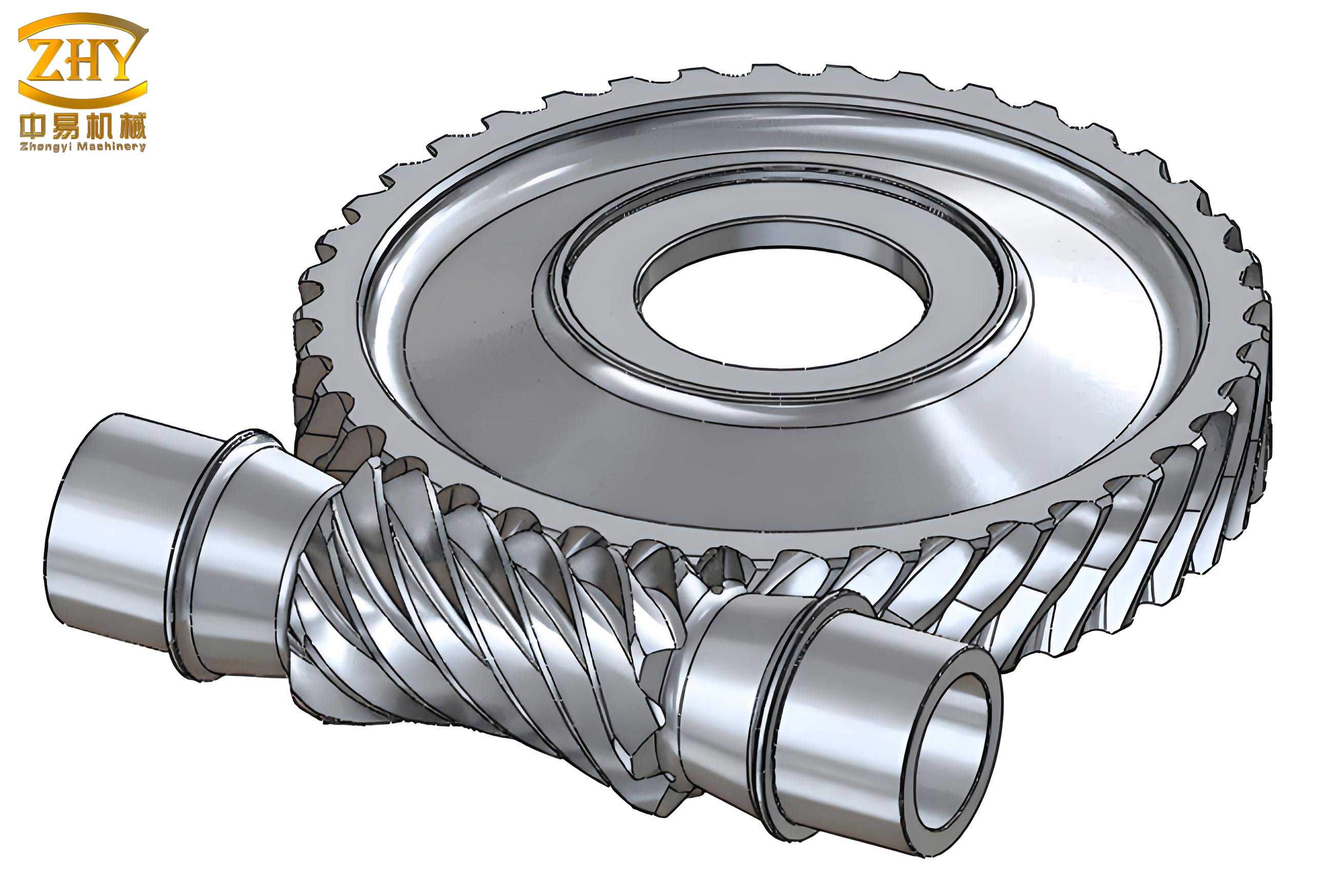
The image above illustrates a typical screw gear pair, highlighting the meshing between worm and worm wheel. Such visual aids are invaluable during measurement, as they help identify key features like tooth profile and alignment. In my work, I often refer to similar diagrams to ensure accurate parameter identification, especially when dealing with worn or damaged screw gears.
Beyond geometric parameters, material selection and heat treatment are crucial for durability. For screw gears under high load, I recommend case-hardened steels for the worm and bronze alloys for the worm wheel to reduce friction and wear. The hardness ratio between worm and wheel should be optimized, typically with the worm being harder. This consideration stems from the sliding contact inherent in screw gear operation, which exacerbates wear compared to other gear types.
To facilitate rapid design, I have compiled common formulas into a reference table, which expedites calculations during fieldwork or urgent repairs. The table below summarizes key relationships for Archimedean screw gears.
| Parameter | Formula | Notes |
|---|---|---|
| Module | \(m = t_a / \pi\) | Standard values preferred |
| Lead angle | \(\gamma = \arctan(Z_1 \cdot m / d_1)\) | Affects efficiency |
| Worm pitch diameter | \(d_1 = D_1 – 2m\) | Approximation |
| Worm wheel pitch diameter | \(d_2 = m \cdot Z_2\) | For standard gears |
| Center distance | \(A = (d_1 + d_2) / 2\) | Theoretical value |
| Tooth thickness | \(s = \pi m / 2\) | At pitch circle |
| Contact ratio | \(\epsilon = \frac{\sqrt{(d_{a1}^2 – d_{b1}^2)} + \sqrt{(d_{a2}^2 – d_{b2}^2)} – A \sin \alpha}{p_b}\) | Ensures smooth engagement |
In this table, \(d_{a1}\) and \(d_{a2}\) are tip diameters, \(d_{b1}\) and \(d_{b2}\) are base diameters, and \(p_b\) is the base pitch. These parameters ensure the screw gears mesh properly without interference. For worn screw gears, I often measure remaining tooth thickness to estimate life and redesign accordingly.
Transitioning to the economic aspects, the maintenance of screw gears is integral to overall equipment efficiency. In many applications, such as boiler systems, screw gears are part of larger传动 systems that include fans and pumps. Optimizing these systems through technologies like variable frequency drives (VFDs) can yield significant energy savings, indirectly benefiting from reliable screw gear operation. I have conducted analyses on this, demonstrating how rapid replacement and design of screw gears contribute to sustained performance.
Consider a case study involving a 10T boiler system, where screw gears might be used in associated machinery. The鼓 and引 fans, often driven by motors through gearboxes, are critical. By implementing VFDs on these fans, energy consumption reduces dramatically. Below is an economic analysis based on my experience, assuming screw gears are maintained optimally to prevent downtime.
| Component | Motor Power (kW) | VFD Investment (k$) | Speed Reduction (%) | Energy Savings Rate (%) | Annual Energy Saved (kWh) | Annual Cost Savings (k$) |
|---|---|---|---|---|---|---|
| 鼓 Fan | 30 | 4.0 | 70 | 66 | 95,040 | 57.024 |
| 引 Fan | 55 | 5.0 | 70 | 66 | 174,240 | 104.544 |
| Total | 85 | 9.0 | – | – | 269,280 | 161.568 |
The calculations assume operation at 70% rated speed for 16 hours daily over 300 days, with electricity at $0.6 per kWh. The payback period for the additional investment in VFDs is approximately 0.7 years, showcasing remarkable returns. This does not even account for secondary benefits like extended motor and screw gear life due to soft starts and reduced current, which further enhance economic viability.
Fundamentally, the integration of IGBT-based VFDs with vector control has revolutionized speed regulation in fluid负载 applications. Since fans and pumps constitute about half of motor capacity and 30% of national electricity consumption, adopting such technologies in systems involving screw gears—like boiler fans and circulating pumps—replaces inefficient throttling methods. This synergy between mechanical maintenance (e.g., rapid screw gear测绘) and electronic optimization fosters scientific operation, elevating both economic and social效益.
In deeper technical exploration, the dynamics of screw gears involve complex interactions. The efficiency \(\eta\) of a worm gear set can be approximated by:
$$\eta = \frac{\tan \gamma}{\tan(\gamma + \phi)}$$
where \(\phi\) is the friction angle, dependent on material pairing and lubrication. For self-locking screw gears, \(\gamma < \phi\) ensures no back-driving. During measurement, I assess wear by checking changes in \(\gamma\) and tooth profile, which affect efficiency. If the measured lead angle deviates from design, it may indicate advanced wear, necessitating redesign with adjusted parameters.
Moreover, load distribution across screw gear teeth is uneven due to the sliding contact. The nominal stress \(\sigma\) on worm wheel teeth can be estimated using the Lewis formula adapted for screw gears:
$$\sigma = \frac{F_t}{b m Y}$$
Here, \(F_t\) is the tangential force, \(b\) is face width, \(m\) is module, and \(Y\) is a form factor specific to screw gear geometry. In rapid design, I use conservative values for \(Y\) based on standard tables to ensure safety. For heavily loaded screw gears, I also calculate bending and contact stresses using more refined models, such as:
$$\sigma_H = Z_E \sqrt{\frac{F_t}{d_1 b} \cdot \frac{u+1}{u}}$$
where \(Z_E\) is the elasticity factor and \(u = Z_2 / Z_1\) is the gear ratio. These calculations help in selecting appropriate materials and heat treatments during the redesign phase.
Lubrication is another critical aspect. For screw gears, high-sliding velocities necessitate extreme-pressure (EP) lubricants to prevent scuffing. The film thickness \(h_0\) in elastohydrodynamic lubrication can be approximated by:
$$h_0 = 2.65 \frac{(U \eta_0)^{0.7} R^{0.43}}{E’^{0.03} W^{0.13}}$$
where \(U\) is rolling speed, \(\eta_0\) is dynamic viscosity, \(R\) is effective radius, \(E’\) is reduced modulus, and \(W\) is load per unit width. Maintaining adequate lubrication extends the life of screw gears, reducing frequency of replacement and测绘 needs.
In field measurements, environmental factors like temperature and contamination can affect accuracy. I always calibrate instruments on-site and take multiple readings to average out errors. For screw gears in inaccessible locations, I use boroscopes or remote sensors to capture dimensions, though this adds complexity. The table below outlines common challenges and my mitigation strategies during screw gear测绘.
| Challenge | Impact on Measurement | Mitigation Strategy |
|---|---|---|
| Wear and pitting | Distorts tip and root diameters | Measure multiple points; use statistical averaging |
| Contamination (grease, dirt) | Obscures tooth profiles | Thorough cleaning before measurement |
| Limited access | Difficult to position calipers | Employ gauge blocks or custom fixtures |
| Non-standard profiles | Mismatch with assumed geometry | Use profile gauges or 3D scanning if available |
| Temperature variations | Thermal expansion alters dimensions | Record temperature and apply correction factors |
These strategies ensure that even under adverse conditions, I can derive reliable data for screw gear redesign. For instance, thermal expansion corrections involve the formula:
$$D_{\text{corrected}} = D_{\text{measured}} \left[1 + \alpha (T – T_{\text{ref}})\right]$$
where \(\alpha\) is the coefficient of thermal expansion for the material, \(T\) is operating temperature, and \(T_{\text{ref}}\) is reference temperature (usually 20°C). This is crucial for precision screw gears used in high-temperature environments.
Beyond individual components, system-level integration of screw gears affects overall performance. In conveyor systems or rotary actuators, the backlash in screw gears can impact positioning accuracy. During measurement, I quantify backlash by fixing the worm and measuring angular movement of the worm wheel. The backlash \(B\) in linear terms is related to angular backlash \(\theta\) by:
$$B = \frac{d_2 \theta}{2}$$
Excessive backlash may require redesign with tighter tolerances or anti-backlash mechanisms. In rapid design, I often specify modified tooth thickness to compensate for wear-induced backlash.
The manufacturing aspect also ties into rapid design. Once parameters are determined, I generate CAD models and CNC programs for quick production. For screw gears, hobbing is common, and the hob design relies on measured parameters. The hob diameter \(D_h\) should satisfy:
$$D_h \geq D_1 + 2m$$
to avoid interference. In urgent repairs, I sometimes use additive manufacturing for prototyping screw gears before final metal cutting, accelerating the process.
Looking at broader implications, the lifecycle cost of screw gears includes initial design, maintenance, and energy consumption. My rapid测绘 approach minimizes downtime, while pairing it with energy-efficient drives like VFDs optimizes operational costs. The total cost of ownership (TCO) for a screw gear system can be modeled as:
$$\text{TCO} = C_{\text{initial}} + \sum_{t=1}^{n} \left(C_{\text{maintenance},t} + C_{\text{energy},t}\right)$$
where \(n\) is lifespan in years. By reducing \(C_{\text{maintenance}}\) through fast replacements and \(C_{\text{energy}}\) via system optimizations, TCO decreases significantly.
In conclusion, the methodology I have presented for rapid measurement and design of screw gears combines practical field techniques with robust engineering calculations. By emphasizing accuracy in parameter acquisition and leveraging standard formulas, I ensure that replacement screw gears restore machinery functionality promptly. The integration of economic analyses, such as VFD benefits, highlights the interconnectedness of mechanical maintenance and energy management. As technology advances, tools like 3D scanning and AI-assisted design may further streamline this process, but the core principles remain: precise measurement, sound design, and holistic system thinking. Through continued practice and innovation, I believe the field of screw gear maintenance will evolve, contributing to sustainable industrial operations worldwide.