
In the realm of precision machinery and high-performance motion control, the pursuit of eliminating positional error and achieving exceptional repeatability is paramount. Gear transmissions, renowned for their stable transmission ratios, ease of control, and high unidirectional accuracy, are ubiquitous. However, their inherent Achilles’ heel—backlash or side clearance—introduces nonlinearities that manifest as transmission error, reduced positional accuracy, noise, and vibration, ultimately compromising system performance. To mitigate these detrimental effects, various anti-backlash mechanisms have been developed. Among these, systems utilizing screw gears, specifically worm gear pairs, have been favored for high-ratio, compact applications, though traditional designs often suffer from manufacturing complexity and high cost.
This article delves into the nonlinear dynamic characteristics of a novel zero-backlash drive mechanism, which ingeniously employs a pair of opposing screw gears in conjunction with a dual-pinion configuration. We will establish its dynamic model, conduct a numerical investigation into its behavior, and analyze the influence of key parameters. The core of this mechanism leverages the inherent irreversibility and high reduction ratio of screw gears to create a pre-loaded, permanently engaged drive train, effectively eliminating the dead zone caused by backlash.
Introduction to Backlash and Anti-Backlash Techniques
Backlash, the clearance between mating teeth of a gear pair, is a necessary evil in most gear designs to allow for lubrication, thermal expansion, and manufacturing tolerances. However, in precision systems like CNC rotary tables, robotic joints, or satellite tracking systems, this clearance leads to non-linear response during direction reversals, causing contouring errors and limiting stability. Traditional anti-backlash methods for worm drives, such as dual-lead worm gears or dual-servo motor systems, present significant drawbacks. Dual-lead worms are difficult and expensive to manufacture and adjust, while dual-motor systems increase complexity, cost, and control challenges.
The proposed mechanism addresses these shortcomings. Its principle is based on using two axially opposed worm-and-gear sets (hereafter referred to as screw gear sets) to pre-load a central bull gear via two pinions. This configuration ensures that one flank of the bull gear teeth is always in contact with a driving pinion, regardless of the rotational direction. This article focuses on the dynamic ramifications of such a design. By eliminating the piecewise-linear nonlinearity of backlash, the system’s dynamics change fundamentally. We investigate this nonlinear dynamic landscape, paying particular attention to the effects of time-varying meshing stiffness and damping—phenomena acutely present in screw gear engagements due to their sliding contact and varying number of contact lines.
Mechanism and Operating Principle
The core architecture of the zero-backlash drive is designed primarily for applications demanding high rotational accuracy, such as the rotary axis of a machining center. The system’s output is a large bull gear, which is directly coupled to the load (e.g., a worktable). The key innovation lies in the dual-path drive input.
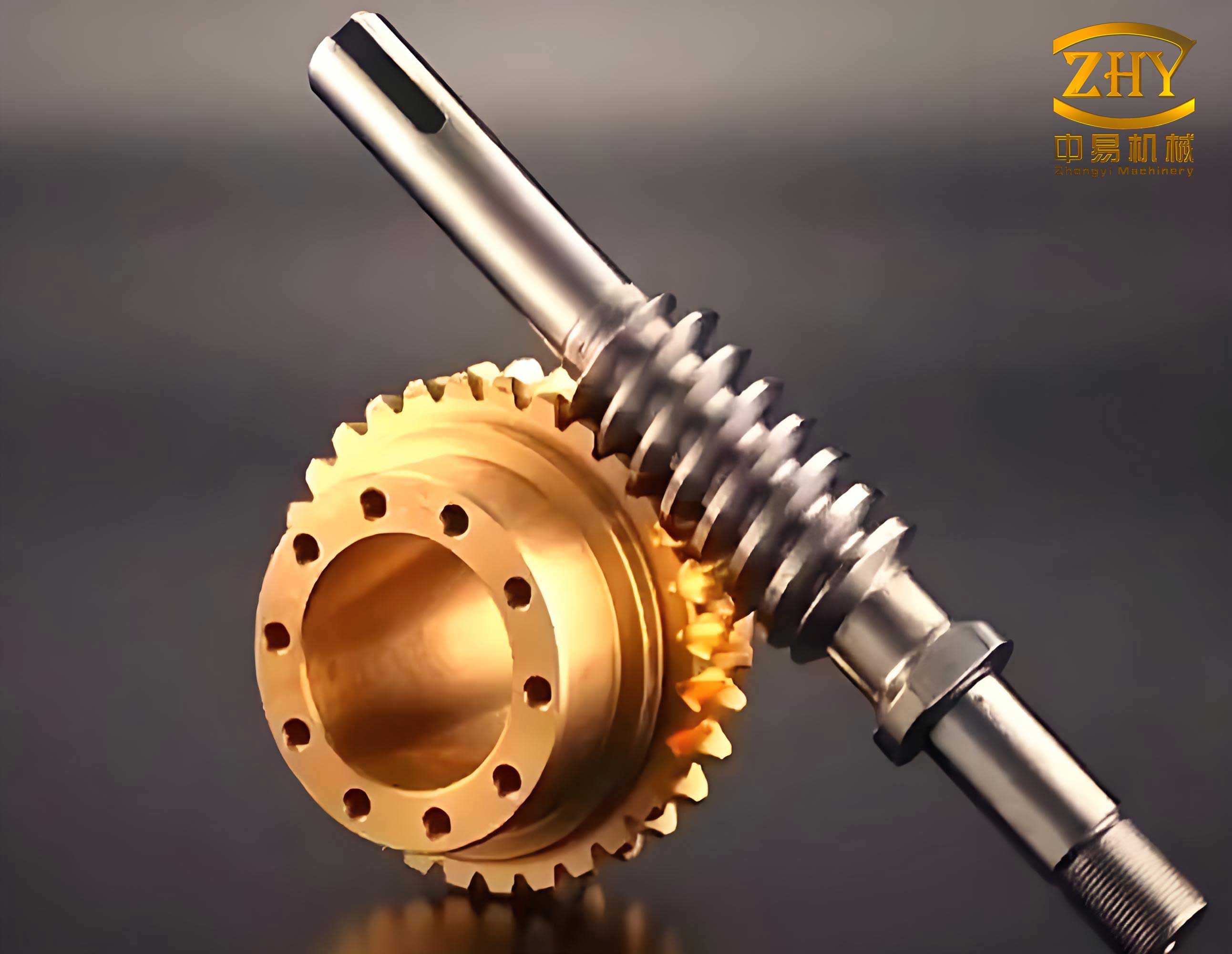
The bull gear is simultaneously engaged with two identical pinions. Each pinion is mounted on the shaft of a worm wheel. These two worm wheels are each driven by a separate worm shaft. Critically, the two worm shafts are aligned on a common axis but are mechanically pre-loaded against each other in the axial direction using opposing nuts. This axial pre-load force is translated through the screw gear pairs into a radial pre-load force at the gear mesh between the pinions and the bull gear. The mechanics are as follows:
- Pre-load Generation: Tightening the opposing nuts forces the two worms apart axially. Since each worm is engaged with its respective worm wheel, this axial motion induces a slight rotational displacement in the worm wheels and their attached pinions. One pinion is forced against the left flank of the bull gear teeth, while the other is forced against the right flank.
- Unidirectional Drive Paths: Two independent, zero-backlash drive chains are thus created:
- Chain A (Clockwise Drive): Motor → Worm Shaft A → Worm Wheel A → Pinion A (contacts bull gear’s right flank).
- Chain B (Counter-Clockwise Drive): Motor → Worm Shaft B → Worm Wheel B → Pinion B (contacts bull gear’s left flank).
- Operation: When a clockwise torque is commanded, the motor drives through Chain A. Pinion A, already pre-loaded against the bull gear’s right flank, transmits torque immediately without any lost motion. Chain B simply idles, maintaining pre-load. For counter-clockwise rotation, Chain B becomes the active drive path. The axial pre-load in the screw gear assembly ensures that the transition between driving chains involves no free play, resulting in seamless bidirectional operation with high stiffness and damping.
This design elegantly solves the backlash problem using standard, manufacturable components. The screw gears provide the high reduction ratio and the mechanical means to generate and maintain the critical pre-load force across the entire gear train.
Nonlinear Dynamic Modeling
To analyze the dynamic performance, a lumped-parameter model is developed. We focus on one active drive chain at a time, as the system is symmetric. The model considers the rotational inertia of the gears and the flexibility/damping of the gear meshes. Supporting structures are assumed rigid for this analysis. The model for the active chain (e.g., Chain A) is depicted conceptually and consists of three inertia elements: the pinion (I1), the bull gear (I2), and for completeness, the reflected inertia of the worm wheel (though the worm gear’s high ratio often allows it to be considered as part of the motor drive). The primary compliance is modeled at the spur gear mesh between the pinion and bull gear.
The equation of motion is derived using Newton’s second law. Defining the dynamic transmission error (DTE) along the line of action as the difference between the actual and kinematic relative displacement of the gears is a standard and powerful approach. Let θ1, θ2 be the rotational displacements of the pinion and bull gear, and r1, r2 their base circle radii. The DTE, \( u_d \), is:
$$ u_d = r_1 \theta_1 – r_2 \theta_2 $$
The static transmission error (STE), \( \epsilon(t) \), which includes manufacturing errors, is then introduced to define the total displacement variable \( u(t) \):
$$ u(t) = u_d – \epsilon(t) = r_1 \theta_1 – r_2 \theta_2 – \epsilon(t) $$
The nonlinear equation of motion in terms of \( u(t) \) becomes:
$$ m_e \ddot{u}(t) + c \dot{u}(t) + k(t) f(u(t)) = F_m – m_e \ddot{\epsilon}(t) $$
where:
- \( m_e = \frac{I_1 I_2}{I_1 r_2^2 + I_2 r_1^2} \) is the equivalent mass.
- \( c \) is the linear meshing damping coefficient.
- \( k(t) \) is the time-varying meshing stiffness.
- \( F_m = \frac{T_1}{r_1} = \frac{T_2}{r_2} \) is the average force transmitted (assuming constant input torque T1 and load torque T2).
- \( -m_e \ddot{\epsilon}(t) \) acts as an internal displacement excitation.
- \( f(u(t)) \) is the backlash nonlinearity function.
The Backlash Nonlinearity Function
In a conventional gear pair, the function \( f(u) \) describes the piecewise-linear spring characteristic due to backlash \( 2b \):
$$
f(u) =
\begin{cases}
u – b, & u > b \\
0, & -b \le u \le b \\
u + b, & u < -b
\end{cases}
$$
However, in the proposed pre-loaded, zero-backlash mechanism, the gears are never disengaged. Therefore, the backlash nonlinearity is eliminated. Mathematically, this corresponds to setting the backlash parameter \( b = 0 \), simplifying the function to a linear one:
$$ f(u) = u $$
This is a crucial distinction that fundamentally alters the system’s dynamic response, removing the bifurcations and chaotic regimes often associated with clearance nonlinearities.
Time-Varying Mesh Stiffness and Excitation
Even with zero backlash, the system retains important nonlinear dynamic features. The meshing stiffness \( k(t) \) is periodic due to the changing number of tooth pairs in contact and the varying contact conditions along the path of contact. For screw gears like worm gears, this variation can be complex due to the sliding contact and gradual engagement, but for the spur gear stage in our model, it is well-approximated by a sinusoidal function:
$$ k(t) = k_m + k_a \cos(\omega_e t + \phi_s) $$
where \( k_m \) is the average mesh stiffness, \( k_a \) is the stiffness variation amplitude, \( \omega_e \) is the gear mesh frequency ( \( \omega_e = Z_1 \Omega_1 \) , with \( Z_1 \) as pinion teeth and \( \Omega_1 \) as pinion rotational speed), and \( \phi_s \) is a phase angle.
The static transmission error \( \epsilon(t) \), a primary source of internal excitation, is also periodic at the mesh frequency and its harmonics:
$$ \epsilon(t) = \sum_{n=1}^{\infty} E_n \sin(n \omega_e t + \phi_n) $$
where \( E_n \) and \( \phi_n \) are the amplitude and phase of the n-th harmonic.
Non-Dimensionalization of the Equation of Motion
For general analysis and numerical stability, the equation is non-dimensionalized. We introduce a characteristic length \( l_c \) (often related to the nominal static deflection \( F_m/k_m \)) and the natural frequency \( \omega_n = \sqrt{k_m / m_e} \). Defining non-dimensional time \( \tau = \omega_n t \) and displacement \( x = u / l_c \), we obtain:
$$ \ddot{x}(\tau) + 2\zeta \dot{x}(\tau) + [1 + \kappa \cos(\Omega \tau)] f(x(\tau)) = \bar{F} + \eta \Omega^2 \sum_{n=1}^{\infty} \sin(n\Omega \tau + \phi_n) $$
where the new parameters are:
| Symbol | Definition | Physical Meaning |
|---|---|---|
| \( \zeta \) | \( \frac{c}{2 m_e \omega_n} \) | Damping ratio |
| \( \kappa \) | \( k_a / k_m \) | Stiffness variation coefficient |
| \( \Omega \) | \( \omega_e / \omega_n \) | Non-dimensional excitation frequency |
| \( \bar{F} \) | \( F_m / (m_e l_c \omega_n^2) \) | Non-dimensional mean force |
| \( \eta \) | \( E_1 / l_c \) | Non-dimensional STE amplitude |
With zero backlash (\( b=0 \)), \( f(x(\tau)) = x(\tau) \). The governing equation simplifies to a parametrically and externally excited linear system with time-periodic coefficients:
$$ \ddot{x}(\tau) + 2\zeta \dot{x}(\tau) + [1 + \kappa \cos(\Omega \tau)] x(\tau) = \bar{F} + \eta \Omega^2 \sum_{n=1}^{\infty} \sin(n\Omega \tau + \phi_n) $$
Numerical Analysis and Dynamic Characteristics
The non-dimensional equation is solved using numerical integration methods, specifically the fourth-order Runge-Kutta algorithm, which is well-suited for systems with time-varying parameters. The simulation parameters are based on a realistic gear set for a medium-sized rotary drive. The spur gear stage has a pinion with 24 teeth and a bull gear with 192 teeth, module 6 mm. The screw gear stage provides the initial speed reduction and pre-load.
| Parameter | Pinion | Bull Gear |
|---|---|---|
| Teeth (Z) | 24 | 192 |
| Module (mm) | 6 | 6 |
| Inertia, I (kg·m²) | 3.255e-2 | 46.101 |
| Avg. Mesh Stiffness, k_m (N/m) | 1.0e8 (Representative) | |
| Parameter | Symbol | Baseline Value |
|---|---|---|
| Damping Ratio | \( \zeta \) | 0.05 |
| Stiffness Variation Coeff. | \( \kappa \) | 0.1 |
| Excitation Frequency Ratio | \( \Omega \) | 0.043 |
| Non-dim. Force | \( \bar{F} \) | 512.8 |
| Non-dim. STE Amplitude | \( \eta \) | 1538.4 |
The time history response of the non-dimensional transmission error \( x(\tau) \) and its velocity \( \dot{x}(\tau) \) under the baseline parameters is computed. The results reveal the dynamic signature of the zero-backlash system:
- Transient Response: The system exhibits an initial oscillatory transient. Due to the absence of a backlash-induced jump discontinuity, this transient is smooth and decays exponentially.
- Steady-State Response: After the transient decays (typically within 100 non-dimensional time units for \( \zeta=0.05 \)), the system settles into a steady-state periodic vibration. This vibration is driven solely by the periodic excitations from \( \kappa \cos(\Omega \tau) \) and \( \eta \Omega^2 \sin(\Omega \tau) \). The amplitude is bounded and the response is synchronous with the mesh frequency.
This behavior confirms a key advantage: the elimination of backlash not only removes lost motion but also suppresses the complex, potentially chaotic, sub-harmonic, and super-harmonic responses that plague systems with clearance. The pre-load from the screw gear assembly ensures the system remains in a linear operating regime, leading to predictable, stable dynamics.
Parametric Study: Influence of Damping and Stiffness Variation
The performance of the zero-backlash drive is sensitive to system parameters. We investigate the effects of meshing damping and stiffness variation, both of which are influenced by the design and pre-load of the screw gear stage.
Effect of Meshing Damping (\( \zeta \))
Meshing damping arises from material hysteresis, friction, and lubrication squeeze film effects. In a pre-loaded system with screw gears, the sliding friction in the worm mesh contributes significantly to overall system damping. We vary the damping ratio \( \zeta \) while keeping other parameters at baseline values.
| Damping Ratio (\( \zeta \)) | Transient Decay Time | Steady-State Amplitude | Observations |
|---|---|---|---|
| 0.02 (Low) | Long | Moderate | Pronounced ringing, slow stabilization. |
| 0.05 (Baseline) | Medium | Moderate | Reasonable decay, stable harmonic response. |
| 0.10 (High) | Short | Slightly Reduced | Rapid settling, clean harmonic output. |
| 0.15 (Very High) | Very Short | Reduced | Critically damped appearance, minimal vibration. |
The simulations clearly show that increasing \( \zeta \) drastically reduces the transient decay time. A system with higher damping, perhaps achieved through specific lubrication or material selection in the screw gears, reaches its steady-state operational condition more quickly after a start-up or direction change. While its effect on the steady-state amplitude is less pronounced for harmonic excitation, higher damping generally lowers the vibration level across the spectrum, contributing to smoother operation and reduced noise.
Effect of Mesh Stiffness Variation (\( \kappa \))
The parameter \( \kappa = k_a / k_m \) represents the intensity of the parametric excitation. A lower \( \kappa \) means a more constant mesh stiffness. The average mesh stiffness \( k_m \) itself is a function of gear geometry, tooth profile, and material. The pre-load from the screw gear assembly can slightly increase the effective mesh stiffness by ensuring full tooth contact. We analyze the response for different \( \kappa \) values.
| \( \kappa \) Value | Steady-State Amplitude | Response Character | Implications for Design |
|---|---|---|---|
| 0 (Constant Stiffness) | Very Small | Pure forced vibration from STE. Minimal modulation. | Ideal but unattainable in practice. |
| 0.05 (Small Variation) | Small | Stable harmonic response, slight sidebands. | Excellent dynamic performance target. |
| 0.2 (Moderate Variation) | Larger | Clearly modulated harmonic response. | Typical of standard gear designs. |
| 0.4 (Large Variation) | Largest, Potentially Unstable | Significant amplification, possible parametric resonance near certain \( \Omega \). | Undesirable; leads to high vibration and noise. |
The results are striking. A reduction in \( \kappa \) (i.e., a more uniform mesh stiffness) directly and significantly reduces the steady-state vibration amplitude. This highlights a critical design goal: minimizing stiffness fluctuation. This can be approached by:
- Increasing Contact Ratio: Using helical gears instead of spur gears for the pinion/bull gear stage provides more overlapping teeth contact, smoothing the transition of load from one tooth pair to the next.
- Tooth Profile Modification: Tip and root relief can optimize the load sharing between teeth.
- High-Precision Manufacturing: Reducing pitch and profile errors minimizes the effective \( \epsilon(t) \) and contributes to smoother stiffness variation.
Furthermore, increasing the average mesh stiffness \( k_m \) (e.g., through wider face width or higher modulus material) raises the system’s natural frequency \( \omega_n \), which often lowers the operational frequency ratio \( \Omega \), moving the system away from potential resonance conditions. This makes the system more robust to parametric excitations. The interplay between the screw gear pre-load and the spur gear mesh condition is subtle; optimal pre-load ensures contact without inducing excessive friction or deformation that could negatively affect \( k(t) \).
Discussion and Design Implications
The nonlinear dynamic analysis of this zero-backlash drive mechanism reveals a system whose behavior is dominated by linear, time-periodic dynamics once the major nonlinearity of backlash is removed. This is a highly desirable outcome for precision systems. The role of the screw gears is twofold: first, to provide the mechanical advantage and compactness of a high-ratio reduction stage, and second, to act as the precise, lockable actuator for generating the essential axial pre-load force that eliminates clearance across the entire kinematic chain.
The parametric study offers clear guidelines for optimizing dynamic performance:
- Maximize Damping (\( \zeta \)): Incorporate damping mechanisms. The screw gear mesh itself, with its sliding action, is a natural damper. Using lubricants with high damping properties or considering materials with high internal damping for the worm wheel can be beneficial. The goal is to shorten transients and reduce vibration amplitudes.
- Minimize Stiffness Variation (\( \kappa \)): This is perhaps the most effective way to improve steady-state performance. Design the spur gear stage for a high contact ratio. Precision manufacturing and profile modification are key investments that pay off in smoother, quieter operation. The pre-load from the screw gears must be calibrated to ensure full tooth contact without causing binding or excessive wear that could alter the stiffness characteristics over time.
- Increase Average Stiffness (\( k_m \)): A stiffer gear mesh shifts the system’s natural frequency higher, generally placing the operational frequency ratio \( \Omega \) further into a sub-critical region. This reduces the amplification factor of excitations and improves bandwidth.
The synergy between these parameters is important. For instance, a design featuring high-precision, high-contact-ratio helical gears (low \( \kappa \)) combined with a well-lubricated, pre-loaded screw gear set (providing good damping \( \zeta \) and ensuring zero backlash) will yield a drive system with exceptional dynamic characteristics: fast settling times, low vibration, high stiffness, and flawless bidirectional accuracy.
Conclusion
This study has presented a comprehensive nonlinear dynamic analysis of a novel dual-path, zero-backlash drive mechanism centered on the use of opposed screw gear sets. By establishing a lumped-parameter model and conducting numerical simulations, we have elucidated the dynamic behavior of the system when the critical nonlinearity of gear backlash is eliminated through mechanical pre-load.
The key findings are:
- The elimination of backlash transforms the system’s dynamics, leading to a stable, periodic steady-state response free from the complex transients and chaotic potential associated with clearance nonlinearities. The pre-load mechanism enabled by the screw gears is fundamental to this achievement.
- System damping, influenced significantly by the screw gear mesh characteristics, plays a crucial role in governing the transient response. Higher meshing damping drastically reduces the time required for the system to settle after a disturbance or direction change.
- The time-varying nature of the mesh stiffness is the dominant remaining source of vibration. Minimizing this variation (lower \( \kappa \)) through gear design and precision manufacturing is the most effective strategy for reducing steady-state vibration amplitudes. Concurrently, increasing the average mesh stiffness improves the system’s robustness.
In conclusion, the proposed drive architecture, leveraging the unique capabilities of screw gears for pre-load generation, offers a viable and high-performance solution for applications demanding absolute positional fidelity and smooth dynamic response. The insights from this nonlinear analysis provide a clear roadmap for optimizing the design, focusing on managing damping and stiffness properties to harness the full potential of a true zero-backlash mechanical transmission.