
In the realm of mechanical power transmission, screw gears, commonly referred to as worm gears, play a pivotal role due to their ability to provide high reduction ratios and smooth, quiet operation. The efficient and reliable performance of screw gears is heavily dependent on proper lubrication. As an engineer specializing in tribology and gear systems, I have extensively studied and applied various lubrication strategies for screw gears. This article delves into the critical aspects of selecting and using lubricants for screw gears, incorporating empirical formulas, tabulated data, and practical guidelines. The goal is to provide a comprehensive resource that aids in optimizing lubrication practices, thereby enhancing the longevity and efficiency of screw gears in diverse applications.
The interaction between the worm and the wheel in screw gears involves significant sliding motion, which generates considerable heat and wear. Therefore, lubricant selection is not merely about reducing friction; it is about managing thermal loads, preventing adhesive wear (scuffing or scoring), and protecting against corrosion. The following sections systematically address lubrication mode selection, viscosity determination, oil quality grading, and application methodologies, all tailored specifically for screw gears. Throughout this discussion, I will emphasize the unique characteristics of screw gears that influence lubrication requirements.
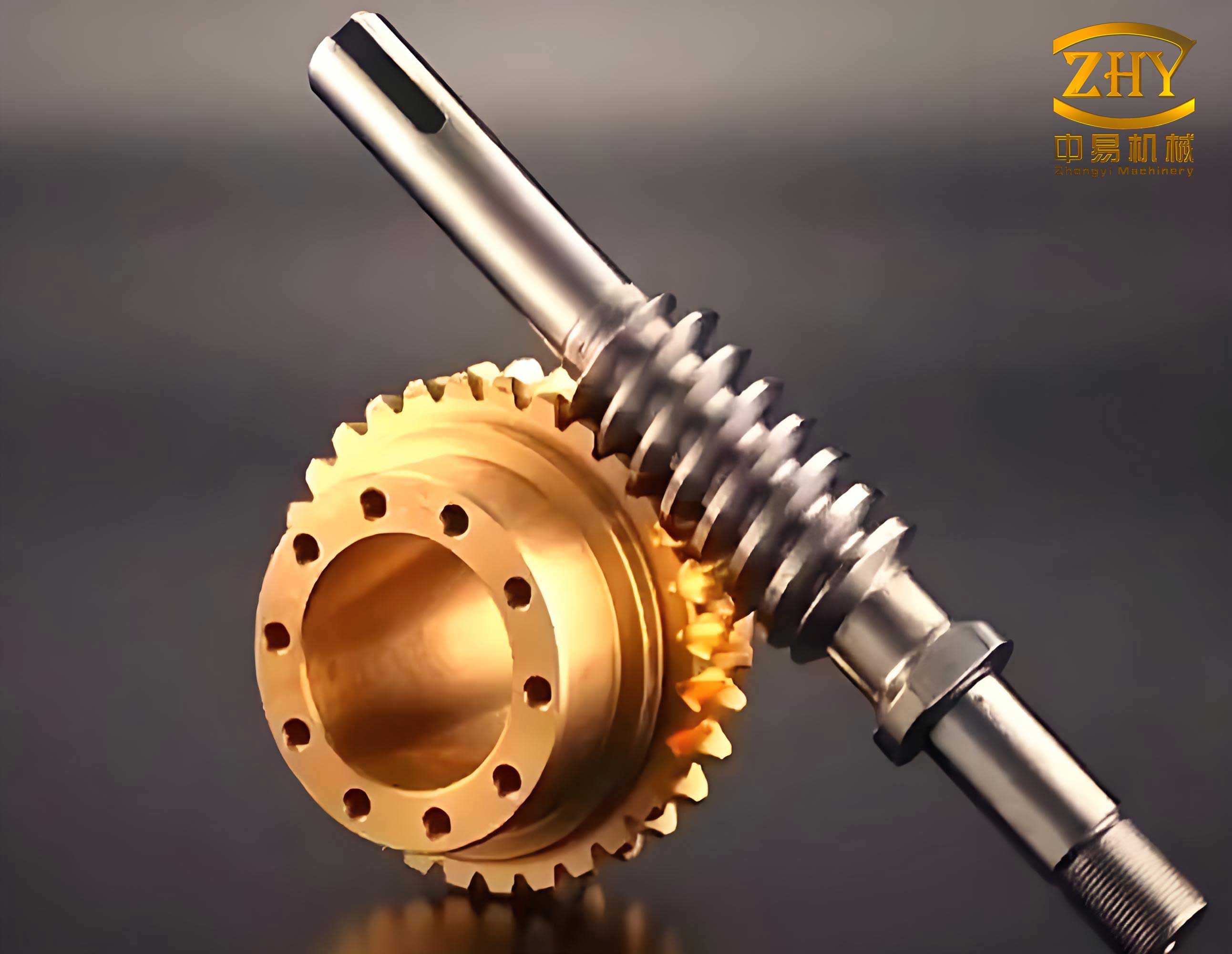
Before proceeding, it is beneficial to visualize the typical configuration of screw gears. The image above illustrates a common screw gear set, highlighting the meshing between the worm and the gear wheel. This visual reference underscores the sliding contact areas where lubrication is most critical. Now, let us explore the foundational principles governing lubricant choice for these components.
1. Selection of Lubrication Method
The primary lubrication methods for screw gears are oil bath lubrication and circulating spray (pressure) lubrication. The choice between these methods is predominantly dictated by the relative sliding velocity at the gear mesh. For screw gears, the sliding velocity has components both in the tooth height direction and, more significantly, in the tooth width (axial) direction. A practical formula to estimate the relative sliding velocity, \( v_s \), is essential for making an informed decision.
The relative sliding velocity \( v_s \) in meters per second (m/s) can be calculated using the following equation, which considers the worm geometry and operating conditions:
$$ v_s = \frac{\pi \cdot m \cdot n}{60 \cdot 1000} \cdot \sqrt{q^2 + 1} $$
Where:
\( m \) = Axial module of the worm (mm)
\( n \) = Rotational speed of the worm (rpm)
\( q \) = Worm characteristic coefficient (diameter factor), defined as \( q = d_1 / m \), with \( d_1 \) being the pitch diameter of the worm (mm).
This formula encapsulates the combined effect of worm geometry and speed on the sliding action inherent in screw gears.
Based on the calculated sliding velocity \( v_s \) or, alternatively, on the worm rotational speed, the lubrication method can be selected. The following table provides empirical guidelines:
| Criterion | Condition | Recommended Lubrication Method |
|---|---|---|
| Relative Sliding Velocity | \( v_s > 5 \, \text{m/s} \) | Circulating Spray Lubrication |
| Relative Sliding Velocity | \( v_s \leq 5 \, \text{m/s} \) | Oil Bath Lubrication |
| Worm Rotational Speed | \( n > 500 \, \text{rpm} \) | Circulating Spray Lubrication |
| Worm Rotational Speed | \( n \leq 500 \, \text{rpm} \) | Oil Bath Lubrication |
These thresholds are derived from field experience and aim to ensure adequate oil delivery and heat dissipation. For screw gears operating at high sliding speeds, circulating lubrication is necessary to continuously supply cool, filtered oil to the contact zone and carry away generated heat. For slower screw gears, the simpler oil bath method, where the gear dips into an oil sump, is often sufficient.
2. Selection of Lubricant Viscosity
Once the lubrication method is chosen, the next critical step is selecting the appropriate oil viscosity. Viscosity is paramount because it directly influences the formation and maintenance of a protective lubricant film between the sliding surfaces of the screw gears. The optimal viscosity is primarily a function of the relative sliding velocity \( v_s \) and the operating temperature.
A standard practice is to consult viscosity recommendation tables based on \( v_s \). The viscosity is typically specified at a reference temperature of 40°C. The following table offers generalized recommendations for mineral-based lubricants used in screw gears. It is crucial to note that these values serve as a starting point; final selection may require adjustment based on specific operating conditions and manufacturer specifications.
| Relative Sliding Velocity \( v_s \) (m/s) | Recommended Kinematic Viscosity at 40°C (cSt) |
|---|---|
| \( v_s < 1 \) | 460 – 680 |
| \( 1 \leq v_s < 2.5 \) | 320 – 460 |
| \( 2.5 \leq v_s < 5 \) | 220 – 320 |
| \( 5 \leq v_s < 10 \) | 150 – 220 |
| \( v_s \geq 10 \) | 68 – 150 |
For circulating systems, viscosities at the lower end of these ranges or even slightly lower may be used to reduce pumping losses and improve cooling. The table above assumes the worm is positioned above the gear in oil bath systems. If the worm is below the gear, slightly higher viscosity may be selected from the range to account for different splash patterns. To provide concrete data, typical analysis of a dedicated screw gear oil is presented below. This data represents a generic high-quality lubricant formulated specifically for the demands of screw gears.
| Property | Test Method | Typical Value |
|---|---|---|
| Kinematic Viscosity @ 40°C | ASTM D445 | 460 cSt |
| Kinematic Viscosity @ 100°C | ASTM D445 | 42 cSt |
| Viscosity Index | ASTM D2270 | 105 |
| Pour Point | ASTM D97 | -12 °C |
| Flash Point (COC) | ASTM D92 | 260 °C |
| Copper Strip Corrosion (3h @ 100°C) | ASTM D130 | 1b |
| Four-Ball Wear Scar Diameter | ASTM D4172 | 0.45 mm |
| Friction Coefficient (Measured on screw gear test rig) | Proprietary | 0.035 – 0.045 |
The friction coefficient data is particularly relevant for screw gears, as it indicates the oil’s ability to reduce sliding friction. Oils with lower friction coefficients can improve the efficiency of screw gear sets, which are inherently less efficient than other gear types due to the dominant sliding action.
3. Selection of Lubricant Quality Grade
Beyond viscosity, the chemical composition and additive package of the lubricant are vital, especially under varying load conditions. Screw gears often experience high loads concentrated on a small contact area. A useful parameter for roughly estimating the load severity is the load factor \( K \), expressed in force per unit area (e.g., kg/cm² or N/mm²). While exact calculation requires detailed gear geometry and material data, an approximate \( K \) value can guide lubricant selection.
The load factor \( K \) can be estimated using the formula related to transmitted torque and contact area. A simplified approach is:
$$ K \approx \frac{2 T_2}{d_2^2 \cdot b} $$
Where:
\( T_2 \) = Torque on the gear wheel (N·mm)
\( d_2 \) = Pitch diameter of the gear wheel (mm)
\( b \) = Face width of the gear wheel (mm)
Based on the magnitude of \( K \), the load condition can be categorized, and the required lubricant type can be chosen accordingly.
| Load Condition | Load Factor \( K \) (Approx. in kg/cm²) | Recommended Lubricant Type |
|---|---|---|
| Light Load | \( K < 30 \) | Pure Mineral Oil (R&O inhibited) |
| Medium Load | \( 30 \leq K < 100 \) | Mineral Oil with Anti-wear (AW) Additives |
| Heavy Load / Shock Load | \( K \geq 100 \) | Specialized Screw Gear Oil with High-Efficiency Friction Modifiers and EP Additives* |
*Caution: Extreme Pressure (EP) additives for screw gears must be carefully selected. Traditional sulfur-phosphorus (S-P) or sulfur-chlorine (S-Cl) EP additives used in hypoid gears can be corrosive to the bronze alloy commonly used for worm wheels in screw gears. They may accelerate pitting or wear. Therefore, specialized screw gear oils often use additive systems based on polymers, fatty oils, or other non-corrosive friction modifiers that form protective films under high pressure without attacking the bronze surface.
This distinction is critical. Using a standard industrial gear oil with aggressive EP additives in a screw gear set with a bronze wheel can lead to premature failure. Therefore, lubricants labeled specifically for “worm gears” or “screw gears” should be preferred for heavy-duty applications.
4. Application of Lubricants in Screw Gears
4.1 Oil Bath Lubrication Details
For screw gears employing oil bath lubrication, the correct oil level is crucial. It affects splash lubrication, churning losses, and heat dissipation. The optimal oil level depends on the orientation of the worm relative to the gear.
- Worm Below Gear: When the worm is positioned below the gear wheel, the oil level can vary from one tooth height of the gear up to the centerline of the gear wheel. A general rule is to use a shallower immersion depth for higher-speed screw gears to minimize churning and parasitic power loss, and a deeper immersion for lower-speed screw gears to ensure adequate lubrication.
- Worm Above Gear: When the worm is positioned above the gear wheel, the oil level should be maintained at or just below the centerline of the worm shaft. In this configuration, the gear does not dip into the oil. Lubrication of the gear mesh and the worm wheel bearings is achieved through oil flung by the rotating worm or via auxiliary scrapers/scoops that direct oil onto the gear.
Maintaining the correct oil level ensures that the sliding interfaces of the screw gears receive a continuous supply of oil while avoiding excessive agitation and heat generation from oil churning.
4.2 Circulating Pressure Spray Lubrication Details
For high-speed or heavily loaded screw gears where oil bath lubrication is insufficient, a forced circulation system with directed sprays is mandatory. Key design parameters for such a system are the oil flow rate and the spray pressure.
The required oil flow rate \( Q \) (in liters per minute or m³/s) can be estimated based on the gear center distance and the pitch line velocity. A common empirical formula is:
$$ Q \approx (0.06 \,\text{to}\, 0.12) \cdot a \cdot v $$
Where:
\( a \) = Center distance of the screw gear set (mm)
\( v \) = Pitch line velocity of the gear wheel (m/s)
The spray pressure \( p \) (in bar) is typically low, as the goal is to direct a stream of oil, not to achieve hydrodynamic separation. It can be estimated by:
$$ p \approx 0.5 \cdot \sqrt{v} $$
Where \( v \) is again the pitch line velocity in m/s. For example, for screw gears with a pitch line velocity of 10 m/s, the spray pressure would be approximately \( 0.5 \cdot \sqrt{10} \approx 1.58 \, \text{bar} \). The oil should be sprayed directly into the mesh area as the teeth disengage, ensuring effective cooling and lubrication of the contact zone.
5. Thermal Management and Prevention of Gear Failures
A significant challenge in screw gear operation is heat generation due to the high sliding friction. Excessive temperature rise can lead to lubricant breakdown, loss of viscosity, and catastrophic failures like scoring or severe adhesive wear (scuffing). Therefore, thermal equilibrium must be achieved where the heat generated equals the heat dissipated.
The heat generated \( H_{gen} \) (in kW) is primarily from gear mesh friction and bearing losses. The heat dissipated \( H_{diss} \) depends on the gearbox surface area and cooling conditions. Under steady-state operation, \( H_{gen} = H_{diss} \). The resulting temperature difference \( \Delta t \) between the oil sump temperature and the ambient air temperature can be estimated using the following fundamental heat balance equation:
$$ \Delta t = \frac{P \cdot (1 – \eta)}{k \cdot A} $$
Where:
\( P \) = Input power to the worm shaft (kW)
\( \eta \) = Total efficiency of the screw gear drive (dimensionless)
\( k \) = Overall heat transfer coefficient of the gearbox (kW/(m²·°C))
\( A \) = Effective surface area of the gearbox for heat dissipation (m²)
The total efficiency \( \eta \) for screw gears is relatively low and varies significantly with the lead angle, lubrication, and number of worm threads. Typical values are:
| Number of Worm Threads (Starts) | Approximate Total Efficiency \( \eta \) |
|---|---|
| 1 | 0.70 – 0.80 |
| 2 | 0.80 – 0.90 |
| 3 or 4 | 0.85 – 0.95 |
The heat transfer coefficient \( k \) depends on the material, surface finish, and air circulation. For a typical cast iron gearbox with natural convection, \( k \) is often taken as \( 0.015 \, \text{kW/(m}^2 \cdot \text{°C)} \). For forced air cooling (with a fan), \( k \) can increase to \( 0.03 \, \text{kW/(m}^2 \cdot \text{°C)} \) or higher.
A common specification is to limit the oil sump temperature rise \( \Delta t \) to a maximum of 50-60°C above ambient. If the calculated \( \Delta t \) exceeds this limit, additional cooling measures are required. Relying solely on a different lubricant is rarely an effective solution for gross overheating. Effective measures include:
- Installing an external cooling fan to increase air flow over the gearbox.
- Incorporating a water-cooling coil (serpentine tube) inside the oil sump.
- Using an external oil-to-air or oil-to-water heat exchanger in the circulating lubrication system.
These measures directly enhance the heat dissipation capacity, represented by increasing the effective \( k \cdot A \) product in the denominator of the heat balance equation, thereby reducing the equilibrium temperature rise \( \Delta t \) for the screw gears.
6. Caution in Lubricant Selection and Compatibility
The material combination in screw gears is often a hardened steel worm mating with a phosphor bronze or aluminum bronze wheel. This dissimilar metal pairing has unique tribological characteristics. The lubricant’s role extends beyond hydrodynamic or elastohydrodynamic film formation; it involves forming protective boundary layers through physical adsorption or mild chemical reaction.
Consequently, the choice of lubricant additives must be made with extreme caution. As alluded to earlier, certain active sulfur or chlorine-based EP additives can chemically attack the copper in bronze alloys, leading to corrosive wear and accelerated pitting on the gear wheel teeth. Similarly, some phosphorus-based anti-wear additives might not provide optimal protection for the sliding contact in screw gears and could even increase wear under certain conditions.
Therefore, it is imperative to use lubricants specifically formulated and tested for screw gears. These specialized oils contain additive packages designed to form tenacious, low-shear-strength films on both steel and bronze surfaces without causing chemical corrosion. They often include polar compounds, fatty acids, or polymer-based friction modifiers that reduce the coefficient of friction specifically under the high-sliding conditions present in screw gears.
Before switching to a new lubricant for an existing screw gear set, compatibility should be verified, preferably through consultation with the gear manufacturer or the lubricant supplier. In critical applications, oil analysis and performance monitoring are recommended to ensure the lubricant continues to protect the screw gears effectively.
7. Extended Discussion on Lubricant Performance Parameters
To further aid in the selection process, let’s examine key lubricant properties and their significance for screw gears in more detail, using additional formulas and tables.
Film Thickness Calculation: While full fluid film lubrication is challenging to achieve in the sliding contact of screw gears, ensuring adequate lubricant film thickness is still a goal to minimize metal-to-metal contact. The minimum film thickness \( h_{min} \) in the contact can be estimated using a simplified form of the elastohydrodynamic lubrication (EHL) equation, adapted for line contact conditions similar to those in screw gears:
$$ h_{min} \approx 1.6 \cdot R \cdot \left( \frac{\eta_0 \cdot u}{E’ \cdot R} \right)^{0.7} \cdot \left( \frac{E’ \cdot R}{\sigma_c} \right)^{0.03} $$
Where:
\( R \) = Equivalent radius of curvature at the contact (m)
\( \eta_0 \) = Dynamic viscosity at operating temperature (Pa·s)
\( u \) = Average rolling/sliding velocity (m/s) – for screw gears, this is dominated by sliding.
\( E’ \) = Equivalent Young’s modulus (Pa)
\( \sigma_c \) = Contact stress (Pa)
This formula highlights the strong dependence of film thickness on viscosity (\( \eta_0 \)) and speed (\( u \)), reinforcing the importance of correct viscosity selection based on operating conditions for screw gears.
Viscosity-Temperature Relationship: The viscosity of lubricants decreases exponentially with increasing temperature. This is critical for screw gears due to their heat generation. The Vogel equation is an accurate model for this relationship:
$$ \eta(T) = A \cdot e^{\frac{B}{T + C}} $$
Where \( \eta(T) \) is the dynamic viscosity at temperature \( T \) (in Kelvin), and \( A \), \( B \), and \( C \) are oil-specific constants. Knowing this relationship helps predict the in-service viscosity of the oil in the screw gear housing at the operating temperature, ensuring it remains within an effective range.
Additive Synergy and Performance Testing: The performance of a screw gear lubricant is the result of synergistic effects between base oil and additives. Standard tests like the FZG test (DIN 51354) are modified for worm gears. A dedicated screw gear test rig measures parameters like efficiency, temperature rise, and wear under controlled load and speed. The following table summarizes key performance indicators for a high-quality screw gear oil, as determined from such specialized testing.
| Performance Indicator | Test Method / Description | Target Value for Heavy-Duty Screw Gears |
|---|---|---|
| Load Stage (Fail) | Modified FZG Worm Gear Test | > Load Stage 12 |
| Temperature Rise Reduction | Compared to reference oil in standardized test | > 15% reduction |
| Wear Scar Volume (Worm Wheel) | Measured after prolonged endurance test | < 5 mm³ |
| Efficiency Improvement | Measured at rated load and speed | > 2% relative improvement |
| Oxidation Stability (TOST Life) | ASTM D943 | > 2000 hours |
These indicators help quantify the benefits of using a premium lubricant specifically designed for the harsh environment within screw gears, leading to longer component life and lower energy consumption.
8. Practical Case Study and Calculation Examples
To solidify the concepts, let’s consider a practical example. Assume we have a screw gear set with the following parameters:
– Worm: double-threaded (\( z_1 = 2 \)), axial module \( m = 5 \, \text{mm} \), characteristic coefficient \( q = 10 \), speed \( n = 1450 \, \text{rpm} \).
– Gear: 30 teeth.
– Center distance \( a = 100 \, \text{mm} \).
– Input power \( P = 15 \, \text{kW} \).
– Gearbox surface area \( A = 0.8 \, \text{m}^2 \).
– Ambient temperature = 30°C.
Step 1: Calculate Sliding Velocity \( v_s \)
First, calculate the worm pitch diameter: \( d_1 = m \cdot q = 5 \cdot 10 = 50 \, \text{mm} \).
Now, using the sliding velocity formula:
$$ v_s = \frac{\pi \cdot m \cdot n}{60 \cdot 1000} \cdot \sqrt{q^2 + 1} = \frac{\pi \cdot 5 \cdot 1450}{60000} \cdot \sqrt{10^2 + 1} $$
$$ v_s = \frac{22776.5}{60000} \cdot \sqrt{101} \approx 0.3796 \cdot 10.05 \approx 3.81 \, \text{m/s} $$
Since \( v_s = 3.81 \, \text{m/s} \) which is less than 5 m/s, oil bath lubrication is acceptable according to Table 1.
Step 2: Select Viscosity
Referring to Table 2, for \( v_s = 3.81 \, \text{m/s} \) (in the range 2.5 to 5 m/s), the recommended viscosity at 40°C is 220 to 320 cSt. We might select an oil with a viscosity of 280 cSt at 40°C.
Step 3: Estimate Load Factor \( K \)
First, find gear torque. Assuming an efficiency \( \eta = 0.85 \) for a double-threaded worm (from Table 5), output power \( P_{out} = P \cdot \eta = 15 \cdot 0.85 = 12.75 \, \text{kW} \).
Gear speed: \( n_2 = n / (z_2 / z_1) = 1450 / (30/2) = 1450 / 15 \approx 96.7 \, \text{rpm} \).
Output torque: \( T_2 = \frac{9550 \cdot P_{out}}{n_2} = \frac{9550 \cdot 12.75}{96.7} \approx 1260 \, \text{N·m} = 1.26 \times 10^6 \, \text{N·mm} \).
Gear pitch diameter: \( d_2 = m \cdot z_2 = 5 \cdot 30 = 150 \, \text{mm} \). Assume face width \( b = 0.75 \cdot d_1 \approx 38 \, \text{mm} \).
Approximate load factor:
$$ K \approx \frac{2 T_2}{d_2^2 \cdot b} = \frac{2 \cdot 1.26 \times 10^6}{150^2 \cdot 38} = \frac{2.52 \times 10^6}{855000} \approx 2.95 \, \text{N/mm}^2 $$
Converting to kg/cm² (1 N/mm² ≈ 10.2 kg/cm²): \( K \approx 2.95 \cdot 10.2 \approx 30.1 \, \text{kg/cm}^2 \).
According to Table 4, this falls into the medium load category. Therefore, a lubricant with anti-wear (AW) additives is recommended, but not necessarily a heavy-duty EP oil designed for screw gears unless shock loads are present.
Step 4: Check Thermal Equilibrium
Using the heat balance equation with \( \eta = 0.85 \), \( k = 0.015 \, \text{kW/(m}^2 \cdot \text{°C)} \), and \( A = 0.8 \, \text{m}^2 \):
$$ \Delta t = \frac{P \cdot (1 – \eta)}{k \cdot A} = \frac{15 \cdot (1 – 0.85)}{0.015 \cdot 0.8} = \frac{15 \cdot 0.15}{0.012} = \frac{2.25}{0.012} = 187.5 \, \text{°C} $$
This calculated temperature rise is excessively high (187.5°C), indicating that with natural convection, the gearbox would overheat severely. The equilibrium oil temperature would be \( 30 + 187.5 = 217.5°C \), which is untenable as it would lead to rapid oil degradation and failure.
Conclusion: Additional cooling is absolutely necessary. Options include adding a cooling fan to increase \( k \). If a fan raises \( k \) to \( 0.03 \, \text{kW/(m}^2 \cdot \text{°C)} \), then:
$$ \Delta t = \frac{2.25}{0.03 \cdot 0.8} = \frac{2.25}{0.024} = 93.75 \, \text{°C} $$
This is still high. Further measures like a larger gearbox surface area (fins) or an oil cooler are needed to bring \( \Delta t \) below 50-60°C. This example starkly illustrates that for many screw gears, thermal management, not just lubricant selection, is the primary design constraint.
9. Summary and Concluding Remarks
The selection and application of lubricants for screw gears is a multifaceted engineering task that balances lubrication mode, viscosity, additive chemistry, and thermal management. The unique kinematics of screw gears, characterized by high sliding velocities, necessitate a dedicated approach. Key takeaways include:
- Lubrication method (bath vs. spray) should be chosen based on calculated sliding velocity or worm speed.
- Optimal viscosity is selected from tables correlating viscosity to sliding velocity, with adjustments for orientation and temperature.
- Lubricant quality (additive package) must match the load severity, with special caution against using corrosive EP additives when bronze wheels are present.
- Proper application involves maintaining correct oil levels in bath systems or calculating adequate flow rates and pressures in circulating systems.
- Thermal equilibrium analysis is critical. The heat balance equation should be used to predict temperature rise and to design necessary cooling systems, as overheating is a common failure mode for screw gears.
- Always prefer lubricants specifically formulated and tested for screw gears to ensure compatibility and optimal performance.
By rigorously applying these principles and continuously monitoring performance, the reliability, efficiency, and service life of screw gear drives can be maximized across countless industrial applications, from conveyor systems to precision positioning equipment. The interplay between the mechanical design of the screw gears and the tribological performance of the lubricant forms the cornerstone of successful power transmission in these versatile but demanding components.