
In high-precision manufacturing, particularly for powertrain and transmission components, the machining of screw gears housings presents distinct challenges. These housings, which contain the critical mating pairs of worm and wheel, or other crossed-axis screw gears, demand exceptional accuracy in bore alignment, perpendicularity, and positional tolerances. My extensive experience in machining such components on large horizontal boring mills, such as the TPX6111B/2, has consistently highlighted a fundamental inefficiency: the machine’s generous worktable (1100 mm x 960 mm) is ironically ill-suited for the repeated, precise setup of smaller, box-like screw gears housings. The conventional approach necessitates multiple re-clampings to access different faces, leading to cumulative errors, wasted time aligning datums, and compromised spindle rigidity when over-extending to reach distant features. To systematically overcome these limitations and enable efficient, high-accuracy batch production, I designed and implemented a dedicated rotary indexing fixture. This article details the design rationale, structural analysis, operational methodology, and the quantifiable benefits realized in machining screw gears assemblies.
1. Precision Requirements and Machining Challenges for Screw Gear Housings
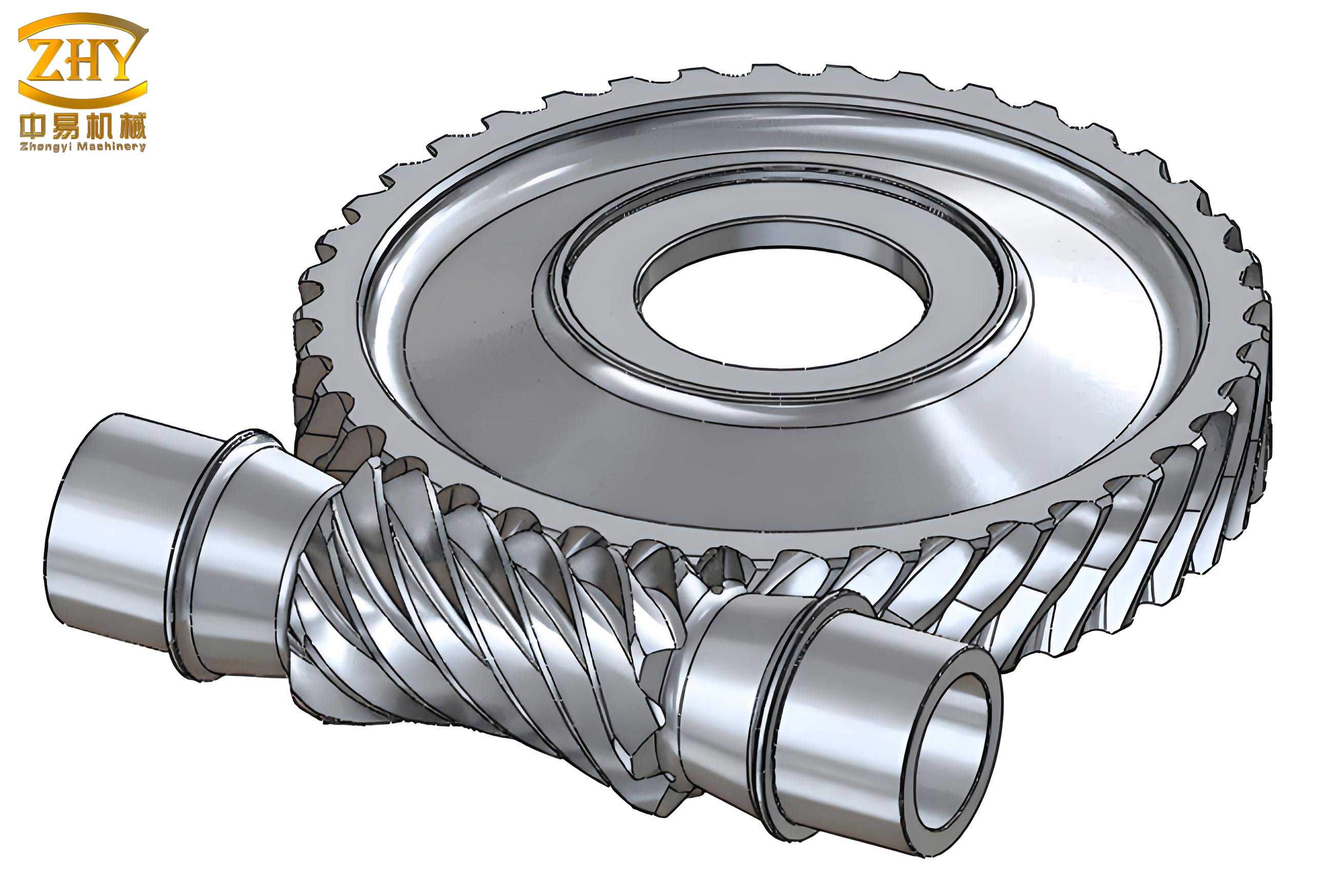
The target component is a rectangular housing designed to encase a worm and wheel set, a specific and common type of screw gears system. The machining specifications involve four distinct feature groups on orthogonal faces, each with stringent tolerances that collectively ensure proper gear meshing, load distribution, and longevity. A detailed breakdown is presented below.
| Feature Group | Critical Features | Key Tolerances | Geometric Relationship |
|---|---|---|---|
| Group A (Primary Worm Shaft Bore) | Bore: Ø40H7 (+0.025/0). Face. 12x M6 threaded holes on PCD. | Bore cylindricity; Coaxiality of 0.05 mm between opposite bores; Position of threaded holes: Ø0.5 mm. | Primary axis for the worm (input). |
| Group B (Wheel Shaft Bore) | Bore: Ø34H8 (+0.039/0). Face. | Perpendicularity of bore axis to Group A axis: 0.05 mm. | Axis for the worm wheel, must be precisely perpendicular to worm axis. |
| Group C (Bearing Cap / Seal Bore) | Bore: Ø42H8 (+0.039/0). Face. 4x M8 threaded holes. | Coaxiality of 0.05 mm with its opposing bore. | Often houses bearings or seals for the worm shaft, requiring precise alignment. |
| Group D (Access/Mounting Features) | Through-holes: Ø52 mm and Ø42 mm. | Location dimensions. | Secondary mounting or lubrication access points. |
The central challenge lies in maintaining the 0.05 mm coaxiality across pairs of bores and, more critically, the 0.05 mm perpendicularity between the worm axis (Group A) and the wheel axis (Group B). This perpendicularity is paramount for the correct contact pattern and efficient power transmission in screw gears. Furthermore, critical face dimensions, such as $191.5^{+0.3}_{+0.2}$ mm and $38.5 \pm 0.05$ mm, must be held tightly to ensure proper gear center distance and component assembly. Traditional methods, involving flipping and re-indicating the part, introduce too many variables and consume excessive time to consistently meet these specs in a production environment.
2. Design Philosophy and Structural Analysis of the Rotary Indexing Fixture
The core concept was to transform the boring mill’s large work area into a “virtual,” precise, and smaller workspace dedicated to the screw gears housing. Instead of moving the heavy part, we move a lightweight, precision-engineered sub-plate relative to the fixed machine spindle. The fixture is designed as a modular system comprising three main subsystems: the Base Plate, the Rotary Indexing Table, and the Part-Locating & Clamping Module.
2.1 Subsystem 1: The Foundation – Base Plate
The base plate serves as the permanent interface between the fixture and the machine worktable. It is manufactured from stress-relieved steel (e.g., AISI 1045) to ensure long-term dimensional stability. Its bottom surface is ground flat and features precisely machined T-slots or a grid of tapped holes that align with the mill’s table slots, allowing for rigid bolting. The top surface is precision ground and features a central precision-machined locating spigot and a circular array of four positioning pin holes (e.g., hardened and ground dowel pin holes) arranged at 90° intervals on a precise bolt circle diameter (BCD). The central spigot provides radial location for the rotary table, while the pin holes provide accurate angular indexing.
2.2 Subsystem 2: The Motion Core – Rotary Indexing Table
This is the heart of the fixture. The rotary table is a circular plate, again made from stable material, with a central bore that fits precisely over the base plate’s spigot (H7/g6 fit). A large-diameter central bolt or a captured stud with a nut secures the table axially to the base. Crucially, the underside of the rotary table houses a corresponding circular array of four hardened bushings aligned with the base plate’s pin holes. A spring-loaded, taper-ended定位销 (positioning pin) can be manually engaged to lock the table at 0°, 90°, 180°, and 270°. For rigidity during cutting, once indexed, the table is clamped to the base using at least two hefty circumferential clamps or bolts. The stiffness of this connection is critical. The deflection $ \delta $ at the center of the table under a cutting force $ F_c $ can be approximated by considering the table as a clamped circular plate:
$$
\delta \approx \frac{F_c \cdot R^2}{D}
$$
where $ R $ is the effective radius and $ D $ is the flexural rigidity of the plate assembly, given by:
$$
D = \frac{E t^3}{12(1 – \nu^2)}
$$
Here, $ E $ is the modulus of elasticity, $ t $ is the effective thickness, and $ \nu $ is Poisson’s ratio. Maximizing $ t $ and using high-$E$ materials (like steel) minimizes deflection, ensuring machining accuracy for the screw gears housing.
2.3 Subsystem 3: The Interface – Part-Locating & Clamping Module
Mounted onto the top of the rotary table is a custom module that replicates the datums of the screw gears housing. This typically consists of:
- Primary Locators: Two orthogonal ground pads or pins that contact the housing’s pre-machined bottom datum face and a side datum face, constraining three degrees of freedom (two translations and one rotation).
- Secondary Locator: An adjustable stop or pin on the adjacent side, constraining the final rotational degree of freedom (3-2-1 locating principle).
- Clamping System: Multiple swing clamps or hydraulic clamps positioned to apply force directly over supporting features (ribs, walls) of the housing, minimizing distortion. The clamping force must be sufficient to counteract the cutting forces. For a boring operation, the tangential cutting force $ F_t $ can be estimated as:
$$
F_t = k_c \cdot a_p \cdot f
$$
where $ k_c $ is the specific cutting force (material-dependent, ~1500-2500 N/mm² for cast iron), $ a_p $ is the depth of cut, and $ f $ is the feed per revolution. The total required clamping force $ F_{clamp} $ should satisfy:
$$
\mu \cdot F_{clamp} > F_t + F_{thrust}
$$
where $ \mu $ is the coefficient of friction between the part and locators, and $ F_{thrust} $ is the axial (thrust) force during machining.
The integration of these three subsystems creates a closed-loop, rigid structure that transfers machining loads directly from the part, through the fixture, into the massive machine table, while providing precise, repeatable indexing.
3. Operational Methodology and Process Flow
The implementation of this fixture standardizes the machining process for the screw gears housing, transforming it from a skilled artisan task to a repeatable, operator-friendly procedure. The following table outlines the optimized workflow.
| Step | Action | Purpose & Control |
|---|---|---|
| 1. Fixture Setup | Mount and tram the base plate to the machine table using a dial indicator. Indicate to within 0.01 mm over its length. | Ensures the fixture’s foundation is parallel to the machine’s X-Y travel, making all subsequent indexing accurate. |
| 2. Part Loading (Position 0°) | Place housing on locators. Engage side clamps. Verify seating with a feeler gauge. | Establish a single, unvarying datum reference for all subsequent operations. |
| 3. Machining Face 1 | Machine Group A features (Ø40H7 bore, face, drill/tap M6 holes). | Complete all operations on the first primary face without any intervention. |
| 4. Index to 90° | Loosen table clamps. Retract positioning pin. Rotate table 90°. Engage pin. Re-tighten clamps. | Present Face 2 to the spindle. The 90° index accuracy is inherent to the fixture’s pin/bushing system, typically within ±0.005°. |
| 5. Machining Face 2 | Machine Group B features (Ø34H8 bore, face). The spindle requires no re-orientation. | The 0.05 mm perpendicularity is guaranteed by the fixture’s build accuracy, not by manual indication. |
| 6. Index to 180° | Repeat indexing procedure. | Present the opposite side of Face 1 to the spindle. |
| 7. Machining Face 3 | Machine the opposing Ø40H7 bore and its face. | The 0.05 mm coaxiality with the first bore is ensured by the spindle’s inherent alignment and the fixture’s rotational accuracy. |
| 8. Index to 270° (or -90°) | Repeat indexing procedure. | Present the final face (opposite Face 2) to the spindle. |
| 9. Machining Face 4 | Machine Group C features (Ø42H8 bore, face, M8 holes) and Group D holes. | Complete all remaining features. The part is never unclamped until all machining is finished. |
This process flow eliminates the traditional “indicate-bore-indicate-bore” cycle for each face. The machine operator simply loads the part, initiates the CNC program (or follows the manual sequence), and indexes the table as prompted. The critical geometrical relationships between the bores for the screw gears are built into the fixture’s geometry and indexing mechanism.
4. Analysis of Results and Performance Metrics
The deployment of this dedicated fixture led to measurable improvements across three key areas: dimensional/geometric accuracy, process efficiency, and system rigidity.
4.1 Accuracy and Repeatability
Statistical process control data collected from multiple production batches confirmed the fixture’s capability. The following table compares key achieved tolerances against specification limits for a sample of housings.
| Housing Sample | Coaxiality (Ø40H7) [mm] | Coaxiality (Ø42H8) [mm] | Perpendicularity (Ø34H8 to A) [mm] | Face Dimension: 38.5±0.05 [mm] |
|---|---|---|---|---|
| Specification Limit | ≤ 0.05 | ≤ 0.05 | ≤ 0.05 | 38.45 – 38.55 |
| #1 | 0.032 | 0.028 | 0.035 | 38.52 |
| #2 | 0.028 | 0.030 | 0.038 | 38.49 |
| #3 | 0.035 | 0.025 | 0.031 | 38.53 |
| Process Mean (x̄) | 0.031 | 0.028 | 0.035 | 38.51 |
| Process Std Dev (σ) | 0.0035 | 0.0025 | 0.0035 | 0.020 |
The data demonstrates not just conformance but a significant margin of safety. The process capability indices (Cpk) for these critical characteristics are well above 1.33, indicating a highly capable and reliable process for producing precision screw gears housings.
4.2 Efficiency Gains
The time-saving was substantial. The non-value-added activities of cleaning the table, indicating datums, and trial cutting for each setup were eliminated. A direct time study showed the following reduction:
$$
\text{Time Saving} = \frac{T_{old} – T_{new}}{T_{old}} \times 100\% \approx \frac{320 \text{ min} – 240 \text{ min}}{320 \text{ min}} \times 100\% = 25\%
$$
Where $T_{old}$ is the total processing time per part using the traditional multi-setup method, and $T_{new}$ is the time using the indexing fixture. This 25% productivity increase directly supports batch production targets.
4.3 Enhanced Machining Stability
By keeping the spindle retracted closer to the quill for all operations (since the part is brought to the spindle via rotation, not by moving the part to the far edge of the table), the dynamic rigidity of the spindle-tool system is maximized. The deflection at the tool tip is proportional to the cube of the overhang length $L$:
$$
\delta_{tool} \propto L^3
$$
Minimizing $L$ by even 30% can reduce tool deflection by nearly 66%, allowing for more aggressive cutting parameters, better surface finish, and improved tool life when machining the often hard cast iron of screw gears housings.
5. Design Extensibility and Broader Applications
The success of this fixture for a specific screw gears housing underscores a universal principle in fixture design: the decoupling of part positioning/re-orientation from the machine tool’s primary axes. This concept is highly extensible. The design can be adapted for other families of prismatic parts by making the Part-Locating & Clamping Module interchangeable. A library of quick-change sub-plates, each custom-fitted for a different component (e.g., pump bodies, valve blocks, other gearbox types), can be developed to mount onto the universal Rotary Indexing Table and Base Plate. This transforms the fixture into a flexible manufacturing system (FMS) module. The core calculations for stiffness, clamping force, and indexing accuracy remain valid, with only the part-specific locator geometry needing redesign. This approach is particularly powerful for small-to-medium batch production of high-precision components like various screw gears assemblies, where the cost of a dedicated machine is unjustified, but the need for precision and efficiency is paramount.
6. Conclusion
The design and implementation of a dedicated rotary indexing fixture for machining screw gears housings on a horizontal boring mill provide a compelling solution to the classic conflict between large machine capacity and small-part precision. By integrating a rigid base, a precise 90° indexing mechanism, and a custom part-locating module, the fixture encapsulates the required geometric relationships—coaxiality and perpendicularity—within its own construction. This transforms the machining process from a skill-dependent, error-prone sequence of setups into a deterministic, repeatable, and efficient operation. The results are quantifiable: superior part accuracy with tight process control, a significant reduction in non-productive setup time, and improved machining dynamics. This fixture philosophy, born from the specific needs of manufacturing high-quality screw gears systems, offers a replicable template for enhancing the capability and productivity of general-purpose machine tools when tasked with the batch production of complex, precision prismatic components.