
In the field of industrial automation, electric valve actuators play a crucial role in controlling the opening and closing of valves and dampers. As control requirements become increasingly sophisticated, the design of reliable and efficient actuators is paramount. Among the mechanical components, screw gears, commonly referred to as worm gears, are extensively used due to their ability to transmit both power and positional signals. However, the performance and longevity of these screw gears are highly dependent on the hardness matching between the worm and the worm wheel. Through extensive experimentation and analysis, I have investigated the optimal hardness relationships to enhance efficiency and reduce wear. This article delves into the principles, structural characteristics, and experimental findings, emphasizing the importance of hardness compatibility in screw gears.
The fundamental operation of an electric valve actuator involves a motor driving a worm, which in turn rotates a worm wheel connected to the valve or damper. Initially, the worm wheel remains stationary due to frictional forces, with the worm sliding at the contact surface. When the torque on the worm exceeds the frictional moment, the worm wheel begins to rotate, transmitting motion to the final control element. This interaction involves temporary elastic deformation and permanent plastic deformation, leading to wear if the hardness mismatch is significant. The efficiency of screw gears is often compromised by phenomena such as tearing, material transfer, and adhesive wear, which can ultimately result in failure. Thus, understanding the hardness dynamics is essential for optimal design.
Screw gears offer advantages like compact structure, high transmission ratio, and quiet operation, but they suffer from relatively low efficiency and substantial sliding wear. The material combinations for screw gears in actuators vary widely, including steel worms with ductile iron worm wheels, steel worms with copper alloy worm wheels, and other non-ferrous combinations. Wear typically manifests as tooth breakage, pitting, scuffing, or thinning of the worm wheel teeth. Current theoretical models for anti-wear and anti-scuffing calculations are inadequate, often relying on conditional contact strength and bending strength analyses or empirical testing. Factors such as lubrication and mounting orientation further complicate the design process, necessitating a thorough experimental approach.
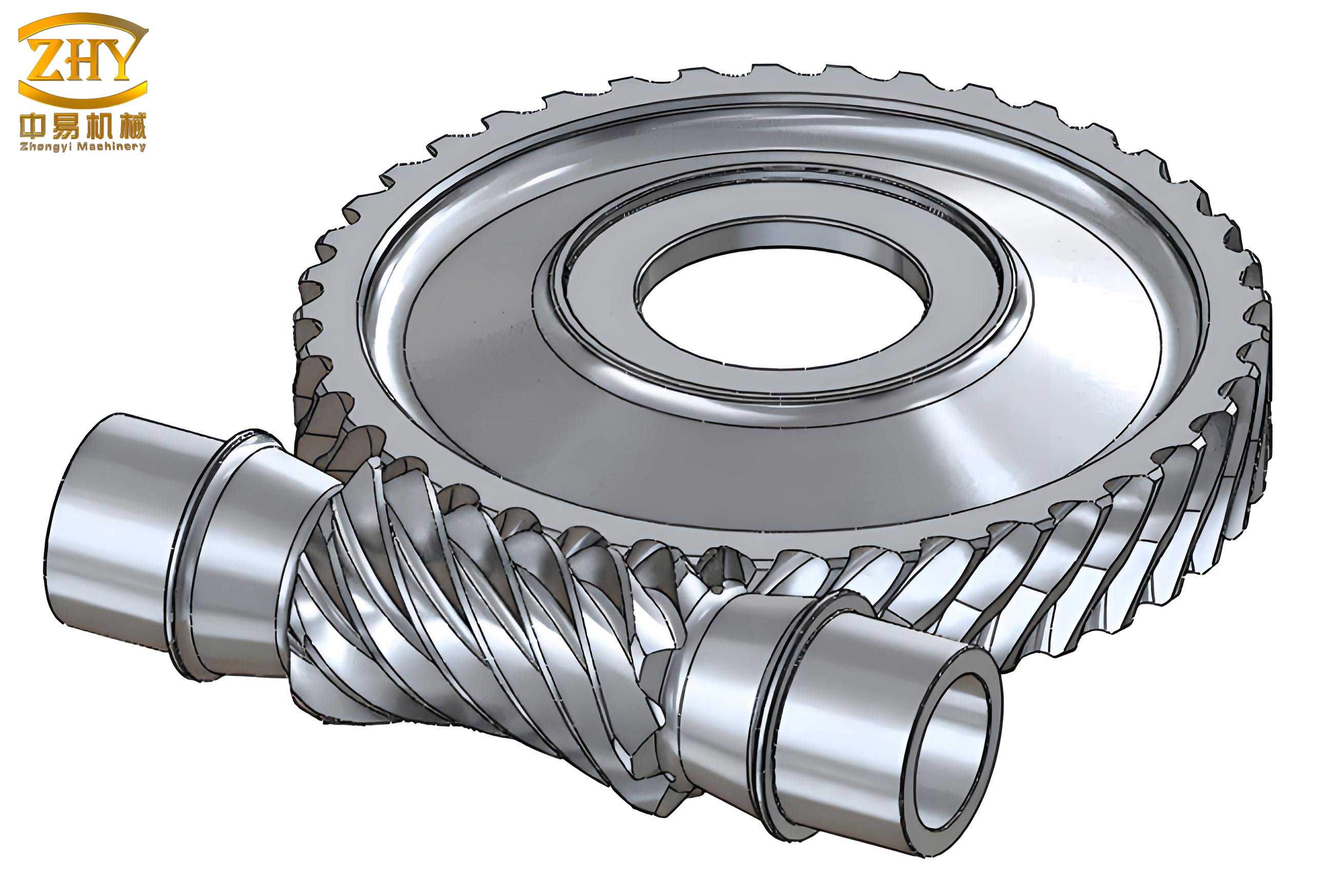
To systematically evaluate the impact of hardness matching on screw gear performance, I designed a test rig comprising a standard motor driving a worm, which engages with a worm wheel connected to a torque output device. This setup allows for direct measurement of transmission efficiency under consistent conditions, with all other components fixed except for interchangeable screw gear pairs. The torque measurements were taken under locked-rotor conditions, where the motor is stalled, to capture maximum efficiency and observe wear patterns. The efficiency of the screw gear pair is calculated using the formula:
$$\eta = \frac{M \cdot n_2}{M_1 \cdot k \cdot n_1} \times 100\%$$
where \(\eta\) is the calculated efficiency, \(M\) is the measured torque in N·m, \(n_2\) is the output speed in r/s, \(M_1\) is the motor’s locked-rotor torque in N·m, \(k\) is the utilization factor of the valve-specific motor, and \(n_1\) is the motor output speed in r/s. For our experiments, \(M_1 = 27 \, \text{N·m}\), \(n_1 = 1300 \, \text{r/min} = 21.67 \, \text{r/s}\), \(k = 3\), and \(n_2 = 28 \, \text{r/min} = 0.467 \, \text{r/s}\). Thus, the efficiency simplifies to \(\eta = 0.02659 \times M\), providing a direct correlation between measured torque and performance.
The first experimental group involved a 15CrMn worm with surface carburized hardening and tempering (hardness 60 HRC, case depth 0.5–0.8 mm) paired with ZCuAl9Fe4Ni4Mn2 worm wheels of varying hardness. The results are summarized in Table 1, illustrating how worm wheel hardness affects output torque and efficiency. As the hardness increases, both torque and efficiency improve significantly, with a threshold around 140 HB for meeting design requirements (torque > 1100 N·m). Post-test examination revealed scuffing on the worm wheel teeth and copper transfer onto the worm surface, indicating adhesive wear.
| Worm Wheel Hardness (HB) | Measured Torque, M (N·m) | Calculated Efficiency, η (%) |
|---|---|---|
| 110 | 660 | 17.55 |
| 123 | 880 | 23.40 |
| 131 | 1100 | 29.25 |
| 139 | 1350 | 35.90 |
| 150 | 1520 | 40.42 |
| 163 | 1680 | 44.67 |
| 175 | 1720 | 45.73 |
| 188 | 1790 | 47.60 |
The second group utilized a 40Cr worm (tempered to 260 HB) with ZCuAl10Fe3 worm wheels. The data in Table 2 shows a similar trend, where efficiency rises with hardness, but the wear characteristics differ. Fatigue wear was observed on the worm wheel teeth with minimal copper transfer, suggesting that moderate hardness differences reduce severe adhesive wear. This highlights the importance of material pairing in screw gears, as different alloys respond uniquely to hardness variations.
| Worm Wheel Hardness (HB) | Measured Torque, M (N·m) | Calculated Efficiency, η (%) |
|---|---|---|
| 108 | 890 | 23.67 |
| 112 | 1120 | 29.78 |
| 120 | 1220 | 32.44 |
| 125 | 1350 | 35.90 |
| 128 | 1400 | 37.23 |
| 131 | 1550 | 41.21 |
| 135 | 1690 | 44.94 |
| 142 | 1800 | 47.86 |
For the third group, a 15CrMn worm (60 HRC) was combined with ZCuAl10Fe3 worm wheels. As shown in Table 3, the performance is lower compared to the first group, with severe scuffing and extensive copper transfer noted. This underscores that hardness matching is not solely about individual values but also the specific material interaction in screw gears. The efficiency drops markedly when the worm wheel hardness is below 130 HB, leading to accelerated wear and shortened lifespan.
| Worm Wheel Hardness (HB) | Measured Torque, M (N·m) | Calculated Efficiency, η (%) |
|---|---|---|
| 110 | 580 | 15.42 |
| 116 | 610 | 16.22 |
| 125 | 680 | 18.08 |
| 132 | 750 | 19.94 |
| 139 | 790 | 21.01 |
| 147 | 990 | 26.32 |
| 153 | 1080 | 28.72 |
| 158 | 1380 | 36.69 |
Analyzing the results, several key insights emerge regarding screw gears. First, hardness matching directly influences transmission efficiency and wear resistance. When the worm is surface-hardened (e.g., carburized), the worm wheel hardness should not fall below 140 HB to meet operational torque requirements. Different material combinations impose distinct hardness constraints; for instance, harder worms necessitate higher worm wheel hardness to prevent excessive wear. Second, the hardness difference between the worm and worm wheel plays a critical role. Excessively large differences lead to lower efficiency and severe wear, as seen in the third experimental group. Conversely, too small a difference risks premature worm wear. An optimal balance must be struck, typically with the worm wheel hardness above 130 HB and a moderate disparity. Third, the service life of screw gears correlates strongly with worm wheel strength. In steel-copper alloy pairs, worm wheels with hardness below 130 HB exhibit rapid deterioration, failing to satisfy industrial standards. Above this threshold, longevity improves significantly, as confirmed by industrial trials.
To further elucidate these findings, we can model the wear rate in screw gears using empirical equations. The wear volume \(V\) can be approximated by Archard’s law:
$$V = \frac{K \cdot L \cdot s}{H}$$
where \(K\) is a wear coefficient, \(L\) is the normal load, \(s\) is the sliding distance, and \(H\) is the hardness. For screw gears, the sliding distance is proportional to the number of cycles and the gear geometry. By integrating hardness effects, we can derive a relative wear index \(W_r\) for different combinations:
$$W_r = \frac{K \cdot \rho}{H_w \cdot (H_w – H_g)}$$
Here, \(H_w\) is the worm hardness, \(H_g\) is the worm wheel hardness, and \(\rho\) is a material compatibility factor. This index highlights that wear increases as the hardness difference grows, aligning with our experimental observations. Additionally, the efficiency of screw gears can be expressed in terms of friction coefficients and hardness ratios. The mechanical efficiency \(\eta_m\) considering hardness is:
$$\eta_m = \frac{1}{1 + \mu \cdot \frac{H_g}{H_w} \cdot \frac{\pi}{2 \cdot \tan(\lambda)}}$$
where \(\mu\) is the coefficient of friction and \(\lambda\) is the lead angle. This formula underscores that higher worm wheel hardness relative to the worm enhances efficiency, provided the difference is not extreme.
Beyond hardness, other factors influence screw gear performance. Lubrication is paramount; proper lubricant selection can mitigate wear even with suboptimal hardness matching. The viscosity-pressure relationship in elastohydrodynamic lubrication (EHL) for screw gears is given by:
$$\alpha = \frac{1}{p_0} \ln\left(\frac{\eta}{\eta_0}\right)$$
where \(\alpha\) is the pressure-viscosity coefficient, \(p_0\) is the Hertzian contact pressure, \(\eta\) is the dynamic viscosity, and \(\eta_0\) is the ambient viscosity. This affects the film thickness and thus wear rates. Mounting orientation also matters; vertical arrangements may exacerbate wear due to gravity effects on lubrication distribution. Thermal effects cannot be ignored either, as operating temperatures alter hardness properties. The temperature-dependent hardness \(H(T)\) can be modeled as:
$$H(T) = H_0 \cdot e^{-\beta (T – T_0)}$$
with \(H_0\) as room-temperature hardness, \(\beta\) a material constant, and \(T\) the temperature. This necessitates considering environmental conditions in screw gear design.
In practical applications, controlling worm wheel hardness is challenging due to variables in casting, alloy composition, and heat treatment. Micro-additives like nickel or manganese in copper alloys can enhance hardness uniformity. Statistical process control (SPC) methods are recommended to maintain hardness within tight tolerances. For instance, implementing control charts for hardness measurements during production can reduce variability. Design guidelines derived from our experiments include:
- For carburized steel worms (硬度 > 55 HRC), specify worm wheel hardness ≥ 140 HB for copper alloys.
- For tempered steel worms (硬度 ~ 260 HB), worm wheel hardness should be ≥ 130 HB.
- Aim for a hardness difference (worm – worm wheel) of 100–150 HB to balance efficiency and wear.
- Prioritize material pairs with proven compatibility, such as steel with high-tin bronzes for screw gears.
These recommendations help optimize screw gear performance in electric valve actuators.
Future research should explore advanced materials like polymer composites or surface coatings for screw gears. For example, diamond-like carbon (DLC) coatings on worms could reduce friction and wear independent of hardness matching. Additionally, computational wear simulation using finite element analysis (FEA) can predict long-term behavior under dynamic loads. The contact stress \(\sigma_c\) in screw gears is given by Hertzian theory:
$$\sigma_c = \sqrt{\frac{F_n}{\pi \cdot b} \cdot \frac{1}{\frac{1 – \nu_1^2}{E_1} + \frac{1 – \nu_2^2}{E_2}}}$$
where \(F_n\) is the normal force, \(b\) is the contact width, \(\nu\) is Poisson’s ratio, and \(E\) is Young’s modulus. Integrating this with wear models could yield more accurate life predictions. Furthermore, real-time monitoring of screw gear condition via vibration or acoustic emission sensors could enable predictive maintenance, reducing downtime in industrial settings.
In conclusion, the hardness matching between worm and worm wheel is a critical determinant of efficiency and durability in screw gears for electric valve actuators. Through systematic experimentation, I have demonstrated that worm wheel hardness should exceed 130 HB, with careful attention to the hardness difference based on material pairs. The use of formulas and tables, as presented herein, provides a framework for designers to select appropriate hardness values. By adhering to these principles, manufacturers can enhance the reliability and performance of screw gears, ultimately improving actuator systems. Continued investigation into material science and tribology will further refine our understanding, paving the way for next-generation screw gear technologies.