
In the field of agricultural irrigation, hose reel sprinklers have gained prominence due to their cost-effectiveness, compact structure, high mobility, and uniform water distribution. However, traditional models often suffer from inefficiencies in their transmission systems, particularly when driven by hydraulic turbines. These systems typically employ multiple stages of spur gear drives, leading to excessive power losses, large volumes, and limited speed adjustment ranges. To address these issues, we propose a redesigned transmission system based on screw gears, specifically worm drives, which offer high reduction ratios in a single stage, compactness, and improved efficiency. This article presents a comprehensive design and optimization approach, utilizing genetic algorithms to enhance transmission efficiency and minimize gearbox volume, ultimately contributing to more sustainable and efficient irrigation equipment.
The original transmission system of a typical hose reel sprinkler, such as the JP75 model, consists of a hydraulic turbine driving a series of spur gears, V-belt drives, and chain drives. This configuration results in a complex multi-stage system with low overall efficiency, often below 55%. The hydraulic turbine itself operates at efficiencies under 20%, and the numerous gear stages introduce significant friction and lubrication challenges. The speed range for the sprinkler cart is typically 8 to 60 m/h, requiring a large total transmission ratio, which exacerbates the inefficiencies. By replacing the hydraulic turbine with a permanent magnet brushless DC motor and incorporating screw gears, we aim to simplify the transmission, increase the reduction ratio, and boost efficiency. The screw gears, or worm drives, are particularly advantageous due to their ability to achieve high speed reductions in a single mesh, quiet operation, and compact design, making them ideal for this application.
We begin by analyzing the original transmission system. It includes a V-belt drive, four stages of spur gear drives, and a chain drive, all connected in series. The total transmission ratio required for the speed range of 8 to 60 m/h can be calculated based on the motor speed and reel parameters. For a DC motor with a rated speed of 1500 r/min and a PE hose reel radius ranging from intermediate values, the total ratio ia is given by:
$$ i_a = \frac{120 \pi r_i n_N}{v} $$
where ri is the reel radius, nN is the motor speed, and v is the cart speed. This yields a range of approximately 6,240.8 to 62,701.9, indicating the need for a substantial reduction. The original system struggles to achieve this efficiently due to its multiple stages. Each stage introduces losses from gear meshing, bearing friction, and oil churning. The meshing efficiency for spur gears can be estimated using the Kubo formula:
$$ \eta_g = 1 – k f \left( \frac{1}{z_1} \pm \frac{1}{z_2} \right) $$
where k is a coefficient related to addendum height, f is the friction coefficient, and z1 and z2 are the tooth numbers of the driving and driven gears. For the worm drive, the efficiency when the worm is driving is approximated by:
$$ \eta_w = \frac{\tan \gamma}{\tan \gamma + \arctan \left( \frac{0.3979 \pi d_1 n_1}{60000 \cos \gamma} – 0.03407 \right)^{-0.353}} $$
where γ is the lead angle, d1 is the worm pitch diameter, and n1 is the worm speed. These formulas highlight that screw gears can achieve higher efficiencies with proper design, especially when optimized for lead angle and lubrication.
To improve the system, we designed a two-speed transmission system incorporating screw gears. The new configuration replaces some spur gear stages with a single worm drive, reducing the total number of stages and simplifying the gearbox. The system is divided into two speed ranges: low speed (8–34 m/h) and high speed (34–60 m/h), achieved by shifting a clutch gear. This allows for better matching of motor output to load requirements. The schematic of the new transmission includes a worm drive as the first stage, followed by spur gear drives and a chain drive. The total transmission ratios for the two speeds are:
$$ i_{\text{I}} = \frac{z_{b2} z_{b5} z_{b9} z_{b11}}{z_{b1} z_{b3} z_{b7} z_{b10}} \quad \text{and} \quad i_{\text{II}} = \frac{z_{b2} z_{b6} z_{b9} z_{b11}}{z_{b1} z_{b4} z_{b7} z_{b10}} $$
where z denotes tooth numbers for gears and sprockets. The screw gears here refer to the worm and worm wheel, which provide the initial high reduction. This design not only increases the transmission ratio but also enhances compactness. To visualize the screw gears configuration, consider the following representation:
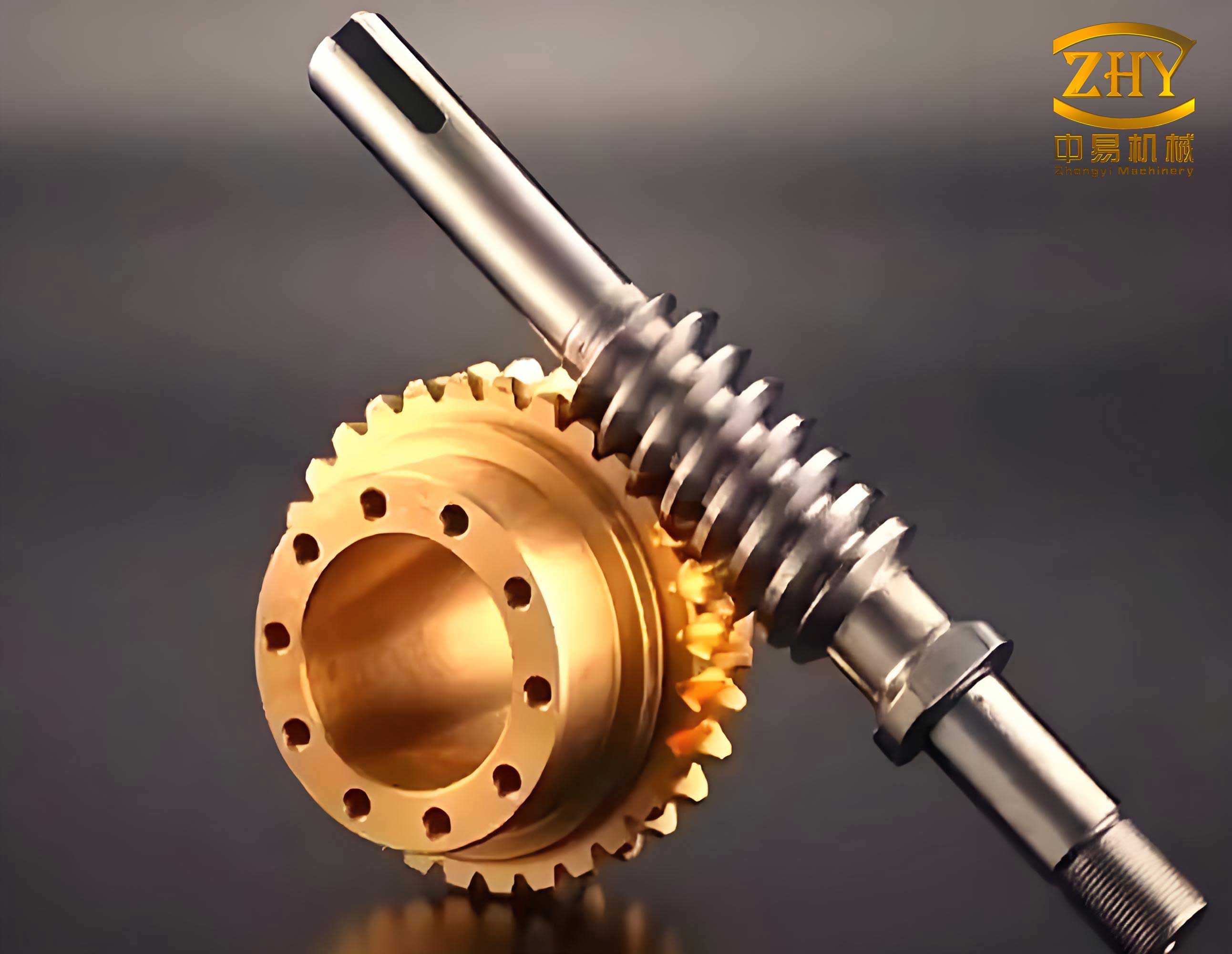
The optimization of this transmission system focuses on maximizing efficiency and minimizing volume. We define design variables including lead angle γ, worm module mw, number of worm threads z1, diameter factor q, tooth numbers for spur gears z3 to z9, face width coefficients φd2, φd3, φd4, φd7, and modules for spur gears m3, m4, m7. The objective functions are the total transmission efficiencies for the two speeds and the total volume of the gearbox. The efficiencies are computed as:
$$ \eta_{\text{I total}} = \eta_w \left(1 – k f \left( \frac{1}{z_3} + \frac{1}{z_5} \right) \right) \left(1 – k f \left( \frac{1}{z_7} + \frac{1}{z_9} \right) \right) \eta_{\text{chain}} \eta_2^6 \eta_3^2 $$
$$ \eta_{\text{II total}} = \eta_w \left(1 – k f \left( \frac{1}{z_4} + \frac{1}{z_6} \right) \right) \left(1 – k f \left( \frac{1}{z_7} + \frac{1}{z_9} \right) \right) \eta_{\text{chain}} \eta_2^6 \eta_3^2 $$
where η2 and η3 account for bearing and churning losses, set to 0.99 and 0.98, respectively, and ηchain is the chain drive efficiency at 0.98. The total volume V is the sum of spur gear volumes and the worm wheel volume:
$$ V_g = \sum_{i=3}^{9} \frac{\pi b_i d_{ai}^2}{4} \quad \text{with} \quad d_{ai} = m_i (z_i + 2h_a^*) $$
$$ V_w = \frac{\pi \psi m^3 (q + 2)}{4} \left[ (u z_1 + 2 + 6)^2 – (u z_1 + 6.4)^2 \right] $$
where bi is face width, dai is addendum diameter, ha* is addendum coefficient, ψ is face width factor for the worm wheel, and u is gear ratio. The overall objective is to minimize F = ( -ηI total, -ηII total, V ).
Constraints include transmission ratio limits (2–5 for spur gear pairs, up to 80 for screw gears), tooth number minima (≥17 to avoid undercutting), face width coefficients (0.4–0.9), bending and contact stress limits, lead angle bounds (3°–28°), worm thread count (1–2), diameter factor range (8–16), and module discreteness (standard values). The bending stress constraint for gears is:
$$ \sigma_{Fi} = \frac{2K T_i}{b_i d_{i1} m_i} Y_{Fai} Y_{Sai} \leq [\sigma_{Fi}] $$
and the contact stress constraint is:
$$ \sigma_H = Z_E Z_H \sqrt{\frac{2K T_1 (u+1)}{b d_1^2 u}} \leq [\sigma_H] $$
where K is load factor, T is torque, YFa and YSa are form and stress correction factors, ZE and ZH are elasticity and zone factors, and allowable stresses are material-dependent. For the screw gears, additional constraints ensure proper meshing and durability.
We employ a genetic algorithm with mixed continuous and discrete variables to solve this multi-objective optimization problem. Using MATLAB’s genetic algorithm toolbox, we define the design variables and constraints, then iterate to find Pareto-optimal solutions. The algorithm handles discrete variables such as gear modules by specifying predefined sets. After optimization, we obtain improved parameters that enhance efficiency and reduce volume. The results are summarized in the following table, comparing initial and optimized values for key parameters:
| Parameter | Initial Design | Optimized Design |
|---|---|---|
| Lead angle γ | 3°13’28” | 9°11’17” |
| Worm module mw | 3 mm | 2 mm |
| Worm threads z1 | 1 | 1 |
| Worm wheel teeth z2 | 46 | 61 |
| Spur gear teeth z3 | 40 | 25 |
| Spur gear teeth z4 | 23 | 29 |
| Spur gear teeth z5 | 100 | 111 |
| Spur gear teeth z6 | 117 | 73 |
| Spur gear teeth z7 | 32 | 37 |
| Spur gear teeth z9 | 96 | 111 |
| Face width coefficient φd2 | 0.30 | 0.45 |
| Face width coefficient φd3 | 0.30 | 0.50 |
| Face width coefficient φd4 | 0.40 | 0.50 |
| Face width coefficient φd7 | 0.45 | 0.50 |
| Spur gear module m3 | 2.0 mm | 1.5 mm |
| Spur gear module m4 | 2 mm | 2 mm |
| Spur gear module m7 | 2.5 mm | 2.0 mm |
| Efficiency ηI total | 0.6058 | 0.7435 |
| Efficiency ηII total | 0.6253 | 0.7564 |
| Total volume V | 0.0136 m³ | 0.0122 m³ |
The optimization demonstrates significant improvements: efficiency for the low-speed range increased by 13.77%, for the high-speed range by 13.11%, and the total volume decreased by 10.30%. These gains are attributed to the optimal selection of screw gears parameters, such as lead angle and module, which enhance meshing efficiency and compactness. The use of screw gears allows for a higher reduction in the first stage, reducing the burden on subsequent spur gears and enabling better load distribution. Additionally, the adjusted face width coefficients improve gear contact and durability, contributing to overall system reliability.
To validate the design, we conducted experimental tests comparing the new screw gears-based transmission with the original hydraulic turbine system. The test setup involved a load simulation using weights and a pulley system to mimic the friction and drag on the PE hose. Measurements of input torque, speed, and output power were taken at various loads and motor speeds. The results, summarized in the table below, show that the new system achieves higher efficiencies across all tested conditions, confirming the optimization outcomes. For instance, at a load of 1000 kg and a motor speed of 1400 r/min, the efficiency for the low-speed range reached 75.1%, compared to 50.1% for the original system. This underscores the superiority of the screw gears design in practical applications.
| Load (kg) | Motor Speed (r/min) | Original Efficiency Low (%) | Original Efficiency High (%) | New Efficiency Low (%) | New Efficiency High (%) |
|---|---|---|---|---|---|
| 1000 | 1400 | 50.1 | 42.9 | 75.1 | 73.9 |
| 800 | 1200 | 47.3 | 40.7 | 72.5 | 70.8 |
| 600 | 1000 | 41.3 | 37.5 | 67.4 | 66.6 |
| 400 | 800 | 37.0 | 31.2 | 59.9 | 60.3 |
| 200 | 600 | 24.6 | 21.9 | 48.8 | 51.0 |
The integration of screw gears into the transmission system not only boosts efficiency but also offers other benefits. Screw gears provide inherent self-locking capabilities under certain conditions, which can enhance safety by preventing back-driving. Moreover, their smooth and quiet operation reduces noise pollution in agricultural settings. The two-speed design allows for flexible adaptation to varying field conditions, ensuring optimal water application rates. From a manufacturing perspective, the reduced number of parts simplifies assembly and maintenance, potentially lowering lifecycle costs. However, it is crucial to consider lubrication for screw gears, as improper lubrication can lead to increased wear and efficiency drops. We recommend using high-quality lubricants and regular maintenance schedules to sustain performance.
In terms of broader implications, this optimization approach can be applied to other agricultural machinery requiring high reduction ratios and compact designs. The use of genetic algorithms enables handling complex, multi-objective problems with mixed variables, providing a robust framework for engineering design. Future work could explore advanced materials for screw gears, such as composites or surface-treated steels, to further improve efficiency and durability. Additionally, integrating smart control systems with the DC motor could enable real-time speed adjustments based on soil moisture or weather conditions, enhancing the overall automation of irrigation systems.
In conclusion, we have successfully designed and optimized a transmission system for hose reel sprinklers based on screw gears. By replacing traditional multi-stage spur gear drives with a combination of screw gears and optimized spur gears, we achieved significant improvements in efficiency and volume reduction. The genetic algorithm optimization effectively handled the design variables and constraints, yielding parameters that enhance performance. Experimental tests validated the design, showing superior efficiency compared to the original system. This screw gears-based approach offers a promising solution for upgrading existing irrigation equipment, contributing to energy savings and improved irrigation uniformity. We believe that the methodologies and results presented here will inspire further innovations in agricultural machinery transmission systems, ultimately supporting sustainable farming practices.
The role of screw gears in this context cannot be overstated; they are pivotal in achieving high reduction ratios with minimal stages. Their unique geometry allows for efficient power transmission in compact spaces, making them ideal for mobile irrigation equipment. As we continue to refine these systems, attention to detail in screw gears design—such as lead angle optimization and lubrication management—will be key to maximizing benefits. We encourage researchers and engineers to explore further applications of screw gears in agricultural and other heavy-duty machinery, leveraging advanced optimization techniques for continuous improvement.