
In the realm of gear manufacturing, gear shaving stands out as a highly economical and efficient finishing method. This process is pivotal for enhancing gear accuracy and surface quality, making it a cornerstone in automotive, aerospace, and industrial machinery sectors. As a manufacturing engineer deeply involved in gear production optimization, I find that understanding and calculating the machining time for gear shaving operations is essential for effective production planning and cost management. Gear shaving, in its various forms, offers distinct advantages, and selecting the appropriate method can significantly impact overall efficiency. This article delves into the principles of gear shaving, the determination of cutting parameters, and a detailed analysis of machining times for axial and radial gear shaving methods, with an emphasis on computational approaches and practical insights.
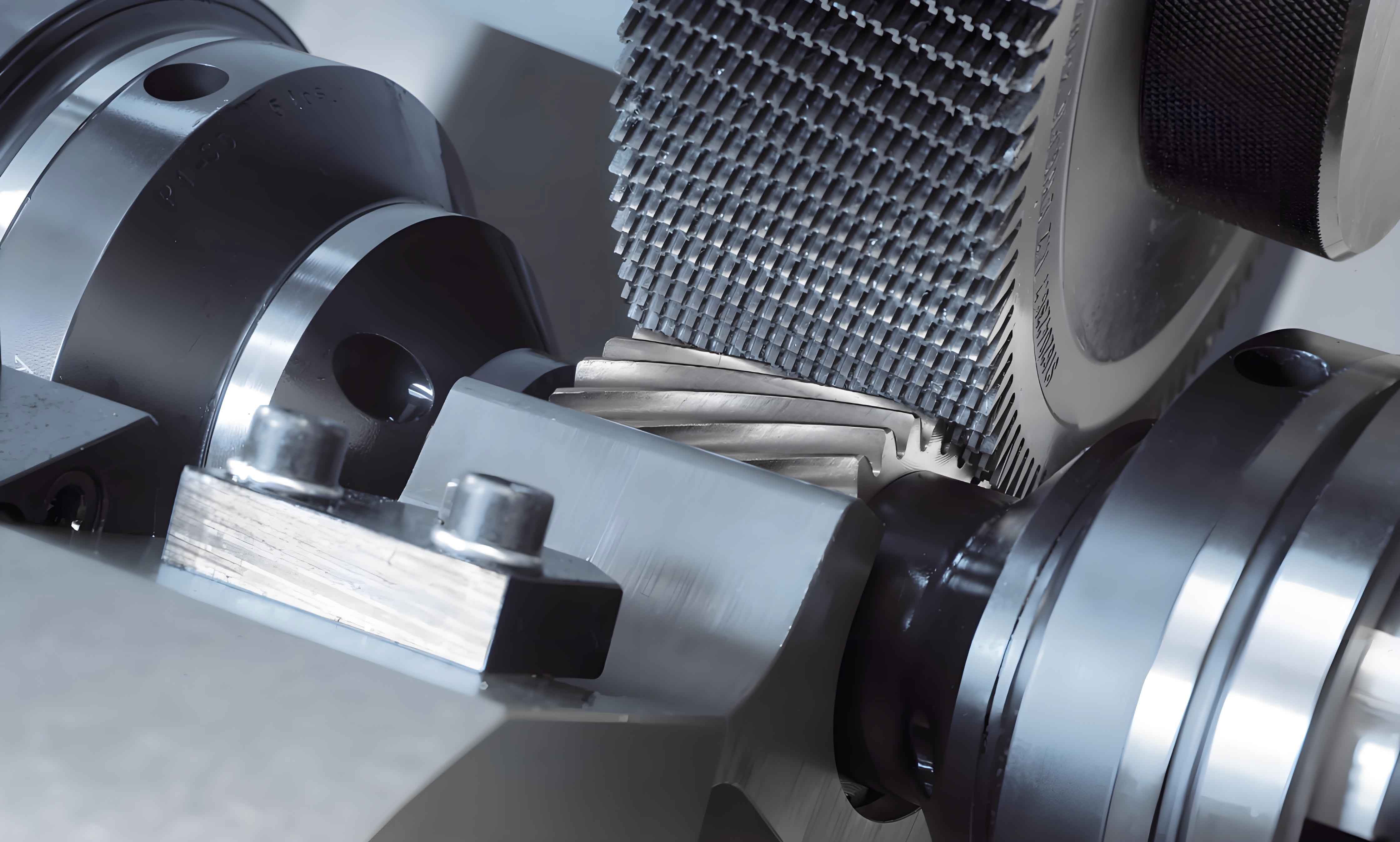
The fundamental principle of gear shaving revolves around the meshing of a shaving cutter and the workpiece gear as a pair of crossed helical gears with a small shaft angle, typically between 10° and 20°, operating without backlash. This gear shaving process exploits the relative sliding motion between the tooth surfaces to remove minute amounts of material, thereby refining the gear profile. The primary motion in gear shaving is the rotational movement of both the cutter and the workpiece, but the cutting action is derived from the sliding velocity along the tooth direction. At the pitch point P of meshing, the relative sliding velocity, which constitutes the cutting speed, is critical for effective material removal. This gear shaving mechanism is illustrated in the following diagram, which depicts the interaction between the cutter and workpiece during the shaving operation.
To quantify the cutting speed in gear shaving, we consider the velocities at the pitch point. The shaving cutter, with a pitch diameter \(d_o\) (in mm) and rotational speed \(n_o\) (in rpm), has a velocity \(v_o\) at the pitch point given by \(v_o = \frac{\pi d_o n_o}{1000}\) m/min. The workpiece gear, with a pitch diameter \(d_w\), has a velocity \(v_w\). The helix angles of the cutter and workpiece at the pitch point are \(\beta_o\) and \(\beta_w\), respectively. The shaft angle \(\Sigma\) is defined as \(\Sigma = \beta_w \pm \beta_o\), where the plus sign applies when the helices are of the same hand, and the minus sign when opposite. The cutting speed \(v\) (in m/min) is the vector difference of the tangential components of these velocities, expressed as:
$$ v = v_w \pm v_o = \frac{v_o \sin \Sigma}{\cos \beta_w} $$
In practice, for simplification, the pitch helix angles are often approximated by the nominal helix angles, and the cutter’s pitch diameter is taken as its reference diameter. The cutting speed in gear shaving typically ranges from 20 to 40 m/min, depending on factors such as cutter material, gear parameters, workpiece hardness, and desired surface finish. Once the cutting speed is selected, the cutter speed \(n_o\) is determined, and the workpiece speed \(n_w\) is calculated using the gear ratio:
$$ n_w = \frac{n_o z_o}{z_w} $$
where \(z_o\) and \(z_w\) are the number of teeth on the cutter and workpiece, respectively. This relationship is fundamental to setting up the gear shaving machine for optimal performance.
Beyond cutting speed, the feed motions in gear shaving are crucial for covering the entire tooth surface. In axial gear shaving, the workpiece must move axially to ensure that the cutter contacts the full face width. The axial feed per revolution of the workpiece, denoted \(f_x\), is measured in mm/rev and depends on the shaft angle and workpiece characteristics. The following table provides typical values for axial feed in gear shaving, which can be adjusted based on workpiece rigidity, hardness, and surface roughness requirements.
| Shaft Angle \(\Sigma\) (°) | Workpiece Teeth \(z_w\) (17–25) | Workpiece Teeth \(z_w\) (25–40) | Workpiece Teeth \(z_w\) (40–50) | Workpiece Teeth \(z_w\) (50–100) |
|---|---|---|---|---|
| 7–10 | 0.075–0.10 mm/rev | 0.10–0.15 mm/rev | 0.15–0.20 mm/rev | 0.20–0.25 mm/rev |
| 10–15 | 0.10–0.15 mm/rev | 0.15–0.20 mm/rev | 0.20–0.25 mm/rev | 0.25–0.30 mm/rev |
| 15+ | 0.15–0.20 mm/rev | 0.20–0.25 mm/rev | 0.25–0.30 mm/rev | 0.30–0.35 mm/rev |
The axial feed velocity \(v_x\) (in mm/min) is then calculated as \(v_x = f_x n_w\). In contrast, radial gear shaving employs a different approach: the cutter has a modified tooth profile that allows line contact with the workpiece, eliminating the need for axial movement. Instead, radial feed is applied to gradually reduce the tooth thickness to the specified dimension. The radial feed per stroke, \(f_r\), typically ranges from 0.02 to 0.06 mm for axial gear shaving, often applied in multiple increments of unequal amounts to enhance efficiency and surface quality. For radial gear shaving, the radial feed velocity \(v_r\) is generally lower to reduce contact pressure and machine load. The total radial infeed \(L_r\) required is related to the machining allowance on the gear, specifically the allowance in normal chordal thickness or over pins, but commonly expressed via the allowance in base tangent length \(\Delta W\) (in mm) and the normal pressure angle \(\alpha_n\):
$$ L_r = \frac{\Delta W}{2 \sin \alpha_n} $$
This formula is pivotal for planning the radial motion in both gear shaving methods. The axial travel length \(L_x\) for axial gear shaving includes the face width \(b_w\) and an additional allowance, often taken as twice the module \(m\): \(L_x = b_w + 2m\).
The machining time for gear shaving operations is a composite of various motion sequences. For axial gear shaving, the work cycle typically involves rapid approach, radial infeeds, axial feed, dwell or spark-out, and rapid retraction. Each phase contributes to the total machine time, and accurate calculation is essential for productivity assessment. The total machine time \(t\) for axial gear shaving can be expressed as:
$$ t = t_s + t_r + t_x + t_m + t_f + t_b $$
where \(t_s\) is the time for rapid approach over a clearance distance \(L_s\) (usually 0.2–0.3 mm) at rapid traverse velocity \(v_q\); \(t_r\) is the time for radial infeeds, summed over multiple increments \(L_{r1}, L_{r2}, \ldots, L_{rn}\) at radial feed velocity \(v_r\); \(t_x\) is the time for axial feed over length \(L_x\) at velocity \(v_x\), multiplied by the number of radial infeed passes \(n\); \(t_m\) is the time for a slight retraction \(L_m\) (0.02–0.04 mm) at rapid velocity; \(t_f\) is the time for finishing passes (spark-out) over \(L_x\) at a reduced axial velocity \(v_f\) (about two-thirds of \(v_x\)), repeated \(N\) times; and \(t_b\) is the time for rapid retraction over the distance \(L_s + L_r – L_{rn}\) at velocity \(v_q\). Mathematically, these components are:
$$ t_s = \frac{L_s}{v_q}, \quad t_r = \sum_{i=1}^{n} \frac{L_{ri}}{v_r}, \quad t_x = \frac{n L_x}{v_x}, \quad t_m = \frac{L_m}{v_q}, \quad t_f = \frac{N L_x}{v_f}, \quad t_b = \frac{L_s + L_r – L_{rn}}{v_q} $$
In practice, the number of radial infeed passes \(n\) is usually 4 to 6, and the number of finishing passes \(N\) is 2 to 4. This structured cycle ensures thorough material removal and high surface finish in axial gear shaving.
To illustrate, consider a detailed case study for axial gear shaving. The workpiece is a spur gear with module \(m = 2.5\) mm, number of teeth \(z_w = 23\), normal pressure angle \(\alpha_n = 20^\circ\), face width \(b_w = 18\) mm, material 20CrMnTi, hardness ≤217 HBW, required surface roughness \(Ra = 1.6 \mu m\), and machining allowance on base tangent length \(\Delta W = 0.07\) mm. The axial shaving cutter has \(z_o = 67\) teeth and a helix angle \(\beta_o = 15^\circ\). The machine is a YWA4232 universal gear shaving machine. From these inputs, we derive the following parameters for gear shaving:
- Cutting speed: Initially selected as \(v = 30\) m/min. Using the formula \(v = \frac{v_o \sin \Sigma}{\cos \beta_w}\), with \(\Sigma = \beta_w – \beta_o = 0^\circ – 15^\circ = -15^\circ\) (since the workpiece is spur, \(\beta_w = 0^\circ\)), and approximating \(v_o = \frac{\pi d_o n_o}{1000}\), we first calculate the theoretical cutter speed. However, for simplicity, we directly use the cutting speed equation to find \(n_o\). With \(\sin \Sigma = \sin(-15^\circ) = -\sin 15^\circ \approx -0.2588\), and \(\cos \beta_w = \cos 0^\circ = 1\), we have \(v = v_o \times 0.2588\). Setting \(v = 30\) m/min gives \(v_o \approx 115.9\) m/min. Then, using \(v_o = \frac{\pi d_o n_o}{1000}\), and estimating \(d_o\) from the cutter specifications (e.g., \(d_o \approx m z_o / \cos \beta_o = 2.5 \times 67 / \cos 15^\circ \approx 173.4\) mm), we get \(n_o \approx \frac{115.9 \times 1000}{\pi \times 173.4} \approx 212.8\) rpm. The machine’s available speed is selected as \(n_o = 225\) rpm. Then, \(n_w = \frac{225 \times 67}{23} \approx 655.4\) rpm.
- Axial feed: From the table, for shaft angle \(15^\circ\) and \(z_w = 23\), \(f_x \approx 0.15\) mm/rev. Thus, \(v_x = f_x n_w \approx 0.15 \times 655.4 \approx 98.3\) mm/min. The machine setting is chosen as \(v_x = 100\) mm/min for cutting and \(v_f = 60\) mm/min for finishing.
- Radial infeed: \(L_r = \frac{0.07}{2 \sin 20^\circ} \approx \frac{0.07}{2 \times 0.3420} \approx 0.102\) mm. The axial travel length \(L_x = 18 + 2 \times 2.5 = 23\) mm.
- Other parameters: \(L_s = 0.2\) mm, \(L_m = 0.02\) mm, rapid traverse velocity \(v_q = 3.75\) mm/min (fixed for this machine), radial feed velocity \(v_r = 3.75\) mm/min (same as rapid, as the machine lacks separate rapid for axial shaving), number of radial infeed passes \(n = 4\), and finishing passes \(N = 2\). The radial infeeds are distributed as, for example, \(L_{r1} = 0.03\) mm, \(L_{r2} = 0.03\) mm, \(L_{r3} = 0.022\) mm, \(L_{r4} = 0.02\) mm, summing to \(0.102\) mm.
Calculating each time component for this axial gear shaving operation:
| Time Component | Calculation | Time (min) |
|---|---|---|
| Rapid Approach \(t_s\) | \(0.2 / 3.75\) | 0.053 |
| Radial Infeed \(t_r\) | \(0.102 / 3.75\) | 0.027 |
| Axial Feed \(t_x\) | \(4 \times 23 / 100\) | 0.920 |
| Slight Retraction \(t_m\) | \(0.02 / 3.75\) | 0.005 |
| Finishing Passes \(t_f\) | \(2 \times 23 / 60\) | 0.767 |
| Rapid Retraction \(t_b\) | \((0.2 + 0.102 – 0.02) / 3.75\) | 0.075 |
| Total Machine Time \(t\) | Sum | 1.847 |
This table highlights that the axial feed and finishing phases dominate the cycle time in axial gear shaving, underscoring the need for optimization in these segments.
In contrast, radial gear shaving simplifies the work cycle by eliminating axial movement. The cutter has a specially modified profile that ensures line contact across the tooth face, so only radial feed is required. The work cycle for radial gear shaving comprises rapid approach, radial infeed with dwell periods, slight retraction, and rapid retraction. The total machine time \(t\) for radial gear shaving is given by:
$$ t = t_s + t_r + t_p + t_m + t_b $$
where \(t_s\), \(t_m\), and \(t_b\) are as defined earlier; \(t_r\) is the time for radial infeed over \(L_r\) at radial feed velocity \(v_r\); and \(t_p\) is the total dwell time during infeeds and spark-out, which allows for cutter reversal and ensures surface finish. The dwell time \(t_p\) is the sum of individual pause times \(t_{p1}, t_{p2}, \ldots, t_{pn}\) during radial steps and a final spark-out pause \(t_{pf}\). Typically, each dwell lasts 2 to 6 seconds, depending on tooth count and roughness requirements. For radial gear shaving, the radial infeed is often applied in a single continuous motion or with fewer steps compared to axial gear shaving, and the radial feed velocity \(v_r\) is slower to mitigate machine load.
Using the same workpiece specifications for a radial gear shaving operation on the YWA4232 machine, with a radial shaving cutter of identical \(z_o = 67\) and \(\beta_o = 15^\circ\), we set the parameters: \(n_o = 225\) rpm (thus \(n_w = 655.4\) rpm), rapid velocity \(v_q = 3.75\) mm/min, radial feed velocity \(v_r = 0.67\) mm/min (as typical for radial shaving on this machine), dwell times of 4 seconds per pause (0.067 minutes), \(L_s = 0.2\) mm, \(L_m = 0.02\) mm, and \(L_r = 0.102\) mm. The machine’s radial shaving cycle involves one radial infeed with a dwell, followed by a spark-out dwell. Assuming one infeed dwell and one spark-out dwell, each 4 seconds, we calculate the time components:
| Time Component | Calculation | Time (min) |
|---|---|---|
| Rapid Approach \(t_s\) | \(0.2 / 3.75\) | 0.053 |
| Radial Infeed \(t_r\) | \(0.102 / 0.67\) | 0.152 |
| Dwell Time \(t_p\) | \(2 \times 0.067\) | 0.134 |
| Slight Retraction \(t_m\) | \(0.02 / 3.75\) | 0.005 |
| Rapid Retraction \(t_b\) | \((0.2 + 0.102 – 0.102) / 3.75\) | 0.053 |
| Total Machine Time \(t\) | Sum | 0.397 |
This drastic reduction in machine time—from about 1.85 minutes to 0.40 minutes—demonstrates the superior efficiency of radial gear shaving for this application. The elimination of prolonged axial movements is the key factor, even though the radial feed is slower. This comparison underscores why radial gear shaving is often preferred when feasible, as it enhances productivity significantly.
The choice between axial and radial gear shaving depends on various factors beyond time, such as gear geometry, machine capabilities, cutter availability, and quality requirements. Axial gear shaving offers flexibility and is suitable for a wide range of gears, including those with complex profiles, but at the cost of longer cycle times. Radial gear shaving, with its line contact and reduced motions, provides faster cycles and potentially better surface finish due to controlled dwells, but requires specialized cutters and may not be applicable for all gear types. In modern manufacturing, advancements in gear shaving technology, including CNC controls and adaptive feed strategies, further optimize these processes. For instance, variable feed rates and real-time monitoring can minimize non-cutting time and improve accuracy.
From a computational perspective, the formulas and tables provided here serve as a foundation for machining time estimation in gear shaving. Engineers can adapt these models to specific shop-floor conditions by incorporating machine acceleration/deceleration, tool wear factors, and batch sizes. Moreover, the integration of gear shaving with other finishing processes like honing or grinding can be evaluated using similar time-motion studies. It is also worth noting that the cutting speed and feed parameters in gear shaving are interdependent; for example, higher cutting speeds may allow increased feeds, but must be balanced against tool life and heat generation. Empirical data from historical gear shaving operations often informs these selections, and continuous improvement cycles help refine them.
In conclusion, gear shaving remains a vital finishing technique in gear production, and understanding its machining time dynamics is crucial for efficiency. Through detailed analysis of axial and radial gear shaving methods, we see that radial gear shaving typically offers shorter cycle times due to the absence of axial travel, making it advantageous for high-volume applications. However, the selection must align with technical constraints and quality goals. By applying the principles and calculations outlined here—such as cutting speed formulas, feed tables, and time breakdowns—manufacturers can better plan their gear shaving operations, optimize resource allocation, and reduce costs. As gear shaving technology evolves, further research into predictive modeling and automation will likely enhance these benefits, solidifying gear shaving’s role in precision manufacturing.