
The pursuit of high precision in gear manufacturing is a cornerstone of modern mechanical engineering, directly impacting the efficiency, noise, vibration, and longevity of power transmission systems. Among the various finishing processes, gear shaving remains a highly efficient and cost-effective method for refining the tooth flanks of unhardened gears. The process relies on the crossed-axis meshing of the shaving cutter and the workpiece gear, where the relative sliding velocity at the contact point performs the finishing cut. However, a critical challenge inherent to this method is the management of tooth undercut. This paper delves into the nature of undercut in the context of gear shaving, proposes a refined classification, analyzes its root causes theoretically, and presents a practical methodology for its control through the precise management of shaving allowance. The discussion is substantiated with theoretical formulations, summarized data, and practical insights.
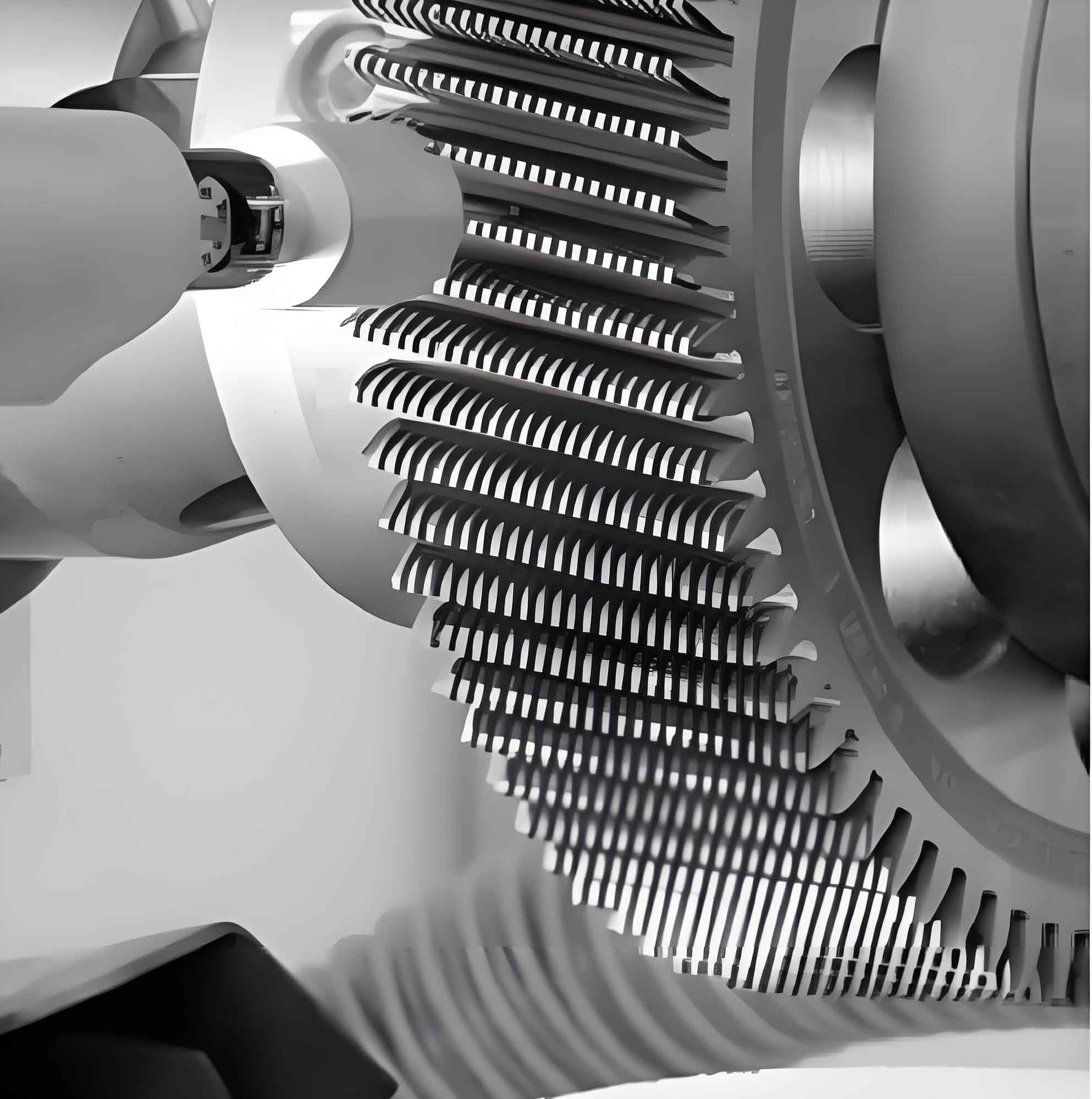
Involute gear generation via hobbing or shaping can lead to undercut, a condition where the tool removes material from the dedendum of the gear tooth, interfering with the involute profile near its base. Traditional definitions often label any such removal as detrimental. However, a more nuanced understanding is necessary, especially for processes like gear shaving. I propose classifying undercut into two distinct categories based on its final impact after the gear shaving operation: “Harmful Undercut” and “Harmless Undercut.”
- Harmless Undercut: This refers to material removal confined to a region below the active part of the tooth profile—the segment that actually contacts the mating gear during operation. While it slightly reduces the root thickness and thus marginally affects bending strength and stiffness, it does not compromise the accuracy of the working involute form. Consequently, it has no adverse effect on transmission smoothness or noise.
- Harmful Undercut: This occurs when the undercut extends into the active region of the tooth flank. It not only weakens the tooth root but, more critically, distorts the involute profile within the zone of meshing action. This leads to increased profile error, deteriorated transmission stability, elevated noise levels, and potentially premature failure. The prevention of harmful undercut is therefore paramount in precision gear shaving.
The fundamental cause of undercut in generation is geometric interference. When the cutting tool’s tip (or its effective cutting line) extends beyond the theoretical limit point (the tangent point of the involute to the base circle) on the workpiece, it begins to cut into the undeveloped involute. For standard gear generation with a basic rack cutter, the minimum number of teeth to avoid undercut is given by:
$$ Z_{min} = \frac{2}{\sin^2\alpha} $$
where $\alpha$ is the pressure angle. For a standard $20^\circ$ pressure angle, $Z_{min} \approx 17$. However, the scenario in gear shaving is more complex due to the two-stage process: pre-shave hobbing followed by the shaving operation itself.
Pre-shave hobbing is not performed with a standard gear hob. Instead, a specialized “pre-shave hob” is used. The defining feature of this hob is a protuberance or “top corner” on its tooth profile. The primary function of this protuberance is to deliberately create a small amount of undercut and root relief during hobbing. This is a preventive measure designed to ensure that during the subsequent gear shaving operation, the tip of the shaving cutter does not interfere with the root of the workpiece gear. The geometry of this pre-shave undercut is critical. An appropriately designed protuberance generates a “harmless” undercut that is completely removed during gear shaving, leaving a clean, precise involute and the necessary root clearance. The relationship between hob protuberance and the resulting tooth form is summarized below.
| Hob Feature | Design Purpose | Effect on Pre-Shave Gear | Risk if Improper |
|---|---|---|---|
| Protuberance Height | Create controlled root relief/undercut | Determines depth of material removed at root | Excessive height leads to deep undercut, potentially harmful if not fully shaved. |
| Protuberance Width/Form | Define the shape of the root region | Creates a specific root contour and undercut profile | Incorrect form may cause shaving cutter interference or leave residual undercut. |
| Hob Tooth Profile | Generate the main involute flank | Produces the bulk tooth form for shaving | Profile errors transfer to workpiece. |
The central problem arises when the undercut generated during pre-shave hobbing is not entirely eliminated by the gear shaving process. The shaving cutter, while finishing the flank, may not reach the very bottom of the undercut zone. Whether this residual undercut is harmful or harmless depends entirely on its axial location relative to the lowest point of active meshing on the tooth flank.
To control this, we must first define the limit of the active profile. Consider a gear pair with pinion $Z_1$ and gear $Z_2$ in mesh. The length of path of contact is $g_\alpha$. The lowest point of single-tooth contact on the driven gear $Z_2$ is the critical boundary. Any undercut above this point will affect meshing. The radius to this point, $r_{2B}$, can be derived from the geometry of meshing.
Let:
- $m$: Module
- $Z_1, Z_2$: Number of teeth
- $\alpha$: Reference pressure angle
- $\alpha_{a1}, \alpha_{a2}$: Pressure angles at pinion and gear tip circles
- $r_{b1}, r_{b2}$: Base circle radii of pinion and gear, where $r_b = \frac{mZ \cos\alpha}{2}$
- $a$: Center distance
The radius $r_{2B}$ to the lowest point of contact on gear $Z_2$ is given by:
$$ r_{2B} = \sqrt{ r_{b2}^2 + \left( \sqrt{r_{a1}^2 – r_{b1}^2} – a \sin\alpha \right)^2 } $$
Alternatively, using pressure angles:
$$ r_{2B} = \sqrt{ r_{b2}^2 + \left( r_{b1} (\tan\alpha_{a1} – \tan\alpha) – r_{b2}\tan\alpha \right)^2 } $$
where $r_{a1}$ is the tip radius of the driving pinion. The parameter $r_{2B}$ represents the maximum permissible limit for undercut. If the radial point where the undercut transitions to the true involute (the “undercut limit point”) is at a radius $r_{uc}$, then:
- If $r_{uc} < r_{2B}$, the undercut is harmless.
- If $r_{uc} \ge r_{2B}$, the undercut is harmful as it infringes upon the active profile.
In practice, the gear manufacturer often cannot modify the pre-shave hob design, as it is typically supplied by a tooling specialist. Therefore, the most accessible and powerful control variable in the gear shaving process is the shaving allowance—the amount of material left on the tooth flank after pre-shave hobbing for the shaving cutter to remove. This allowance is closely related to the radial infeed during the final pass of pre-shave hobbing. Its management is the key to controlling final undercut. The following analysis outlines the effects of different shaving allowance magnitudes:
| Shaving Allowance Condition | Effect on Pre-Shave Undercut Position | Result After Gear Shaving | Impact on Gear |
|---|---|---|---|
| Too Small (Pre-shave infeed too deep) | Undercut is deep and its limit point ($r_{uc}$) is positioned low on the root. | The shaving cutter may not reach the bottom of the deep undercut. Residual undercut remains, but $r_{uc} < r_{2B}$. | Harmless Undercut. Tooth root is significantly weakened, reducing bending strength and stiffness. Profile accuracy in the active zone is acceptable. |
| Optimal | Undercut is precisely sized and positioned so its limit point is just below $r_{2B}$. | The shaving cutter fully cleans up the active flank. Any residual undercut is well clear of the meshing zone. | Ideal outcome. No harmful undercut. Minimal impact on strength. Excellent profile accuracy and transmission smoothness. |
| Too Large (Pre-shave infeed too shallow) | Undercut is shallow and its limit point ($r_{uc}$) is positioned high on the flank. | High risk that the shaving cutter cannot remove all of the shallow undercut, leaving $r_{uc} \ge r_{2B}$. | Harmful Undercut. Tooth root is weakened, and the active profile is distorted. This causes large profile error, poor meshing, and increased noise. Alternatively, excessive stock causes rapid shaving cutter wear, higher surface roughness, and risk of tool tip interference with the gear root. |
The relationship between shaving allowance $\delta$, the pre-shave undercut geometry, and the final undercut limit point $r_{uc}$ is complex and depends on the tool geometries. However, a fundamental principle can be expressed. The effective depth of cut of the shaving cutter is not uniform along the flank; it is greatest at the pitch line and diminishes towards the root and tip. Therefore, for a given pre-shave undercut profile $f_{pre}(r)$, the final profile $f_{final}(r)$ after gear shaving with a nominal stock removal $S$ can be conceptually modeled as:
$$ f_{final}(r) \approx f_{pre}(r) – \eta(r) \cdot S $$
where $\eta(r)$ is an efficiency function that varies from 1 (full removal) at the pitch point to less than 1 near the root and tip. The condition for eliminating harmful undercut is:
$$ f_{pre}(r) – \eta(r) \cdot S \ge f_{ideal}(r) \quad \text{for all } r \ge r_{2B} $$
where $f_{ideal}(r)$ is the ideal involute profile. This inequality must be solved with respect to $S$ to find the minimum required shaving allowance to clean up the active profile.
To validate the theoretical premise that shaving allowance critically influences undercut and profile error, a controlled manufacturing and measurement sequence can be conceptualized. Multiple batches of gears (e.g., module $m=3$, teeth $Z=35$, pressure angle $\alpha=20^\circ$) are pre-shave hobbed with intentional variations in the final radial infeed to produce different levels of stock left for gear shaving. Each batch is then shaved to a common final size (e.g., a target chordal tooth thickness or span measurement). Post-shaving, each gear undergoes precise profile measurement on a gear measuring center or coordinate measuring machine (CMM).
The hypothetical results from such an experiment would strongly support the theory. Data would typically show that batches with very small or very large shaving allowances exhibit residual undercut. Critically, only the batches with excessively large allowance would show the characteristic profile error “kink” in the active region, confirming “harmful undercut.” Batches with moderate allowance would display smooth, accurate profiles with any residual undercut confined to the sub-active root area. The profile error $F_\alpha$ as a function of shaving allowance $\delta$ would follow a “bathtub curve,” with minima in an optimal range and rising errors at both extremes. The following table summarizes expected findings:
| Batch ID | Shaving Allowance $\delta$ (mm) | Post-Shave Span (mm) | Profile Error $F_\alpha$ (μm) | Undercut Character | Root Stress Concentration Factor (Estimate) |
|---|---|---|---|---|---|
| A | 0.05 | 32.581 | 17 | Pronounced harmless undercut | Increased (~5-8%) |
| B | 0.10 | 32.585 | 17 | Moderate harmless undercut | Slightly increased (~2-4%) |
| C | 0.15 | 32.580 | 19 | Minimal harmless undercut | Negligible change |
| D | 0.20 | 32.582 | 30 | Harmful undercut begins | Increased & profile degraded |
| E | 0.25 | 32.585 | 30+ | Clear harmful undercut | Significantly increased & profile degraded |
The process of gear shaving is integral to mass-producing high-quality gears. Mastering the control of undercut is not merely an academic exercise but a vital practical skill. The dichotomy between “harmful” and “harmless” undercut provides a clear framework for decision-making. The theoretical determination of the maximum permissible undercut point via $r_{2B}$ offers a quantitative target. Ultimately, for the production engineer, the most effective and adjustable parameter is the shaving allowance. A methodical approach involving careful setup of pre-shave hobbing depth, followed by verification through first-article inspection measuring the profile and root form, is essential. The goal is to find the “Goldilocks zone” for the shaving allowance—enough to ensure complete removal of pre-shave imperfections in the active zone without being so excessive that it promotes harmful undercut or tool wear. This balance is the key to achieving the full potential of the gear shaving process: excellent profile accuracy, smooth operation, and reliable performance in the field.
Future refinements in this area could involve advanced simulation software that models the complete cutting interaction of both the pre-shave hob and the shaving cutter, predicting the final tooth form and undercut based on input parameters. This would allow for the virtual optimization of shaving allowance and hob design before physical trials, further enhancing the efficiency and precision of gear shaving operations. The integration of in-process measurement and adaptive control could also dynamically adjust shaving parameters to compensate for tool wear, ensuring consistent quality throughout the tool’s life. The fundamental principles of undercut control, however, will remain the foundation upon which these advanced technologies are built.