
Gear honing, as a precision finishing process for hardened gears, has evolved significantly since its inception in the 1960s. The breakthrough came in the early 1980s with the advent of synthetic diamond and other superhard materials, along with advanced composite coating technologies, which propelled gear honing into practical applications. This process not only enhances gear quality but also substantially improves gear accuracy, earning a prominent position in hard gear surface finishing. In this article, we delve into the development of internal gear honing machines and their配套技术, focusing on the principles, design, and applications from our firsthand experience. The term “gear honing” will be frequently emphasized throughout, as it is central to our discussion.
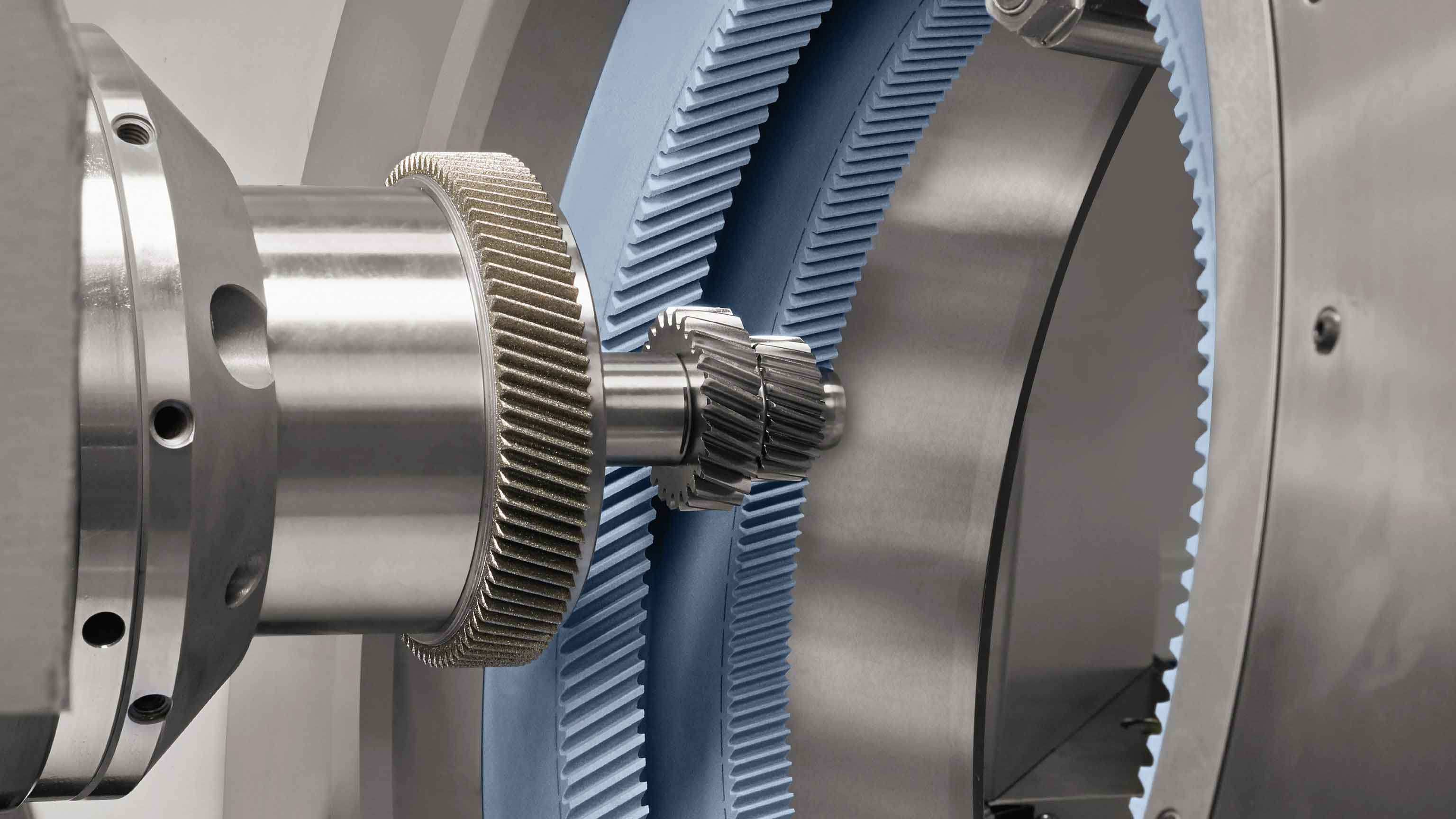
The core of gear honing lies in the cross-axis spatial meshing principle, where an internal honing wheel engages with the workpiece gear. This method allows for efficient material removal and surface refinement. We have developed a series of internal gear honing machines, including hydraulic and CNC variants, tailored for mass production and flexible small-batch applications. These machines are capable of honing gears with modules up to 4 mm and diameters under 200 mm, including straight, helical, and shoulder gears. The integration of diamond electroplated dressing wheels enables in-machine honing wheel修整, eliminating interference and restoring精度, which is crucial for consistent gear honing performance.
Our gear honing machines operate on two primary cycles: the加工循环 for gear finishing and the修整循环 for honing wheel maintenance. During gear honing, the honing wheel rotates at high speeds (450-500 rpm), while in修整 mode, it slows to 45-50 rpm. This dual functionality ensures that the honing wheel remains precise over its lifespan. The机床传动 systems vary between models: the hydraulic version uses fluid motors for无级调速 of honing wheel rotation and radial feed, whereas the CNC version employs servo motors and ball screws controlled by a microprocessor. This数控技术 enhances flexibility, allowing parameters like honing wheel speed, feed rates, and tool angles to be programmed and stored for multiple gear types. For instance, the longitudinal feed (Z-axis) and radial feed (X-axis) are digitally controlled, with real-time displays on CRT for monitoring. Such features make gear honing adaptable to diverse production needs.
The layout of our gear honing machines follows a horizontal plane configuration, which facilitates easy变形 for different machine sizes. We adopted a modular design, enabling the derivation of a series of machines covering diameters up to 500 mm. Key structural enhancements include a贯通式刀架 for improved rigidity over traditional悬臂式 designs, as shown in the comparison below:
| 刀架 Type | Rigidity | Application |
|---|---|---|
| 悬臂式 (Cantilever) | Moderate | Traditional honing |
| 贯通式 (Through-type) | High | Internal gear honing |
Additionally, we implemented anti-vibration measures, such as coating guideways with polytetrafluoroethylene-based materials to increase damping and reduce friction. The鼓形机构 for crowning gears was redesigned with eccentric rollers and rolling bearings to eliminate play, ensuring stable crowning during gear honing. The tool post angle adjustment mechanism allows precise setting via handwheels or automated CNC controls, simplifying operations. These design choices contribute to the机床热稳定性 and overall accuracy in gear honing processes.
In terms of work methods, our gear honing machines support both axial and radial honing cycles. Axial honing is suitable for general gears, while radial honing is ideal for shoulder gears. The machine can also perform longitudinal modifications, such as taper or crown profiles, though directly honing these may reduce honing wheel life. For mass production of crowned gears, using a dressed honing wheel with a crown profile is recommended to avoid extra mechanisms. The control system, whether PC-based or CNC, ensures reliable cycle execution, with fault diagnostics and honing wheel usage计数 displayed. This automation streamlines gear honing in high-volume settings.
The internal honing wheel is a critical component in gear honing. It is fabricated from epoxy resin bonded with abrasive grains—aluminum oxide for gears below RC 60 and silicon carbide for harder surfaces. The abrasive grain size can range up to 36号, still yielding excellent surface finish. Unlike conventional honing wheels, our配方 increases the abrasive ratio by 2-3 times, necessitating a压制 method instead of浇注 to achieve proper density and strength. The honing wheel parameters are calculated based on workpiece specs, ensuring an optimal轴交角 of 8° to 12° to maximize gear honing efficiency. The installation diameter is standardized at 310 mm, with widths of 20 mm or 25 mm available to match gear widths and maintain adequate pressure per unit area. The honing wheel精度 heavily depends on in-machine dressing; thus, the initial压制 must保证 minimal runout between the mounting diameter and tooth ring. The honing wheel寿命 can be estimated using the formula:
$$ L = n \cdot \Delta x \cdot \frac{1}{2m} $$
where \( L \) is the total radial life, \( n \) is the number of dressing cycles, \( \Delta x \) is the dressing amount per cycle (typically 0.05–0.1 mm), and \( m \) is the module. This yields 60–120 dressing cycles per honing wheel. The table below summarizes honing wheel life for various工艺方案:
| 工艺方案 (Process) | 工件精度 (Workpiece Accuracy) | Honing Wheel Life (Pieces) |
|---|---|---|
| 滚-剃-热-形 (Hob-Shave-Heat-Hone) | 9–12级 | 10–15 |
| 滚-热-粗磨-晰 (Hob-Heat-Rough Grind-Hone) | 7–9级 | 30–50 |
| Precision honing after grinding | 5–6级 | 100–1000 |
These values highlight how gear honing effectiveness correlates with pre-honing accuracy, underscoring the importance of integrated process chains.
The diamond dressing wheel, employing an external electroplating method, is pivotal for maintaining honing wheel精度 in gear honing. Its features include a steel gear-shaped base hardened to RC 60 and ground to grade 4–5 accuracy, a single-layer diamond coating electroplated with a metal binder, and a reusable base after电解清理. The coating has an open structure, allowing切削 rather than挤压 during dressing, with recesses acting as “chip pockets” to enhance honing wheel performance. The dressing wheel parameters generally match the workpiece, but for small batches, they can cover a range. To prevent齿底 engagement, a diamond dressing ring is used to create间隙 at the honing wheel齿顶, as illustrated:
$$ \text{Gap} = r_a – r_f $$
where \( r_a \) is the honing wheel tip radius after dressing and \( r_f \) is the dressing wheel root radius. This prolongs dressing wheel life, which is typically 10 times the honing wheel’s total life. For mass production,粗精修整轮 pairs are advised: coarse for initial interference removal and fine for accuracy restoration. Our manufacturing process involves成形电极 for uniform current density, high-precision gear grinding for the base, and careful diamond grain selection. Post-plating研磨 removes defects, ensuring reliable performance in gear honing operations.
From an application perspective, gear honing has proven effective in automotive and machinery sectors. For example, in变速箱 production, our machines achieved significant精度 improvements, with plans for line integration. The “hob-shave-heat-hone” process链 leverages existing expertise, making gear honing adoption straightforward. The benefits include reduced noise, increased load capacity, and extended gear life—key outcomes of precision gear honing. Looking ahead, we aim to develop剃磨技术 (hone-grinding), which combines CNC internal linkage with gear-shaped grinding wheels for even higher efficiency. This aligns with industry trends toward economical and accurate gear finishing.
In conclusion, gear honing represents a transformative advancement in gear manufacturing. Our internal gear honing machines and配套技术 offer robust solutions for hard gear surface finishing, with modular designs, advanced controls, and durable tooling. By emphasizing “gear honing” throughout, we underscore its centrality in modern precision engineering. The integration of diamond dressing wheels and optimized honing wheel compositions further enhances process stability. As we continue to innovate, gear honing will undoubtedly play a larger role in meeting the demands for high-quality gears in various industries.
To delve deeper into the technical aspects, let’s consider the meshing dynamics in gear honing. The cross-axis angle \( \Sigma \) between the honing wheel and workpiece is critical for generating the desired helicoidal motion. The relative sliding velocity \( v_s \) can be expressed as:
$$ v_s = \omega_h r_h \sin \Sigma – \omega_w r_w \sin \Sigma $$
where \( \omega_h \) and \( \omega_w \) are the angular velocities of the honing wheel and workpiece, and \( r_h \) and \( r_w \) are their pitch radii. This sliding action facilitates material removal during gear honing. Additionally, the honing pressure \( P \) is governed by the radial feed force \( F_r \) and contact area \( A \):
$$ P = \frac{F_r}{A} $$
Optimal pressure ensures efficient honing without excessive wheel wear. Our machines allow fine-tuning of these parameters via CNC, enabling adaptive gear honing for different materials and hardness levels.
Another key factor is the honing wheel wear model. The wear rate \( \dot{w} \) can be approximated as:
$$ \dot{w} = k \cdot v_s \cdot P^\alpha $$
where \( k \) is a wear coefficient dependent on abrasive and workpiece material, and \( \alpha \) is an exponent typically around 1.5 for gear honing. This model helps predict honing wheel life and schedule dressing cycles, minimizing downtime in gear honing production lines.
Regarding the dressing process, the diamond dressing wheel’s effectiveness relies on the电镀 parameters. The current density \( J \) during electroplating must be uniform across the齿廓 to avoid coating irregularities. We use a conforming electrode to achieve this, with the plating thickness \( t \) given by:
$$ t = \frac{J \cdot t_e \cdot \eta}{\rho} $$
where \( t_e \) is the plating time, \( \eta \) is the current efficiency, and \( \rho \) is the density of the plating metal. Consistent thickness ensures the dressing wheel’s accuracy for prolonged gear honing use.
In terms of economic impact, gear honing reduces the need for secondary grinding operations, lowering costs and lead times. A comparative analysis of processes shows:
| Process | Accuracy Improvement | Cost Relative to Grinding |
|---|---|---|
| Gear Honing | 1–2 grades | 70% |
| Grinding | 2–3 grades | 100% |
| Shaving | 0.5–1 grade | 50% |
This makes gear honing a cost-effective choice for many applications. Furthermore, the environmental benefits include reduced energy consumption and less waste compared to传统 grinding, as gear honing operates at lower speeds and uses fewer consumables.
We have also explored advanced monitoring systems for gear honing machines, incorporating sensors for vibration, temperature, and acoustic emissions. These data feed into AI algorithms to predict tool wear and optimize process parameters in real-time. For instance, if vibration exceeds a threshold during gear honing, the system can automatically adjust the feed rate or initiate a dressing cycle. This smart manufacturing approach enhances the reliability and efficiency of gear honing operations.
In summary, the journey of gear honing from a niche technique to a mainstream process reflects broader trends in manufacturing innovation. Our contributions in machine design, tooling, and process integration have helped democratize gear honing for various industries. As we look to the future, continuous improvement in diamond coatings, CNC capabilities, and sustainable practices will further elevate gear honing’s role. We remain committed to advancing this technology, ensuring that gear honing remains at the forefront of precision gear finishing.