
The integration of ultrasonic vibration into traditional gear honing processes represents a significant advancement in precision manufacturing. Ultrasonically-assisted gear honing addresses inherent limitations of conventional honing, such as low efficiency and difficulties in form correction, by superimposing high-frequency vibrations onto the honing tool or workpiece. This hybrid process leverages the advantages of both ultrasonic machining and gear honing, leading to improved material removal rates, enhanced surface finish, and superior profile accuracy. The core enabling technology for this method is the design of a robust and efficient ultrasonic vibration system.
The efficacy of ultrasonically-assisted gear honing hinges on the effective delivery of ultrasonic energy to the honing interface. The vibration system’s core is a composite structure, typically comprising an ultrasonic transducer, a horn (or amplitude transformer), and the resonant load—which in this context is the gear itself or a representative disk. The horn plays a crucial role in amplifying the small vibrational displacement output from the transducer and efficiently coupling this energy into the gear. This coupling induces a complex state of flexural (bending) vibration in the gear, transforming the longitudinal wave from the horn into transverse motion at the gear’s honing surface. It is this amplified transverse displacement in the honing zone that directly facilitates the improved process performance.
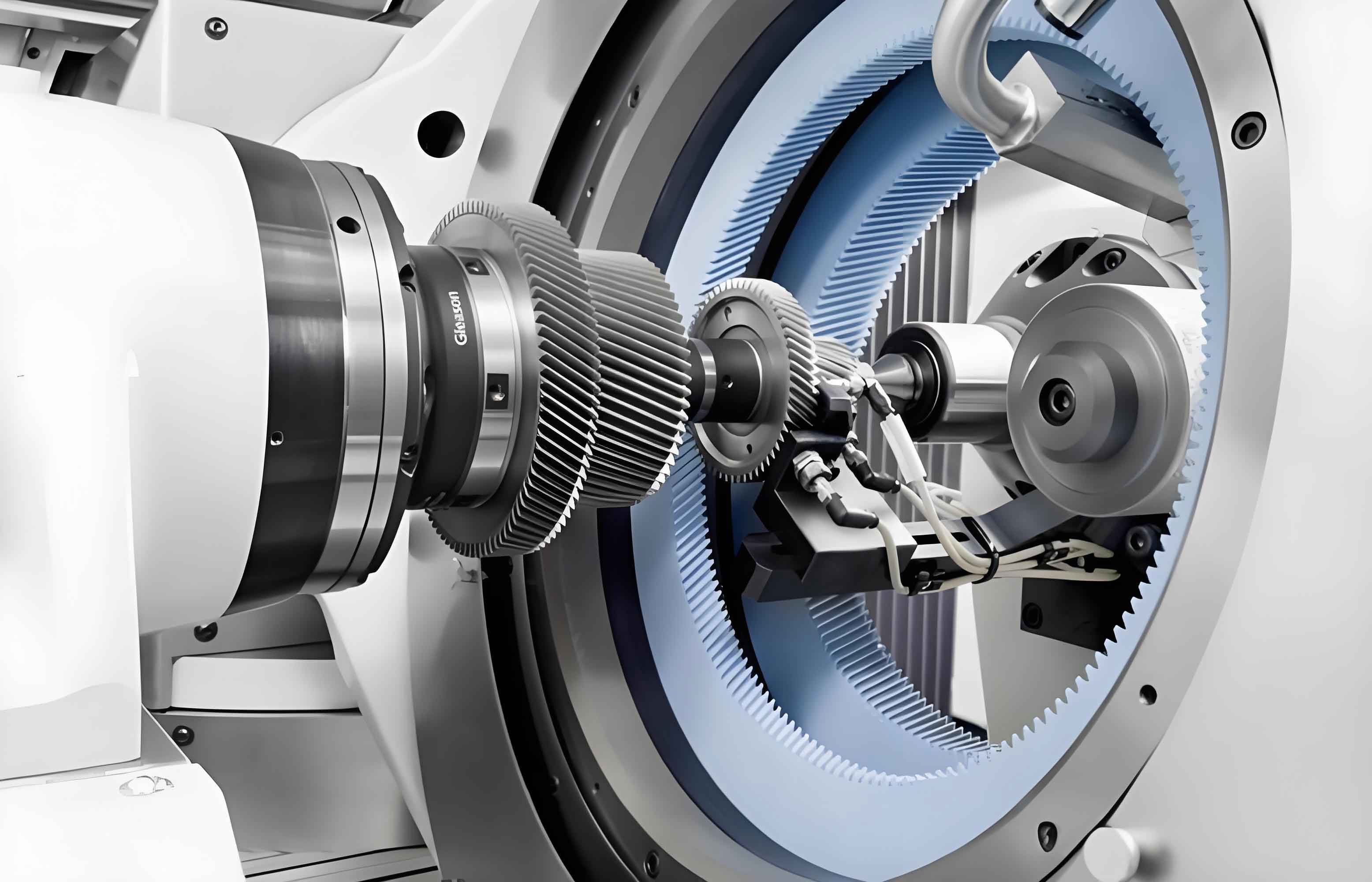
However, designing this composite vibration system for gear honing applications presents unique and formidable challenges, distinct from typical ultrasonic machining setups where the tool is small and can often be treated as a rigid extension of the horn. In gear honing, the load (the gear) has a significantly larger radial dimension, drastically influencing the resonant characteristics of the entire system. Furthermore, the flexural vibration of a disk-like structure is inherently complex, characterized by various modal shapes with specific nodal circles and diameters. The connection point between the horn and the gear becomes critical, as it must coincide with a suitable vibrational mode of the gear to avoid local resonance issues and ensure efficient energy transfer. This complexity renders purely theoretical design approaches insufficient. Therefore, a synergistic methodology combining analytical horn design theory, plate vibration theory, and iterative finite element analysis (FEA) is essential to determine the optimal structural parameters for a successful ultrasonically-assisted gear honing system.
Theoretical Design and Modal Analysis of a Conical Horn
The first step in building the vibration system for ultrasonic gear honing is the design of the amplitude-transforming horn. A half-wavelength conical horn is chosen for its good amplitude gain and mechanical strength. The target resonant frequency for the system is set at $$f_t = 14.79 \text{ kHz}$$. The material selected for the horn is AISI 1045 steel (equivalent to Chinese grade 45 steel), whose properties in the supplied state are summarized in Table 1.
| Parameter | Symbol | Value | Unit |
|---|---|---|---|
| Density | $\rho$ | 7.81 | g/cm³ |
| Elastic Modulus | $E$ | 20,920 | kg/mm² (≈205 GPa) |
| Longitudinal Wave Speed | $c$ | 5,170 | m/s |
| Poisson’s Ratio | $\nu$ | 0.3 | – |
To ensure impedance matching and high energy transfer efficiency from the piezoelectric transducer, the large-end diameter of the horn ($D_1$) should closely match the transducer’s output diameter. Given a transducer output diameter of 75 mm, we set $D_1 = 78$ mm. The small-end diameter ($D_2$) must be compatible with the gear/disk connection; it is initially set to $D_2 = 25$ mm. This gives a area ratio $N = D_1 / D_2 = 3.12$. For a conical horn, the resonant frequency and amplification factor depend on its geometry and material. The design parameters for a half-wavelength longitudinal vibrating conical horn can be derived from the one-dimensional wave equation. The wavelength $\lambda$ in the material is given by $\lambda = c / f_t$. The half-wavelength $l$ (theoretical resonant length) is approximately $\lambda/2$, but requires correction for the tapered geometry.
The amplification factor (ratio of output to input particle displacement amplitude), $M_p$, for an unloaded, lossless conical horn is:
$$
M_p = \frac{D_1}{D_2} = N
$$
However, the exact resonant length $l$ and the location of the displacement node $x_0$ (where mounting is optimal) are determined from the characteristic frequency equation for a conical horn. Using standard design formulas from ultrasonic engineering literature, the key parameters for our horn are calculated and listed in Table 2.
| Parameter | Symbol | Value | Unit |
|---|---|---|---|
| Large-end Diameter | $D_1$ | 78.0 | mm |
| Small-end Diameter | $D_2$ | 25.0 | mm |
| Resonant Length | $l$ | 195.0 | mm |
| Amplification Factor | $M_p$ | 3.12 | – |
| Displacement Node Position | $x_0$ | 76.8 | mm |
| Shape Factor | $\phi$ | 1.639 | – |
To validate this theoretical design, a finite element model was created in ANSYS 9.0. The model used SOLID185 (20-node brick) elements. A modal analysis was performed within a frequency range of 12–17 kHz. The FEA predicted a first-order longitudinal modal frequency of $f_{FEA} = 14.607$ kHz. The error relative to the theoretical target is:
$$
\text{Error} = \frac{|f_t – f_{FEA}|}{f_t} \times 100\% = \frac{|14.79 – 14.607|}{14.79} \times 100\% \approx 1.2\%
$$
This close agreement confirms the accuracy of the analytical design for the horn in isolation and provides a reliable baseline for the subsequent, more complex analysis of the composite system critical for gear honing.
Investigation of the Horn-Disk Composite Vibration System
The primary challenge in designing an ultrasonic system for gear honing arises when the horn is coupled to its intended load—the gear. For this study, a steel disk (simulating a gear blank) with a diameter of 116 mm and a thickness of 12 mm is used. This disk represents a significant inertial and stiffness load compared to the horn, fundamentally altering the system’s dynamics. The composite system’s resonant frequency, modal shape, and energy distribution are no longer governed by the horn alone but by the coupled interaction between the horn and the disk’s flexural vibrations.
The design objective is to tune the composite system to resonate longitudinally at the target frequency (≈14.79 kHz), while ensuring the disk exhibits a desirable flexural mode (e.g., a mode with significant transverse displacement at its outer radius, corresponding to the honing teeth). Given that the large-end diameter $D_1$ is fixed for transducer matching, only two key horn parameters can be adjusted to achieve this tuning: the horn length $l$ and the small-end diameter $D_2$. We employ a parametric FEA approach to systematically study their influence on the composite system’s resonant frequency.
Influence of Horn Length on System Resonant Frequency
Keeping $D_1 = 78$ mm and $D_2 = 25$ mm constant, the horn length $l$ is varied. A series of modal analyses on the horn-disk assembly are conducted. The results, plotted conceptually, reveal a clear trend: the resonant frequency $f_{sys}$ of the composite system decreases as the horn length $l$ increases. This is intuitively consistent with the behavior of a longitudinal resonator; a longer acoustic path generally corresponds to a lower fundamental frequency. The relationship is non-linear, with the rate of frequency decrease diminishing for longer horn lengths. This data is crucial for fine-tuning the system for gear honing, as it provides a direct adjustment parameter.
| Horn Length $l$ | System Frequency $f_{sys}$ | Trend |
|---|---|---|
| Decrease | Increase | $f_{sys} \propto 1/l$ (approximately) |
| Increase | Decrease | Sensitivity reduces at larger $l$ |
Influence of Horn Small-End Diameter on System Resonant Frequency
Conversely, with $D_1 = 78$ mm and a fixed horn length $l = 195$ mm, the small-end diameter $D_2$ is varied. The FEA results demonstrate that $f_{sys}$ increases with increasing $D_2$. A larger $D_2$ increases the stiffness and the cross-sectional area at the connection to the disk, effectively making the horn “shorter” acoustically and raising its natural frequency. This parameter offers another effective means of tuning the composite vibration system for optimal gear honing performance.
| Small-end Diameter $D_2$ | System Frequency $f_{sys}$ | Trend |
|---|---|---|
| Decrease | Decrease | Reduced connection stiffness lowers $f_{sys}$ |
| Increase | Increase | Increased connection stiffness raises $f_{sys}$ |
Finalized Design of the Composite System
By synthesizing the effects of both $l$ and $D_2$, and considering practical constraints and the desired modal shape of the disk, an optimal design is determined through iterative FEA. The final chosen dimensions for the horn in the composite system are: $D_1 = 78$ mm, $D_2 = 25$ mm, and a modified length $l = 130$ mm (shorter than the isolated horn design to compensate for the mass loading of the disk). A full modal analysis of this final horn-disk assembly yields a resonant frequency of $f_{sys-final} = 14.715$ kHz. This value is within an acceptable tolerance of the original 14.79 kHz target, demonstrating the success of the FEA-guided design adjustment process for the ultrasonic gear honing system.
$$
f_{sys-final} = 14.715 \text{ kHz} \approx f_t
$$
Determination of Nodal Location for System Mounting
A critical practical step in implementing an ultrasonic gear honing system is identifying the position of the vibrational node—the region of minimal displacement amplitude—for secure mounting on the honing machine. Theoretically, in a longitudinal resonator, this is a point (or a circular cross-section for axisymmetric horns) where the stress is maximum and displacement is zero. In practice, it is a finite region of very low motion. Mounting the system at this node minimizes energy loss to the machine frame and prevents damping of the ultrasonic vibration.
For the isolated horn, the theoretical node position $x_0$ was calculated (76.8 mm from the large end). However, in the composite horn-disk system, the node location shifts. To locate it precisely, a practical method is employed: a thin “node disk” with the same diameter as the horn’s large end (78 mm) and a thickness of 5 mm is conceptually attached at various positions along the horn’s large-diameter section. In FEA, the surface of this node disk is then fully constrained (fixed boundary condition), simulating a rigid mount. The composite system’s resonant frequency is analyzed with this constraint applied at different axial locations.
The principle is that when the constraint is applied exactly at, or very near, the true nodal region, it will have the least impact on the system’s resonant frequency. Comparing the constrained frequency $f_{con}$ to the unconstrained frequency $f_{sys-final}$ reveals the optimal mounting point. The position where the frequency shift $\Delta f = |f_{con} – f_{sys-final}|$ is minimized is selected as the mounting location. Through this FEA procedure, the optimal position is determined. The analysis confirms that constraining the system at this identified node location results in a resonant frequency of $f_{con} = 14.793$ kHz, which is an excellent match to the target and the unconstrained system frequency, validating the node placement strategy for the gear honing assembly.
$$
\Delta f_{min} = |14.793 – 14.715| \approx 0.078 \text{ kHz}
$$
Conclusion and Implications for Gear Honing
The design of an effective ultrasonic vibration system for gear honing is a multifaceted engineering challenge that successfully bridges theoretical acoustics and practical manufacturing needs. This study demonstrates that a purely analytical approach is inadequate due to the significant influence of the gear-like disk load, the complexity of coupled flexural vibrations, and local resonance phenomena at the joint. The adopted methodology—combining analytical horn design with iterative parametric finite element analysis—proves to be powerful and necessary.
Key findings from this design research for ultrasonically-assisted gear honing include:
- The resonant frequency of the horn-disk composite system is highly sensitive to the horn’s geometric parameters. Increasing the horn length lowers the system frequency, while increasing the horn’s small-end connection diameter raises it. These relationships provide clear tuning guidelines.
- Finite element analysis is indispensable for predicting the coupled vibrational behavior, allowing for the precise adjustment of horn dimensions (in this case, shortening the horn from 195 mm to 130 mm) to achieve the target resonant frequency when the disk is attached.
- The vibrational node of the composite system can be accurately located using FEA by observing the minimal shift in resonant frequency when a simulated mounting constraint is applied. This ensures that the system can be rigidly and efficiently mounted on a honing machine without dissipating vibrational energy.
This designed and analyzed composite vibration system establishes a foundational platform for subsequent experimental research into the ultrasonically-assisted gear honing process. It ensures that high-frequency mechanical energy can be reliably delivered to the gear honing interface, paving the way for investigating the tangible benefits of this hybrid process, such as reduced honing time, improved gear surface integrity, and enhanced geometrical accuracy. The principles and methods outlined here are directly applicable to scaling the system for different gear sizes and honing applications, contributing significantly to the advancement of precision gear manufacturing technology.