
In the field of gear manufacturing, precision finishing of hardened gears is a critical step to ensure optimal performance, longevity, and noise reduction. Among various finishing techniques, external gear honing has emerged as an efficient and cost-effective method. However, traditional external gear honing has been limited primarily to improving surface roughness with minimal enhancement in accuracy, often restricting its application to lower-precision gears. In this article, I will explore a novel approach to profiling honing gears using diamond dressing gears, which significantly elevates the precision of external gear honing. This method not only addresses inherent issues like mid-concave tooth profiles and root/tip removal but also opens new avenues for high-precision hard gear finishing. Throughout this discussion, I will emphasize the importance of gear honing and its transformative potential when integrated with advanced profiling techniques.
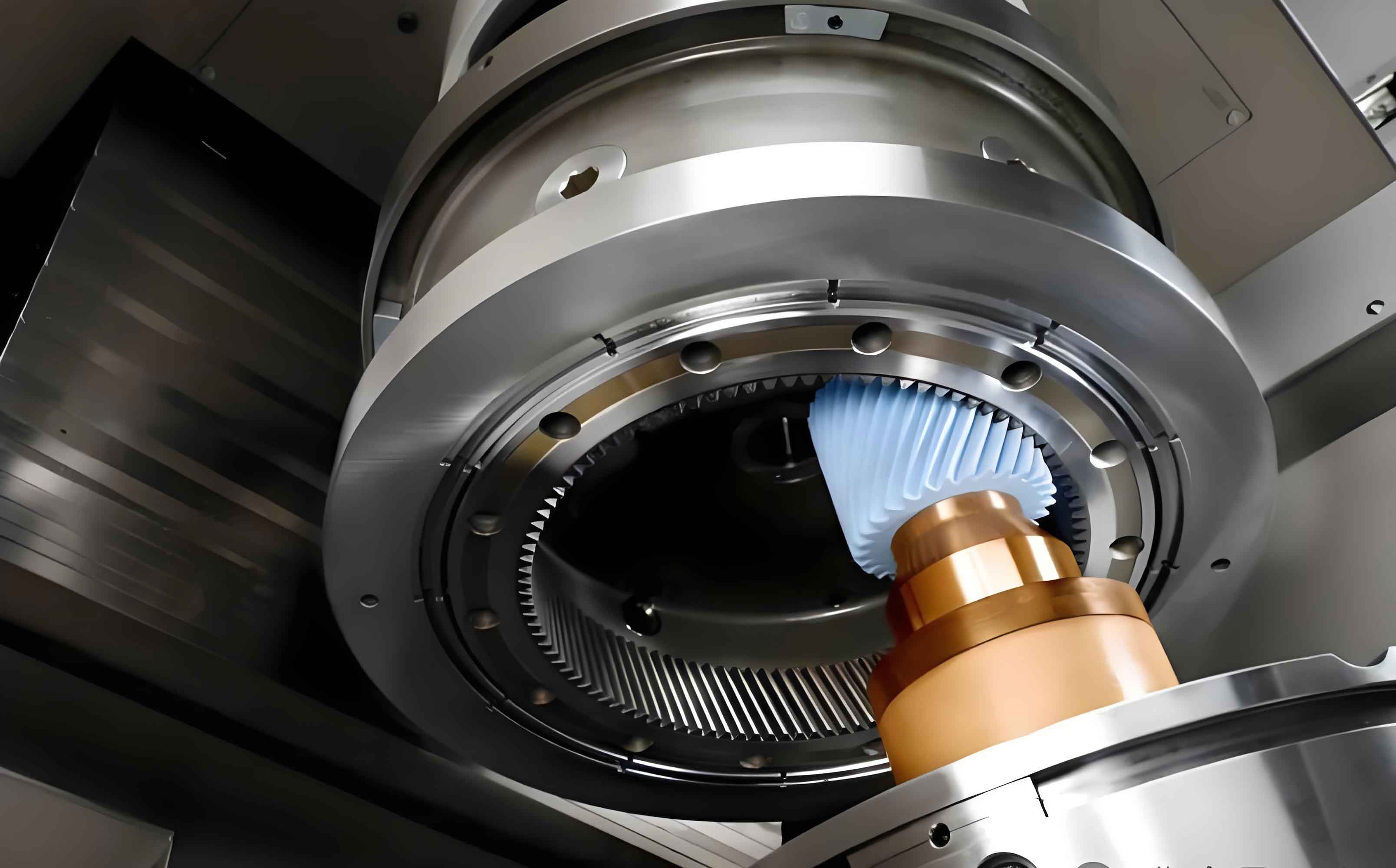
External gear honing, as a gear honing process, involves the meshing of a honing gear with the workpiece gear in a free-turning arrangement, akin to crossed-helical gear传动. The relative sliding velocity and pressure between the tooth surfaces facilitate micro-cutting action. The honing gear is typically made from elastic composite materials, such as synthetic resin or rubber, embedded with abrasive particles. This structure allows for fine切削纹路 and low surface roughness without inducing burns or cracks. However, due to the elastic nature of the honing gear and non-uniform切削速度 across the tooth profile, several distortions occur: mid-concave profiles near the pitch circle, excessive material removal at the root and tip (often termed “root digging” and “tip relief”), and limited correction of pre-honing errors. These limitations have traditionally confined external gear honing to gears with accuracy no better than Grade 7 (according to standards like GB10095-88), underscoring the need for improved profiling methods in gear honing.
To overcome these challenges, I have developed and analyzed a profiling technique using齿轮式金刚石修整滚轮 (diamond dressing gears). This method employs a high-precision gear-shaped tool coated with diamond abrasive particles, which is used to dress the honing gear directly on the honing machine. The原理 is based on the反切 principle: during the honing motion, the harder diamond dressing gear removes material from the honing gear’s surface, imparting a modified profile that compensates for the aforementioned distortions. By replicating the geometry of the workpiece gear, the dressing gear intentionally induces errors onto the honing gear, which then corrects the workpiece during subsequent gear honing. This approach eliminates the need for separate honing gear profiling, reduces time and cost, and allows for real-time compensation of system errors. The effectiveness of this gear honing enhancement relies on precise mathematical modeling of the tooth contact and material removal.
The kinematic relationship in external gear honing can be described using the following equations for relative sliding velocity and pressure distribution. For crossed-helical gears with axes at an angle $\Sigma$, the sliding velocity $v_s$ at a point on the tooth surface is given by:
$$v_s = \omega_1 r_1 \sin\beta_1 – \omega_2 r_2 \sin\beta_2$$
where $\omega_1$ and $\omega_2$ are angular velocities of the honing gear and workpiece, $r_1$ and $r_2$ are pitch radii, and $\beta_1$ and $\beta_2$ are helix angles. The pressure $p$ at the contact point is influenced by the elastic modulus $E$ of the honing gear and the interference $\delta$, approximated as:
$$p = k \cdot \delta^{2/3} \cdot E^{1/3}$$
where $k$ is a constant dependent on geometry. In the profiling process using a diamond dressing gear, the material removal rate $\dot{m}$ from the honing gear can be modeled as:
$$\dot{m} = C \cdot v_s \cdot p \cdot t$$
with $C$ as a切削系数 and $t$ as time. By adjusting parameters such as dressing depth and feed rate, the profile modification $\Delta z(x)$ along the tooth flank (where $x$ is the profile coordinate) can be controlled. For a target compensation of mid-concave error, the desired modification might follow a parabolic function:
$$\Delta z(x) = a \cdot (x – x_p)^2 + b$$
where $x_p$ is the pitch point, and $a, b$ are coefficients derived from error analysis. This mathematical framework ensures that the honing gear, after profiling, produces accurate tooth forms during gear honing.
To validate this method, I conducted experiments on a Y4632A external gear honing machine. A diamond dressing gear with Grade 5 accuracy (equivalent to GB10095-88) was fabricated, featuring a steel core coated with金刚石磨粒. The honing gear was made from an epoxy resin composite with mixed abrasive grits (e.g., Al₂O₃ and SiC) and additives like MoS₂ to enhance self-sharpening. The workpiece was a C620 gearbox gear with hardened surfaces. The process involved two phases: first, dressing the honing gear with the diamond tool under controlled conditions (e.g., radial feed of 0.01 mm per pass, 10 passes), and second, honing the workpiece using the profiled honing gear. Key parameters are summarized in Table 1.
| Parameter | Value | Unit |
|---|---|---|
| Honing gear diameter | 200 | mm |
| Workpiece gear module | 3 | mm |
| Honing pressure | 0.5 | MPa |
| Dressing feed rate | 0.01 | mm/pass |
| Abrasive grit size | #400/#800 mix | – |
| Honing time per gear | 120 | seconds |
The results demonstrated significant improvements in gear accuracy. Before profiling, the honing gear exhibited standard渐开线 deviations, leading to characteristic errors in the workpiece. After profiling with the diamond dressing gear, the honing gear’s tooth profile was modified to counteract these errors. Measurements using a gear analyzer showed reductions in profile error $\Delta F_\alpha$, helix error $\Delta F_\beta$, and pitch error $\Delta f_{pt}$. The data are presented in Table 2, comparing pre- and post-honing accuracies for multiple workpieces.
| Error Type | Pre-honing (μm) | Post-honing (μm) | Improvement (%) |
|---|---|---|---|
| Profile error $\Delta F_\alpha$ | 15.2 | 5.8 | 61.8 |
| Helix error $\Delta F_\beta$ | 12.7 | 4.3 | 66.1 |
| Base pitch error $\Delta f_{pb}$ | 8.9 | 3.1 | 65.2 |
| Surface roughness $R_a$ | 0.8 | 0.2 | 75.0 |
These enhancements translate to a notable noise reduction of 3–5 dB in gearbox assemblies, as observed in the C620 gearbox test. The success of this gear honing process hinges on the precision of the diamond dressing gear. Its manufacturing involves镀覆金刚石 onto a high-accuracy gear blank, followed by grinding to achieve micron-level tolerances. The durability of the dressing gear allows for hundreds of dressing cycles, and the coating can be reapplied after wear, making it economically viable. Furthermore, the integration of profiling directly into the honing machine enables补偿 of随机误差, such as thermal drift or tool wear, which are common in gear honing operations.
To delve deeper into the profiling mechanism, consider the contact mechanics between the diamond dressing gear and the honing gear. Using Hertzian contact theory, the contact patch半-width $a$ for two cylinders in rolling-sliding contact is:
$$a = \sqrt{\frac{4PR}{\pi E^*}}$$
where $P$ is the normal load, $R$ is the effective radius, and $E^*$ is the equivalent elastic modulus. For the dressing process, the material removal per unit length $\Delta h$ can be expressed as a function of sliding distance $L$ and dressing force $F_d$:
$$\Delta h = K_d \cdot F_d^{0.7} \cdot L^{0.3}$$
with $K_d$ as a dressing常数. By optimizing $F_d$ and the number of dressing passes, the honing gear profile can be tailored to specific error corrections. For instance, to mitigate root digging, additional material removal at the root zone can be programmed by adjusting the dressing path. This level of control exemplifies the sophistication possible in modern gear honing with advanced profiling.
The benefits of this new method extend beyond accuracy. In terms of process efficiency, the in-situ profiling reduces downtime, as the honing gear does not need removal for separate dressing. This aligns with lean manufacturing principles and enhances the overall productivity of gear honing lines. Moreover, the use of diamond abrasives ensures consistent切削性能 over long periods, maintaining the honing gear’s sharpness and reducing the frequency of tool changes. Economic analysis indicates that while the initial investment in diamond dressing gears is higher, the long-term savings from reduced scrap and improved throughput justify the adoption in high-volume gear honing applications, such as automotive or aerospace industries.
Comparative studies with other gear finishing methods, like grinding or shaving, highlight the unique advantages of this gear honing approach. For example, gear grinding often induces thermal damage and requires costly equipment, whereas gear honing operates at lower temperatures and pressures. The profiling method described here bridges the accuracy gap, enabling gear honing to achieve Grade 5 or better, rivaling traditional磨齿. Table 3 summarizes key comparisons based on industrial data.
| Method | Typical Accuracy (Grade) | Surface Roughness $R_a$ (μm) | Process Cost (Relative) | Suitability for Hard Gears |
|---|---|---|---|---|
| 传统 Gear Honing | 7-8 | 0.4-0.8 | Low | Moderate |
| Advanced Gear Honing with Profiling | 5-6 | 0.1-0.3 | Medium | High |
| Gear Grinding | 3-5 | 0.2-0.5 | High | High |
| Gear Shaving | 6-7 | 0.3-0.6 | Low | Low (pre-hard) |
This table underscores how gear honing, when enhanced with diamond dressing gear profiling, becomes competitive for high-precision applications. Additionally, the environmental impact is lower due to reduced energy consumption and coolant usage, aligning with sustainable manufacturing trends. As gear honing evolves, integration with digital technologies like IoT sensors and AI for real-time monitoring could further optimize the profiling process, ensuring consistent quality in mass production.
Looking ahead, the principles of this profiling method can be adapted to other gear forms, such as internal gears or非圆齿轮, expanding the scope of gear honing. Research into alternative abrasive materials, like cubic boron nitride (CBN), may offer even greater wear resistance for dressing gears. Furthermore, the concept of using反切 for error compensation can be applied to other machining processes, demonstrating the versatility of this approach. In my ongoing work, I am exploring the use of simulation软件 to predict profile modifications and reduce experimental trials, thereby accelerating the adoption of precision gear honing in industry.
In conclusion, the introduction of diamond dressing gear profiling represents a significant advancement in external gear honing. By addressing long-standing issues like mid-concave profiles and root/tip errors, this method elevates gear honing to a viable solution for high-accuracy hard gear finishing. The in-situ nature of the process reduces costs and downtime, while the durability of diamond tools ensures economic feasibility. As demonstrated through experiments, improvements in profile, helix, and pitch accuracies are substantial, leading to enhanced gear performance and noise reduction. The future of gear honing is bright, with potential integrations into automated lines and smart factories, solidifying its role as a key technology in gear manufacturing. I believe that continued innovation in profiling techniques will further unlock the potential of gear honing, making it indispensable for precision engineering applications worldwide.
To encapsulate the technical核心, the success of this gear honing method relies on the interplay of kinematics, contact mechanics, and material science. The governing equations for sliding velocity and pressure, combined with empirical models for material removal, provide a framework for optimizing the profiling process. By iteratively refining these models through experiments, I have achieved reproducible results that meet industrial standards. This holistic approach ensures that gear honing is not merely a finishing step but a precision machining operation capable of producing gears with exceptional accuracy and surface quality. As the demand for high-performance gears grows in sectors like electric vehicles and robotics, advancements in gear honing will play a pivotal role in meeting these challenges.