
Gears are fundamental transmission components extensively used across various industries. Their precision is paramount for the quality and performance of the final products. Traditionally, dedicated gear hobbing machines have been the primary means for gear production. However, with the advancement of CNC technology, new possibilities have emerged. The exploration of implementing gear hobbing processes on versatile CNC machining centers represents a significant step in expanding the capabilities of modern machine tools and diversifying manufacturing methods.
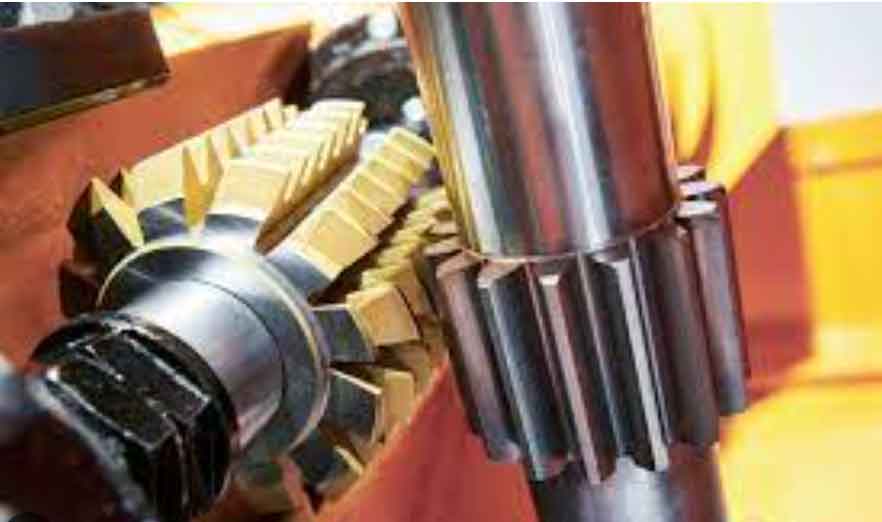
Fundamentals of Gear Manufacturing
Principles of Gear Hobbing
Gear hobbing is based on the generating principle. The process simulates the meshing of a pair of crossed helical gears. The hob and the workpiece rotate in a precise spatial relationship, and the gear tooth profile is generated as the envelope of successive hob cutter positions.
The gear hobbing process is analogous to the meshing of a worm and a worm wheel. A gear hob is essentially a worm whose thread has been gashed and relieved to form cutting edges. For a single-start hob, one revolution of the hob corresponds to the linear displacement of one tooth space of an imaginary rack. The relationship between the hob and workpiece rotations is critical and is defined by the gear ratio, which must be strictly maintained to generate the correct number of teeth and the involute profile.
The generating motion can be described mathematically. The fundamental relationship for the rotation of the workpiece (N_w) relative to the hob rotation (N_h) is given by:
$$ N_w = \frac{Z_h}{Z_w} \times N_h $$
Where $Z_h$ is the number of starts on the hob and $Z_w$ is the number of teeth on the workpiece.
Key characteristics of the gear hobbing process include:
- High Efficiency: Gear hobbing offers one of the highest material removal rates among gear generation processes, especially with multi-start hobs.
- Fixed Process Parameters: Operating on the generating principle, the process is controlled by a relatively fixed set of parameters: center distance, hob lead angle, rotational speeds, and feed rates.
- Versatility: It can be used to produce spur gears, helical gears, worms, and splines over a wide range of modules.
- Complex Tool Path: Multiple cutting edges on the hob engage simultaneously, creating a complex, enveloping tool path to form the gear teeth.
Kinematic Movements in Gear Hobbing
To generate a gear, the machine must provide several essential, synchronized motions:
- Generating (Indexing) Motion: This is an “internal relation” movement. It creates the involute tooth profile through the precise rotational relationship between the hob and the workpiece.
- Axial Feed Motion: This is an “external relation” movement. It moves the hob along the axis of the workpiece to cut the full face width of the gear.
- Differential Motion (for helical gears): This is an additional “internal relation” movement. It synchronizes the axial feed with an extra rotation of the workpiece to generate the required helix angle.
In conventional mechanical gear hobbing machines, these relationships are established through complex gear trains. In CNC-based gear hobbing, these mechanical linkages are replaced by electronic synchronization, often referred to as an “Electronic Gearbox” (EGB). This substitution simplifies the machine’s mechanical structure, enhances rigidity, and improves accuracy by eliminating errors from mechanical transmission components.
Critical Setup and Process Parameters for Gear Hobbing
Hob Setup and Alignment
Correct hob setup is crucial for accurate gear hobbing. The primary adjustment is the hob installation angle ($\alpha$). The hob must be tilted so that its cutting edges are aligned with the direction of the gear tooth space at the point of contact. The setup depends on the hand of the hob and the workpiece (for helical gears).
| Workpiece Type | Left-Hand Hob ($\lambda$) | Right-Hand Hob ($\lambda$) |
|---|---|---|
| Spur Gear | $\alpha = \lambda$ (CCW) | $\alpha = \lambda$ (CW) |
| Left-Hand Helical Gear (Helix angle $\beta$) | $\alpha = \beta – \lambda$ (CW) | $\alpha = \beta + \lambda$ (CW) |
| Right-Hand Helical Gear (Helix angle $\beta$) | $\alpha = \beta + \lambda$ (CW) | $\alpha = \beta – \lambda$ (CCW) |
Where $\lambda$ is the hob lead angle and $\beta$ is the workpiece helix angle. CW/CCW denotes the direction of tilt relative to a vertical plane. A common practice is to use a hob with the same hand as the helical gear to minimize the installation angle, which improves cutting force direction and stability.
Selection of Hobbing Methods
The path of the hob relative to the workpiece, defined by the feed strategy, significantly impacts machining time, tool life, and accuracy. Common gear hobbing methods are compared below.
| Hobbing Method | Characteristics |
|---|---|
| Axial (Feed) Hobbing | Stable cutting with smooth force direction. Produces good surface finish. |
| Radial (Plunge) Hobbing | Shorter non-cutting time. Suitable for narrow face widths. Cutting load changes during entry. |
| Radial-Axial Hobbing | Combines radial plunge to full depth followed by axial feed. Offers a good balance of efficiency and tool life. |
| Diagonal Hobbing | The hob moves both axially and radially/tangentially. Distributes wear more evenly across the hob, extending tool life. Requires specialized machine capability. |
Cutting Data Selection
Optimal cutting parameters are essential for quality, productivity, and tool longevity in gear hobbing. Selection must consider machine power and rigidity, tool material and geometry, workpiece material, gear module, and required accuracy.
| Parameter | Selection Principle |
|---|---|
| Number of Passes | Typically 1-3 passes. For roughing on less rigid setups or pre-hardened gears, 2-3 passes may be used. Finishing often uses a single pass. |
| Feed Rate ($f_z$ or $f_a$) | Use the maximum feasible feed that meets quality requirements. Roughing: higher feed. Finishing: lower feed for better surface finish. |
| Cutting Speed ($v_c$) | Dependent on tool and workpiece material. Coated carbide hobs allow higher speeds than HSS. Hard material machining may require adjusted speed-feed combinations. |
| Other Factors | Climb (down) hobbing may allow higher feeds than conventional (up) hobbing. Large helix angles or diameters may require reduced parameters. |
The material removal rate (MRR) in gear hobbing can be approximated for axial hobbing by:
$$ MRR \approx \pi \cdot d_w \cdot b \cdot f_a \cdot n_w $$
Where $d_w$ is the workpiece diameter, $b$ is the face width, $f_a$ is the axial feed per workpiece revolution, and $n_w$ is the workpiece rotational speed.
Implementation on CNC Machining Centers
Machine Tool Requirements
To perform gear hobbing, a CNC machine must fulfill specific kinematic requirements. A turning-milling (mill-turn) center is an ideal platform, as it typically features:
- A main spindle (C-axis) for workpiece rotation with precise angular control.
- A driven tool spindle (often with a B-axis for orientation) to hold and rotate the hob.
- Synchronized control of these axes via an Electronic Gearbox (EGB) function.
The EGB function is critical. Unlike standard linear interpolation which coordinates axis motion for contouring, the EGB establishes a strict, real-time master-slave relationship between rotational axes (e.g., hob spindle and workpiece spindle) to emulate the mechanical generating train. This allows for the accurate execution of the gear hobbing process.
CNC Programming with Electronic Gearbox
Programming gear hobbing on a CNC system with EGB capability involves defining the coupling relationship and then activating it. The syntax varies by control system. A generalized approach involves two main steps:
- Define the Axis Coupling: This command establishes which axis is the follower (workpiece) and which is the leader (hob), and the type of coupling.
- Activate the Coupling with Ratio: This command turns on the electronic gearing, specifying the exact gear ratio. The ratio is defined as the number of leads/starts on the hob to the number of teeth on the gear. For a single-start hob, the ratio is 1:K, where K is the number of workpiece teeth.
A pseudo-code structure for a common EGB implementation might look like this:
// 1. Define the Electronic Gear relationship
EG_DEFINE(FOLLOWER_AXIS, LEADER_AXIS, COUPLING_MODE);
// 2. Activate the gearing with the specific ratio
EG_ON(FOLLOWER_AXIS, SYNC_MODE, LEADER_AXIS, NUMERATOR, DENOMINATOR);
// Example for a 70-tooth gear with a single-start hob:
EG_DEFINE(C_AXIS, B_AXIS, 1); // C-axis follows B-axis actual position
EG_ON(C_AXIS, "FINE", B_AXIS, 1, -70); // Ratio = 1 / -70
// The negative sign often accounts for the relative rotation direction.
Once the EGB is active, the machine controller maintains the precise speed ratio. The tool path program then controls the axial (Z-axis) and radial (X-axis) feed motions to complete the gear hobbing cycle.
Process Design and Tooling
A practical implementation requires careful process design. For a small module gear, the steps include:
- Hob Mounting: A dedicated hob arbor is used, mounted in a precision collet chuck on the milling spindle. Runout must be minimized (e.g., < 0.01 mm) to ensure accuracy.
- Workpiece and Hob Orientation: The milling spindle (B-axis) is rotated to the calculated hob installation angle ($\alpha$). The workpiece is mounted on the main turning spindle.
- Tool Path Strategy: A combination of radial infeed and axial feed is often employed for robustness. The cycle involves stepping radially to the full tooth depth in multiple passes, while the EBG maintains synchronization, followed by an axial pass to finish the tooth flanks.
The radial depth of cut per pass ($a_p$) for a multi-pass roughing cycle can be calculated based on the total tooth height ($h$):
$$ a_p = \frac{h}{n} $$
where $n$ is the chosen number of radial infeeding passes.
Results and Advantages
Successful implementation of gear hobbing on a CNC turning center demonstrates significant benefits. Testing with multiple parts confirms that gear quality meeting design specifications can be consistently achieved. The integration of turning and gear hobbing in a single setup offers a compelling advantage:
- Reduced Setup Time: The part can be turned and hobbed in one clamping, improving accuracy between features and eliminating handling time.
- Increased Overall Equipment Effectiveness (OEE): By performing multiple operations on one machine, overall production throughput can increase significantly—reported gains of over 45% are feasible compared to using separate, dedicated machines.
- Process Flexibility: The same machine platform can be used for a wide variety of parts, not just gears. The gear hobbing program, once developed, becomes a modular routine that can be adapted for different gear sizes by changing parameters like tooth count and diameter, lowering the programming barrier.
- Simplified Maintenance: Replacing complex mechanical gear trains with electronic synchronization reduces mechanical wear and simplifies maintenance.
Conclusion
The migration of gear hobbing technology from dedicated mechanical machines to multi-axis CNC machining centers represents a convergence of manufacturing capabilities. By leveraging the Electronic Gearbox function, the precise generating motion fundamental to gear hobbing is replicated with high fidelity electronically. This approach not only provides a viable alternative for producing high-quality gears but also enhances the flexibility and productivity of modern manufacturing cells. It underscores a broader trend where deep process knowledge, combined with advanced CNC capabilities, unlocks new and efficient solutions for complex manufacturing challenges. The continuous development in this area promises further integration and optimization of gear manufacturing within agile and versatile production environments.