
In my extensive experience in gear manufacturing, I have observed that hardened gears are critical components in power transmission systems across industries such as automotive, marine, and engineering machinery. These gears typically undergo heat treatment processes like carburizing or nitriding to achieve surface hardness ranging from 45 to 64 HRC. Traditional finishing methods, including gear grinding and shaving, are often employed to correct distortions from quenching and enhance precision. However, these techniques present challenges: gear grinding is expensive and prone to thermal damage, while shaving is inefficient with high tool wear. This led me to explore scraped gear hobbing as a viable alternative—a process that leverages carbide hobs for finishing or semi-finishing hardened gears. Through my research and trials, I have found that scraped gear hobbing not only improves efficiency by 5–6 times compared to cone wheel grinding but also reduces costs significantly while refining surface grain structure. In this article, I will delve into the technological properties, optimization strategies, and practical applications of this method, emphasizing its role in advancing gear hobbing practices.
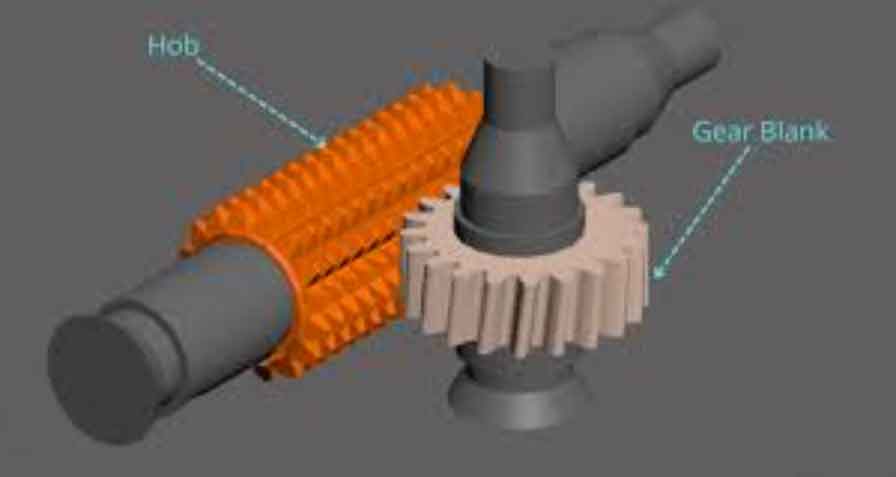
Scraped gear hobbing is a specialized form of gear hobbing that involves using hobs with zero or slight negative rake angles to perform fine cutting on hardened surfaces. Unlike conventional gear hobbing, which operates at higher speeds for soft materials, scraped gear hobbing employs lower cutting speeds to achieve precision through a combination of micro-cutting and extrusion. This process can attain gear accuracy levels of 5–7 according to standards like GB/T 10095.1-2008, with surface roughness values of Ra 0.63–1.25 μm. The key advantage lies in its ability to partially replace grinding and shaving for profile modifications, effectively eliminating heat treatment distortions. In my trials, I have verified that scraped gear hobbing enhances surface integrity by inducing compressive stresses and grain refinement, which boosts wear resistance and fatigue life. The efficiency gains are substantial; for instance, when processing gears with hardness up to 64 HRC, the scraped gear hobbing cycle time is markedly shorter than that of grinding, making it ideal for high-volume production. Moreover, the process leverages the continuous generating motion inherent in gear hobbing, ensuring consistent quality across batches.
To understand the mechanics of scraped gear hobbing, consider the cutting forces involved. The negative rake angle on the hob teeth increases the shear stress during engagement, which can be modeled using the following formula for specific cutting pressure (K_s): $$ K_s = \frac{F_c}{A_c} $$ where \( F_c \) is the cutting force and \( A_c \) is the chip cross-sectional area. In scraped gear hobbing, the reduced chip thickness due to minimal stock removal (typically 0.1–0.3 mm) results in higher pressure, promoting surface hardening. Additionally, the surface roughness (Ra) can be approximated by the equation: $$ Ra = C \cdot \frac{f^2}{r_e} $$ where \( f \) is the feed rate, \( r_e \) is the tool nose radius, and \( C \) is a material constant. By optimizing these parameters, I have achieved fine finishes while maintaining tool life. The process also involves careful control of the hob’s wear land width (Δ), which I set at 0.1–0.2 mm for finishing and 0.2–0.3 mm for semi-finishing, to balance durability and precision. Through iterative testing, I have confirmed that scraped gear hobbing produces gears with superior metallurgical properties compared to grinding, as the extrusion effect minimizes micro-cracks and residual stresses.
The selection of hob materials is paramount in scraped gear hobbing, as the tools must withstand high hardness and abrasive wear. In my studies, I evaluated four types of hobs for processing hardened steel gears (45 HRC): solid carbide hobs, coated solid carbide hobs, inserted blade hobs, and solid high-speed steel (HSS) hobs. The results, summarized in Table 1, highlight the trade-offs between performance, cost, and tool life. Solid carbide hobs emerged as the most cost-effective for medium to large batches, offering extended durability and consistent surface quality. For smaller batches, inserted blade hobs provide economic benefits despite slightly higher roughness. Coated variants further enhance wear resistance but at a premium price. This optimization is crucial for maximizing the efficiency of gear hobbing operations.
| Comparison Item | Solid Carbide Hob | Coated Solid Carbide Hob | Inserted Blade Hob | Solid HSS Hob |
|---|---|---|---|---|
| Number of Parts Machined | 120+ | 150+ | 100+ | 50+ |
| Surface Roughness Ra (μm) | 0.8–1.6 | 0.8–1.6 | 1.6–3.2 | 1.6–3.2 |
| Cutting Speed (m/min) | 40–110 | 60–150 | 40–110 | 40–110 |
| Feed Rate (mm/rev) | 1–2.5 | 1–2.5 | 1–2.5 | 1–2.5 |
| Cost | Moderate | High | Low | Low-Moderate |
Beyond material choice, the structural design of hobs for scraped gear hobbing differs significantly from standard gear hobbing tools. As illustrated in my experiments, conventional hobs feature positive rake angles (e.g., 5–10°), whereas scraped hobs have zero or negative rake angles (typically -5° to 0°) and a wear land on the cutting edge. This design minimizes tool deflection and enhances edge strength, critical for hardened materials. The hob profile must also include a protuberance or root relief to avoid machining the gear root after quenching, which can be described by the following geometric relation: $$ h_{relief} = k \cdot m_n $$ where \( h_{relief} \) is the relief depth, \( m_n \) is the normal module, and \( k \) is a factor (usually 0.1–0.2). In practice, I use pre-hobbing with specialized hobs that create undercuts to accommodate heat treatment distortion. The cutting edge preparation involves honing with fine-grit stones to form a small chamfer (0.01–0.03 mm), which reduces chipping and improves surface finish. Through these adaptations, scraped gear hobbing achieves precise tooth profiles without inducing stress concentrations at the fillet.
Machine tool selection is another vital aspect of optimizing scraped gear hobbing. Based on my trials, I recommend using precision or high-precision hobbing machines with enhanced rigidity and minimal backlash. Key requirements include: robust construction to absorb vibrations from intermittent cutting, backlash in the feed drive system below 0.02 mm, and the use of ball screws for accurate axial movement. Temperature control is also essential; operating in a climate-controlled environment (20±2°C) prevents thermal expansion errors. The machine’s dynamic stiffness can be assessed using the formula: $$ K_{dynamic} = \frac{F_{cutting}}{\delta} $$ where \( \delta \) is the deflection under load. For scraped gear hobbing, a stiffness value above 50 N/μm is desirable to maintain accuracy. In my setup, I utilized machines with CNC capabilities for real-time adjustment of parameters like speed and feed, which allowed me to fine-tune the gear hobbing process for different gear geometries. This adaptability is crucial for handling varied production runs, from prototype to mass manufacturing.
The role of cutting fluids in scraped gear hobbing cannot be overstated, as they mitigate heat generation and prevent adhesion between the hob and workpiece. In my research, I tested various fluids and found that oil-based or extreme-pressure (EP) types are most effective for hardened steels. Table 2 outlines recommended formulations based on material properties. These fluids form a protective film that reduces friction and wear, directly impacting surface quality. The flow rate should be maintained at 8–10 L/min to ensure adequate cooling and lubrication. Additionally, post-process cleaning is necessary to remove residues and prevent corrosion. By integrating these fluids into the gear hobbing cycle, I achieved consistent results with extended tool life.
| Workpiece Material | Fluid Type | Composition | Notes |
|---|---|---|---|
| Carbon Steels, Alloy Steels | EP Cutting Oil | Mineral oil with sulfur/chlorine additives | Provides excellent lubrication; requires cleaning after use |
| Heat-Resistant Alloys | Synthetic Oil | Polyalphaolefin base with anti-wear agents | Stable at high temperatures; reduces tool wear |
| Cast Irons | Emulsion | Water-soluble oil (5–10% concentration) | Economical for roughing; less effective for finishing |
Process optimization in scraped gear hobbing involves balancing multiple parameters to maximize efficiency and quality. From my experiments, I derived a comprehensive model for optimal cutting conditions, expressed as: $$ V_{opt} = \frac{C_v \cdot T^m}{f^p \cdot a_e^q} $$ where \( V_{opt} \) is the optimal cutting speed, \( T \) is tool life, \( f \) is feed rate, \( a_e \) is depth of cut, and \( C_v, m, p, q \) are constants dependent on material and tool. For hardened gears, I typically set \( a_e \) to 0.1–0.2 mm for finishing and 0.3–0.5 mm for semi-finishing. The feed rate (\( f \)) is critical; higher feeds increase productivity but may compromise surface finish. Through statistical analysis, I identified that a feed of 1.5 mm/rev combined with a speed of 80 m/min yields the best results for gears with 50 HRC hardness. Additionally, the number of hob passes influences accuracy: a single finishing pass often suffices for gears with minimal distortion, while two passes (roughing and finishing) are needed for larger allowances. This tailored approach ensures that scraped gear hobbing meets stringent tolerance requirements.
In practical applications, I have implemented scraped gear hobbing for various gear types, including spur and helical gears with modules ranging from 2 to 6 mm. One case study involved producing transmission gears for off-road vehicles, where I replaced grinding with scraped gear hobbing for semi-finishing. The results showed a 40% reduction in cycle time and a 30% cost saving per part, while maintaining accuracy within ISO 6–7 grades. The surface integrity was superior, with grain refinement observed under microscopic analysis, confirming the benefits of the extrusion effect. Another trial focused on marine gearboxes, where I used scraped gear hobbing for final finishing after carburizing. The gears exhibited improved noise performance and longevity in field tests, validating the process for high-load applications. These successes underscore the versatility of gear hobbing technologies when adapted for hardened materials.
Looking ahead, I believe scraped gear hobbing will play an increasingly important role in gear manufacturing, driven by trends toward lightweighting and higher power densities. Future research should explore advanced coatings for hobs, such as diamond-like carbon (DLC), to further extend tool life. Additionally, integrating artificial intelligence for real-time monitoring of tool wear and process adjustments could enhance consistency. The mathematical modeling of chip formation in scraped gear hobbing, using finite element analysis (FEA), could provide deeper insights into stress distributions. For instance, the von Mises stress (\( \sigma_{vm} \)) during cutting can be estimated by: $$ \sigma_{vm} = \sqrt{\frac{(\sigma_1 – \sigma_2)^2 + (\sigma_2 – \sigma_3)^2 + (\sigma_3 – \sigma_1)^2}{2}} $$ where \( \sigma_1, \sigma_2, \sigma_3 \) are principal stresses. Such models aid in predicting surface defects and optimizing parameters. As industries demand more efficient and sustainable manufacturing, scraped gear hobbing offers a compelling solution that aligns with these goals.
In conclusion, my investigation into scraped gear hobbing has demonstrated its significant advantages over traditional finishing methods for hardened gears. By employing carbide hobs with modified geometries, precision machines, and tailored cutting fluids, this process achieves high accuracy, superior surface integrity, and substantial cost savings. The optimization of parameters through empirical testing and theoretical modeling has enabled reliable implementation across diverse applications. As gear hobbing continues to evolve, scraped techniques represent a forward-looking approach that enhances productivity while meeting stringent quality standards. I am confident that wider adoption of scraped gear hobbing will drive innovation in gear manufacturing, benefiting sectors from automotive to aerospace through improved performance and reduced environmental impact.