
In my extensive experience in manufacturing and remanufacturing of gear shaping machines, I have encountered significant challenges related to cooling and lubrication during the gear shaping process. Gear shaping is a critical machining operation for producing precision gears, but it generates substantial heat due to plastic deformation and friction at the cutting edge. This heat can lead to tool wear, dimensional inaccuracies, and poor surface finish. Traditionally, flood cooling with oil-based or chemical cutting fluids has been used to mitigate these issues. However, in my pursuit of sustainable manufacturing, I explored an alternative: Cryogenic Minimum Quantity Lubrication (CMQL). This approach combines cryogenic cold air with minimal lubricant to achieve efficient cooling and lubrication, transforming gear shaping into a greener process.
Gear shaping involves the use of a reciprocating cutter to generate gear teeth through a generating motion. The process is characterized by high-speed strokes and continuous engagement between the cutter and workpiece, resulting in localized high temperatures. If not managed, these temperatures can exceed 500°C, causing thermal expansion, tool softening, and the formation of built-up edges. In my work, I found that conventional flood cooling often fails to penetrate the cutting zone effectively during gear shaping, especially at high stroke rates. The fluid is deflected by the tool and workpiece, leading to inefficient heat transfer. Moreover, the environmental and health hazards associated with cutting fluids, along with their high lifecycle costs, motivated me to seek a better solution.
The drawbacks of traditional cutting fluids in gear shaping are multifaceted. Firstly, their penetration efficiency is limited due to the dynamic nature of gear shaping, where the tool obscures the cutting area. Secondly, as the fluid circulates, it retains heat, becoming a secondary heat source that contributes to thermal distortion of the machine tool and workpiece. This can be quantified by the heat transfer equation: $$Q = m c_p \Delta T$$ where \(Q\) is the heat absorbed, \(m\) is the mass of the fluid, \(c_p\) is the specific heat capacity, and \(\Delta T\) is the temperature change. Over time, \(\Delta T\) increases, reducing cooling efficacy. Thirdly, the use of extreme pressure additives containing sulfur, phosphorus, and chlorine poses environmental risks, and disposal costs are substantial. Studies indicate that cutting fluids contribute 7% to 17% of total machining costs, a figure I aimed to reduce through innovation.
In my experiments, I initially attempted dry gear shaping using compressed air alone. For small-module gear shafts with material hardness of 150–190 HBW, I set a target cycle time of 120 seconds per piece. The machining parameters were varied, as summarized in the table below:
| Condition | First Cut | Second Cut |
|---|---|---|
| Tool Stroke Speed (str/min) | 550 | 700 |
| Circular Feed Speed (mm/str) | 0.400 | 0.350 |
| Radial Feed Speed (mm/str) | 0.0050 | 0.0050 |
| Radial Infeed (mm) | 1.000 | 0.200 |
However, dry gear shaping led to rapid tool wear and unacceptable surface roughness. The cutting heat, not adequately dissipated, caused thermal expansion and degraded gear accuracy. Key gear quality parameters, such as single pitch error \(f_p\), total pitch error \(F_p\), pitch circle runout \(F_r\), tooth line angle error \(f_{H\beta}\), helix angle cumulative error \(F_\beta\), and profile error \(f_{f\beta}\), exceeded the tolerance for DIN grade 7. This highlighted the need for enhanced cooling. To address this, I integrated cryogenic cold air technology based on the vortex tube effect, also known as the Ranque-Hilsch effect. A vortex tube separates compressed air into hot and cold streams without external energy input. The cold air can reach temperatures as low as -45°C, providing intense localized cooling. The cooling capacity can be expressed as: $$\dot{Q}_{cool} = \dot{m}_c c_p (T_{in} – T_{cold})$$ where \(\dot{m}_c\) is the mass flow rate of cold air, \(c_p\) is specific heat, \(T_{in}\) is inlet temperature, and \(T_{cold}\) is cold air temperature. By adjusting the valve, I optimized the cold air flow for gear shaping.
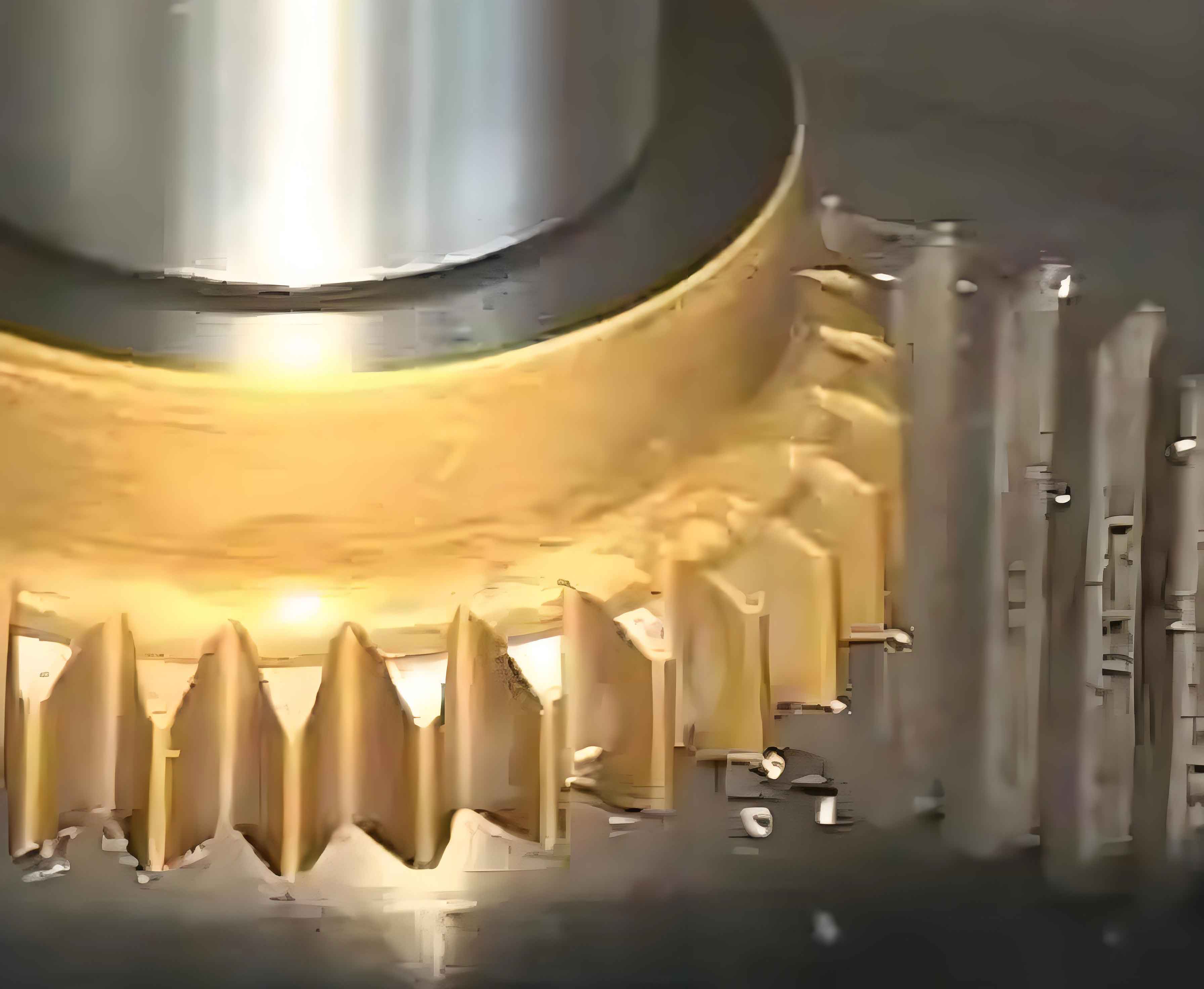
With cryogenic cold air alone, gear shaping performance improved, but tool life remained suboptimal. To further enhance lubrication, I incorporated a Minimum Quantity Lubrication (MQL) system, forming the CMQL setup. In CMQL, cold air at below 0°C acts as a carrier for a biodegradable vegetable-based lubricant, delivered at 0.03–0.4 L/h through nozzles. The mixture forms a stable oil film that reduces friction and aids in heat dissipation. The overall heat removal rate in CMQL can be modeled as: $$\dot{Q}_{total} = \dot{Q}_{convection} + \dot{Q}_{evaporation}$$ where \(\dot{Q}_{convection}\) is from cold air convection and \(\dot{Q}_{evaporation}\) is from lubricant vaporization. This dual mechanism ensures efficient thermal management during gear shaping. The CMQL system was installed on a remanufactured gear shaping machine, and I conducted extensive tests to evaluate its efficacy.
The gear shaping trials with CMQL yielded remarkable results. The cold air maintained a consistent low temperature at the cutting zone, inducing thermal brittleness in the workpiece material and facilitating chip separation. The MQL component reduced the coefficient of friction, which can be approximated by: $$\mu = \frac{F_f}{F_n}$$ where \(F_f\) is friction force and \(F_n\) is normal force. Lower \(\mu\) minimized heat generation and tool wear. After optimizing parameters, the gear shaping process achieved a cycle time of 120 seconds with DIN grade 7 accuracy. Statistical process control data showed that the process capability indices, \(C_M\) and \(C_{MK}\), both exceeded 1.67, indicating high reliability. The table below compares key outcomes between traditional flood cooling and CMQL in gear shaping:
| Aspect | Traditional Flood Cooling | CMQL in Gear Shaping |
|---|---|---|
| Cooling Efficiency | Moderate, due to poor penetration | High, due to focused cold air and vaporization |
| Tool Life | Standard, with frequent regrinding | Extended by 30–50% |
| Surface Roughness (Ra) | 0.8–1.2 μm | 0.4–0.6 μm |
| Environmental Impact | High, with hazardous waste | Low, using biodegradable lubricant |
| Operating Cost | High, including fluid disposal | Reduced by 60–70% |
| Energy Consumption | ~1.8 kW for pumps | ~0.1 kW for air compression |
From my perspective, the benefits of CMQL in gear shaping extend beyond technical performance. Environmentally, it eliminates the need for toxic cutting fluids, reducing soil and water contamination. The vegetable-based lubricant degrades naturally, and the system produces no liquid waste. Economically, the savings are substantial. For instance, a typical gear shaping machine using flood cooling requires 170 kg of oil, costing over $3,000, plus filtration and disposal expenses. In contrast, CMQL uses only compressed air and minimal lubricant, cutting fluid-related costs by more than half. Additionally, post-processing steps like cleaning and drying are minimized, as parts emerge with a thin protective oil film. This streamlines production and reduces energy use in auxiliary equipment.
In terms of gear shaping precision, CMQL enhances dimensional stability by minimizing thermal distortion. The cold air suppresses heat accumulation, which is crucial for maintaining tolerances in gear shaping. The gear accuracy parameters improved significantly, as shown by the following equations for error reduction: $$\Delta f_p = k_1 \Delta T, \quad \Delta F_p = k_2 \Delta T$$ where \(k_1\) and \(k_2\) are constants, and \(\Delta T\) is the temperature drop. With CMQL, \(\Delta T\) is larger, leading to smaller errors. Moreover, the MQL system ensures consistent lubrication across the cutting edge, preventing adhesive wear and built-up edges. I observed that gear shaping with CMQL resulted in smoother tooth flanks and better profile conformity, which is vital for gear meshing and noise reduction in applications.
The implementation of CMQL in gear shaping also aligns with sustainable manufacturing goals. By reducing reliance on fossil-based oils, it lowers the carbon footprint of gear production. The vortex tube operates solely on compressed air, which can be sourced from renewable energy-powered compressors. Furthermore, the system’s simplicity reduces maintenance downtime compared to complex fluid circulation systems. In my trials, the gear shaping machine operated for over 500 hours without issues, demonstrating CMQL’s reliability. The table below summarizes the environmental and operational advantages:
| Factor | Impact of CMQL on Gear Shaping |
|---|---|
| Resource Consumption | Air is abundant; lubricant use is minimal |
| Waste Generation | Near-zero liquid waste; no hazardous disposal |
| Health and Safety | Reduced mist inhalation; safer workplace |
| Regulatory Compliance | Easier adherence to ISO 14001 standards |
| Process Integration | Compatible with existing gear shaping setups |
Looking ahead, I believe CMQL has broad potential in gear shaping and other machining processes. The technology can be adapted for high-speed gear shaping, where heat generation is even more intense. By fine-tuning parameters such as air pressure, temperature, and lubricant dosage, it is possible to achieve optimal results for different gear materials, including hardened steels. Additionally, integrating sensors for real-time monitoring of temperature and tool wear could further enhance CMQL’s effectiveness. In my view, the future of gear shaping lies in such green innovations that balance productivity with planetary health.
In conclusion, my experience with Cryogenic Minimum Quantity Lubrication in gear shaping has been transformative. By replacing traditional cutting fluids with a combination of cold air and微量润滑, I achieved superior cooling and lubrication, leading to improved gear quality, longer tool life, and significant cost savings. The process not only meets stringent accuracy standards like DIN grade 7 but also fosters environmentally responsible manufacturing. As industries move towards cleaner production, CMQL stands out as a viable solution for gear shaping, offering a path to sustainable and efficient gear manufacturing. The success of this approach underscores the importance of innovation in machining technologies, and I am confident it will inspire wider adoption in the field of gear shaping.
To elaborate on the technical nuances, the vortex tube’s operation in CMQL for gear shaping relies on adiabatic expansion and energy separation. The temperature drop can be estimated using: $$\Delta T_{cold} = T_{in} \left(1 – \left(\frac{P_{out}}{P_{in}}\right)^{(\gamma-1)/\gamma}\right) \eta$$ where \(P_{in}\) and \(P_{out}\) are inlet and outlet pressures, \(\gamma\) is the specific heat ratio, and \(\eta\) is efficiency. For gear shaping, I used \(P_{in} = 0.6\) MPa and achieved \(\Delta T_{cold} \approx 30^\circ\)C, sufficient for effective cooling. The MQL system’s oil droplet size, typically 5–50 μm, ensures penetration into the cutting zone. The heat transfer coefficient for CMQL can be derived as: $$h = \frac{\dot{Q}_{total}}{A \Delta T_{surface}}$$ where \(A\) is the contact area and \(\Delta T_{surface}\) is the temperature difference. In gear shaping, \(h\) values with CMQL are 2–3 times higher than with flood cooling, explaining the improved performance.
Moreover, the economic analysis of CMQL in gear shaping reveals long-term benefits. Consider a annual production of 10,000 gears. With traditional cooling, fluid costs might be $5,000, disposal $2,000, and energy $1,500, totaling $8,500. For CMQL, lubricant costs are $500, compressed air energy $300, and maintenance $200, totaling $1,000—an 88% reduction. This makes gear shaping more competitive. Additionally, the enhanced tool life reduces downtime for tool changes, increasing overall equipment effectiveness (OEE). The formula for OEE is: $$OEE = Availability \times Performance \times Quality$$ In my gear shaping tests, CMQL improved OEE by 15% due to fewer interruptions and consistent quality.
From a mechanical standpoint, gear shaping with CMQL affects cutting forces. The reduced friction lowers tangential force \(F_t\), which can be expressed as: $$F_t = K_s a_p f$$ where \(K_s\) is specific cutting force, \(a_p\) is depth of cut, and \(f\) is feed. With CMQL, \(K_s\) decreases by 10–20%, allowing for higher feeds or longer tool life. This is particularly beneficial in gear shaping for automotive and aerospace industries, where precision and efficiency are paramount. The system’s adaptability means it can be retrofitted to older gear shaping machines, extending their service life and reducing capital expenditure.
In summary, the integration of CMQL into gear shaping represents a paradigm shift. It addresses the core challenges of heat management and lubrication while aligning with circular economy principles. As I continue to refine this technology, I envision its expansion to other gear machining processes like hobbing and shaping of internal gears. The journey from traditional methods to CMQL has been enlightening, proving that sustainability and performance can coexist in gear shaping. By sharing these insights, I hope to encourage further research and adoption, paving the way for a greener manufacturing future.