
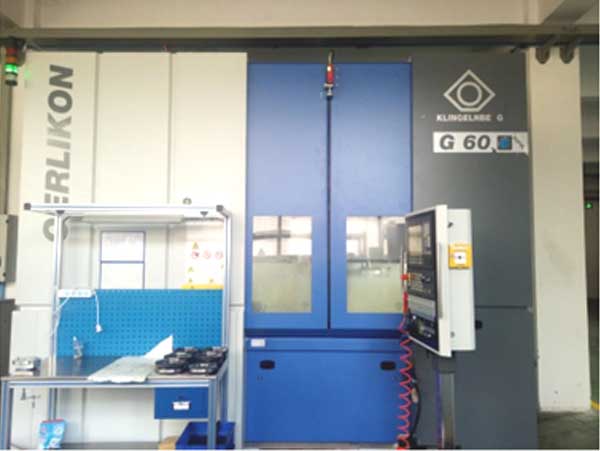
In the field of power transmission, the production of high-performance spiral bevel gears is a critical process. The method of gear milling employed by machines such as the Klingelnberg AMK852 represents a sophisticated synthesis of mechanical motion and cutting tool geometry. This analysis delves into the foundational principles of its operation, from parameter definition and kinematic generation to the practical aspects of tooling and the crucial final step of contact pattern correction. Through this exploration, the intricate dance of the cutter head, work piece, and generating mechanism that defines modern spiral bevel gear milling is revealed.
1. Defining Gear Parameters for the Milling Process
1.1 Fundamental Design Parameters
The gear milling process begins not at the machine, but at the design stage. The starting point is the set of application requirements: shaft angle, gear ratio, input speed, and transmitted torque. From these, the fundamental gear geometry is derived. Key design parameters include:
- Number of teeth (z)
- Pitch diameter at the gear outer end
- Pitch cone angle (δ)
- Spiral angle at the design reference point (β)
- Face width (b)
- Profile shift coefficient (x)
The design objective is to configure these parameters—within the limits of available cutter head radii and machine capacity—to achieve the necessary load-carrying capacity, service life, and safety factor. This initial design defines the theoretical target for the subsequent gear milling operations.
1.2 Theoretical Machining Parameters
The actual tooth form produced by gear milling is governed by the machine kinematics and tooling. Parameters such as the normal module at the reference point, large end, and small end, as well as the spiral angles at the extremities, are not directly set but are theoretical outcomes determined by the chosen cutter head radius and the machine’s generating motions. These define the tooth lengthwise curve, known as the extended epicycloid (or “Palloid” in Klingelnberg terminology).
Since these parameters are theoretical results of the process, verification is essential. The rolling test, conducted on a dedicated testing machine, is the primary method for inspecting the meshing quality of a gear pair. A satisfactory contact pattern signifies a合格 gear set. An unsatisfactory pattern necessitates corrective adjustments on the milling machine, which inherently alters these theoretical parameters. This feedback loop between design, gear milling, and testing is central to achieving a functional gear pair.
2. Analysis of the Machine’s Operating Principle
The core of spiral bevel gear milling on a machine like the AMK852 is the generation of the tooth geometry through the coordinated relative motion of three main components: the work piece (gear blank), the rotating cutter head, and the generating cradle (or “tilt”).
The tooth profile is a normal involute, generated by the simulated rolling engagement between the cutter blade profile and the gear tooth flank. This is achieved through a differential motion between the work piece and the cutter head.
The tooth lengthwise form is a long extended epicycloid. This curve is generated as the envelope of countless arcs traced by the cutter blades as they move relative to the gear blank through the coordinated motion of the cutter head and the generating cradle.
To understand this, consider the kinematics. Let $O_p$ be the center of the generating cradle with angular velocity $\omega_p$, and $O_c$ be the center of the cutter head with angular velocity $\omega_c$. $O_p$ is the instantaneous center of rotation for the cradle’s absolute motion. The relative motion between the cradle and the cutter head has its instantaneous center at $O_c$.
If the cradle and cutter head rotate in opposite directions, the absolute instantaneous center of the cutter head, $P’$, lies on the line connecting $O_p$ and $O_c$. The relationship is governed by the ratio of angular velocities and distances:
$$ \frac{\omega_c}{\omega_p} = \frac{\overline{O_p P’}}{\overline{O_c P’}} $$
This motion is equivalent to the cutter head rolling without slip on a fixed base circle. This rolling action of the cutter head (the generating circle) around an imaginary base circle attached to the cradle is what produces the extended epicycloidal path for each point on the cutter blade. The fundamental relationship can be expressed as:
$$ \rho = R_c \cdot \frac{\omega_p}{\omega_c} $$
where $\rho$ is the radius of the base circle and $R_c$ is the nominal cutter head radius. The trajectory of a cutter blade point relative to the work piece is therefore given by the parametric equations for an extended epicycloid:
$$ x = (\rho + R_c) \cos(\theta) – h \cos\left(\frac{\rho + R_c}{R_c} \theta\right) $$
$$ y = (\rho + R_c) \sin(\theta) – h \sin\left(\frac{\rho + R_c}{R_c} \theta\right) $$
where $\theta$ is the cradle rotation angle and $h$ is the distance of the blade point from the cutter head center.
In practical terms for gear milling: if the cradle were held stationary and only the cutter head and work piece rotated at a fixed ratio, it would result in continuous indexing and slot cutting. The required speed ratio would equal the ratio of the gear’s pitch cone distance to the cutter head’s rolling radius, or the ratio of the gear’s tooth number to the number of cutter blade groups. However, by superimposing the cradle rolling motion, the machine simultaneously generates the correct profile and lengthwise curvature in a single rolling cycle per tooth slot.
3. Tooling for Soft-Cutting and Hard-Finishing in Gear Milling
3.1 Soft-Cutting (Roughing and Semi-Finishing)
The soft-cutting process for gear milling utilizes a composite cutter head equipped with multiple groups of blades. A standard configuration for the AMK852 involves 20 blades arranged in 5 groups (i.e., number of cutter starts, $Z_0 = 5$). The blades within a group are arranged in a specific sequence which depends on the hand of spiral of the gear being cut. The standard sequence is: Inside Blade (for the concave flank), Inside Middle Blade, Outside Middle Blade, Outside Blade (for the convex flank).
The middle blades perform the primary slotting operation, while the side blades finish the tooth flanks. Key geometry differences include:
| Blade Type | Primary Function | Tool Point Height (Ha) Relation |
|---|---|---|
| Middle Blades | Roughing the tooth slot | $Ha \approx 1.3 \cdot M_0$ (M0 is the reference point module) |
| Side Blades | Finishing the tooth flanks | $Ha \approx 1.25 \cdot M_0$ |
The 0.05 $M_0$ difference in height creates the necessary clearance for the side blades to perform their finishing cut. The profile depth and form are controlled by the radial position of the blades on the cutter head. The angular indexing between inside and outside blades within a group is typically $240^\circ / Z_0$. The feed along the lengthwise epicycloid is governed by the programmed rotational speed of the generating cradle.
3.2 Hard-Finishing (Hard Gear Milling)
Hard gear milling is a finishing operation performed after the gear has been case-hardened. It uses cutter heads equipped with indexed, wear-resistant carbide insert blades. This process is characterized by:
- Tool Configuration: Typically 10 blades (5 inside, 5 outside) arranged in 5 groups ($Z_0 = 5$). Only side blades are used.
- Process: Pure generating cut on the hardened tooth flanks only. No slotting or depth cutting occurs.
- Setup: Blades must be precisely set using a dial indicator gauge to ensure all cutting edges lie on the same theoretical circle.
A critical feature for contact pattern control is the two-part design of both soft and hard cutter heads. The inside blade body cuts the convex flank of the mating gear, and the outside blade body cuts the concave flank. The outside body is mounted on an eccentric mechanism. By adjusting this eccentricity, the effective center of the outside blade circle is shifted, introducing a controlled “crowning” or lengthwise curvature modification to the tooth flank. This crowning is essential to localize the contact pattern under load and compensate for potential misalignment in the final assembly.
The integrated cycle of the AMK852 exemplifies modern gear milling efficiency. In soft-cutting, a single automated cycle performs rough slotting followed immediately by simultaneous finishing of both flanks via generating motions. Cutting parameters are adaptively controlled. The subsequent hard-finishing operation then precisely finishes the hardened flanks, all within the same machine platform.
4. Correction of the Gear Contact Pattern
The ultimate validation of a successful gear milling process is a correct and stable contact pattern under loaded conditions. Achieving this often requires corrective adjustments based on rolling test results. The following summarizes common contact pattern faults and their corresponding corrective adjustments on the gear milling machine.
4.1 Basic Lateral Displacement (Toe/Heel Contact)
Symptom: Contact is biased towards the toe (small end) or heel (large end) on one flank (typically the concave), while the opposite flank is correct.
Primary Correction: Adjust the Cutter Head Tilt Angle ($\Delta m$) for the pinion or gear. Increasing $\Delta m$ generally moves the contact on a concave flank towards the heel; decreasing it moves contact towards the toe. Typical adjustment range is $\pm 1^\circ$ to $4^\circ$.
4.2 Diagonal Contact
Symptom: Contact runs diagonally across the tooth face from toe to heel or vice versa.
Correction Methods: Two primary parameters can be adjusted, often with predictable directional effects based on hand of spiral.
| Hand of Spiral | Desired Change | Method 1: Change Pinion Machine Root Angle ($\tau$) | Method 2: Change Mating Gear’s Cutter Head Tilt ($\Delta m$) |
|---|---|---|---|
| Right-Hand | Reduce Diagonal | Decrease $\tau$ by several minutes of arc | Decrease $\Delta m$ by $1^\circ$-$4^\circ$ |
| Right-Hand | Increase Diagonal | Increase $\tau$ by several minutes of arc | Increase $\Delta m$ by $1^\circ$-$4^\circ$ |
| Left-Hand | Reduce Diagonal | Decrease $\tau$ by several minutes of arc | Increase $\Delta m$ by $1^\circ$-$4^\circ$ |
| Left-Hand | Increase Diagonal | Increase $\tau$ by several minutes of arc | Decrease $\Delta m$ by $1^\circ$-$4^\circ$ |
4.3 Symmetrical Lateral Displacement (Contact at Both Toes or Both Heels)
Symptom: Contact is simultaneously near the toe or heel on both convex and concave flanks in a symmetrical manner.
Correction Methods: This typically requires combined adjustments.
Option A (Adjust Pinion): Simultaneously change both the Machine Root Angle ($\tau$) and the Cutter Head Tilt ($\Delta m$).
Option B (Adjust Both Gears): Apply opposite changes to the Cutter Head Tilt ($\Delta m$) on the pinion and gear. The specific combination (increase/decrease) depends on the hand of spiral and the direction of correction needed.
4.4 Interference at Tooth Top or Root (Noise)
Symptom: Contact pattern position may be acceptable, but gear noise is high due to interference at the tip or root of the teeth.
Correction Methods: Several approaches can relieve this interference:
- Increase the Gear Blank Mounting Angle ($\delta_E$) by $0.15^\circ$ to $0.2^\circ$ beyond the calculated cutting value.
- Modify the Generating Depth ($T_w$) value (increase or decrease).
- Alter the pinion’s axial mounting distance in the final assembly.
- Use wedge-shaped shims behind the cutter blades to effectively change the tool pressure angle by approximately $\pm0.15^\circ$ to $\pm0.2^\circ$. This intentionally removes material from the tip or root region, shifting the contact and eliminating interference.
Mastering contact pattern correction in spiral bevel gear milling is an empirical skill built upon understanding the directional influence of key machine settings. Parameters like the Machine Root Angle ($\tau$), Cutter Head Tilt ($\Delta m$), and axial mounting distance are often the most direct and effective levers for adjustment. The optimal correction strategy must always consider the specific gear geometry—module, face width, spiral angle, and diameter—to predictably and efficiently achieve a robust and quiet-running gear pair.