
In the field of gear milling, especially when dealing with large-scale gear milling machines, a common and persistent issue arises in the form of pitch deviation errors during the machining process. One of the most frequent problems encountered in actual gear milling operations is the excessive pitch deviation between the first and last teeth of a gear being processed. This deviation often exceeds tolerance limits, becoming a recurring challenge that requires frequent troubleshooting on the shop floor. Through data analysis from pitch deviation measurements, it has been observed that the radial cutting depth of the tooth slots systematically increases from the first tooth to the last tooth during the gear milling process. This indicates a variation in the feed rate, which consequently leads to pitch deviation errors. I hypothesize that this phenomenon is likely caused by thermal deformation of the milling cutter head due to temperature changes during prolonged gear milling operations.
The fundamental working principle of a gear milling machine involves form milling using a single indexing method. After completing the milling of one tooth, the cutter returns to its initial position, the worktable rotates by an angle of $360°/Z$ (where $Z$ is the number of teeth on the workpiece), and then the next tooth is milled. This cycle repeats until all teeth are processed. From this principle, it is evident that the milling cutter head operates continuously throughout the gear milling process. The prolonged, uninterrupted operation can lead to a rise in the temperature of the milling cutter head assembly. Over time, as different teeth of the same workpiece are machined, the temperature variation in the cutter head induces thermal deformation. This deformation causes the tool to gradually deviate from its intended position relative to the workpiece. Meanwhile, if the feed rate remains constant, the actual radial depth of cut relative to the workpiece will vary between different teeth. This variation affects the depth of the tooth slots, resulting in excessive pitch deviation and commonly manifesting as a noticeable error between the first and last teeth, often referred to as “run-out” or “pitch accumulation error” in gear milling terminology.
To verify the hypothesis that temperature-induced deformation of the cutter head during gear milling causes changes in tooth slot depth and consequently pitch deviation, a simple dial indicator test was conducted on a YK83500/4 model gear milling machine. The test utilized a temperature gun and two dial indicators (percent gauges). Dial indicator one was mounted on the workpiece or fixture, with its stylus positioned against the milling cutter head assembly and zeroed. Dial indicator two was mounted on the column guide rail, with its stylus against the machine column and zeroed. The temperature gun was calibrated for accuracy. Before starting the test, the initial temperature of the milling cutter head was measured. Then, the cutter head was started. During the operation of the gear milling machine, the temperature of the cutter head was measured at regular intervals using the temperature gun, and the corresponding readings from both dial indicators were recorded. The spindle speed was set to 120 rpm, and the ambient room temperature was 14°C. The data collected is summarized in Table 1.
| Time (min) | Temperature (°C) | Dial Indicator 1 Reading (mm) | Dial Indicator 2 Reading (mm) |
|---|---|---|---|
| 0 | 18.5 | 0 | 0 |
| 20 | 21.0 | 0.02 | 0 |
| 40 | 23.3 | 0.05 | 0 |
| 60 | 25.1 | 0.08 | 0 |
| 90 | 27.7 | 0.11 | 0 |
| 120 | 29.4 | 0.135 | 0 |
| 180 | 31.8 | 0.163 | 0 |
| … | … | … | … |
| 300 | 37.8 | 0.22 | 0 |
| 360 | 37.8 | 0.22 | 0 |
After 360 minutes, the gear milling machine was stopped. Readings from the temperature gun and dial indicators were continued as the machine cooled down, with the data accumulated as shown in Table 2. During this recording period, the spindle speed was 0 rpm, and the room temperature remained at 14°C.
| Time (min) | Temperature (°C) | Dial Indicator 1 Reading (mm) | Dial Indicator 2 Reading (mm) |
|---|---|---|---|
| 360 | 37.8 | 0.22 | 0 |
| 380 | 35.0 | 0.20 | 0 |
| 400 | 33.4 | 0.185 | 0 |
| 420 | 30.9 | 0.154 | 0 |
| 450 | 28.0 | 0.12 | 0 |
| 480 | 28.0 | 0.12 | 0 |
| 540 | 28.0 | 0.12 | 0 |
| … | … | … | … |
| 1200 | 19.0 | 0 | 0 |
Analyzing the data from Tables 1 and 2 reveals that after the gear milling machine starts, the temperature of the milling head, as measured by the temperature gun, continuously rises. The temperature difference increases from 18.5°C to a maximum of 37.8°C, resulting in a temperature rise of approximately 20°C. Concurrently, over time, as the temperature increases, the cutter head deforms in the radial direction, exhibiting an expansion. The expansion increases from 0 mm to a maximum of 0.22 mm. When the temperature reaches its peak, the expansion also reaches its maximum. Subsequently, after the spindle stops, the temperature of the milling cutter head decreases at a steady rate, and the radial deformation also gradually recovers from 0.22 mm back to 0 mm. Based on this data, the relationship between temperature and the deformation of the milling cutter head can be plotted, showing a clear correlation.
The data and the derived relationship graph confirm that during the gear milling operation, thermal deformation indeed occurs due to the temperature rise of the milling cutter head. This deformation results in a specific amount of radial expansion. It is precisely this radial expansion that ultimately causes the deepening of the tooth slots, subsequently leading to pitch deviation errors. This validates the initial hypothesis that temperature changes in the cutter head during gear milling cause variations in tooth slot depth. Through this experiment, temperature variation has been identified as the root cause of the pitch deviation issue in gear milling.
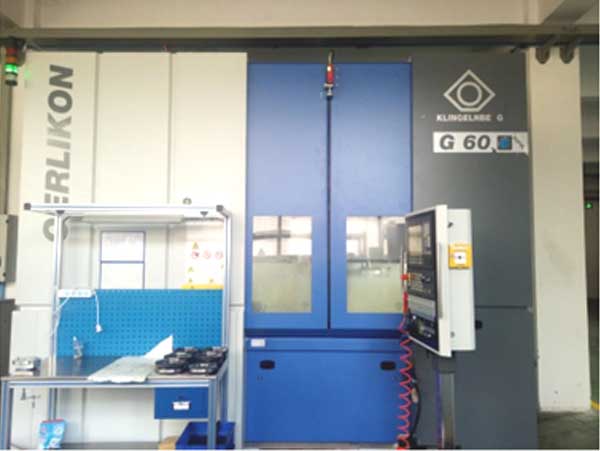
To mitigate the impact of temperature variations and ensure machining accuracy in gear milling, two potential solutions were considered. The first involves idling the machine to allow the internal components of the milling cutter head to reach thermal equilibrium before commencing actual gear milling. The second method involves manually calculating the offset caused by thermal expansion and compensating for it by adjusting the feed rate during the gear milling process, thereby offsetting the error induced by temperature changes. While the first method seems plausible, it is highly impractical in a production workshop for gear milling operations. Achieving thermal equilibrium requires a significant amount of idle run time, which drastically reduces production efficiency. Therefore, the second method, known as temperature compensation, was adopted. This method involves real-time monitoring of the milling cutter head’s temperature, estimating the tool offset based on the temperature change, and compensating for this offset in the radial cutting depth. This ensures a consistent actual cutting depth, reducing the influence of thermal deformation caused by heat generated from the main drive system on the final dimensions in gear milling.
The specific temperature compensation scheme for gear milling is detailed in Table 3.
| Device Model | Required Equipment | Quantity |
|---|---|---|
| 6FC5311-0AA00-1AA0 | Siemens PP72/48D 2/2A PN I/O board (with two channels of analog signal input/output) | 1 |
| KYW-T1 | Beijing Kunlun Yuanyang Instrument patch-type temperature sensor (PT100 thermal resistor, range: -50 to 100°C) | 2 |
| KYW-DP3V | Beijing Kunlun Yuanyang Instrument temperature transmitter, output signal: 0-10V voltage signal | 2 |
For temperature acquisition, two patch-type temperature sensors (KYW-T1) are used. One sensor monitors the temperature of the machine bed (serving as the reference or ambient temperature), and the other monitors the temperature of the milling head. The signals from these sensors are fed into KYW-DP3V temperature transmitters, which convert the temperature values into voltage signals (0-10V). These voltage signals are then sent to the CNC system for processing. Using the temperature difference between the two points as the compensation data helps avoid inaccuracies caused by ambient temperature fluctuations, ensuring precise compensation during gear milling. The temperature transmitter and sensor wiring is configured accordingly, with the V0 terminal connected to the analog input port of the system’s I/O board.
After conversion by the temperature transmitter, the CNC system (in this case, a Siemens 828D system) displays the values in its analog input voltage measurement mode. The relationship between the system’s read value and the actual temperature is crucial for gear milling compensation. The system reads a numerical range from 0 to 6581 for the analog input corresponding to the sensor’s full range of -50 to 100°C, which is a 150°C span. From this, the temperature scaling coefficient M can be calculated:
$$ M = \frac{6581}{150} \approx 43.87 $$
This coefficient indicates that for every 1°C increase in temperature, the numerical value read by the system increases by approximately 43.87. The relationship between thermal expansion and temperature can be derived from the experimental data in Tables 1 and 2.
Based on Tables 1 and 2, the temperature rise during spindle operation in this gear milling test is approximately 20°C, and the maximum radial expansion is about 0.22 mm. This experimental result aligns with the theoretical thermal expansion coefficient calculated by material research laboratories, which is around 0.01 mm/°C for the relevant materials. Using this data, the expansion coefficient K for the milling cutter head material can be calculated. The formula for thermal expansion is:
$$ \Delta L = \alpha \cdot L_0 \cdot \Delta T $$
Where $\Delta L$ is the change in length (expansion in mm), $\alpha$ is the coefficient of linear thermal expansion (1/°C), $L_0$ is the original length (mm), and $\Delta T$ is the change in temperature (°C). From the experimental data, we can derive an effective expansion coefficient $K$ relating the system’s temperature reading deviation to the radial expansion specifically for the gear milling cutter head assembly. For compensation purposes, we define the expansion amount $\Delta L$ per tooth in gear milling as:
$$ \Delta L_n = K \cdot \frac{\Delta P_n}{M} $$
Where:
$K$ is the derived expansion coefficient (mm per unit of system reading change), specific to the gear milling machine structure.
$M$ is the temperature scaling coefficient (43.87 as calculated).
$\Delta P_n$ is the increment in the reading difference between the two sensors for tooth $n$.
$\Delta P_n = (P_n – P’_n) – (P_{n-1} – P’_{n-1})$, where $P_n$ is the system reading from the milling head sensor and $P’_n$ is the system reading from the bed sensor at the time tooth $n$ is finished.
$n$ is the current tooth number being processed in the gear milling sequence.
Therefore, the compensation value $C_n$ for the radial depth of cut for tooth $n+1$ in gear milling is:
$$ C_n = -\Delta L_n = -K \cdot \frac{ (P_n – P’_n) – (P_{n-1} – P’_{n-1}) }{M} $$
This compensation is applied iteratively. After milling each tooth in the gear milling process, the temperature sensor data is read, the temperature difference is calculated, and based on the CNC system’s readings, the expansion compensation amount is computed and applied to the next tooth’s cutting parameters. This cycle continues until the last tooth is milled. This constitutes the complete principle of the temperature compensation scheme for gear milling.
After confirming this scheme, programming work was implemented on the YK83500/4 gear milling machine. The gear milling program was modified to incorporate compensation for the milling cutter head’s thermal expansion. Test cuts were performed under this new compensated gear milling regime. The results demonstrated that the scheme successfully achieved the expected outcome: it reduced the progressive variation in tooth slot cutting depth. The cutting depth remained consistent across all teeth, thereby correcting the pitch deviation that typically manifested in later stages of gear milling. This outcome proves that the temperature compensation method is an effective solution for correcting pitch deviation errors in gear milling operations. Subsequently, this scheme is intended for widespread application in actual gear milling production environments.
The implementation of temperature compensation in gear milling involves several detailed steps. First, the physical installation of sensors is critical. The patch-type PT100 sensors must be securely attached to clean, flat surfaces on both the milling head and the machine bed to ensure accurate temperature measurement. Thermal paste might be used to improve thermal contact. The sensors are connected to the temperature transmitters via shielded cables to minimize electrical noise, which is crucial in the industrial environment of a gear milling workshop. The transmitters are configured to output a 0-10V signal corresponding to the -50 to 100°C range. These output wires are then connected to the analog input channels of the Siemens PP72/48D I/O board. This board is integrated into the Siemens 828D CNC system, which controls the gear milling machine.
Within the CNC system software for gear milling, a dedicated subroutine or a custom cycle must be programmed. This routine handles the data acquisition and compensation calculation. After the milling of each tooth is completed, the routine reads the current analog input values from the two channels (representing head temperature and bed temperature). It converts these raw values (0-6581) back to temperature differences using the scaling factor M. The core of the compensation logic in gear milling is the calculation of the incremental temperature difference since the last tooth. The following pseudocode illustrates the process within the gear milling CNC program:
Gear Milling Cycle with Temperature Compensation:
1. Initialize variables: $PrevDiff = 0$, $Compensation = 0$.
2. For tooth index $n = 1$ to $Z$ (total number of teeth):
a. Execute standard gear milling cycle for tooth $n$ with radial depth adjusted by current $Compensation$ value.
b. After milling, read analog inputs: $HeadRaw_n$, $BedRaw_n$.
c. Calculate current temperature difference in system units: $Diff_n = HeadRaw_n – BedRaw_n$.
d. Calculate incremental difference: $\Delta Diff_n = Diff_n – PrevDiff$.
e. Calculate expansion offset for next tooth: $\Delta L_n = K \cdot (\Delta Diff_n / M)$. (Where K is a machine-specific constant determined empirically, e.g., 0.22mm / (final Diff in units) from the test).
f. Update compensation for next tooth: $Compensation = Compensation – \Delta L_n$. (Negative sign because if head expands outward, we need to reduce radial infeed).
g. Update previous difference: $PrevDiff = Diff_n$.
h. Index worktable for next tooth: Rotate by $360°/Z$.
3. End cycle.
The constant $K$ in the gear milling compensation formula needs to be calibrated for each specific machine or machine type. It can be derived from a thermal test similar to the one described earlier. By running the machine until thermal equilibrium is approached and recording the final system difference value ($Diff_{final}$) and the corresponding total measured expansion ($\Delta L_{total}$), $K$ can be calculated as:
$$ K = \frac{\Delta L_{total} \cdot M}{Diff_{final} – Diff_{initial}} $$
For the test data, assuming initial difference $Diff_{initial}$ corresponding to 18.5°C head temp and 14°C bed temp (4.5°C diff), and final $Diff_{final}$ corresponding to 37.8°C head temp and 14°C bed temp (23.8°C diff), the temperature difference change is 19.3°C. In system units, this is $19.3 \times M \approx 19.3 \times 43.87 \approx 846$ units. The total expansion $\Delta L_{total}$ is 0.22 mm. Therefore,
$$ K \approx \frac{0.22 \times 43.87}{846} \approx \frac{9.6514}{846} \approx 0.0114 \text{ mm per unit of system difference change} $$
This $K$ value is then used in the real-time gear milling compensation formula. It encapsulates the combined effect of the material’s thermal expansion coefficient and the specific mechanical structure of the gear milling machine’s cutter head assembly.
The advantages of this temperature compensation method in gear milling are multifold. Primarily, it significantly improves the pitch accuracy of gears without requiring long idle pre-heating times, thus enhancing productivity. It is a proactive correction method that adapts to the machine’s thermal state during the gear milling job. Furthermore, it is a software-based solution, requiring relatively low hardware investment (sensors, transmitters, I/O board) compared to the cost of the gear milling machine itself or the scrap parts due to errors. The system can also log temperature and compensation data, providing valuable insights for process monitoring and predictive maintenance in gear milling operations.
Potential challenges and considerations in implementing temperature compensation for gear milling include sensor reliability, the need for periodic calibration of the temperature measurement chain, and ensuring that the compensation model adequately captures the complex thermal behavior of the machine. The thermal deformation might not be purely linear or one-dimensional; however, for the radial depth of cut in gear milling, the dominant effect is often the axial expansion of the spindle/cutter head assembly along the radial infeed direction. The compensation model assumes this primary effect. For extremely high-precision gear milling, more sophisticated models incorporating multiple temperature points or finite element analysis predictions could be explored, but the described two-sensor differential method provides a robust and practical solution for most industrial gear milling applications.
In conclusion, the issue of pitch deviation in large gear milling machines, particularly the cumulative error between the first and last teeth, is fundamentally linked to thermal deformation of the milling cutter head. Through experimental verification, a direct correlation between temperature rise and radial expansion was established. The temperature compensation method, utilizing real-time temperature monitoring and algorithmic feed adjustment, effectively mitigates this error source. By calculating the thermal expansion offset based on sensor data and applying it as a corrective compensation to the radial depth of cut during the gear milling cycle, consistent machining accuracy is achieved. This method represents a practical and efficient solution to a longstanding problem in gear milling, promising improved product quality and reduced waste in gear manufacturing processes. Future developments may integrate this compensation seamlessly into CNC systems as a standard feature for gear milling machines, further automating precision control.