
In the realm of precision manufacturing, the reliability of CNC spiral bevel gear milling machines is paramount for ensuring high-quality gear production. As an engineer deeply involved in the design and maintenance of these machines, I have undertaken a comprehensive study to analyze failure patterns and enhance reliability. This article presents a detailed statistical analysis of failures encountered in gear milling operations, based on field data from multiple machines. The goal is to identify critical failure modes and causes, and propose effective improvement measures to boost the overall reliability of gear milling equipment.
The gear milling process is integral to producing spiral bevel gears used in various industrial applications, such as automotive and aerospace. However, frequent failures in CNC gear milling machines can lead to significant downtime and reduced productivity. To address this, I collected failure data from 20 CNC spiral bevel gear milling machines of a specific model manufactured in 2009. Over their operational lifespan, these machines reported 198 failure incidents. After rigorous screening, 75 related failures were identified for analysis. This data forms the basis for a thorough investigation into failure locations, modes, and causes, utilizing quality management methodologies. The analysis aims to pinpoint the root causes affecting reliability and suggest actionable solutions.
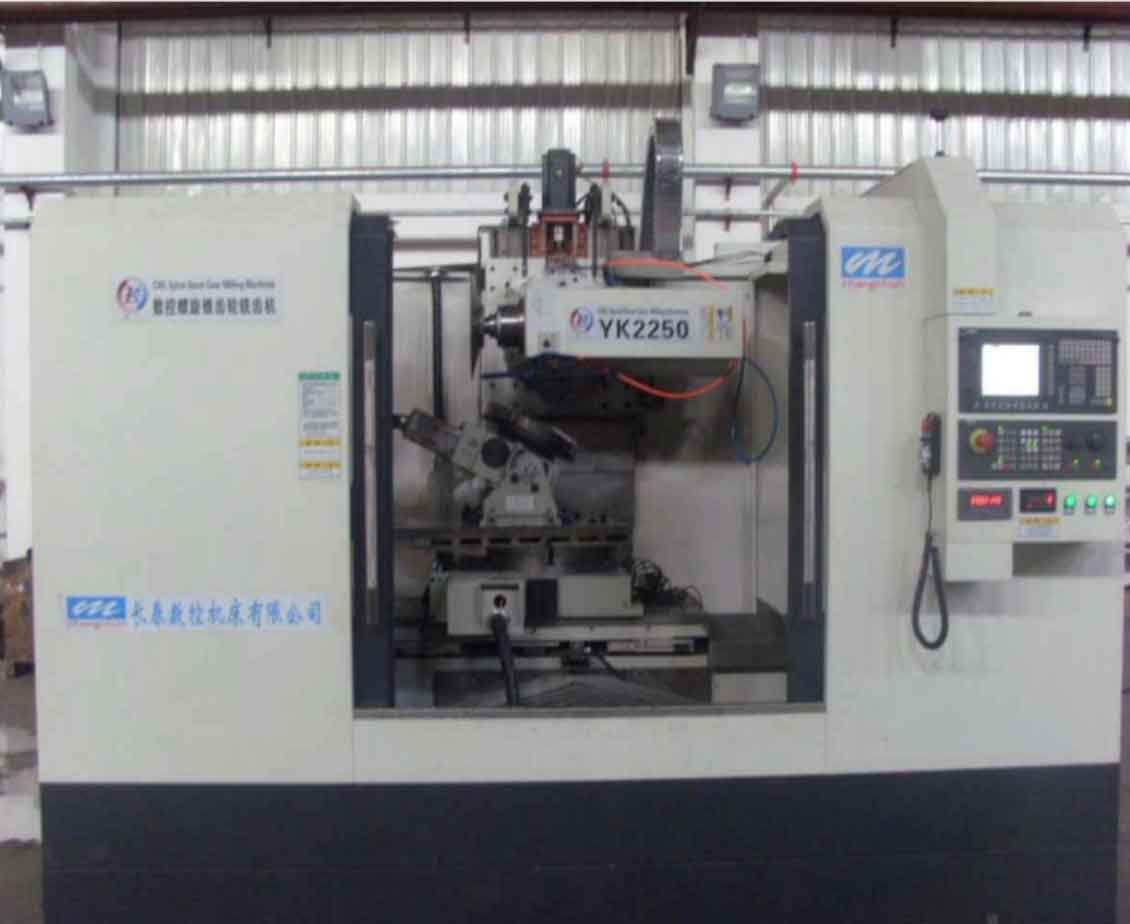
To begin, I categorized the failures based on their locations within the gear milling machine. The machine consists of several subsystems, including the bed, workpiece box, cradle, cutter box, drive box, electrical system, and auxiliary systems (e.g., hydraulic and cooling systems). Table 1 summarizes the failure frequency and percentage for each subsystem. The data reveals that the electrical system, workpiece box, cutter box, and auxiliary systems account for the majority of failures, totaling 84.03% of all incidents. This indicates that these areas require focused attention to improve the reliability of gear milling operations.
| Failure Location | Count | Percentage (%) |
|---|---|---|
| Electrical System | 62 | 28.31 |
| Workpiece Box | 48 | 21.92 |
| Cutter Box | 42 | 19.18 |
| Auxiliary Systems | 32 | 14.61 |
| Cradle | 20 | 9.13 |
| Drive Box | 10 | 4.56 |
| Bed | 5 | 2.28 |
| Total | 219 | 100 |
Next, I analyzed the failure modes, which refer to the manner in which a failure occurs. In gear milling machines, common failure modes include loss of component function, failure to execute program commands, fluid leaks, and excessive clearance in moving parts. Table 2 provides a breakdown of failure modes across different subsystems. The top 10 failure modes constitute 74.88% of all incidents, with “loss of component function” being the most prevalent at 21.00%. This highlights the need for robust component selection and maintenance in gear milling processes.
| Failure Mode | Count | Percentage (%) |
|---|---|---|
| Loss of Component Function | 46 | 21.00 |
| Failure to Execute Program Commands | 27 | 12.33 |
| Fluid Leaks (Oil, Air, Coolant) | 14 | 6.39 |
| Excessive Clearance in Moving Parts | 14 | 6.39 |
| Loosening of Locking Components | 13 | 5.93 |
| Unusual Noises | 11 | 5.02 |
| Incorrect Pressure Adjustment | 11 | 5.02 |
| Overheating | 10 | 4.47 |
| Inaction of Moving Parts | 9 | 4.11 |
| Component Damage | 9 | 4.11 |
| Other Modes | 55 | 25.12 |
| Total | 219 | 100 |
Understanding the root causes of failures is crucial for implementing effective improvements. I classified the causes based on factors such as component quality, assembly errors, and operational issues. Table 3 lists the primary failure causes and their frequencies. The leading cause is “failure of purchased components,” accounting for 31.50% of incidents, followed by “improper adjustment” at 10.95%. This underscores the importance of供应链管理和 precise calibration in gear milling machine maintenance.
| Failure Cause | Count | Percentage (%) |
|---|---|---|
| Failure of Purchased Components | 69 | 31.50 |
| Improper Adjustment | 24 | 10.95 |
| Poor Assembly | 15 | 6.84 |
| CNC System Program Corruption | 15 | 6.84 |
| Fluid Leakage | 13 | 5.93 |
| Incorrect CNC Parameters | 12 | 5.47 |
| Inappropriate Pressure or Flow | 12 | 5.47 |
| Wear and Tear | 9 | 4.11 |
| Component Damage | 8 | 3.65 |
| Operator Error | 8 | 3.65 |
| Other Causes | 34 | 15.47 |
| Total | 219 | 100 |
To further dissect the failure causes, I examined them based on the product life cycle stages: design, assembly, usage, and procurement. Table 4 shows the distribution, revealing that procurement-related issues (e.g., defective purchased parts) contribute 38.35% of failures, while assembly and debugging account for 25.57% and 14.15%, respectively. This indicates that reliability in gear milling must be addressed across all stages, from sourcing components to final assembly.
| Life Cycle Stage | Count | Percentage (%) |
|---|---|---|
| Procurement (Purchased Parts) | 84 | 38.35 |
| Assembly | 56 | 25.57 |
| Debugging | 31 | 14.15 |
| Part Manufacturing | 24 | 10.95 |
| Usage (Operator Error, Normal Wear) | 22 | 10.04 |
| Design and Process | 2 | 0.91 |
| Total | 219 | 100 |
From the analysis, several conclusions can be drawn. First, the electrical system, workpiece box, and cutter box are the most failure-prone areas in gear milling machines. Second, common failure modes like component function loss and program execution failures dominate. Third, purchased component quality and assembly errors are key root causes. These insights guide the development of targeted improvement measures.
To quantify reliability, I calculated the Mean Time Between Failures (MTBF) for the gear milling machines. MTBF is a critical metric for assessing the reliability of数控 equipment. Based on the data from 20 machines, with a total operational time of 49,500 hours and 75 related failures, the MTBF is computed as follows:
$$ \text{MTBF} = \frac{1}{N_0} \sum_{i=1}^{n} t_i = \frac{\sum_{i=1}^{n} t_i}{\sum_{i=1}^{n} r_i} $$
where \( N_0 \) is the total number of failures, \( n \) is the number of machines, \( t_i \) is the operational time for the \( i \)-th machine, and \( r_i \) is the failure count for the \( i \)-th machine. Substituting the values:
$$ \text{MTBF} = \frac{49,500 \text{ hours}}{75} = 660 \text{ hours} $$
This MTBF value indicates the average故障间隔时间 for these gear milling machines, highlighting areas for enhancement. To improve reliability, a multifaceted approach is necessary, encompassing design, manufacturing, assembly, and maintenance phases.
One key area is reliability design during the product development stage. In gear milling machines, reliability must be built into the design through failure mode, effects, and criticality analysis (FMECA) and fault tree analysis (FTA). These techniques help identify薄弱环节 and allow for proactive design changes. For instance, in the gear milling process, components prone to wear, such as cutting tools and bearings, should be designed for durability and easy replacement. Additionally, incorporating redundancy in critical electrical systems can mitigate failures.
Another critical aspect is consistency control during part manufacturing. The quality and reliability of gear milling machines depend heavily on the precision of machined parts. Implementing strict process control measures, such as statistical process control (SPC), ensures that parts meet specifications. For key components like gears and shafts, the manufacturing tolerance must be tightly controlled to prevent premature failures. The equation for process capability index \( C_p \) can be used to monitor quality:
$$ C_p = \frac{\text{USL} – \text{LSL}}{6\sigma} $$
where USL and LSL are the upper and lower specification limits, and \( \sigma \) is the standard deviation of the process. A \( C_p \geq 1.33 \) is generally desired for critical components in gear milling.
Assembly reliability is equally important. For gear milling machines, proper assembly ensures that all subsystems function harmoniously. I recommend developing detailed assembly guidelines, including torque specifications for fasteners and alignment procedures for moving parts. Reliability testing at the component and subsystem levels, such as空运转 tests for the workpiece box and cutter box, can catch issues early. Moreover, standardizing cable routing in electrical systems reduces interference and improves stability in gear milling operations.
Hydraulic system quality control is vital, as fluid leaks and pressure inconsistencies are common failure modes. Implementing cleanliness protocols during assembly, such as using filtered fluids and sealed connections, can prevent contamination. The Reynolds number \( Re \) for fluid flow in hydraulic lines should be calculated to ensure laminar flow and avoid turbulence:
$$ Re = \frac{\rho v D}{\mu} $$
where \( \rho \) is fluid density, \( v \) is velocity, \( D \) is pipe diameter, and \( \mu \) is dynamic viscosity. Maintaining \( Re < 2000 \) helps prevent issues in gear milling hydraulic systems.
To address user-related failures, enhancing operator training and maintenance guidance is essential. In gear milling,误操作 can lead to costly downtime. I suggest incorporating fail-safe mechanisms in CNC programs and adding clear warnings on control panels. Regular maintenance schedules, including lubrication and inspection of cutting tools, should be emphasized to prolong machine life.
Procurement control is a major factor, given the high incidence of purchased component failures. Standardizing the selection of外购件 based on reliability data can improve quality. For example, using preferred supplier lists and conducting regular audits ensures that components meet durability standards. The failure rate \( \lambda \) of purchased parts can be modeled using the exponential distribution:
$$ R(t) = e^{-\lambda t} $$
where \( R(t) \) is the reliability at time \( t \), and \( \lambda \) is the failure rate. By sourcing parts with lower \( \lambda \), the overall reliability of gear milling machines can be enhanced.
Finally, fostering a reliability-conscious culture within the organization is crucial. Training programs for engineers and technicians on reliability principles can instill a proactive mindset. Sharing failure analysis reports and best practices across teams promotes continuous improvement in gear milling operations.
In conclusion, this analysis of CNC spiral bevel gear milling machines reveals that reliability is multifaceted, involving design, manufacturing, assembly, and usage. By targeting the key failure locations, modes, and causes, and implementing the suggested measures, the MTBF and overall performance of gear milling equipment can be significantly improved. As gear milling technology evolves, ongoing reliability assessment will remain essential for maintaining competitiveness and ensuring high-quality gear production.