
In my extensive experience within the automotive gear manufacturing sector, the relentless advancement of the industry has placed unprecedented demands on gear quality. The strength, service life, and manufacturing precision of gears are profoundly influenced by their heat treatment. This process is not merely a step in production; it is a critical determinant of final performance. However, heat treatment quality is typically assessed through specialized instruments on a sampled basis. This method, by its very nature, is localized and statistical. It is fundamentally impossible to conduct a 100% inspection of the heat treatment quality for every single tooth on every single gear in a production batch. Consequently, traditional inspection cannot fully reflect the true quality state of an entire batch or a complete component. Adding to the complexity, heat treatment is often one of the final, bulk-processing steps. A failure here, often undetected until late, can lead to catastrophic batch losses, nullifying the value of all preceding machining operations. The consequences are severe: with the development of high-speed highways and increased vehicle load capacities, undetected heat treatment defects have been the root cause of serious mechanical failures. Furthermore, stringent noise standards for urban buses and coaches directly challenge us to achieve superior and consistent gear quality. Therefore, from a quality management perspective, I firmly classify gear heat treatment as a “special process.” It necessitates dedicated procedures, extraordinary control measures, and the implementation of a Total Quality Control (TQC) system spanning the entire production chain.
Total Quality Control for gear heat treatment, in my practice, means establishing proactive control over every single factor influencing the process. This is a shift from passive detection to active prevention. The goal is to eliminate heat treatment defects during the quality formation process itself. The system I advocate encompasses multiple, interconnected domains: raw material quality, forging, pre-heat treatment, final heat treatment, personnel competency, equipment and instrumentation, process consumables, and technical documentation. Implementing such a comprehensive system is undoubtedly an engineering challenge, requiring the integration of specialized technology, management science, and statistical methods. While it adds layers of procedural diligence, the payoff is immense. By constantly monitoring the quality dynamic, we dramatically reduce failures, minimize waste in rework and over-inspection, and ultimately achieve higher quality and profitability. It is, in essence, a strategy that multiplies effectiveness.
The landscape began its transformative shift in the 1990s. I witnessed the rapid modernization of heat treatment facilities as major gear manufacturers phased out traditional pit furnaces. The widespread adoption of automated lines—continuous pusher furnaces, multi-chamber furnaces (like those from Aichelin, Ipsen, and Tōyō Denka)—marked a revolution. The integration of computers and robotics elevated consistency and reliability to new heights, providing the technological backbone necessary for the TQC philosophy to thrive.
Quality management has no single, rigid template. The core task, which aligns with the ISO-mandated PDCA (Plan-Do-Check-Act) cycle, is to scientifically develop a process-based methodology tailored to one’s own enterprise. What follows are my insights and lessons learned from managing this process.
1. Control of Gear Material Quality
1.1 Selection of Raw Material
The choice of material is the foundational decision impacting all subsequent processes, especially the propensity for heat treatment defects. For rear axle spiral bevel gears, common material grades include 20CrMnTiH, 22CrMoH, 20CrMoH, 21NiCrMo5H, 16MnCr5, and 20MnCr5.
| Material Grade | Primary Application | Key Characteristics & Notes |
|---|---|---|
| 20CrMnTiH / 22CrMoH | Large-module gears | Widely used. With controlled hardenability and press quenching, they yield high quality. Less stable for small-module gears due to higher distortion sensitivity. |
| 21NiCrMo5H | Small-module gears | Excellent distortion control and overall quality. High cost limits its use to premium applications. |
| 16MnCr5 / 20MnCr5 | Passenger car gears (16MnCr5 for ring gears, 20MnCr5 for pinions) | German standards. Often used with cold orbital forging for pinions, enhancing mechanical properties. Pre-hardening normalizing for ring gears aids in flatness control, often eliminating need for grinding. |
| 20CrMoH | Small-module gears | Offers a balance of hardenability and favorable distortion control. |
1.2 Influence of Metallurgical Factors
The material’s inherent properties are not just about chemical composition. My experience has shown that hardenability is a double-edged sword. A simple correlation I’ve observed can be expressed as a guideline:
$$ \text{Distortion Tendency} \propto f(\text{Hardenability}) $$
When core hardness exceeds approximately 42 HRC, distortion increases noticeably. Therefore, controlling the hardenability band (Jominy curve) is critical. A narrower band promotes more predictable and uniform distortion. Furthermore, metallurgical imperfections like severe banding or segregation are primary precursors to heat treatment defects. They lead to non-uniform case depth, uneven hardness, and asymmetric distortion during quenching due to differential transformation stresses. The Al/N ratio, when maintained between 1 and 2.5, helps stabilize austenite grain size and narrow the hardenability spread.
2. Control of Forging Quality
The forging process sets the initial grain flow and structural integrity. An excessive forging ratio can lower the finish-forging temperature, leading to a coarse or sparsely fibrous structure that weakens intergranular cohesion. This not only increases the risk of forging cracks but also compromises the final gear’s fatigue strength. Precise control of start and finish forging temperatures is non-negotiable to achieve a fine, uniform grain structure with appropriate hardness for machining.
3. Control of Pre-Heat Treatment Quality
This stage is perhaps the most underrated yet crucial for preventing downstream heat treatment defects. Forging often induces banded ferrite-pearlite structures. These bands create directional mechanical properties, reducing transverse toughness, accelerating tool wear during machining, and most critically, causing non-uniform case formation and erratic quenching distortion. For instance, with 20CrMnTiH ring gears, banding exceeding Level 3 accompanied by mixed grain size frequently results in out-of-tolerance bore distortion after quenching, leaving insufficient grinding stock.
The standard remedy is isothermal normalizing. The typical process involves austenitizing at 920–980°C, followed by forced-air cooling to an isothermal holding temperature of 600–680°C. This produces a fine, uniform pearlite-ferrite structure, effectively eliminating banding and achieving an optimal hardness range (156–207 HBW). The adoption of automated isothermal normalizing lines has been a game-changer for consistency. Inspection via random sampling must verify microstructure (Level 1-4), banding (≤ Level 2), and hardness. Over-hardening, mixed grains, or undesirable Widmanstätten structures from improper normalizing are direct invitations to major heat treatment defects during carburizing and quenching.
4. Control of Final Heat Treatment Quality
The final carburizing, quenching, and tempering process is designed to create a hard, wear-resistant case coupled with a tough, strong core. Modern automated lines (continuous or multi-chamber) with precise temperature, carbon potential, and process control have made standard metallurgical targets—case/core microstructure, hardness, effective case depth, and depth gradient—highly achievable. The persistent challenge, and the source of the most costly heat treatment defects, remains distortion control.
4.1 Control of Heat Treatment Distortion
Distortion manifests as ring gear flatness error, bore out-of-roundness, pinion shaft runout, and poor contact pattern stability (especially for small-module gears). In my view, stable raw material properties are the cornerstone. Assuming that, the thermal and transformation stresses during processing become the focal point. Key controllable factors include:
$$ \text{Total Distortion} = \mathcal{D}_{thermal} + \mathcal{D}_{phase} + \mathcal{D}_{load} $$
Where $\mathcal{D}_{thermal}$ is stress from heating/cooling gradients, $\mathcal{D}_{phase}$ is stress from austenite-to-martensite transformation, and $\mathcal{D}_{load}$ is stress from part fixturing and weight.
My systematic approach involves:
- Material Assessment: Before machining, I validate the heat lot using end-quench tests on normalized samples to determine the actual hardenability curve. This data informs subsequent process adjustments.
- Process Parameter Optimization: I adjust carburizing and, more importantly, quenching temperatures based on hardenability and gear module. The guiding principle is to use the lowest possible quenching temperature that satisfies core hardness and microstructure requirements. The relationships are often explored empirically:
$$ T_{quench} = f( J_{distance}, m_n, HV_{core-target} ) $$
where $J_{distance}$ is the Jominy distance for target hardness, $m_n$ is the normal module. - Equipment Integrity: Uniformity is paramount. Regular audits of temperature and carbon potential uniformity across the workload, as well as oil temperature and agitation uniformity in the quench tank, are essential. Higher temperatures and greater case depths generally increase distortion potential.
- Fixturing: Proper loading and support ensure uniform heating, carburizing, and quenching. Asymmetric fluid flow or part positioning creates uneven cooling, a major source of unpredictable stress ($\mathcal{D}_{thermal}$) and distortion.
- Quenching Process: This is the most critical step. The choice of quench medium, its temperature, and agitation profile are vital levers. For press quenching of ring gears, the adjustment of inner/outer pressures, centering devices, and oil spray patterns is a fine art to control flatness and roundness. The stability of contact patterns, however, remains more challenging for small gears.
Quench oil performance is a long-term investment. Regular oil analysis (viscosity, flash point, water content, cooling curve parameters) is mandatory. The cooling curve, characterized by the maximum cooling rate ($V_{max}$) and the temperature at which it occurs, directly impacts distortion and hardness:
$$ V_{max} = \frac{dT}{dt}\bigg|_{max} $$
Maintaining this performance within specification through proper maintenance, filtration, and timely rejuvenation or replacement is a cornerstone of distortion management. Blaming distortion solely on the heat treatment department is a simplification; it is a multidisciplinary challenge requiring a holistic control strategy.
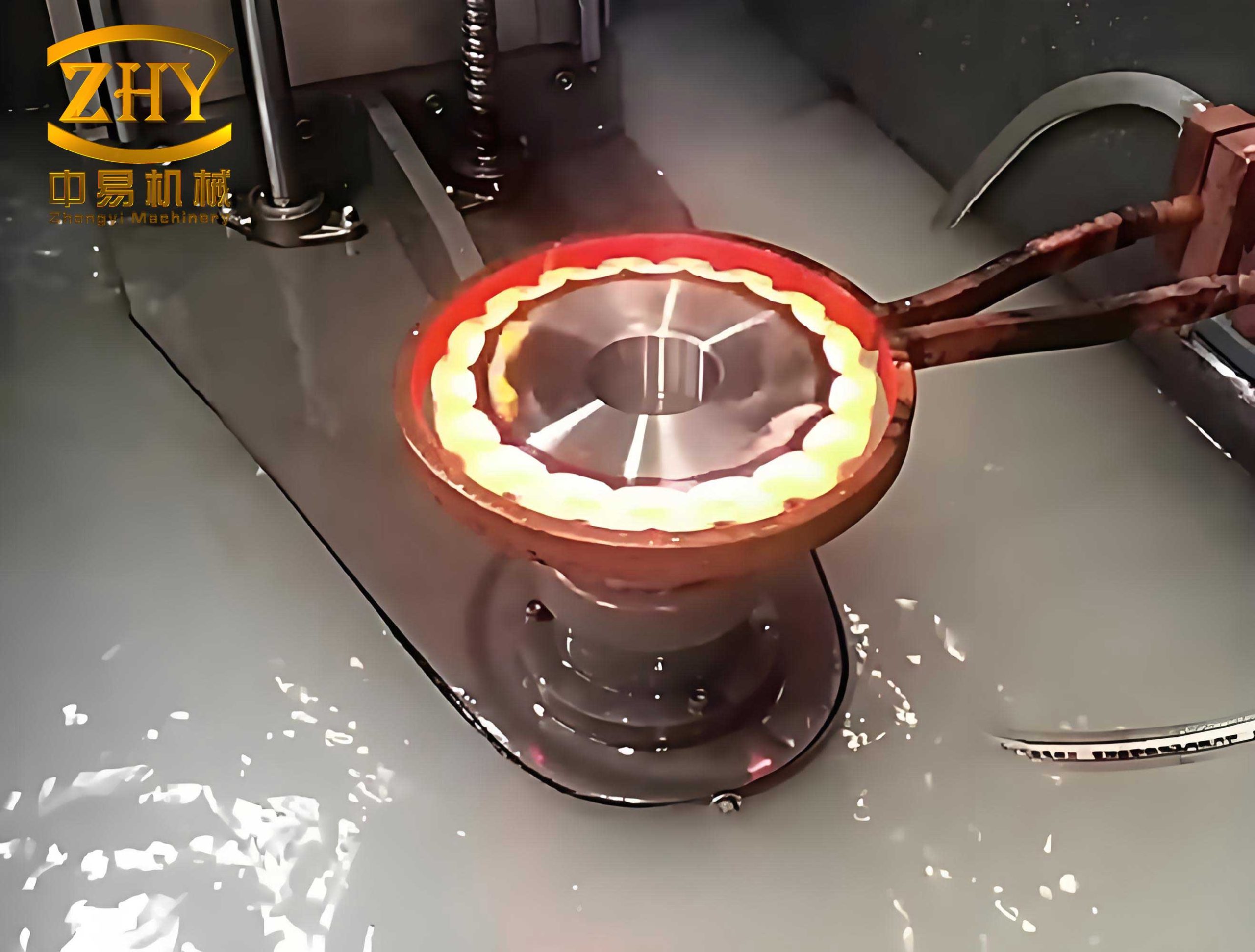
4.2 Control of Microstructure
With automated lines, controlling standard microstructural grades (e.g., case carbide, retained austenite, martensite, core ferrite) to specified levels (e.g., 1-5) is relatively straightforward, provided the process is stable. The common acceptance criteria include: surface hardness 58-64 HRC, core hardness 33-45 HRC, effective case depth per specification, and the absence of detrimental microstructures like excessive non-martensitic products or grain boundary oxidation.
5. Control of Personnel Competency
Ultimately, every system and procedure is executed by people. The competency of operators, technicians, and engineers is the human firewall against heat treatment defects. Beyond basic operational skills, a deep understanding of metallurgical principles, quality control statistics, and equipment functionality is essential. Low staff turnover contributes significantly to institutional knowledge and process stability. While advanced automation, as seen in some international facilities with minimal human intervention, reduces variability, the role of skilled personnel to monitor, interpret, and maintain the system remains irreplaceable.
6. Control of Equipment and Instrumentation
The process is only as good as the equipment that executes it. A rigorous calibration and preventive maintenance program is the backbone of my TQC system. This includes:
- Regular temperature uniformity surveys (TUS) and system accuracy tests (SAT) for all furnaces.
- Calibration of carbon potential probes and oxygen sensors.
- Preventive maintenance of critical components: radiant tubes, fans, oil agitators, cooling systems, and atmosphere generators.
For continuous carburizing lines, maintaining uninterrupted production cycles is key to process stability; frequent door openings or shutdowns introduce variability that can lead to heat treatment defects.
7. Control of Process Materials
Any consumable that contacts the part during heat treatment must be controlled. Residual machining fluids, improper or contaminated washing solutions, inconsistent protective coatings, impurities in carrier/additive gases, and degraded quench oil can all introduce surface or subsurface heat treatment defects. Specifications and incoming quality checks for these materials are as important as those for the steel itself.
8. Control of Production Environment
A clean, organized, and well-defined workspace supports quality. Implementing a strict “6S” (Sort, Set in order, Shine, Standardize, Sustain, Safety) system minimizes mix-ups, prevents contamination, and promotes a culture of discipline. Clearly demarcating areas for raw material, work-in-process, and finished goods, along with proper identification, is fundamental. Furthermore, ensuring a safe and healthy environment for personnel through regular occupational health monitoring fosters a stable and attentive workforce.
9. Control of Process and Technical Documentation
Knowledge must be captured and standardized. Optimized process parameters, troubleshooting guides, material specifications, and equipment manuals form a controlled body of documented information. This ensures that the “best-known method” is preserved and followed consistently, preventing regression and providing a baseline for continuous improvement (the ‘Act’ phase of PDCA).
Summary: An Integrated View of Control Points
To encapsulate my philosophy, the fight against heat treatment defects is waged on multiple fronts simultaneously. The table below summarizes the key control points and their objectives:
| Control Domain | Key Control Points & Checks | Primary Objective |
|---|---|---|
| Material | Chemistry, Hardenability (Jominy), Cleanliness, Grain Size | Ensure predictable response to heat treatment, minimize inherent variability. |
| Forging | Forging Ratio, Start/Finish Temperatures, Grain Flow, Hardness | Achieve sound, fine-grained structure suitable for machining and hardening. |
| Pre-HT | Normalizing Temp/Time, Cooling Rate, Final Microstructure & Hardness | Eliminate banding, produce uniform fine-grained structure for consistent carburizing and minimal distortion. |
| Final HT Process | Carb. Temp/Time/C-Pot, Quench Temp/Oil Agitation, Fixturing | Achieve target case/core properties while actively managing distortion forces. |
| Final HT Output | Case Depth/Gradient, Microstructure, Surface/Core Hardness, Dimensional Distortion | Verify all metallurgical and geometric specifications are met, identifying any heat treatment defects. |
| Support System | Personnel Training, Equipment PM/Calibration, Consumable QC, Document Control | Create a stable, capable, and knowledge-based system to sustain the process controls. |
The governing principle is that control must be preventive and process-based, not just detective and product-based. By understanding and managing the complex interplay of factors described—from the steel mill to the finished gear—we can systematically drive down the occurrence of heat treatment defects, achieving the high levels of quality, reliability, and efficiency demanded by the modern automotive industry.