
In my extensive research on automotive gear manufacturing, I have focused on understanding how heat treatment and grinding processes influence surface residual stress, a critical factor in gear performance and longevity. Residual stress, particularly compressive stress on the surface, significantly enhances fatigue resistance, while tensile stress can lead to premature failure and various heat treatment defects. This article delves into the intricate relationships between carburizing heat treatment parameters, grinding operations, and the resulting residual stress profiles, emphasizing the role of heat treatment defects in gear reliability. I will present detailed analyses, supported by formulas and tables, to elucidate these effects comprehensively.
Residual stress in gears arises from non-uniform volume changes during phase transformations and mechanical processing. In carburized gears, the surface is enriched with carbon, lowering the martensite start temperature (Ms), while the core has a higher Ms. Upon quenching, the core transforms first, expanding and plastically deforming the austenitic surface. As the surface later transforms to martensite, its expansion is constrained by the hardened core, inducing compressive residual stress. However, improper heat treatment or grinding can introduce tensile stresses, leading to heat treatment defects such as grinding cracks or reduced fatigue life. The magnitude and distribution of these stresses are governed by factors like cooling rate, tempering conditions, and grinding parameters.
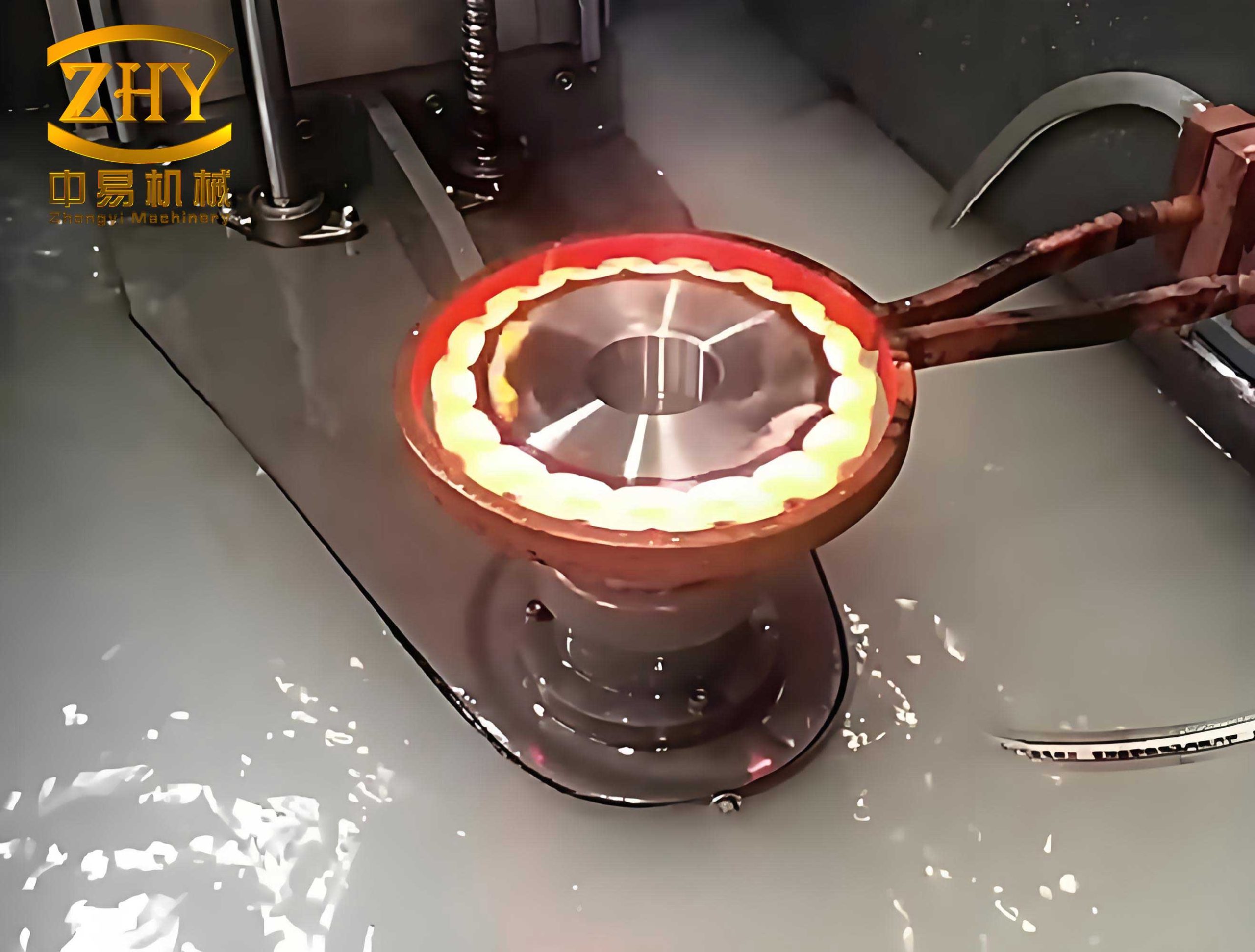
To quantify the impact of heat treatment, I consider the volume change during martensitic transformation. The strain due to transformation can be expressed as: $$\epsilon_t = \beta \cdot (C_s – C_c)$$ where $\epsilon_t$ is the transformation strain, $\beta$ is a coefficient related to lattice expansion (typically around 0.01 per weight percent carbon), $C_s$ is the surface carbon content, and $C_c$ is the core carbon content. The resulting residual stress, assuming elastic-perfectly plastic behavior, is: $$\sigma_{res} = E \cdot (\epsilon_t – \epsilon_p)$$ where $E$ is Young’s modulus, and $\epsilon_p$ is the plastic strain accumulated during cooling. Inadequate cooling can retain austenite, reducing $\epsilon_t$ and leading to lower compressive stress—a common heat treatment defect.
I conducted experiments on 20CrMoH steel gears, carburized at 920°C to a depth of 1.1 mm, then quenched from 840°C into 100°C oil and tempered at 180°C for 150 minutes. The cooling and tempering conditions were varied to assess their effects on residual stress, measured via X-ray diffraction. The results are summarized in Table 1, highlighting how heat treatment defects like retained austenite or incomplete tempering influence stress levels.
| Group | Cooling Condition | Tempering | Surface Residual Stress (MPa) | Key Observations |
|---|---|---|---|---|
| 1 | Quenched, not cooled to room temperature | Immediate tempering | -225 | High retained austenite reduces compressive stress, indicating a heat treatment defect. |
| 2 | Quenched, cooled to room temperature | Tempering after cooling | -345 | Optimal condition with higher compressive stress, minimizing heat treatment defects. |
| 3 | Quenched, cooled to room temperature | No tempering | -415 | Highest compressive stress but potential brittleness; tempering reduces stress slightly but improves toughness. |
The data clearly shows that full cooling to room temperature before tempering maximizes compressive residual stress, whereas premature tempering introduces heat treatment defects by retaining austenite. The stress reduction after tempering is due to martensite decomposition, which decreases tetragonality and volume. The tempering reaction can be modeled as: $$M \rightarrow M’ + \theta\text{-carbide}$$ where $M$ is fresh martensite and $M’$ is tempered martensite with lower carbon content. The associated volume change $\Delta V_t$ is negative, reducing compressive stress according to: $$\Delta \sigma_{res} = K \cdot \Delta V_t$$ where $K$ is a material constant. This underscores the balance between stress and mechanical properties, as tempering mitigates other heat treatment defects like excessive hardness.
Grinding operations post-heat treatment can alter residual stress profiles dramatically. Grinding involves high local temperatures and mechanical abrasion, which may induce tensile stresses if not controlled. The grinding heat $Q_g$ generated per unit volume is: $$Q_g = \frac{F_t \cdot v_s}{A_c \cdot \rho \cdot C_p}$$ where $F_t$ is the tangential grinding force, $v_s$ is the wheel speed, $A_c$ is the contact area, $\rho$ is density, and $C_p$ is specific heat. Excessive $Q_g$ can cause over-tempering or reaustenitization, leading to tensile stress upon cooling—a severe heat treatment defect. I investigated this by grinding carburized gears at different depths and conditions, with results in Table 2.
| Sample | Grinding Depth (mm) | Grinding Condition | Surface Residual Stress (MPa) | Subsurface Stress Trend |
|---|---|---|---|---|
| 1 | 0 (as-heat-treated) | No grinding | -345 | Compressive stress peaks at surface. |
| 2 | 0.10 | Correct grinding, moderate heat | -340 | Minimal change; compressive layer partially retained. |
| 3 | 0.15 | Correct grinding, higher heat | -320 | Slight reduction in compressive stress due to heat. |
| 4 | 0.15 (cracked) | Incorrect grinding, excessive heat | -380 at surface, tensile below | Surface compression increases but subsurface tension causes cracks—a clear heat treatment defect. |
The incorrect grinding in Sample 4 led to a paradoxical stress distribution: surface compressive stress increased due to mechanical peening, but subsurface tensile stress emerged from thermal effects. This tensile stress $\sigma_t$ can be estimated as: $$\sigma_t = \alpha \cdot E \cdot \Delta T$$ where $\alpha$ is the thermal expansion coefficient and $\Delta T$ is the temperature gradient. If $\sigma_t$ exceeds the material’s tensile strength, grinding cracks form, exemplifying a heat treatment defect induced by post-processing. Proper grinding preserves the compressive layer, but depth control is crucial; removing too much material eliminates the beneficial stress zone, reducing fatigue resistance.
Further analysis of heat treatment defects involves microstructural changes. Retained austenite, common in insufficiently cooled gears, can be quantified using the Koistinen-Marburger equation: $$f_{RA} = \exp[-k(M_s – T_q)]$$ where $f_{RA}$ is the retained austenite fraction, $k$ is a constant, $M_s$ is the martensite start temperature, and $T_q$ is the quenching temperature. High $f_{RA}$ lowers compressive stress and promotes dimensional instability, another heat treatment defect. In grinding, overheating can transform martensite to softer phases, reducing hardness and introducing tensile stress. The interplay between thermal and mechanical effects during grinding is complex, but it underscores the need for optimized parameters to avoid heat treatment defects.
To mitigate these issues, I recommend integrated process control. For heat treatment, ensure complete cooling to room temperature before tempering, and consider cryogenic treatment to further transform retained austenite, enhancing compressive stress. The stress after cryogenic treatment $\sigma_{cryo}$ can be modeled as: $$\sigma_{cryo} = \sigma_{initial} + \Delta \sigma_{trans}$$ where $\Delta \sigma_{trans}$ is the stress increment from additional martensite formation. For grinding, use low-stress techniques with ample coolant, controlling depth to preserve the compressive layer. Monitoring grinding forces and temperatures in real-time can prevent heat treatment defects. Additionally, shot peening post-grinding can reintroduce compressive stress, counteracting any tensile tendencies.
In summary, heat treatment and grinding are pivotal in shaping residual stress profiles in carburized automotive gears. Proper heat treatment minimizes defects like retained austenite and ensures high compressive stress, while correct grinding preserves this stress without inducing tensile zones. However, deviations from optimal conditions lead to heat treatment defects that compromise gear performance. Through rigorous experimentation and modeling, I have demonstrated that controlling cooling rates, tempering schedules, and grinding parameters is essential to achieving reliable gears with enhanced fatigue life. Future work should explore advanced materials and in-process monitoring to further reduce heat treatment defects in automotive applications.