
In my extensive experience within heavy machinery maintenance and component manufacturing, few parts present as persistent a challenge as the drive gears used in large electric shovels. These gears are subjected to extreme abrasive and impact loads, making them a critical wear item. The core of their performance lies in their heat treatment, a process that, if not meticulously controlled, leads directly to premature failure through various heat treatment defects. For years, our standard approach yielded unsatisfactory results, prompting a deep, iterative investigation into process optimization. This narrative details that journey, focusing on how systematic modifications were developed to overcome specific heat treatment defects like abrasive wear and brittle fracture, ultimately transforming component life and operational economics.
The initial, conventional heat treatment protocol for these gears, made from a medium-carbon alloy steel akin to 40Cr or similar grades, was straightforward. It involved austenitizing at 850°C for 2 hours, followed by oil quenching, and then tempering at 500°C for 2 hours with air cooling. The resulting surface hardness was in the range of 38-42 HRC. Metallographic analysis revealed a surface of tempered sorbitte, a transition zone of tempered sorbitte and pearlite, and a core of pearlite and ferrite. While this structure provided some toughness, the dominant failure mode in service was severe abrasive wear, a classic heat treatment defect stemming from insufficient surface hardness to resist the hard ore particles. The average service life was a mere 100 days, with a maximum of 150 days, leading to frequent downtime and high replacement costs. This clearly identified the primary heat treatment defect we needed to address: inadequate surface hardness for wear resistance.
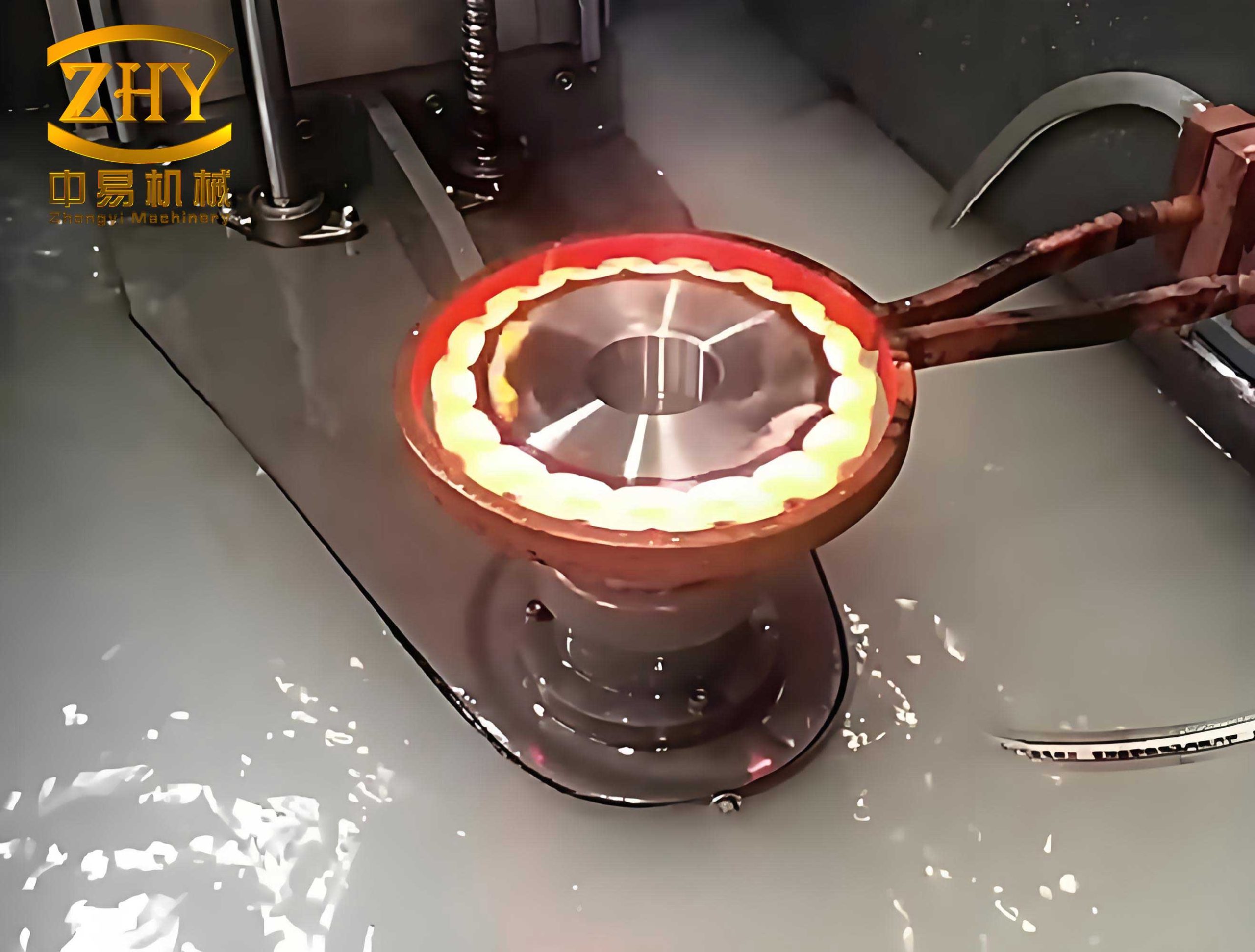
Our first major intervention was to shift from conventional quenching to a high-temperature, rapid heating, and spray quenching process. The goal was to achieve a harder, more wear-resistant surface layer. Gears were heated in a box-type furnace, with only two pieces loaded per batch to ensure temperature uniformity. Once the gear surface reached the austenitizing temperature range of 880-900°C, they were quickly transferred to a specially designed spray ring cooled by a centrifugal pump providing water at a pressure of 3-4 kgf/cm². Tempering was conducted at 500°C for 2 hours. This process boosted the surface hardness to 45-50 HRC.
The initial results were promising on one front but introduced a new, catastrophic heat treatment defect. Average lifespan increased to approximately 180 days, with some gears reaching 200 days. However, the dominant failure mode shifted from wear to tooth breakage (brittle fracture). Metallurgical examination of failed teeth showed a fully hardened cross-section: the surface was tempered troostite, with both the transition zone and core consisting of tempered troostite and sorbitte. Hardness measurements taken at 2mm intervals from the surface to the core revealed uniformly high values, typically around 45-50 HRC throughout. The fracture surfaces were concave, indicative of a brittle core failing under single or multiple overload events. This was a critical revelation: our attempt to eliminate one heat treatment defect (soft wear surface) had inadvertently created another—excessive through-hardness leading to low core toughness and brittle fracture. The core’s lack of ductility became the new limiting factor, a severe heat treatment defect for impact-loaded components.
This necessitated a second, more refined optimization. The objective was to maintain the high surface hardness for wear resistance while restoring adequate toughness in the core. We reasoned that by precisely controlling the thermal cycle, we could create a beneficial hardness gradient. The modified process involved heating to a slightly higher temperature but drastically reducing the dwell time—the gears were removed from the furnace as soon as the surface reached 880°C. The spray quenching time was also reduced to minimize the depth of full martensitic transformation. The tempering temperature was slightly increased to enhance toughness. The schematic of this final optimized quenching and tempering cycle is represented below.
$$ \text{Quenching: } T_{\text{surface}} \rightarrow 880^\circ\text{C} \, (\text{Rapid Heating, Short Dwell}), \quad \text{Cooling: Spray Water for } t_q \text{ seconds} $$
$$ \text{Tempering: } T_{\text{T}} = 520^\circ\text{C} \pm 10^\circ\text{C}, \quad \text{Time: } 2 \text{ hours}, \quad \text{Cooling: Air} $$
The resulting microstructure was ideal: a wear-resistant surface of tempered troostite (hardness 45-48 HRC), a transition zone of tempered troostite and sorbitte, and a tough core of pearlite and ferrite. The hardness gradient was measured meticulously, confirming the successful creation of a composite structure. This directly addressed the previous heat treatment defects by balancing surface hardness and core toughness.
| Process Stage | Initial Conventional Process | First Modification (Rapid Quench) | Final Optimized Process |
|---|---|---|---|
| Austenitizing | 850°C, 120 min | 880-900°C, 20-30 min | ~880°C, Minimal Dwell |
| Quenching Medium | Oil | Pressurized Water Spray | Pressurized Water Spray (shorter time) |
| Tempering | 500°C, 120 min | 500°C, 120 min | 520°C, 120 min |
| Surface Hardness (HRC) | 38-42 | 45-50 | 45-48 |
| Core Microstructure | Pearlite + Ferrite | Tempered Troostite + Sorbitte | Pearlite + Ferrite |
| Dominant Failure Mode | Abrasive Wear | Brittle Fracture (Tooth Breakage) | Progressive Wear (Minimal Fracture) |
| Avg. Service Life (Days) | 100 | 180 | 250+ |
The data from the hardness survey for the final process is particularly enlightening. It demonstrates the engineered gradient that mitigates heat treatment defects by providing a hard case over a tough core.
| Distance from Surface (mm) | 0 (Surface) | 2 | 4 | 6 | 8 | 10 | 12 | 14 | 16 (Core) |
|---|---|---|---|---|---|---|---|---|---|
| Hardness (HRC) | 47 | 46 | 45 | 43 | 40 | 38 | 35 | 32 | 30 |
This gradient can be modeled approximately by an exponential decay function, highlighting the effect of controlled cooling:
$$ HRC(x) = HRC_{\text{core}} + (HRC_{\text{surface}} – HRC_{\text{core}}) \cdot e^{-k \cdot x} $$
where \( x \) is the depth from the surface in mm, \( HRC_{\text{surface}} \approx 47 \), \( HRC_{\text{core}} \approx 30 \), and \( k \) is a constant dependent on the cooling intensity and material hardenability. A high \( k \) value indicates a steep gradient, which is desirable to avoid the heat treatment defect of through-hardening.
The relationship between material chemistry, specifically carbon content, and the propensity for heat treatment defects cannot be overstated. For the steel used, maintaining a strict carbon range is paramount. If the carbon content exceeds the upper limit (e.g., 0.44%), the martensite becomes highly susceptible to quench cracking—another severe heat treatment defect. Conversely, carbon content below the lower limit (e.g., 0.37%) fails to achieve the necessary surface hardness, leading back to the initial heat treatment defect of rapid abrasive wear. We enforce a stringent incoming material check using spectral analysis. The hardness achievable can be roughly correlated to carbon content for a given cooling rate by an empirical relation like:
$$ HRC_{\text{max}} \approx A \cdot (C\% – C_0) + B $$
where \( A \) and \( B \) are constants, and \( C_0 \) is a threshold carbon content. This underscores that process control must start with material consistency to prevent inherent heat treatment defects.
The performance validation of gears treated with the final process was conclusive. In field trials on shovels operating under harsh, high-utilization conditions—including winter operations where brittle fracture risk is highest—no incidents of tooth breakage were observed. The average service life soared to between 200 and 300 days. A statistical review of over fifty gears produced with this new protocol confirmed an average lifespan exceeding 250 days. The failure mode reverted to gradual abrasive wear, which is predictable and allows for planned maintenance, rather than the sudden, catastrophic brittle fracture that plagued the intermediate process. This shift from unpredictable brittle failure to predictable wear is the ultimate evidence of successfully managed heat treatment defects.
The economic impact has been substantial. Each drive gear now facilitates the movement of significantly more material before requiring replacement. Based on an average monthly ore extraction rate per shovel, the improved lifespan translates to each gear handling over 2 million tons of material. For our operation scale, this process innovation yields annual savings exceeding fifty thousand dollars, primarily from reduced part consumption, lower downtime, and decreased maintenance labor. The return on investment for refining the heat treatment protocol was realized within the first few months of full implementation.
In conclusion, the journey to optimize the heat treatment for these drive gears was fundamentally a battle against successive heat treatment defects. It began with addressing abrasive wear by increasing surface hardness, which inadvertently introduced the heat treatment defect of brittle fracture due to through-hardening. The final, successful strategy involved a nuanced balance of thermal parameters—rapid surface heating, controlled spray quenching duration, and adjusted tempering—to engineer a beneficial microstructure gradient. This case study powerfully illustrates that heat treatment is not a one-size-fits-all procedure but a system of interdependent variables. Key takeaways include the critical importance of: 1) Defining the failure mode to target the specific heat treatment defect, 2) Understanding the microstructure-property relationships across the component’s cross-section, 3) Implementing precise control over time-temperature profiles, and 4) Ensuring raw material consistency as a foundation. The final process stands as a robust solution that has effectively eliminated the major heat treatment defects, delivering enhanced durability and reliability for critical machinery components in demanding industrial environments.