
In the manufacturing of large-scale equipment such as ball mills, gears play a critical role in transmission systems. The demand for higher hardness and better performance in these gears has led to the adoption of alloy cast steels like ZG42CrMo. However, the heat treatment of such massive castings presents significant challenges, particularly in avoiding heat treatment defects such as cracking, distortion, and inadequate mechanical properties. From my experience in overseeing production processes, I have developed a comprehensive approach to quality control and heat treatment that ensures reliability and durability. This article details the principles and methods employed, with a focus on mitigating heat treatment defects through precise control of casting, quenching, and tempering. The integration of tables and formulas will help summarize key data, and the discussion will repeatedly emphasize the importance of addressing heat treatment defects to achieve optimal results.
The foundation of successful heat treatment lies in the initial casting quality. For large gears made from ZG42CrMo alloy steel, any inconsistencies in composition or microstructure can exacerbate heat treatment defects during subsequent processes. Therefore, strict control measures are implemented from the melting stage onward. The chemical composition is tailored to minimize carbon content within specifications, reducing the risk of quench cracking—a common heat treatment defect. Table 1 outlines the standard and actual chemical compositions achieved in production, highlighting how deviations are managed to prevent issues like segregation or inclusions that could lead to heat treatment defects.
| Element | Standard Range | Actual Value (Sample) |
|---|---|---|
| C | 0.37–0.47 | 0.40–0.42 |
| Si | 0.30–0.50 | 0.46–0.49 |
| Mn | 0.50–0.80 | 0.68–0.72 |
| P | ≤0.015 | 0.013–0.015 |
| S | ≤0.015 | 0.006–0.015 |
| Cr | 0.80–1.20 | 0.92–1.08 |
| Mo | 0.20–0.30 | 0.20–0.23 |
| Ni | ≤0.30 | 0.10–0.13 |
Casting processes are optimized to ensure uniformity. The pouring temperature is maintained between 1,550°C and 1,560°C to balance fluidity and minimize shrinkage—a potential source of heat treatment defects if not controlled. After casting, a stress-relief annealing is performed, as shown in the following temperature-time profile: heat to 600°C at a rate of 80°C/h, hold for 4 hours, then cool to 300°C at 50°C/h before air cooling. This step alleviates internal stresses that could otherwise contribute to heat treatment defects like distortion during quenching. However, if ultrasonic testing reveals defects, a normalizing treatment is added to refine the grain structure, as coarse grains are prone to heat treatment defects such as cracking. The normalizing curve involves heating to 880°C, holding for 3 hours, and air cooling, which prepares the material for subsequent quenching and tempering.
Moving to the core of the process, the quenching and tempering (i.e., heat treatment) of large ZG42CrMo gears requires meticulous planning to avoid heat treatment defects. The key challenge is achieving sufficient hardness and strength without inducing cracks or excessive deformation. Based on experimental trials, I determined that an intermittent cooling method is effective. This involves alternating between water quenching and air cooling, with precise timing to control thermal gradients. The cooling rate during quenching can be described by the following formula for heat transfer: $$q = h \cdot (T_s – T_m)$$ where \(q\) is the heat flux, \(h\) is the heat transfer coefficient, \(T_s\) is the surface temperature, and \(T_m\) is the medium temperature. By adjusting the water temperature to around 50°C, we mimic the cooling characteristics of oil in the pearlite transformation range (650–550°C), while minimizing the risk of heat treatment defects in the martensite region (300–200°C). Table 2 compares cooling speeds for different media, illustrating why water at 50°C is chosen to balance effectiveness and defect prevention.
| Medium | Temperature | Cooling Speed in 650–550°C Range (°C/s) | Cooling Speed in 300–200°C Martensite Range (°C/s) | Quench Severity (H-value) |
|---|---|---|---|---|
| Water | 18°C | 600 | 270 | 1.00 |
| Water | 50°C | 100 | 270 | 0.17 |
| Mineral Oil | 50°C | 100–150 | 20–50 | 0.17–0.25 |
| Compressed Air | Ambient | 30 | 10 | 0.05 |
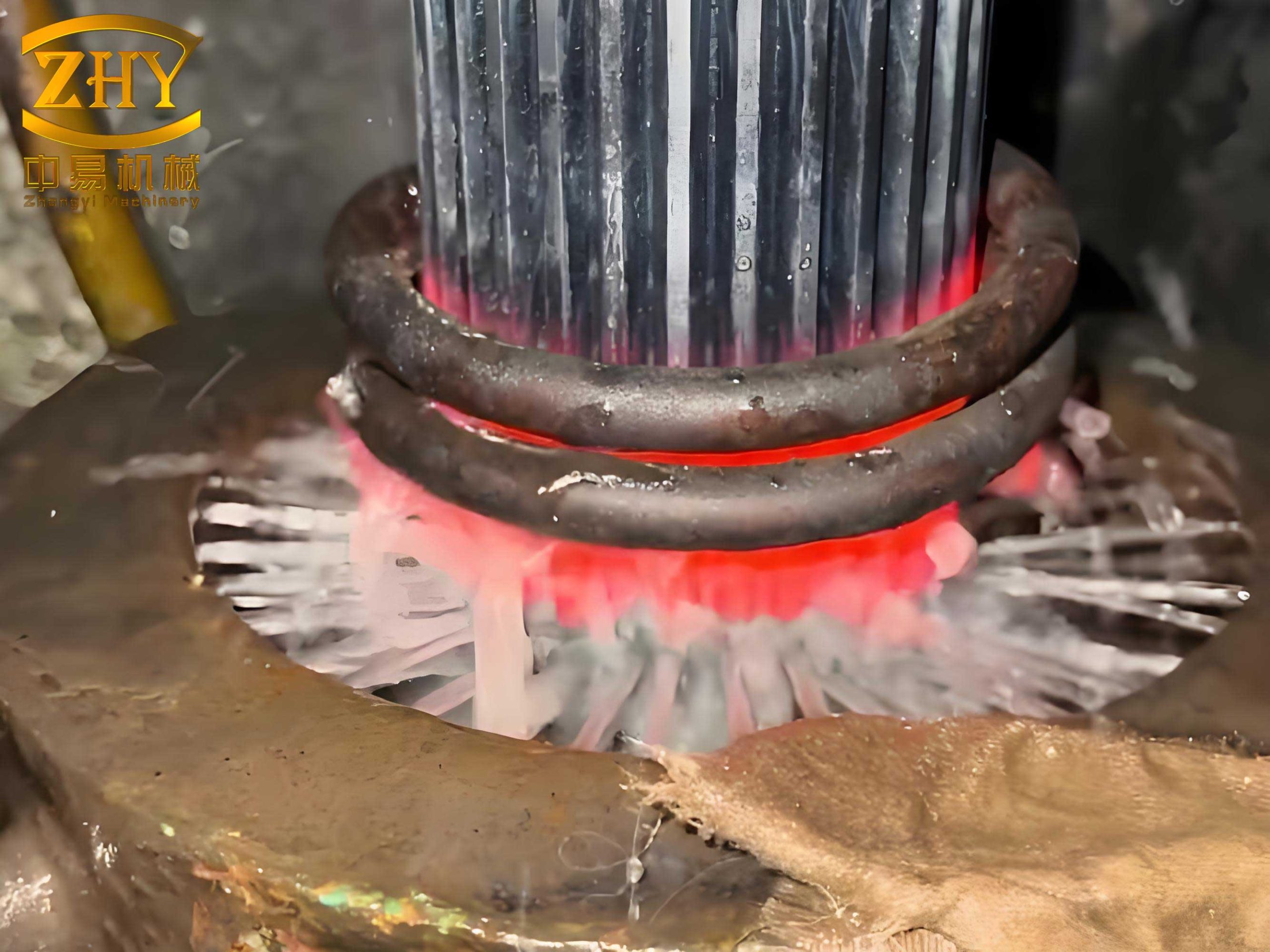
The quenching process is parameterized to avoid heat treatment defects. The gear is heated to 860°C in a furnace, with a pre-soak at 400°C to reduce thermal shock. The holding time is calculated based on section thickness: $$t_h = k \cdot d$$ where \(t_h\) is the hold time in minutes, \(k\) is a factor between 1.0 and 1.3 min/mm, and \(d\) is the effective thickness in mm. For a gear with a 900 mm face width, this translates to approximately 3 hours. Upon removal, the gear is quenched using a custom-designed lifting tool that ensures even cooling—a critical aspect to prevent distortion, a common heat treatment defect. The intermittent cooling sequence is: water quench for 30 seconds, air cool for 30 seconds, repeated until the surface temperature drops to around 300°C. This cycle reduces thermal stresses that cause heat treatment defects. The final quench temperature is monitored to stay above the martensite start temperature, as rapid cooling below this point can lead to cracking, a severe heat treatment defect.
After quenching, tempering is conducted at 580°C for 10 hours to transform martensite into tempered sorbite, enhancing toughness and relieving residual stresses. The tempering temperature is selected based on the desired hardness range of 241–286 HB, which can be estimated using the Hollomon-Jaffe equation: $$H = A – B \cdot \log(t) + C/T$$ where \(H\) is hardness, \(t\) is time, \(T\) is temperature in Kelvin, and \(A\), \(B\), \(C\) are material constants. This step is vital to eliminate heat treatment defects like brittleness. The mechanical properties after heat treatment are summarized in Table 3, showing that all requirements are met without heat treatment defects.
| Property | Requirement | Actual Result |
|---|---|---|
| Tensile Strength (MPa) | ≥740 | 760 |
| Yield Strength (MPa) | ≥540 | 580 |
| Elongation (%) | ≥12 | 17 |
| Impact Energy (J) | ≥27 | 30–38 |
| Hardness (HB) | 241–286 | 250–290 |
In discussing the heat treatment methodology, it is essential to delve deeper into the mechanisms that cause heat treatment defects. For large castings, non-uniform cooling is a primary culprit. The intermittent quenching approach mitigates this by allowing temperature equilibration during air cooling phases. The heat conduction during air cooling can be modeled using Fourier’s law: $$Q = -k \cdot A \cdot \frac{dT}{dx}$$ where \(Q\) is the heat transfer rate, \(k\) is thermal conductivity, \(A\) is area, and \(\frac{dT}{dx}\) is the temperature gradient. By controlling the gradient, we reduce the likelihood of heat treatment defects such as thermal cracking. Additionally, the use of water as a quenchant, despite its aggressiveness, is made safe by temperature moderation. The cooling curve for water at 50°C shows a reduced severity in the martensite range, which is less prone to inducing heat treatment defects compared to colder water. This is quantified by the quench severity factor \(H\), where lower values correlate with fewer defects. For our process, \(H\) is maintained around 0.17, balancing hardness attainment and defect avoidance.
The design of auxiliary equipment also plays a role in preventing heat treatment defects. The custom lifting tool, with four-point suspension, ensures the gear remains horizontal during quenching. This minimizes asymmetric cooling that can cause distortion—a frequent heat treatment defect in large components. The tool’s load capacity of 35 tons accommodates gear halves weighing over 25 tons each. During quenching, the gear’s surface temperature is monitored using thermocouples, with data logged to refine the process. For instance, after the first water quench, the surface temperature drops to 410°C, then rises to 450°C during air cooling. This cycling continues until the final temperature of 250°C is reached before tempering. Such precision is key to averting heat treatment defects.
Moreover, the influence of casting quality on heat treatment cannot be overstated. Defects like porosity or inclusions, if present, can act as stress concentrators during quenching, leading to heat treatment defects such as crack initiation. Therefore, ultrasonic testing is performed after casting and normalizing. Any defects are repaired prior to heat treatment. The chemical composition control, as seen in Table 1, ensures low phosphorus and sulfur levels, which reduces the formation of brittle phases that exacerbate heat treatment defects. The carbon content is kept at the lower end of the range (0.40–0.42%) to enhance hardenability while reducing cracking susceptibility. This aligns with the principle that managing composition is a proactive measure against heat treatment defects.
To further illustrate the thermal dynamics, consider the cooling rate during intermittent quenching. The time-temperature profile can be approximated using the following empirical relation for large castings: $$T(t) = T_0 \cdot e^{-t/\tau} + T_m$$ where \(T(t)\) is temperature at time \(t\), \(T_0\) is initial temperature, \(\tau\) is a time constant dependent on geometry and medium, and \(T_m\) is medium temperature. For water quenching, \(\tau\) is smaller, leading to faster cooling. By interspersing air cooling, we increase \(\tau\) periodically, allowing stress relaxation. This approach is validated by microstructural analysis; the resulting tempered sorbite shows uniform carbide dispersion, indicating absence of heat treatment defects like overtempering or untempered martensite.
In terms of performance, the heat-treated gears exhibit excellent service life in ball mills. The hardness uniformity across the tooth surface, measured at 240–275 HB, ensures resistance to wear and fatigue. The impact energy values exceed requirements, demonstrating toughness achieved without heat treatment defects. Dimensional checks post-treatment show minimal distortion: diameter changes within 5 mm and flatness within 6 mm, well within machining allowances. This success underscores the importance of integrated quality control from casting to heat treatment in mitigating heat treatment defects.
Looking at broader applications, the principles developed here can be extended to other large alloy steel castings. The intermittent cooling method, coupled with medium temperature control, offers a sustainable alternative to oil quenching, reducing environmental impact while preventing heat treatment defects. Future work could involve computational modeling to optimize cooling sequences further, using finite element analysis to predict stress distributions and preempt heat treatment defects. The formula for stress intensity during quenching can be expressed as: $$\sigma = E \cdot \alpha \cdot \Delta T$$ where \(\sigma\) is thermal stress, \(E\) is Young’s modulus, \(\alpha\) is thermal expansion coefficient, and \(\Delta T\) is temperature difference. By minimizing \(\Delta T\) through intermittent cooling, we reduce \(\sigma\), thereby avoiding heat treatment defects.
In conclusion, the heat treatment of large ZG42CrMo cast gears is a complex process that demands attention to detail to prevent heat treatment defects. Through rigorous casting quality control, optimized chemical composition, and innovative quenching techniques like intermittent cooling with temperature-adjusted water, we achieve the desired mechanical properties without defects. The use of custom tooling and precise parameterization further ensures consistency. This approach not only meets technical specifications but also provides a reference for similar applications, highlighting that proactive measures are essential in combating heat treatment defects. As industries push for larger and more durable components, mastering these techniques will be crucial for advancing manufacturing capabilities while minimizing heat treatment defects.