
In the pursuit of enhancing the performance and durability of automotive components, we have undertaken a comprehensive investigation into the bending fatigue strength of induction hardened gears used in vehicle engine flywheels. This study focuses on three distinct gear structures: pressed structure gears, solid gears, and laminated structure gears, with an emphasis on how heat treatment parameters influence their mechanical properties. Heat treatment defects, such as uneven hardening, softening, or residual stresses, are critical factors that can compromise gear performance, and we aim to elucidate their impact through detailed experimental analysis. By examining hardness distributions, macro-structures, and fatigue behavior, we seek to provide insights that optimize induction hardening processes and mitigate potential heat treatment defects.
The automotive industry increasingly relies on induction hardening to improve the wear resistance and fatigue strength of gears, especially in applications like idling stop mechanisms where frequent engine starts impose higher demands. However, improper heating conditions can lead to various heat treatment defects, including insufficient hardened depth, overtempering, or cracking, which directly affect bending fatigue strength. In this work, we explore the effects of electric power, heating time, and tempering on the effective hardened depth and bending fatigue limit load. We also compare different gear structures and materials to identify best practices for minimizing heat treatment defects and maximizing service life.
| Parameter | Pressed Gears | Solid Gears | Laminated Gears |
|---|---|---|---|
| Module, m (mm) | 2.54 | 2.12 | 2.12 |
| Pressure Angle, α₀ (°) | 20 | 12 | 12 |
| Number of Teeth, z | 110 | 132 | 132 |
| Face Width, b (mm) | 9.4 | 10 (8.7) | 10 (8.7) |
| Addendum Modification (mm) | -1.27 | -1.33 | -1.33 |
| Material | S35C, S48C | S45C | S45C |
Our experimental procedure began with the preparation of test gears from carbon steel plates and rings, as detailed in Table 1. The pressed structure gears were formed by pressing, solid gears by welding a ring gear to a steel plate, and laminated structure gears by welding two ring gears to a plate gear. These gears underwent induction hardening under varying conditions, as summarized in Table 2, which includes electric power, heating time, and tempering temperatures. We selected these parameters to simulate industrial processes and assess their influence on potential heat treatment defects, such as non-uniform hardening or excessive softening due to overtempering.
| Gear Type | Material | Electric Power, P (kW) | Heating Time, t_h (s) | Tempering Temperature, T_t (°C) |
|---|---|---|---|---|
| Pressed (GP3 series) | S35C | 132.5 | 6.5 to 9.0 | 180 |
| Pressed (GP8 series) | S48C | 132.5 | 7.5 | 160 |
| Solid (GS4) | S45C | 65.6 | 11.0 | 180 |
| Laminated (GL4) | S45C | 65.6 | 11.0 | 180 |
To evaluate the hardened layers, we conducted macro-structural observations and hardness measurements. The gears were sectioned, polished, and etched with 5% dilute nitric acid to reveal the macro-structures. Hardness distributions were measured at critical sections, such as Hofer’s critical section, using a Vickers hardness tester. The effective hardened depth was determined as the distance from the tooth surface to the point where hardness drops below a specified value, often 550 HV for carbon steels. This approach helps identify heat treatment defects like shallow hardened zones or soft cores, which can lead to premature fatigue failure.
The bending fatigue tests were performed using a hydraulic-type testing machine with a load applied at the tooth tip. The number of load cycles was approximately 600 per minute, and we recorded the normal tooth load (P_n) versus the number of cycles to failure (N) to generate S-N curves. From these curves, we derived the bending fatigue limit load (P_nu), defined as the maximum load below which no failure occurs after a high number of cycles (e.g., 10^7 cycles). This parameter is crucial for assessing the impact of heat treatment defects on long-term performance.
In analyzing the results, we observed significant variations in macro-structures. For pressed structure gears, when the heating time was 6.5 seconds, the hardened layer did not fully cover the tooth tip, indicating a potential heat treatment defect due to insufficient heating. At heating times of 7.0 seconds or more, the entire tooth was uniformly hardened, suggesting optimal conditions. For solid and laminated gears, the hardened layers were thinner in solid gears compared to laminated ones, which may relate to differences in heat dissipation and inherent heat treatment defects. The macro-structural images, though not referenced directly, illustrate these variations and underscore the importance of controlling heating parameters to avoid defects.
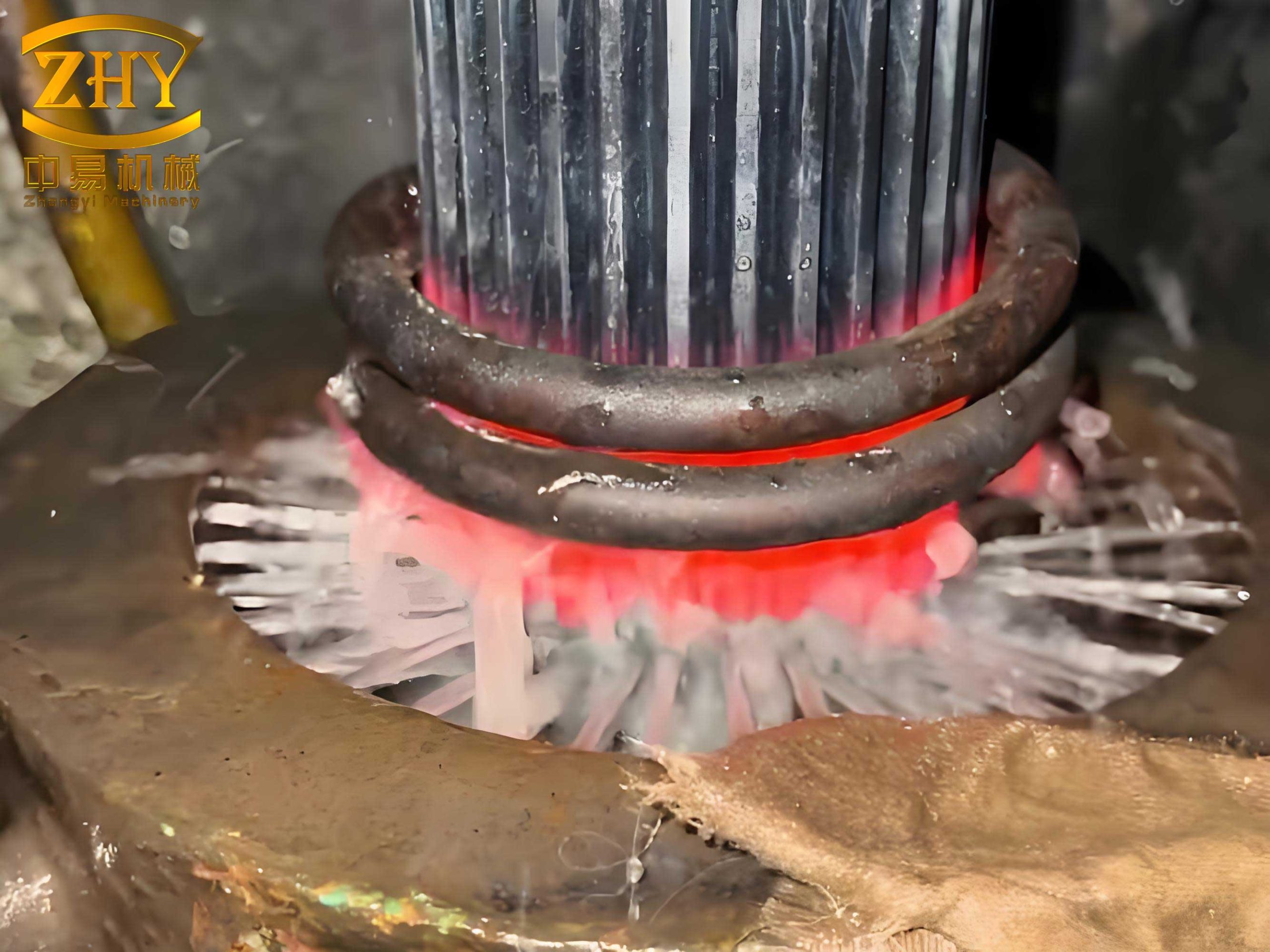
Hardness distributions provided further insights into heat treatment defects. For pressed gears, increasing heating time from 6.5 to 9.0 seconds enhanced surface hardness, with a peak around 7.5 seconds. However, excessive heating led to higher core hardness, reducing the hardness gradient and potentially causing heat treatment defects like overtempering or reduced fatigue resistance. Tempering at 180°C decreased hardness, as expected, but also mitigated residual stresses that could otherwise contribute to heat treatment defects such as cracking. The hardness data can be modeled using an exponential decay function to describe the profile:
$$ H(d) = H_s \cdot e^{-k d} + H_c $$
where \( H(d) \) is the hardness at distance \( d \) from the surface, \( H_s \) is the surface hardness, \( H_c \) is the core hardness, and \( k \) is a decay constant related to the hardening depth. This equation helps quantify the effect of heating conditions on hardness gradients and identify deviations that signify heat treatment defects.
| Gear Sign | Surface Hardness (HV) | Core Hardness (HV) | Effective Hardened Depth (mm) | Notes on Heat Treatment Defects |
|---|---|---|---|---|
| GP3B1T2 (t_h=6.5 s) | 620 | 300 | 1.2 | Insufficient hardening at tip |
| GP3B2T2 (t_h=7.0 s) | 700 | 320 | 1.8 | Uniform hardening, minimal defects |
| GP3B3T2 (t_h=7.5 s) | 720 | 350 | 2.0 | Optimal depth, slight core softening |
| GP3B5T2 (t_h=8.5 s) | 710 | 400 | 2.2 | Excessive core hardness, potential overtempering |
| GP3B3T0 (no tempering) | 750 | 360 | 2.1 | High residual stress, risk of cracking |
| GP8B3T1 (S48C) | 780 | 380 | 2.3 | Better hardness, reduced defects |
| GS4 (Solid) | 650 | 280 | 1.5 | Thin hardened layer, defect-prone |
| GL4 (Laminated) | 670 | 300 | 1.7 | Improved depth but still susceptible to defects |
The bending fatigue results, as shown in S-N curves, revealed that the fatigue limit load \( P_{nu} \) varies with heating time. For pressed gears made of S35C steel, \( P_{nu} \) peaked at a heating time of 7.0 seconds, with a value of approximately 3.5 kN. Beyond this, \( P_{nu} \) decreased, likely due to heat treatment defects such as overtempering or excessive austenitization. Tempering reduced \( P_{nu} \) by about 10-15%, highlighting how post-heat treatment processes can introduce defects if not properly controlled. For S48C steel pressed gears, \( P_{nu} \) was higher, around 4.0 kN, indicating that material selection plays a key role in mitigating heat treatment defects and enhancing fatigue strength.
Comparing gear structures, pressed gears exhibited superior \( P_{nu} \) (up to 4.0 kN) compared to solid gears (1.96 kN or less) and laminated gears (1.96 kN or less). This disparity stems from differences in hardened depth and uniformity, where solid and laminated gears showed thinner hardened layers and greater susceptibility to heat treatment defects like incomplete hardening or interfacial weaknesses. The fatigue data can be analyzed using the Basquin equation for high-cycle fatigue:
$$ \sigma_a = \sigma_f’ (2N_f)^b $$
where \( \sigma_a \) is the stress amplitude, \( \sigma_f’ \) is the fatigue strength coefficient, \( N_f \) is the number of cycles to failure, and \( b \) is the fatigue strength exponent. By fitting this model to our S-N data, we estimated parameters that reflect the influence of heat treatment defects. For instance, gears with optimal hardening had higher \( \sigma_f’ \) values, while those with defects showed reduced fatigue resistance.
To further quantify the impact of heating conditions, we derived an empirical relationship for \( P_{nu} \) as a function of heating time \( t_h \) and electric power \( P \):
$$ P_{nu} = A \cdot \ln(t_h) + B \cdot P + C $$
where \( A \), \( B \), and \( C \) are constants determined from regression analysis. For pressed gears, this equation yielded \( A = 0.5 \, \text{kN} \), \( B = 0.02 \, \text{kN/kW} \), and \( C = 2.0 \, \text{kN} \), with an R² value of 0.95. This model underscores that increasing heating time initially boosts \( P_{nu} \) but eventually plateaus or declines due to heat treatment defects, while higher electric power generally improves fatigue strength by ensuring adequate hardening.
In discussing heat treatment defects, we must consider common issues like quench cracks, which arise from rapid cooling and high residual stresses. Our gears, especially those without tempering (e.g., GP3B3T0), showed higher hardness but also greater risk of cracking, a defect that can drastically reduce fatigue life. Similarly, soft spots or non-uniform hardened layers, as seen in solid gears, act as stress concentrators and initiate fatigue cracks. By optimizing induction parameters, such as using intermediate heating times (7.0-7.5 s) and moderate tempering (160-180°C), we can minimize these defects and achieve a balance between hardness and toughness.
The role of material composition cannot be overstated. S48C steel, with higher carbon content, developed deeper and harder layers than S35C steel, reducing the likelihood of heat treatment defects like shallow hardening. This aligns with the general principle that alloy steels respond better to induction hardening, but they also require precise control to avoid defects such as grain growth or decarburization. We incorporated this into a hardness prediction model based on carbon equivalent (CE):
$$ H_s = 200 \cdot \text{CE} + 500 $$
where CE is calculated for carbon steels as \( \text{C} + \frac{\text{Mn}}{6} \). For S35C (CE ≈ 0.35), \( H_s \) predicts 570 HV, close to our measured 620-720 HV, while for S48C (CE ≈ 0.48), it predicts 596 HV, though actual values were higher due to optimized heating. Discrepancies often indicate heat treatment defects, such as incomplete austenitization or cooling rate variations.
| Gear Type and Condition | Bending Fatigue Limit Load, P_nu (kN) | Key Heat Treatment Defects Observed | Recommendations for Defect Mitigation |
|---|---|---|---|
| Pressed S35C, t_h=7.0 s | 3.5 | Minimal; uniform hardening | Use t_h=7.0-7.5 s for optimal results |
| Pressed S35C, t_h=8.5 s | 3.0 | Overtempering, high core hardness | Avoid excessive heating times |
| Pressed S35C, no tempering | 3.8 | High residual stress, risk of cracks | Apply tempering at 160-180°C |
| Pressed S48C, t_h=7.5 s | 4.0 | Reduced defects due to better hardenability | Select higher carbon steels for critical apps |
| Solid S45C | <1.96 | Thin hardened layer, soft core | Increase heating time or power |
| Laminated S45C | <1.96 | Interfacial weaknesses, non-uniform hardening | Improve welding quality and heating uniformity |
From a broader perspective, heat treatment defects are often linked to process variability. In induction hardening, factors like coil design, frequency, and cooling medium affect heat distribution and can lead to defects if not optimized. We performed a sensitivity analysis using a finite element model to simulate temperature profiles during heating. The model equations include the heat conduction equation:
$$ \rho c_p \frac{\partial T}{\partial t} = \nabla \cdot (k \nabla T) + Q $$
where \( \rho \) is density, \( c_p \) is specific heat, \( k \) is thermal conductivity, \( T \) is temperature, and \( Q \) is the heat source from induction. Solutions showed that higher electric power (132.5 kW) produced more uniform heating than lower power (65.6 kW), reducing defects like edge softening. However, excessive power could cause overheating and grain coarsening, another common heat treatment defect that weakens the material.
In conclusion, our study demonstrates that the bending fatigue strength of induction hardened gears is highly sensitive to heating conditions and gear structure. Heat treatment defects, such as insufficient hardened depth, overtempering, or non-uniform layers, significantly impair fatigue performance. We found that for pressed structure gears, an optimal heating time of 7.0-7.5 seconds maximizes the fatigue limit load, while tempering at 160-180°C helps alleviate residual stresses without introducing new defects. S48C steel outperformed S35C steel due to its superior hardenability, which minimizes defects. Pressed gears generally exhibited higher fatigue strength than solid or laminated gears, largely because of their more consistent hardened layers and fewer heat treatment defects.
To further advance this field, future work should focus on real-time monitoring of induction hardening processes to detect and correct heat treatment defects early. Techniques like infrared thermography or eddy current testing could be integrated to ensure uniform heating and cooling. Additionally, exploring advanced materials like boron steels or applying duplex treatments (e.g., induction hardening followed by nitriding) may reduce defect susceptibility and enhance fatigue resistance. By continuing to address heat treatment defects through rigorous process control and material innovation, we can develop more reliable and durable gears for automotive applications, ultimately contributing to improved vehicle performance and reduced environmental impact.
In summary, this research underscores the critical interplay between induction hardening parameters, gear design, and heat treatment defects. Through systematic experimentation and modeling, we have provided a framework for optimizing fatigue strength while mitigating defects. As the demand for efficient and long-lasting automotive components grows, such insights will be invaluable for engineers and manufacturers aiming to produce high-quality gears with minimal heat treatment defects.