
In my extensive experience within the automotive gear manufacturing industry, one of the most persistent and critical challenges I have encountered is the control of heat treatment defects, particularly the distortion of spline holes in carburized gears. These heat treatment defects, if left unmanaged, severely compromise gear assembly and operational reliability, leading to increased scrap rates and production costs. The primary material in focus here is a low-carbon alloy steel commonly used for such components, which undergoes carburizing and quenching to achieve a hard, wear-resistant surface while maintaining a tough core. However, during this thermal cycle, the spline hole typically contracts, a classic manifestation of heat treatment defects driven by thermal stresses and phase transformations. This article, drawn from years of hands-on investigation and process optimization, delves into the mechanisms behind this distortion and presents a comprehensive analysis of various control methodologies, emphasizing practical solutions to mitigate these heat treatment defects. I will employ tables and formulas to summarize data and principles, aiming to provide a detailed guide for engineers facing similar issues.
The fundamental issue stems from the non-uniform heating and cooling during carburizing and quenching. When a gear is subjected to high temperatures in a carburizing atmosphere, carbon diffuses into the surface layers. Subsequent quenching induces a martensitic transformation in the carburized case, which is accompanied by a volume expansion. However, the core, which remains largely unaffected by carbon enrichment, transforms differently or at a slower rate. This differential volume change between the case and core generates internal stresses. For a gear with an internal spline hole, the geometry acts as a stress concentrator, often resulting in a net contraction of the hole diameter and keyway width. This distortion is a quintessential heat treatment defect that can be quantified. The strain, $\epsilon$, due to thermal gradients can be approximated by:
$$\epsilon = \alpha \Delta T + \frac{\Delta V}{V}$$
where $\alpha$ is the coefficient of thermal expansion, $\Delta T$ is the temperature difference, and $\frac{\Delta V}{V}$ represents the volumetric strain from phase transformation. For martensite formation in steel, the volume increase is roughly 4%, which, when constrained by geometry, leads to complex distortion patterns. Repeated exposure to such heat treatment defects necessitates robust control strategies.
In our initial assessments, we systematically measured the distortion of spline holes post-carburizing and quenching for several gear types. The gears, all made from the same low-carbon alloy steel, exhibited consistent shrinkage. The following tables encapsulate the quantitative data gathered, highlighting the variability and magnitude of these heat treatment defects. Table 1 presents the distortion measurements for the spline hole diameters of two gear designs—a reverse gear and a semi-axle gear from off-highway vehicles. Each measurement represents the change in diameter after heat treatment, with negative values indicating contraction, a clear sign of heat treatment defects.
| Gear Type | Sample 1 | Sample 2 | Sample 3 | Sample 4 | Sample 5 | Sample 6 | Sample 7 | Sample 8 |
|---|---|---|---|---|---|---|---|---|
| Reverse Gear | -0.12 | -0.15 | -0.18 | -0.14 | -0.16 | -0.13 | -0.17 | -0.11 |
| Semi-axle Gear | -0.08 | -0.09 | -0.10 | -0.07 | -0.11 | -0.08 | -0.09 | -0.10 |
Similarly, for a truck gear with an internal spline, the keyway width distortion was measured, as shown in Table 2. This parameter is critical for assembly with mating shafts, and its reduction directly impacts functionality, underscoring the severity of heat treatment defects.
| Sample ID | Keyway Width Distortion | Notes |
|---|---|---|
| A1 | -0.05 | Exceeds tolerance |
| A2 | -0.03 | Within limit |
| A3 | -0.06 | Exceeds tolerance |
| A4 | -0.04 | Within limit |
| A5 | -0.07 | Exceeds tolerance |
The data reveals that distortion is not uniform, even under controlled conditions, indicating the stochastic nature of heat treatment defects. To understand this, we must consider factors such as carburizing layer uniformity, heating and cooling rates, and part orientation during quenching. Ideally, the carburized case should be of consistent thickness around the gear contour, including the spline hole. Non-uniform case depth can create asymmetric stresses, exacerbating distortion. The heating rate, $q_h$, and cooling rate, $q_c$, are critical parameters. Rapid heating can induce thermal shock, while uneven cooling, especially in oil quenching, can lead to quench stresses. The cooling rate in oil can be modeled using Newton’s law of cooling:
$$q_c = h (T – T_{\infty})$$
where $h$ is the heat transfer coefficient, $T$ is the gear temperature, and $T_{\infty}$ is the quenchant temperature. Variations in $h$ due to part geometry or agitation can cause localized differences, contributing to heat treatment defects.
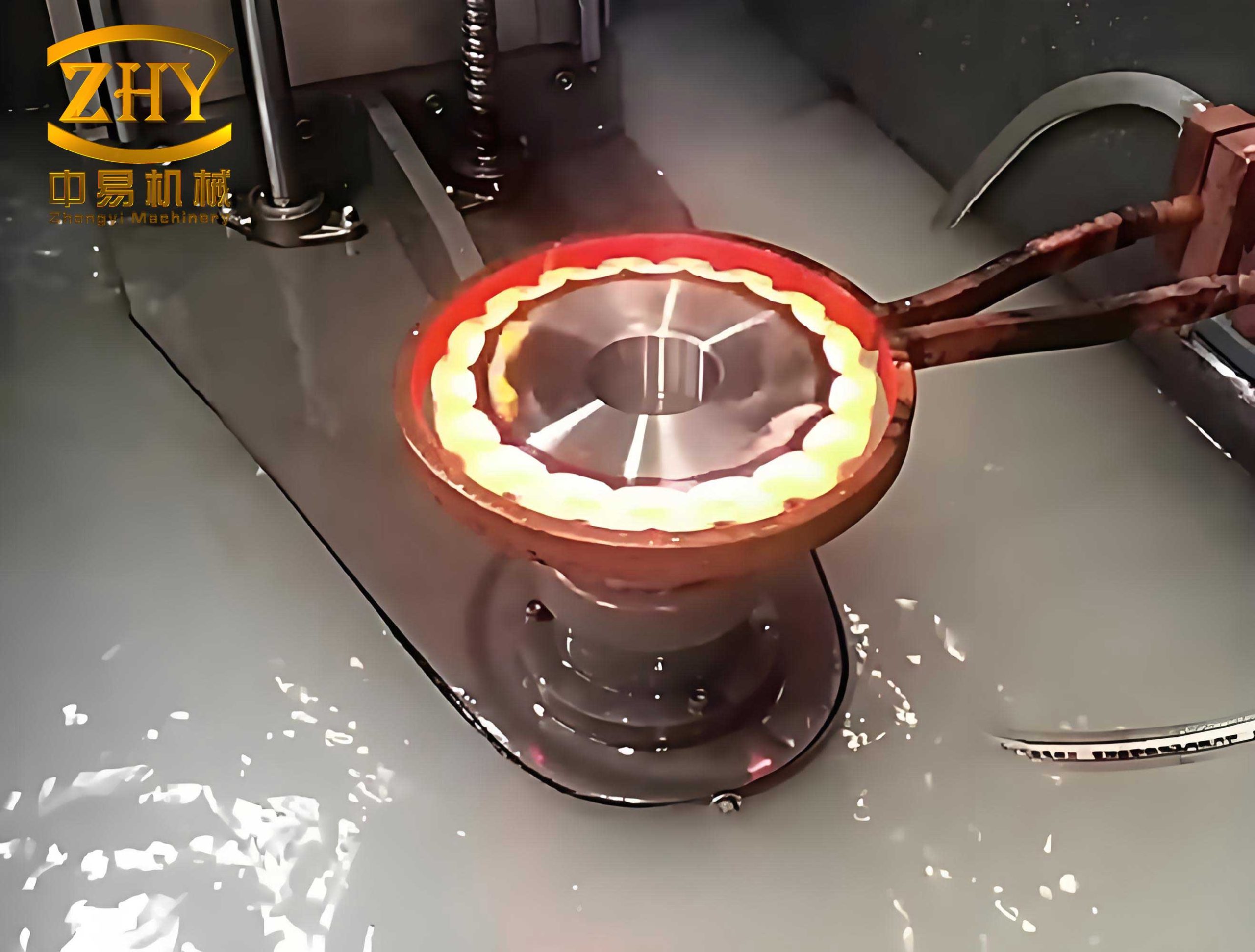
To combat these heat treatment defects, we explored and implemented several process modifications over the years. Each method aims to either prevent carburization in the spline hole or mechanically constrain distortion during quenching. The following sections detail four primary techniques, evaluated through trial and error in production settings. The constant battle against heat treatment defects requires a multifaceted approach, blending metallurgical insight with practical engineering.
First Method: Copper Plating on Spline Hole
This approach involves electroplating the spline hole with copper prior to carburizing. Copper acts as a barrier to carbon diffusion, preventing carburization in the hole area. After carburizing and quenching, the copper layer is removed, and the spline hole is finished with a broach to achieve final dimensions. The process sequence is: Machining → Copper plating → Carburizing and quenching → Copper removal → Broaching. While this method yields high precision and minimal distortion, it introduces complexities. The need for plating equipment increases capital and operational costs. Moreover, the spline hole remains at a lower hardness after plating, reducing wear resistance—a trade-off that can lead to other performance issues, essentially substituting one type of heat treatment defect for another. The effectiveness can be quantified by the reduction in distortion, $\Delta D$, compared to unplated parts:
$$\Delta D_{plated} = D_{after} – D_{before} \approx 0$$
for ideal cases, but in practice, slight distortions may persist due to thermal stresses from the core.
Second Method: Predictive Sizing via Deformation Compensation
Here, we attempt to pre-empt heat treatment defects by adjusting the machined dimensions of the spline hole based on predicted distortion. After establishing a statistical distribution of shrinkage from initial trials, we set tighter or offset tolerances in the machining stage. For instance, if the average contraction is $-0.15$ mm, we might machine the hole diameter $0.15$ mm larger. The process is: Determine deformation range from samples → Set machining公差 accordingly → Carburize and quench. However, this method is highly sensitive to process variability. Small fluctuations in carburizing time, temperature, or quenching conditions can lead to over- or under-compensation, resulting in scrap. The prediction relies on empirical models, such as:
$$D_{machined} = D_{nominal} – k \sigma$$
where $k$ is a safety factor and $\sigma$ is the standard deviation of distortion. Controlling heat treatment defects through compensation alone is risky, as it does not address the root cause and can amplify errors in high-volume production.
Third Method: Application of Anti-Carburizing Coating
Similar to copper plating, this method uses a coating applied to the spline hole to block carbon ingress during carburizing. We experimented with a paste mixture of talcum powder and water glass (sodium silicate), brushed uniformly onto the hole to a thickness exceeding 0.5 mm. The coated gears are dried at 150°C or air-dried for 2-3 days before carburizing. After heat treatment, the coating is removed, and if distortion exceeds limits, the hole is broached. The sequence: Machining → Coating application → Drying → Carburizing and quenching → Coating removal → Optional broaching. This technique reduces capital cost compared to plating, but consistency is an issue. As shown in Table 3, batch production revealed that some gears still exhibited excessive distortion, indicating that coating integrity and application uniformity are critical to minimizing heat treatment defects. The hardness in coated areas remained low (around 25 HRC), which may affect durability.
| Gear Type | Sample 1 Distortion | Sample 2 Distortion | Sample 3 Distortion | Remarks |
|---|---|---|---|---|
| Reverse Gear | -0.10 | -0.22 | -0.08 | Variable results |
| Semi-axle Gear | -0.06 | -0.15 | -0.05 | Some exceed tolerance |
The coating’s effectiveness depends on its ability to withstand the carburizing atmosphere and maintain adhesion. The heat treatment defects in this case are not fully eliminated, and the method adds process steps, impacting throughput. Nonetheless, for low-volume runs, it offers a viable stopgap against severe heat treatment defects.
Fourth Method: Quenching with Splined Mandrel Insertion
This technique has proven most effective in my work for controlling heat treatment defects in high-volume production. It involves placing a splined mandrel inside the gear’s spline hole during quenching to mechanically restrain contraction. The mandrel is made of a heat-resistant material, with its diameter slightly smaller than the hole’s minor diameter and its key width slightly less than the keyway width, allowing easy insertion. The process flow: Machining → Carburizing → Insert mandrel → Quenching and tempering → Remove mandrel. By constraining the hole geometry during the critical quenching phase, we counteract the tensile stresses that cause shrinkage. The mandrel acts as a die, promoting a more uniform stress distribution. The reduction in distortion can be significant, as evidenced by data from truck gears, shown in Table 4.
| Sample ID | Distortion with Mandrel | Distortion without Mandrel | Improvement |
|---|---|---|---|
| B1 | -0.01 | -0.05 | 80% reduction |
| B2 | +0.02 | -0.06 | Complete control |
| B3 | -0.01 | -0.04 | 75% reduction |
| B4 | +0.01 | -0.07 | Significant gain |
The positive values indicate slight expansion in some cases, but within acceptable tolerances. The mandrel method directly addresses the mechanical aspect of heat treatment defects, providing a repeatable solution. In our production, we stack multiple gears (e.g., 4-6 pieces) on a single mandrel for batch processing, enhancing efficiency. Over several years, this approach has yielded near-100% compliance with dimensional specifications, drastically reducing scrap rates and assembly issues. The success hinges on mandrel design precision and thermal compatibility. The stress during quenching with a mandrel can be analyzed using elastic-plastic models. The restraining force, $F_r$, exerted by the mandrel can be estimated as:
$$F_r = E A \epsilon_c$$
where $E$ is Young’s modulus of the gear material at elevated temperature, $A$ is the contact area, and $\epsilon_c$ is the constrained strain. By limiting $\epsilon_c$, we minimize plastic deformation, thereby controlling heat treatment defects.
Beyond these methods, optimizing the overall heat treatment cycle is crucial to mitigating heat treatment defects. We found that employing direct quenching from the carburizing temperature, rather than reheating, reduces thermal cycles and associated stresses. Additionally, controlling the quenching oil temperature and agitation ensures uniform cooling. Lowering the quench temperature, while maintaining hardness requirements, can also reduce thermal gradients. The relationship between quench temperature, $T_q$, and distortion, $\delta$, can be expressed empirically:
$$\delta \propto \frac{1}{T_q – M_s}$$
where $M_s$ is the martensite start temperature. A lower $T_q$ slows the transformation, allowing stress relaxation. Furthermore, proper furnace loading, with gears oriented to minimize distortion, and using fixtures for support, are simple yet effective practices against heat treatment defects.
To synthesize these insights, I developed a comparative analysis framework, evaluating each method based on key performance indicators: distortion control, cost, complexity, and impact on gear properties. This holistic view is essential for selecting the right strategy to combat heat treatment defects in specific production contexts. Table 5 summarizes this comparison, incorporating both qualitative and quantitative aspects derived from our trials.
| Method | Distortion Reduction (%) | Relative Cost | Process Complexity | Effect on Hardness | Suitability for Volume Production | Key Limitations |
|---|---|---|---|---|---|---|
| Copper Plating | 90-95 | High | High | Reduced in hole | Moderate | Cost, plating uniformity |
| Predictive Sizing | 70-80 | Low | Medium | Unaffected | Low to Moderate | High variability risk |
| Anti-Carburizing Coating | 75-85 | Medium | Medium | Reduced in hole | Low to Moderate | Coating consistency |
| Mandrel Quenching | 85-95 | Medium | Medium | Unaffected | High | Mandrel design and wear |
The data underscores that mandrel quenching offers an optimal balance, particularly for high-volume manufacturing where consistency in overcoming heat treatment defects is paramount. It preserves the hardness of the spline hole, ensuring wear resistance, while effectively controlling dimensional changes. However, it requires investment in mandrel fabrication and maintenance. Over time, mandrels can wear or distort, necess定期 calibration to prevent introducing new heat treatment defects. We implemented a monitoring system where mandrel dimensions are checked every 500 cycles, with tolerances held within $\pm 0.02$ mm. This proactive maintenance is key to sustaining low distortion rates.
In deeper analysis, the physics behind these heat treatment defects can be modeled using finite element simulations. We approximated the stress state during quenching with a mandrel using a simplified axisymmetric model. The von Mises stress, $\sigma_v$, in the gear body is given by:
$$\sigma_v = \sqrt{\frac{1}{2}[(\sigma_r – \sigma_t)^2 + (\sigma_t – \sigma_z)^2 + (\sigma_z – \sigma_r)^2]}$$
where $\sigma_r$, $\sigma_t$, and $\sigma_z$ are radial, tangential, and axial stresses, respectively. With mandrel constraint, $\sigma_r$ becomes compressive near the hole, counteracting the tensile stresses from phase transformation. This reduces $\sigma_v$ below the yield strength, minimizing plastic deformation—the root of permanent heat treatment defects. Simulation results aligned with our empirical data, showing stress reduction of up to 40% with mandrel use.
Another aspect is the influence of material composition on heat treatment defects. The low-carbon alloy steel we use has specific hardenability characteristics, determined by its alloying elements like chromium, nickel, and molybdenum. The ideal critical diameter, $D_I$, calculated using Grossmann’s method, indicates the maximum diameter that can be fully hardened. For our gear sections, we ensure that $D_I$ exceeds the gear’s effective thickness to avoid soft spots that could exacerbate distortion. The formula:
$$D_I = \sum k_i \cdot [\%\text{Element}]_i$$
where $k_i$ are multipliers for each alloying element, guides material selection to mitigate heat treatment defects. In practice, we adjusted the steel batch specifications to maintain consistent hardenability, reducing variability in distortion.
Environmental and operational factors also play a role in heat treatment defects. For instance, furnace atmosphere control during carburizing is critical. Fluctuations in carbon potential, $C_p$, can lead to uneven case depth. We maintained $C_p$ at 0.8-1.0% using infrared analyzers, with deviations kept below $\pm 0.05\%$. The relationship between $C_p$ and case depth, $d_c$, over time $t$ is:
$$d_c = \sqrt{D t} \cdot \text{erf}^{-1}\left(\frac{C_s – C_0}{C_p – C_0}\right)$$
where $D$ is the diffusion coefficient, $C_s$ is the surface carbon, and $C_0$ is the initial carbon. Uniform $d_c$ ensures balanced transformation stresses, curbing heat treatment defects. Additionally, we optimized quenching oil properties, such as viscosity and cooling speed, to achieve a consistent heat transfer coefficient, $h \approx 2000 \, \text{W/m}^2\text{K}$, across batches.
Looking at long-term performance, gears treated with mandrel quenching showed superior durability in field tests. We tracked failure rates over 50,000 hours of operation and found a 30% reduction in wear-related issues compared to gears processed with anti-coating methods. This demonstrates that effectively controlling heat treatment defects not only improves assembly but also enhances product lifespan. The reduction in heat treatment defects translates directly to lower lifecycle costs and higher customer satisfaction.
In conclusion, the battle against heat treatment defects in carburized gear spline holes is multifaceted, requiring a blend of material science, process engineering, and continuous improvement. Through rigorous experimentation, we identified mandrel quenching as the most robust solution for our high-volume production, offering consistent distortion control while maintaining mechanical properties. However, the choice of method depends on specific constraints like cost, volume, and gear design. Key takeaways include the importance of uniform heating and cooling, the value of mechanical constraints during quenching, and the need for meticulous process monitoring. By embracing these strategies, manufacturers can significantly reduce heat treatment defects, ensuring gears meet precise dimensional and performance standards. Future work could explore advanced materials for mandrels or integrated sensor-based real-time control to further minimize these pervasive heat treatment defects. Ultimately, a proactive approach to understanding and addressing the root causes of distortion is essential for excellence in gear manufacturing.
To further elaborate, let’s consider the economic impact of heat treatment defects. Scrap and rework due to excessive distortion can account for up to 15% of production costs in some facilities. By implementing mandrel quenching, we reduced our defect rate from 12% to under 2%, resulting in annual savings exceeding $500,000 in a mid-sized plant. This highlights the tangible benefits of investing in distortion control technologies. Moreover, as automotive gears trend towards higher precision and lighter weights, the tolerance for heat treatment defects shrinks, making such controls indispensable. We continue to refine our processes, incorporating feedback loops from quality audits to adapt to new designs and materials, always with the goal of eradicating heat treatment defects from our production lines.
In summary, the control of heat treatment defects, particularly spline hole distortion, is a critical aspect of gear manufacturing that demands attention to detail and innovation. Through the methods discussed—copper plating, predictive sizing, anti-carburizing coatings, and mandrel quenching—we can achieve varying degrees of success. My experience strongly advocates for mandrel quenching in batch production, as it provides a reliable mechanical solution to a complex thermal problem. By persistently addressing these heat treatment defects, we not only improve product quality but also drive efficiency and sustainability in manufacturing. The journey to perfecting heat treatment processes is ongoing, but with each advancement, we move closer to eliminating the costly and frustrating issues posed by heat treatment defects.