
The pursuit of optimal performance in power transmission systems places immense demands on critical components like gears. To meet these demands, gears are routinely subjected to complex thermochemical heat treatment processes, primarily carburizing and quenching, to engineer a hard, wear-resistant surface while maintaining a tough, ductile core. However, these processes, involving drastic thermal gradients and complex microstructural transformations, are fertile ground for the development of heat treatment defects. These defects—encompassing dimensional distortion, residual stresses, retained austenite, and even cracking—directly compromise the geometric accuracy, fatigue life, and reliability of the final component. For complex geometries like thin-web gears, where non-uniform section thickness exacerbates thermal and transformation non-uniformity, predicting and controlling these heat treatment defects becomes a significant engineering challenge. This article delves into the mechanistic origins of these defects in AISI9310 steel thin-web gears and explores the potent role of multi-physics numerical simulation as a tool for understanding, predicting, and ultimately mitigating their detrimental effects.
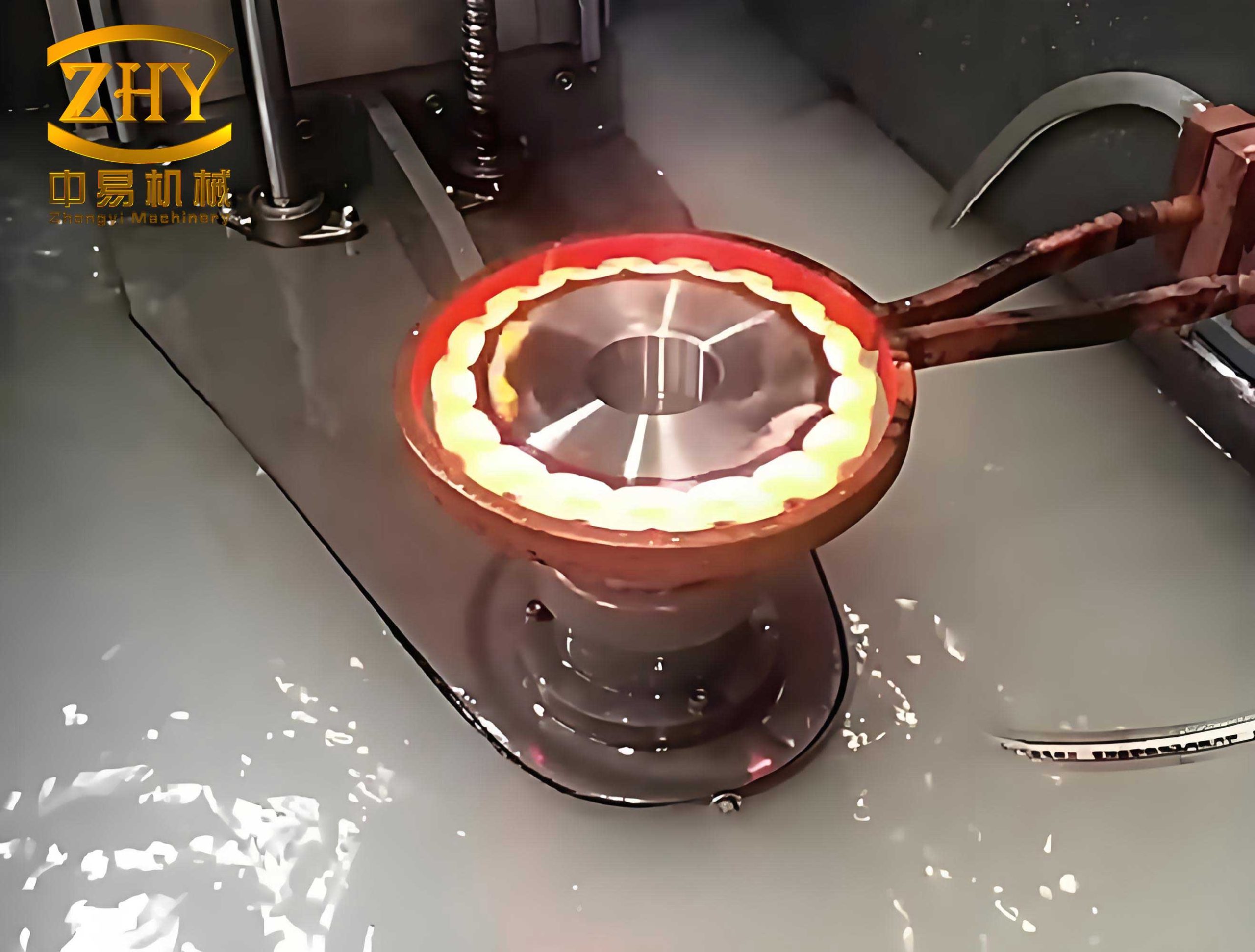
The image above provides a visual synopsis of the challenges faced during heat treatment. It underscores that heat treatment defects are not merely academic concerns but real, observable phenomena that can manifest as warping, size change, surface cracks, or sub-surface stress concentrators. For a gear, distortion can lead to poor meshing, increased noise, and accelerated wear, while uncontrolled tensile residual stresses in critical areas like the tooth root can become initiation sites for fatigue failure. Therefore, a deep understanding of the interplay between thermal history, carbon profile, phase transformations, and the resulting stress-strain state is paramount. This is where finite element method (FEM)-based simulation, integrating coupled field analyses, transitions from a research tool to an essential component of the manufacturing process design.
1. The Intricate Challenge of Gear Heat Treatment
Thin-web gears, characterized by their lightweight design with slender sections connecting the rim to the hub, are particularly susceptible to heat treatment defects. The process sequence for high-performance gears like those made from AISI9310 steel typically involves:
- Carburizing: Diffusion of carbon into the surface at high temperature (e.g., 930°C) to create a high-carbon case.
- Quenching: Rapid cooling (e.g., in oil) to transform the austenitized material into hard martensite.
- Cryogenic Treatment: Cooling to sub-zero temperatures (e.g., -80°C to -196°C) to transform retained austenite (RA) to martensite, enhancing dimensional stability and hardness.
- Tempering: Reheating to a moderate temperature (e.g., 150-200°C) to relieve stresses and improve the toughness of the martensite.
Each stage introduces potential heat treatment defects. The core of the problem lies in the generation of stresses from two primary sources: thermal stress ($\sigma_{th}$) and transformation stress ($\sigma_{tr}$). The total strain increment can be expressed as:
$$ d\varepsilon = d\varepsilon^{e} + d\varepsilon^{p} + d\varepsilon^{th} + d\varepsilon^{tr} + d\varepsilon^{tp} $$
where $d\varepsilon^{e}$ is elastic strain, $d\varepsilon^{p}$ is plastic strain, $d\varepsilon^{th}$ is thermal strain, $d\varepsilon^{tr}$ is transformation strain (volume change), and $d\varepsilon^{tp}$ is transformation plasticity strain. The competition and interaction between these strain components throughout the thermal cycle dictate the final state of distortion and residual stress—the primary heat treatment defects.
2. Classification and Mechanisms of Heat Treatment Defects
Heat treatment defects in carburized and hardened gears can be systematically categorized based on their nature and origin. The following table summarizes the key defects, their root causes, and their impact on gear performance.
| Defect Category | Specific Defect | Primary Mechanism | Consequence for Gear |
|---|---|---|---|
| Dimensional/Geometric | Tooth Profile Distortion (Lead, Profile Error) | Non-uniform cooling and phase transformation due to geometry. Thin sections (tip) cool/transform faster than thick sections (root). | Increased transmission error, noise, vibration, uneven load distribution, reduced contact fatigue life. |
| Diameter Growth/Shrinkage | Net volumetric expansion from martensitic transformation. Carburized case expands more than core. | Altered center distance, affects backlash and mesh conditions. | |
| Warping/Bending of Web | Asymmetric cooling or residual stress patterns causing macroscopic bending moments. | Misalignment, induces runout, affects system dynamics. | |
| Metallurgical/Microstructural | Excessive Retained Austenite (RA) | High surface carbon lowers Martensite Start ($M_s$) temperature, inhibiting complete transformation. | Reduced surface hardness, lower wear resistance, potential for subsequent transformation causing instability. |
| Insufficient Case Hardness or Depth | Incorrect carburizing parameters (time, temperature, atmosphere) or slow quenching. | Reduced load-carrying capacity, increased risk of pitting and spalling. | |
| Stress-Related | Harmful Tensile Residual Stresses | Thermal contraction of the surface constrained by a hotter core during early quenching, followed by complex transformation sequences. | Significantly reduced bending fatigue strength, promotion of crack initiation, especially at tooth root fillets. |
| Quench Cracking | When the combined thermal and transformation stresses exceed the ultimate tensile strength of the material at a given temperature. | Catastrophic failure, part rejection. Often originates at stress concentrators (sharp corners, notches). | |
| Grinding Burns/Cracks | Re-tempering or re-austentization due to excessive heat input during final grinding, exacerbated by pre-existing residual stress fields. | Surface damage, introduction of tensile stresses, reduced fatigue life. |
The genesis of these heat treatment defects is profoundly interconnected. For instance, consider the quenching stage for an AISI9310 gear tooth. The thin tooth tip cools rapidly, contracting and initially going into tension. The cooler, contracting surface tries to shrink but is restrained by the hotter, expanded core, setting up a stress state where the surface is in tension and the core in compression. As the core later cools and undergoes its martensitic transformation (which has a higher $M_s$ temperature due to lower carbon), it expands. This expansion puts the already cold, hard surface into compression. Finally, when the high-carbon surface itself finally cools to its lower $M_s$ and transforms to martensite, it undergoes a large expansion. However, this expansion is constrained by the already-transformed core, leading to a final state where the surface is in high compressive residual stress (desirable) and the core is in tension. Disruptions in this idealized sequence—due to non-uniform heat transfer, geometry, or material properties—are what lead to the undesired heat treatment defects listed above.
3. Numerical Simulation: A Virtual Laboratory for Defect Analysis
Physical experimentation for optimizing heat treatment to minimize heat treatment defects is costly and time-consuming. Numerical simulation based on the Finite Element Method (FEM) provides a powerful alternative. It involves solving a set of coupled partial differential equations governing the physics of the process. The fidelity of the simulation in predicting heat treatment defects hinges on the accuracy of this multi-physics coupling.
3.1 The Governing Equations and Coupling
The simulation integrates four key fields:
1. Temperature Field: Governed by the transient heat conduction equation with internal heat generation from phase transformations ($\dot{q}_{tr}$).
$$ \rho C_p \frac{\partial T}{\partial t} = \nabla \cdot (\lambda \nabla T) + \dot{q}_{tr} $$
where $\rho$ is density, $C_p$ is specific heat, $\lambda$ is thermal conductivity, and $T$ is temperature. The boundary condition involves a heat transfer coefficient ($h$): $-\lambda \frac{\partial T}{\partial n} = h (T – T_{\text{medium}})$.
2. Carbon Diffusion Field: Predicts the carbon profile after carburizing, crucial for determining local $M_s$ temperature and phase transformation behavior. Modeled using Fick’s second law:
$$ \frac{\partial C}{\partial t} = \nabla \cdot (D(T, C) \nabla C) $$
where $C$ is carbon concentration and $D$ is the temperature and composition-dependent diffusion coefficient, often expressed empirically as:
$$ D = D_0 \exp\left(-\frac{Q}{RT}\right) f(C, \text{alloys}) $$
3. Phase Transformation Field: Calculates the evolution of phase fractions (austenite $\gamma$, martensite $\alpha’$, bainite, ferrite/pearlite). Diffusive transformations (ferrite, pearlite, bainite) are often modeled using Johnson-Mehl-Avrami-Kolmogorov (JMAK) kinetics or Scheil’s additive rule. Martensitic transformation, an athermal shear process, is commonly described by the Koistinen-Marburger relationship:
$$ f_{\alpha’} = 1 – \exp[-\kappa (M_s – T)] $$
where $f_{\alpha’}$ is the martensite fraction, $\kappa$ is a material constant, and $M_s$ is the martensite start temperature, which is a strong function of carbon content: $M_s(C) = M_s^0 – K C$, where $M_s^0$ is the $M_s$ for pure iron and $K$ is a constant.
4. Stress-Strain Field: Solves for stresses and strains using the principle of virtual work, incorporating the strain decomposition from the previously stated equation. This requires temperature and phase-dependent material properties: Young’s modulus $E(T, f_i)$, yield strength $\sigma_y(T, f_i)$, thermal expansion coefficient $\alpha(T, f_i)$, and transformation strain (e.g., $\varepsilon^{tr}_{\gamma \to \alpha’} \approx 0.04$ for the volume expansion from austenite to martensite).
The coupling is bidirectional: Temperature affects carbon diffusion, phase transformations, and material properties. Phase transformations release latent heat (affecting temperature) and generate transformation strain (affecting stress). Stress, in turn, can influence phase transformation kinetics (transformation plasticity). Capturing these interactions is essential for accurate prediction of heat treatment defects.
3.2 Simulation Workflow for a Thin-Web Gear
Applying this to an AISI9310 thin-web gear involves:
- Geometry and Meshing: Creating a 3D CAD model, often exploiting symmetry (e.g., a single tooth sector). A fine mesh is critical in areas like the tooth root fillet where stress gradients are high.
- Material Properties: Defining all temperature- and phase-dependent properties for AISI9310 steel. This extensive dataset is often managed within specialized heat treatment simulation software.
- Process Definition: Inputting the exact thermal and chemical boundary conditions for each step: furnace temperature and atmosphere for carburizing, quenchant type and agitation (defining $h(T)$), cryogenic treatment soak, and tempering parameters.
- Execution and Post-Processing: Running the coupled analysis and extracting results: transient temperature, carbon profile, phase fractions (including Retained Austenite), distortion (displacement vectors), and residual stress tensor components ($\sigma_{xx}, \sigma_{yy}, \sigma_{zz}, \tau_{xy}…$).
4. Case Study: Simulating Defects in an AISI9310 Thin-Web Gear
Let’s consider a specific thin-web gear (e.g., module 1.75 mm, 67 teeth). The material is AISI9310, with a nominal composition as shown below.
| C | Ni | Cr | Mn | Mo | Si | Fe |
|---|---|---|---|---|---|---|
| 0.10 | 3.25 | 1.20 | 0.55 | 0.12 | 0.25 | Bal. |
The simulated process includes gas carburizing, oil quenching, cryogenic treatment at -80°C, and tempering at 180°C.
4.1 Predicted Carbon and Hardness Profiles
The simulation first outputs the carbon gradient, which is the foundational driver for subsequent heat treatment defects. The surface carbon reaches ~1.0%, dropping to the core level (~0.1%) over a distance defined as the case depth. Using the carbon profile and the resulting martensite hardness, a hardness gradient is calculated. A typical result might show a surface hardness of 64-66 HRC and an effective case depth (to 550 HV or 52 HRC) of approximately 0.65 mm. Inadequate case depth or low surface hardness are clear heat treatment defects that simulation can help prevent by optimizing carburizing time and potential.
4.2 The Crucial Quenching Sequence: A Dance of Stress and Transformation
Analyzing the transient results during quenching is key to understanding the genesis of residual stress and distortion—the most critical heat treatment defects. The plot below tracks two points: one on the carburized tooth surface and one in the tooth core.
Phase Transformation Sequence: The core, with lower carbon and higher $M_s$, begins transforming to martensite just a few seconds into the quench. The surface, with high carbon and low $M_s$, remains austenitic for over 50 seconds before starting its transformation. This large transformation time lag is a primary source of internal stress development.
Stress Evolution:
– Early Stage (0-2s): Surface cools rapidly, contracts, and goes into tension. Core is hot and in compression.
– Core Transformation (2-50s): Core transforms, expands, and pushes the surface into higher tension. Core stress becomes tensile.
– Surface Transformation (50-300s): Surface finally transforms, undergoes large expansion, but is constrained by the already hard core. This forces the surface into final compression and the core into final tension.
This final stress state—compress surface, tensile core—is generally desirable for fatigue resistance. However, the magnitude and distribution are critical. Excessive tensile stress in the core or at the root fillet are serious heat treatment defects. Simulation quantifies this precisely.
4.3 Impact of Post-Quench Treatments on Defects
Cryogenic treatment and tempering are specifically employed to mitigate certain heat treatment defects.
Cryogenic Treatment: Quenching typically leaves ~15-25% Retained Austenite (RA) at the surface—a potential defect for dimensional stability. The simulation models the further transformation of RA to martensite during cold soak. This secondary transformation induces additional expansion at the surface, typically increasing the surface compressive residual stress by 15-20%. This is beneficial, but it must be controlled to avoid over-stressing the component.
Tempering: This process primarily relieves quench stresses. The simulation shows a reduction in both surface compressive and core tensile stresses, typically by 5-10%. It also models the conversion of brittle quenched martensite to tougher tempered martensite. Inadequate tempering is a defect leading to poor toughness.
The final, most critical heat treatment defects—residual stress and distortion—can now be evaluated.
4.4 Final Residual Stress and Distortion Predictions
The simulation outputs full-field data. Key results for our AISI9310 gear include:
Residual Stress: The axial stress ($\sigma_{zz}$) along the tooth flank and root fillet at the mid-face width is a critical metric. The predicted profile shows maximum compressive stress on the flank (~ -450 MPa) and at the root fillet (~ -560 MPa). The tensile peak is located in the core/sub-case region. The following table compares simulated stresses with experimental measurements from X-ray diffraction (after careful sectioning for the flank measurement).
| Location | Simulated Axial Stress (MPa) | Measured Axial Stress (MPa) | Relative Error |
|---|---|---|---|
| Tooth Flank (Mid-Point) | -448 | -485 | 7.6% |
| Tooth Root Fillet (Mid-Point) | -561 | -536 | 4.7% |
| Sub-surface Tensile Peak | ~+330 | ~+310 | ~6.5% |
The agreement is excellent, validating the model’s ability to predict this major class of heat treatment defects.
Distortion: The simulation predicts the deformed shape. For this thin-web gear, a net radial expansion (growth) of the tooth tip on the order of 0.07-0.08 mm is predicted. Axial distortions (warping of the web) can also be visualized. These predicted deformations can be compared to coordinate measuring machine (CMM) data from treated parts. This allows for the anticipation of geometric heat treatment defects and potential compensation in the pre-heat treatment machining (pre-sizing).
5. Strategies for Mitigating Heat Treatment Defects Using Simulation
The true power of simulation lies not just in predicting heat treatment defects, but in enabling virtual process optimization to minimize them. This involves parametric studies and sensitivity analysis.
| Process Parameter | Typical Adjustment | Primary Effect / Target Defect | Simulation’s Predictive Role |
|---|---|---|---|
| Carburizing Profile | Boost/Diffuse time, Carbon Potential | Controls case depth, surface carbon (affects RA, $M_s$, stress). Target: Optimize hardness profile, control RA. | Predicts carbon gradient, resulting hardness, and $M_s$ gradient for stress analysis. |
| Quenchant & Agitation | Oil type, temperature, agitation speed | Alters heat transfer coefficient $h(T)$. Target: Balance cooling to minimize distortion while achieving hardness. | Models different $h(T)$ curves to find one that minimizes thermal gradients and distortion. |
| Quench Delay | Time between furnace and quench | Allows temperature equalization. Target: Reduce thermal shock and distortion. | Evaluates effect of pre-quench cooling on initial stress state. |
| Cryogenic Cycle | Cooling rate, final temperature, soak time | Controls extent of RA transformation. Target: Maximize dimensional stability without inducing excessive stress. | Quantifies additional martensite formation and the associated stress increase. |
| Tempering Cycle | Temperature, time | Relieves residual stress, improves toughness. Target: Achieve optimal stress relief without over-softening. | Predicts stress relaxation and hardness drop as a function of time-temperature. |
| Fixturing / Press Quenching | Mechanical constraint during quench | Actively counteracts distortion. Target: Achieve net-shape or near-net-shape heat treatment. | Most advanced application. Simulates contact and force between gear and dies to optimize die design and loading. |
For instance, to address tooth bending distortion, a simulation can be run with varying oil temperatures. A warmer oil reduces the cooling severity ($h$), decreasing thermal gradients and likely reducing distortion, but it risks forming non-martensitic products (pearlite, bainite) in the core, which is another defect. Simulation can find the warmest oil temperature that still guarantees full martensite in the core, thereby minimizing distortion-related heat treatment defects without introducing microstructural ones.
6. Advanced Considerations and Future Directions
While the coupled model described is state-of-the-art, the pursuit of ever more accurate prediction of heat treatment defects drives ongoing research. Key areas include:
Material Data Fidelity: The accuracy of the simulation is only as good as the input material properties. Advanced characterization techniques are used to measure $M_s(C)$, transformation plasticity coefficients, and high-temperature flow stresses with greater precision.
Microstructure-Property Linkages: Moving beyond classical continuum mechanics, multi-scale models aim to predict final mechanical properties (fatigue strength, fracture toughness) directly from the simulated microstructure and residual stress field, providing a more direct link between process-induced heat treatment defects and in-service performance.
Machine Learning Integration: The high computational cost of full FEM simulation limits its use for real-time control. Surrogate models built using machine learning (ML) on a large dataset of pre-run simulations can offer instant predictions. This enables closed-loop optimization systems that can adapt the heat treatment process in real-time to compensate for material lot variations or furnace irregularities, actively preventing the formation of heat treatment defects.
7. Conclusion
Heat treatment defects in high-performance AISI9310 thin-web gears, such as distortion, residual stress, and retained austenite, are inherent byproducts of the complex thermochemical and mechanical interactions during processing. These defects are not random but are governed by fundamental principles of heat transfer, diffusion, phase transformation, and mechanics. Numerical simulation based on coupled finite element analysis has emerged as an indispensable tool for decoding these interactions. By virtually modeling the entire sequence—carburizing, quenching, cryogenic treatment, and tempering—engineers can now predict with remarkable accuracy the final state of a component before it ever enters the furnace.
This predictive capability transforms the approach to managing heat treatment defects. It shifts the paradigm from reactive correction (scrap, rework, grinding) to proactive prevention and compensation. Through virtual design of experiments, process parameters can be optimized to find the best compromise between achieving desired hardness and minimizing undesirable stresses and shape changes. Furthermore, simulation provides deep insight into the root causes of defects, guiding fundamental improvements in gear design, fixturing, and process development. As simulation technologies continue to advance, integrating more precise material models and data-driven techniques, their role in eliminating heat treatment defects and manufacturing higher-quality, more reliable gears will only become more central and impactful.