
In our pursuit of advancing agricultural mechanization while optimizing resource utilization, we undertook a significant material substitution project. The challenge was to replace the alloy carburizing steel originally specified for the gears of a small walking tractor model with a more readily available and cost-effective material: 45 medium carbon steel. This initiative, driven by the need for local sourcing and national resource savings, required a fundamental re-evaluation of the manufacturing process, with heat treatment being the most critical factor determining success or failure. The core of this endeavor was not merely substitution but the complete re-engineering of the thermal processing sequence to compensate for the inherent mechanical property differences between the steels and to prevent critical heat treatment defects that could lead to premature gear failure.
The factory leadership actively organized a cross-functional team to tackle this technical challenge. By a certain year, we had produced and assembled gears for over two thousand tractors. Field reports indicated that a significant portion had exceeded substantial operational hours with satisfactory performance. Crucially, rig testing demonstrated that the gears surpassed the standard benchmark, achieving an impressive duration, with wear patterns deemed normal. These results validated that, through meticulously designed heat treatment, 45 steel gears could reliably meet the design and service requirements, effectively circumventing the potential heat treatment defects associated with improper processing of medium carbon steel.
The initial gear design for the 45 steel incorporation already included mechanical reinforcements such as increased module and profile shift. However, these measures were insufficient alone. The performance potential of the material hinges entirely on its thermal history. Analysis of first and second-generation prototype gear failures revealed primary failure modes: tooth breakage, chipping, and fatigue pitting. Tooth fracture was the most prevalent issue. This pointed directly to the comparatively lower impact toughness of 45 steel, especially when subjected to overload or shock loads during service. This inherent limitation became the focal point of our process development. We recognized that unmitigated, this could manifest as a severe heat treatment defect related to inadequate core toughness. Therefore, a rational heat treatment strategy aimed at achieving an optimal combination of surface hardness for wear resistance and core toughness for impact strength was paramount. Our approach focused on two main sequential processes: quenching and tempering (pre-conditioning) and induction surface hardening (final treatment).
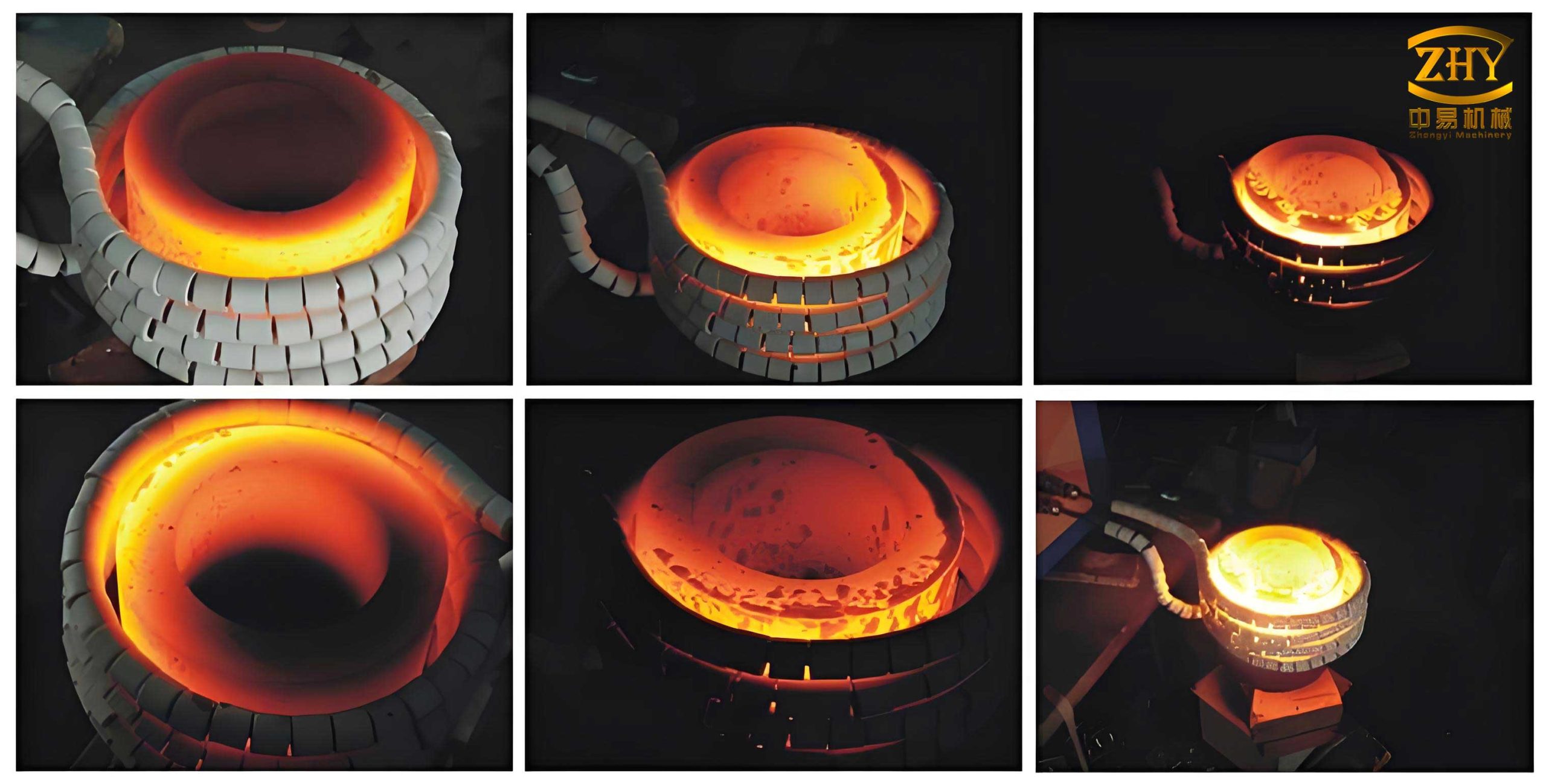
I. Quenching and Tempering (Core Conditioning)
While smaller module gears might bypass this step, it was indispensable for the larger module gears in our application. The objective was to transform the core microstructure into tempered sorbite (fine troostite), with carbides uniformly distributed in a fine, spheroidized form. This structure provides an excellent balance of strength and toughness—the very combination needed to resist catastrophic fracture. For 45 steel, a grade with inherently low hardenability, achieving a uniform structure throughout the tooth cross-section is challenging. Suboptimal processing here is a root cause of subsurface heat treatment defects, such as retained soft ferrite and pearlite bands, leading to poor impact properties.
To overcome the hardenability limitation, we optimized the quenching and tempering parameters aggressively:
- Quenching Temperature: Elevated to approximately 850°C to ensure full austenitization and maximize solute carbon in solution.
- Quenching Medium: A vigorous aqueous solution (e.g., brine or polymer) was employed instead of oil to increase the critical cooling rate and achieve a greater depth of hardening, pushing the martensitic transformation deeper into the core.
- Tempering Temperature: Set at 650°C. This high tempering temperature is crucial. It significantly enhances toughness and ductility by promoting carbide coalescence and stress relief, albeit at the expense of some hardness. The trade-off is deliberate to maximize fracture resistance. The final core hardness target is deliberately kept on the lower side to favor impact energy absorption.
The effectiveness of this stage can be summarized by its role in mitigating the core-related heat treatment defects. A successful process yields a homogeneous, tough core, which also serves as an ideal substrate for the subsequent induction hardening, preventing issues like soft spots or excessive distortion during fast heating.
| Process Parameter | Standard Range for 45 Steel | Our Optimized Parameter | Rationale & Defect Mitigation |
|---|---|---|---|
| Quenching Temperature | 820-840°C | ~850°C | Overcomes hardenability limit, ensures complete transformation, avoids ferrite formation (heat treatment defect). |
| Quenching Medium | Water or Oil | Aggressive Aqueous Solution | Increases cooling rate for deeper martensite penetration, prevents soft pearlitic core (heat treatment defect). |
| Tempering Temperature | 550-600°C | 650°C | Maximizes toughness and stress relief, directly targets the root cause of tooth breakage. |
| Core Hardness (Target) | ~25-32 HRC | <25 HRC | Prioritizes impact toughness over core strength to resist shock loads. |
II. Induction Surface Hardening (Final Treatment)
This is the final and most critical step for imparting surface wear resistance and contact fatigue strength. Poor control here introduces the most direct heat treatment defects affecting service life: shallow case depth, soft surfaces, excessive retained austenite, grinding cracks, or undesirable hardening patterns.
We established stringent control over three key aspects:
1. Case Depth: Depth selection is a compromise. While it must exceed the allowable wear depth, an excessively deep case compromises core toughness and increases quenching stress. For our gear geometry, we targeted a case depth of $$d_c \approx 0.8 \text{ to } 1.2 \text{ mm}$$ at the pitch line. This depth provides sufficient support for surface loads, improving fatigue limits as described by the relationship between endurance limit and case depth, often approximated for bending as: $$\sigma_{e}’ \propto \sigma_{e} \cdot f(d_c, H_{surface}/H_{core})$$ where a properly chosen \(d_c\) enhances the effective endurance limit \(\sigma_{e}’\).
2. Surface Hardness and Microstructure: The aim was to achieve the upper limit of hardness for 45 steel after induction hardening, typically 55-60 HRC. The microstructure target was fine martensite, rated as Level 6 or finer on standard martensite scales for medium carbon steel. Achieving this required precise control over austenitizing temperature during the short induction cycle. Overheating leads to coarse martensite and retained austenite (a ductility-reducing heat treatment defect), while underheating results in incomplete transformation and non-martensitic products like ferrite or pearlite (a hardness-reducing heat treatment defect).
3. Hardness Profile and Pattern Shape: This was our most significant deviation from conventional “full contour” hardening. Acknowledging 45 steel’s lower impact toughness, we deliberately designed the hardening pattern to not extend fully into the tooth root fillet. The stress concentration at the root is high under bending loads. A hard, brittle martensitic case extending into this region can act as a crack initiation site, a classic heat treatment defect leading to tooth breakage. Our optimized pattern leaves approximately 1-2 mm of the tough, tempered core material in the root region. The pattern is “contour-like,” starting at a point on the flank above the root. The specified requirement was that the surface hardness not be below 45 HRC at a point located at a distance from the root equal to one-third of the tooth height. The hardness gradient can be conceptually modeled, showing a steep decline as it approaches the untempered core near the root: $$H(x) \approx H_{surface} – k \cdot x^n$$ where \(x\) is depth from the surface and \(k, n\) are material/process constants. A shallower drop-off (\(k\)) is desirable for load support.
This design offers multiple benefits:
- Improved Bending Strength: The tough core at the root resists crack propagation from bending stresses.
- Reduced Quenching Stress: Eliminates the severe thermal gradients and transformation stresses associated with hardening the complex root geometry, preventing quench cracking—a catastrophic heat treatment defect.
- Process Reliability: Makes the induction heating process more robust and repeatable by avoiding the difficulty of uniformly heating the root area.
Post-analysis of gears that successfully passed extended rig tests confirmed that their hardness patterns consistently exhibited this “root-excluded” characteristic, validating its effectiveness in preventing a critical failure mode.
| Aspect of Induction Hardening | Conventional Target | Our Optimized Target for 45 Steel | Rationale & Defect Avoidance |
|---|---|---|---|
| Case Depth at Pitch Line | Often ~0.5-1.0 mm | 0.8 – 1.2 mm | Balances wear life with core properties. Too shallow is a wear-related heat treatment defect. |
| Hardness Pattern | Full tooth contour, including root | “Contour-like”, excluding root fillet (1-2 mm soft zone) | Prevents brittle fracture initiation at stress-concentrated root, a major heat treatment defect for tough-limited steels. |
| Root Condition | Hardened | Tempered sorbite core (from prior Q&T) | Acts as a crack arrestor, significantly improving impact resistance. |
| Microstructure Quality | Fine Martensite | Fine Martensite (Level 6 or finer) | Avoids coarse martensite or non-martensitic products, both microstructural heat treatment defects. |
III. Analysis of Performance Issues and Correlated Heat Treatment Defects
The initial failure modes observed provided a direct roadmap for process correction. Each failure can be traced to a potential or realized heat treatment defect.
1. Tooth Breakage (Brittle Fracture): This was the dominant issue. The root cause was insufficient fracture toughness. In the context of heat treatment, this defect arises from:
- A core microstructure that is not fully tempered sorbite (e.g., contains bainite or untempered low-carbon martensite with low toughness).
- An induction hardness pattern that extends into the root, creating a sharp, hard-brittle zone at the point of maximum tensile stress.
- Excessive case depth, which reduces the effective cross-section of the tough core material.
The fracture stress in bending, considering a surface crack, relates to toughness: $$\sigma_f \approx \frac{K_{IC}}{Y\sqrt{\pi a}}$$ where \(K_{IC}\) is fracture toughness, \(a\) is flaw size, and \(Y\) is a geometry factor. Our process directly aimed to maximize \(K_{IC}\) of the core and root region.
2. Chipping (Spalling at Edges): This localized failure often results from a combination of high hardness and sharp edges. Heat treatment defects contributing to chipping include:
- Overheating during induction hardening, leading to grain growth and reduced fracture strength at the austenite grain boundaries.
- An excessively deep or through-hardened case at the tooth tip, leaving no ductile substrate to support the hard layer.
3. Fatigue Pitting: While less frequent than breakage, this is a surface fatigue phenomenon. Key heat treatment defects that accelerate pitting are:
- Insufficient surface hardness or a shallow case depth, leading to subsurface shear stress exceeding the material’s fatigue strength.
- The presence of soft spots or non-martensitic transformation products (e.g., troostite, ferrite) on the surface, which act as stress concentrators and initiate micropits.
- Inadequate compressive residual stresses in the case. Proper induction hardening should induce beneficial compressive stresses. Inconsistent heating/quenching can lead to tensile stresses, a detrimental heat treatment defect.
The contact fatigue life is often modeled by equations like the Lundberg-Palmgren theory: $$L_{10} \propto \left( \frac{p_0}{S_{hf}} \right)^c$$ where \(L_{10}\) is the rated life, \(p_0\) is the maximum contact pressure, \(S_{hf}\) is the subsurface fatigue strength, and \(c\) is an exponent. Our process aims to maximize \(S_{hf}\) through high, uniform surface hardness and a supportive case-core transition.
| Observed Failure Mode | Primary Root Cause (Material/Design) | Associated Heat Treatment Defect(s) | Our Mitigation Strategy |
|---|---|---|---|
| Tooth Breakage | Low Impact Toughness of 45 Steel | 1. Inadequate core toughness (Poor Q&T). 2. Hard, brittle root fillet (Wrong hardening pattern). |
1. High-temp tempering for max toughness. 2. “Root-excluded” induction pattern. |
| Chipping / Edge Breakdown | Stress concentration at sharp edges | 1. Overheated, coarse microstructure. 2. Lack of ductile support under hardened case. |
1. Precise control of induction temperature. 2. Controlled case depth, not full through-hardening. |
| Surface Pitting | Cyclic hertzian contact stress | 1. Low/uneven surface hardness. 2. Shallow case depth. 3. Soft spots or non-martensitic phases. |
1. Aim for upper hardness limit (55-60 HRC). 2. Target 0.8-1.2 mm case depth. 3. Ensure fine, fully martensitic case. |
IV. The Integrated Solution: A Process Flow to Minimize Defects
The successful application stemmed from viewing the heat treatment not as two isolated steps but as an integrated system where each stage prepares the component for the next while actively suppressing specific heat treatment defects. The sequence and its purpose are as follows:
- Forging & Normalization: To homogenize the microstructure and refine the grain size after hot working, preventing banded structures that can cause anisotropic properties and become a precursor to heat treatment defects in subsequent steps.
- Machining: Performed on the normalized blank.
- Quenching & High-Temperature Tempering (Core Conditioning):
- Goal: Create a uniform, high-toughness core (Tempered Sorbite, HRC <25).
- Defects Prevented: Soft core with ferrite/pearlite, poor impact strength, distortion/ cracking during induction hardening due to stress incompatibility.
- Induction Surface Hardening (Final Case):
- Goal: Create a hard, wear-resistant surface layer (Fine Martensite, 55-60 HRC) with a controlled “root-excluded” pattern and defined case depth.
- Defects Prevented: Shallow case, soft surface, quench cracks in root, excessive retained austenite, full-hard brittle root, grinding burns (due to lower final hardness than carburized case).
- Low-Temperature Tempering (Stress Relief): A crucial, often overlooked step after induction hardening. Performed at ~180-200°C to relieve quenching stresses from the martensitic transformation without significantly reducing hardness. This step mitigates the risk of delayed cracking, a time-dependent heat treatment defect.
- Final Grinding (if required): Must be performed with extreme care to avoid introducing grinding burns or cracks, which are final manufacturing heat treatment defects that can undo all previous careful processing.
V. Conclusion: Validation and Broader Implications
The rigorous application of this optimized dual-process heat treatment protocol transformed the performance characteristics of the 45 steel gears. By systematically addressing each potential failure mode through targeted thermal processing, we effectively mitigated the key heat treatment defects that would otherwise plague a medium-carbon steel component under high cyclic and shock loads. The field performance and rigorous bench testing confirmed that the gears not only met but exceeded the required lifespan standards.
This case study underscores several critical principles in metal part manufacturing:
- Material substitution is often a systems engineering challenge centered on heat treatment redesign.
- The concept of “defects” extends beyond cracks and distortion to include suboptimal microstructures and mechanical property distributions that predetermine service failure.
- For components subject to impact or bending, a hard case must be supported by a very tough core, and stress concentration zones like root fillets may benefit from being kept out of the brittle case region.
- Process parameters must be tailored to the specific hardenability and property limitations of the chosen material. What works for an alloy steel can induce serious heat treatment defects in a plain carbon steel.
The success of this project demonstrated that with deep process understanding and control, cost-effective and locally sourced materials like 45 steel can be engineered to perform reliably in demanding applications, accelerating the adoption of essential machinery while optimizing national industrial resources. The continuous focus on identifying, understanding, and eliminating every link in the chain of potential heat treatment defects was the cornerstone of this achievement.