
In my experience as a metallurgical engineer, the heat treatment of hot forging dies, particularly those made from 5CrNiMo steel, is a critical process that directly impacts die longevity and performance. This article delves into the comprehensive study of heat treatment parameters for 5CrNiMo steel gear hot forging dies, emphasizing how proper thermal processing can mitigate common heat treatment defects. The goal is to outline a scientifically sound approach to enhance hardness, mechanical properties, and overall service life, addressing production needs efficiently.
Hot forging dies are expensive and heavily utilized in manufacturing, making their lifespan a significant economic factor. The primary determinants of die durability are material selection and the quality of heat treatment. Based on practical production scenarios, I have analyzed various factors influencing die performance, with a focus on designing a robust heat treatment protocol. This involves meticulous material choice, precise control of thermal parameters, and rigorous assessment of mechanical outcomes. Failure to address heat treatment defects can lead to premature die failure, resulting in costly downtime and reduced productivity.
The selected material for this study is 5CrNiMo steel, a low-alloy tool steel known for its excellent hardenability, toughness, strength, and wear resistance. Its mechanical properties remain relatively stable from room temperature up to 500–600°C, retaining hardness above 300 HBW even at 500°C due to molybdenum content, which reduces sensitivity to temper brittleness. This steel is widely used for large and medium-sized forging dies. However, it is prone to forming flake cracks (white spots) if cooling processes post-forging are not strictly controlled, highlighting the importance of proper thermal management. The chemical composition of the 5CrNiMo steel used here is detailed in Table 1.
| C | Ni | Mn | Mo | Cr | S | P |
|---|---|---|---|---|---|---|
| 0.55 | 1.68 | 0.72 | 0.25 | 0.73 | 0.006 | 0.006 |
The die in question is designed for producing intermediate constant-mesh gears, with a height of 336 mm, a weight of 3 tons, and specified hardness values: 38 HRC for the working face and 32 HRC for the shank (tail section). Achieving these targets requires a nuanced heat treatment strategy to avoid common heat treatment defects such as surface oxidation, decarburization, inadequate cooling, or improper tempering.
A critical aspect of my analysis involves examining die failure causes. Statistics indicate that heat treatment issues account for approximately 50% of all die failures, underscoring the necessity of optimizing thermal processes. Common heat treatment defects include surface oxidation or decarburization (30%), prolonged cooling or insufficient tempering (10%), and incorrect quenching temperatures (10%). Other factors, like structural design flaws (10%), material problems (10%), and machining errors (10%), also contribute, but heat treatment remains the predominant concern. Table 2 summarizes these failure modes, emphasizing the prevalence of heat treatment defects.
| Failure Cause | Percentage (%) |
|---|---|
| Structural Design Issues | 10 |
| Material Problems (Including Selection Errors) | 10 |
| Machining Process Defects | 10 |
| Heat Treatment Defects (e.g., oxidation, decarburization, improper cooling/tempering) | 50 |
| Surface Treatment and Grinding Cracks | 12 |
| Equipment Misoperation | 8 |
To mitigate these heat treatment defects, a systematic heat treatment protocol is essential. The process begins with forging the steel billet to eliminate directional fiber structures and achieve uniform properties. Post-forging, slow cooling is mandatory to prevent white spot formation, a severe heat treatment defect that drastically reduces ductility and impact toughness. The subsequent heat treatment stages include annealing, quenching and tempering (conditioning), and shank tempering, each tailored to enhance specific properties.
Annealing is performed to relieve internal stresses from forging, refine grain structure, and improve machinability. The steel is heated to 780–800°C, held for sufficient time, and then furnace-cooled to 500°C before air cooling. This yields a ferrite-pearlite microstructure with reduced hardness, facilitating further machining. Inadequate annealing can lead to residual stresses, contributing to heat treatment defects like cracking during quenching.
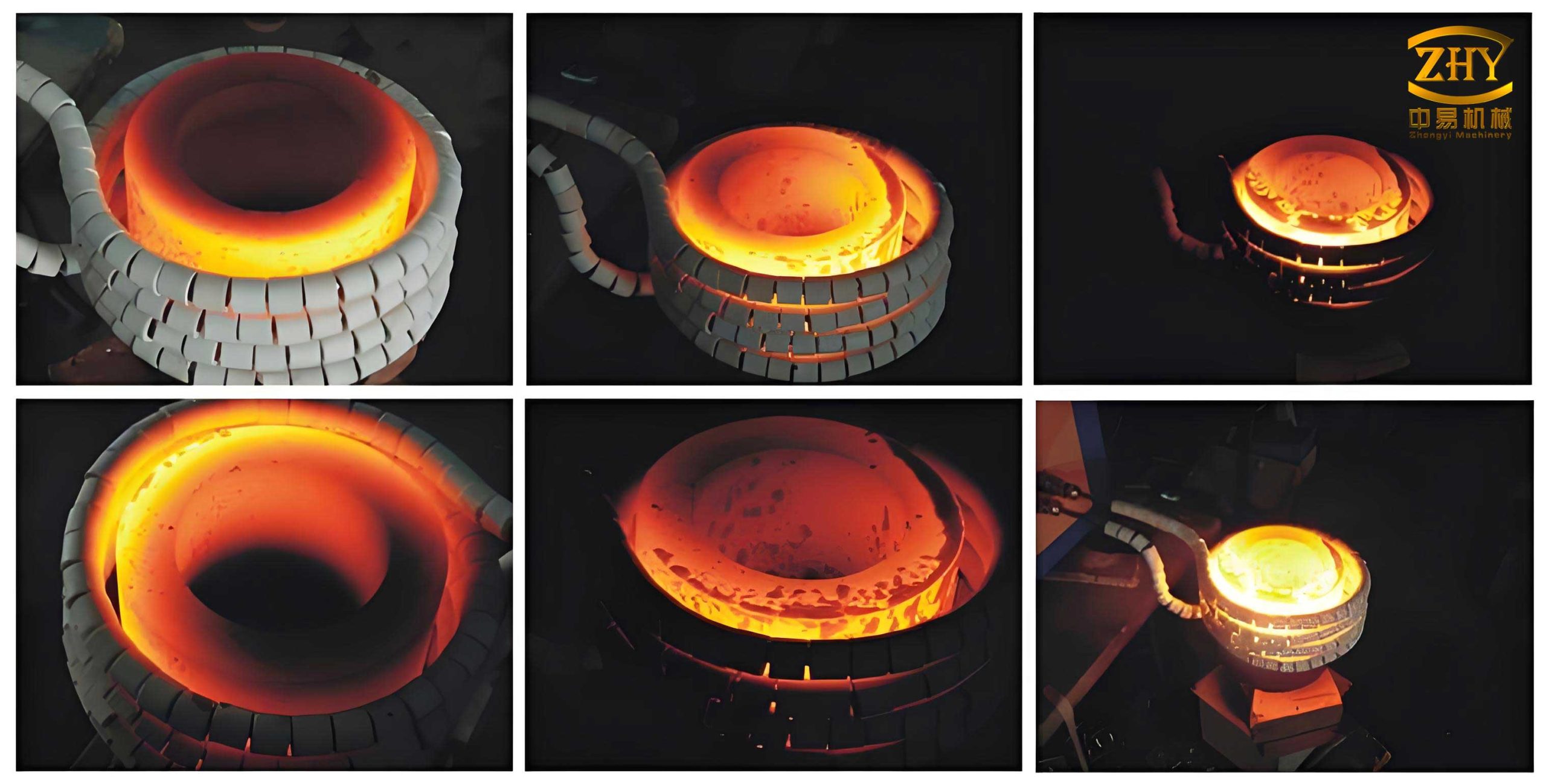
Quenching and tempering (conditioning) are pivotal for achieving the desired hardness and toughness. The die is preheated at 600–650°C to minimize thermal shock, then heated to the austenitizing temperature of 840–860°C. The holding time is calculated based on die dimensions to ensure thorough austenitization while avoiding grain growth, a potential heat treatment defect. The formula for minimum holding time is: $$ \tau = a h $$ where:
– \(\tau\) is the holding time in minutes,
– \(a\) is a coefficient (0.4 min/mm for salt bath furnaces),
– \(h\) is the die height in mm.
For a die height of 365 mm, \(\tau \approx 146\) minutes (about 2.5 hours). In practice, a 6-hour hold is used to account for furnace characteristics and ensure homogeneity.
After heating, the die is air-cooled to ≤780°C to reduce thermal stress, then quenched in oil. The quenching sequence involves partial immersion to manage cooling rates: the die is immersed for 5 minutes, the shank is exposed to allow temperature recovery, and this cycle repeats 3–5 times until the overall temperature drops to 150°C. This controlled cooling prevents cracking and distortion, common heat treatment defects associated with rapid quenching. Immediately after, tempering is conducted at 420–450°C for 5–6 hours in a box furnace to relieve stresses, reduce brittleness, and produce a tempered troostite structure. The heat treatment curve is illustrated in Figure 1, though no explicit reference is made to images in the text.
Shank tempering is specifically applied to lower the hardness of the die’s shank (to 286–321 HBW or 30.5–35 HRC), enhancing toughness to prevent breakage. This is done using a salt bath heated to 620–650°C, with heating duration determined by observing the color change on the working face (bluish-gray indicates ~400°C). After heating, the shank is oil-quenched to 100°C and air-cooled, yielding a sorbitic structure. Neglecting this step can result in localized heat treatment defects, such as excessive hardness leading to premature failure.
To quantify the impact of heat treatment on mechanical properties, several formulas and models are relevant. For instance, the relationship between hardness and tempering temperature can be expressed using the Hollomon-Jaffe equation: $$ H = H_0 – k \cdot T \cdot \log(t) $$ where:
– \(H\) is the hardness after tempering,
– \(H_0\) is the as-quenched hardness,
– \(k\) is a material constant,
– \(T\) is the tempering temperature in Kelvin,
– \(t\) is the tempering time in hours.
This helps predict hardness variations and optimize parameters to avoid heat treatment defects like under- or over-tempering.
Additionally, cooling rate during quenching influences microstructure and stress. The heat transfer during oil quenching can be modeled with Newton’s law of cooling: $$ \frac{dT}{dt} = -r (T – T_{\text{oil}}) $$ where:
– \(T\) is the die temperature,
– \(T_{\text{oil}}\) is the oil temperature,
– \(r\) is the cooling rate constant.
Integrating this allows estimation of cooling times to prevent martensitic transformation issues, a source of heat treatment defects.
After implementing the above heat treatment process, the dies were tested for hardness and mechanical properties. The working surface exhibited an average hardness of 39 HRC, and the shank averaged 32.5 HRC, meeting the specified requirements. Tensile strength reached 1360 MPa, indicating excellent overall performance. These results confirm that the tailored heat treatment protocol effectively minimizes heat treatment defects, ensuring uniform hardness, enhanced toughness, and improved thermal fatigue resistance.
In summary, the heat treatment of 5CrNiMo steel gear hot forging dies is a complex but crucial process that demands precision to avoid prevalent heat treatment defects. Through careful control of annealing, quenching, tempering, and shank treatment, optimal mechanical properties can be achieved. The use of formulas and systematic approaches, as detailed here, provides a framework for replicating success in industrial settings. Future work could explore advanced techniques like cryogenic treatment or surface engineering to further mitigate heat treatment defects and extend die life. This study underscores that mastering heat treatment is key to unlocking the full potential of hot forging dies, driving efficiency and cost-effectiveness in manufacturing.