
As an engineer specializing in mechanical design and manufacturing, I have always been fascinated by the complex interplay between material processing and component performance. In particular, the heat treatment of critical transmission components like spiral bevel gears presents a significant challenge due to the inherent risk of heat treatment defects. These defects, primarily manifested as undesirable residual stresses and dimensional distortions, can severely compromise gear fatigue life, noise characteristics, and overall transmission efficiency. Traditional experimental methods for probing these internal phenomena are often costly, time-consuming, and limited in spatial resolution. Therefore, in this comprehensive analysis, I employ the finite element method (FEM) via DEFORM software to delve deeply into the carburizing and quenching process of a spiral bevel gear. My goal is to unravel the temporal evolution of microstructure, stress, and deformation, and to quantify how key process parameters influence these critical outcomes. This virtual prototyping approach is indispensable for predicting and mitigating heat treatment defects before physical trials, thereby optimizing process windows and enhancing product reliability.
The core material under investigation is a low-alloy steel, analogous to 12Cr2Ni4A, commonly chosen for high-performance gears due to its excellent hardenability and core toughness. The chemical composition that governs its response to heat treatment is summarized below.
| Element | C | Mn | Si | Cr | Ni | P | S |
|---|---|---|---|---|---|---|---|
| Content (wt.%) | 0.10-0.15 | 0.30-0.60 | 0.17-0.37 | 1.25-1.75 | 3.25-3.75 | <0.025 | <0.015 |
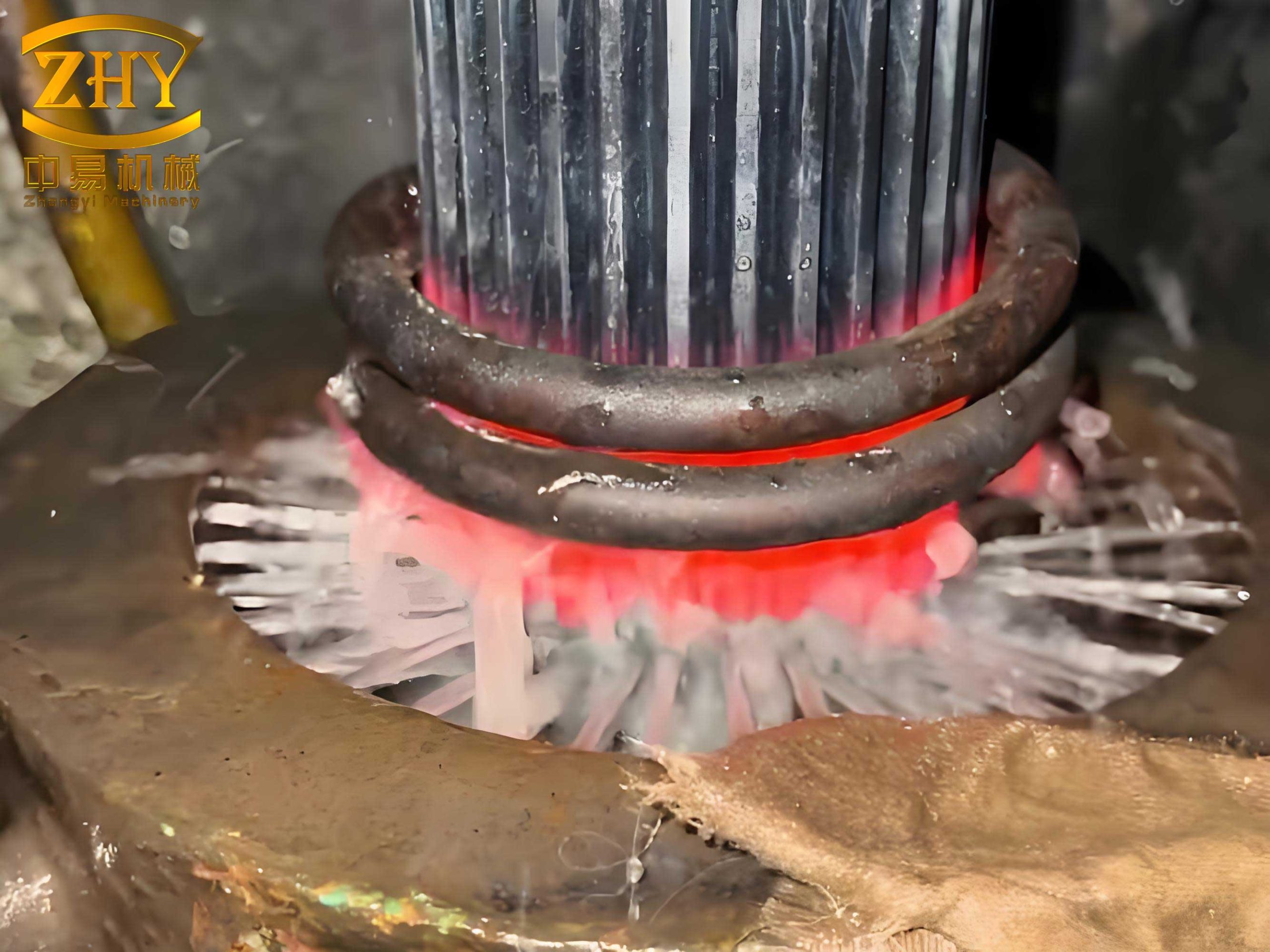
The comprehensive heat treatment cycle simulated includes normalizing, quenching, tempering, carburizing, deep cryogenic treatment, and low-temperature tempering. However, the focal point of this simulation is the carburizing and quenching segment, which is the primary generator of residual stresses and distortion. The thermal profile for this segment involves heating to a carburizing temperature, holding for diffusion, followed by rapid quenching in oil. The quenching phase is where the most severe thermal gradients and phase transformations occur, leading directly to the formation of heat treatment defects.
The simulation is grounded in fundamental principles of heat transfer and thermo-elasto-plasticity. The transient temperature field during quenching is governed by the three-dimensional heat conduction equation with an internal heat source term accounting for the latent heat of phase transformation:
$$ \lambda \left( \frac{\partial^2 T}{\partial r^2} + \frac{1}{r} \frac{\partial T}{\partial r} + \frac{\partial^2 T}{\partial x^2} \right) + Q = \rho c_p \frac{\partial T}{\partial t} $$
Here, \(T\) is temperature, \(t\) is time, \(\lambda\) is thermal conductivity, \(\rho\) is density, \(c_p\) is specific heat, and \(Q\) represents the heat generation rate from phase transformations. The boundary condition for heat loss during oil quenching is modeled as convection: \( -k \frac{\partial T}{\partial n} = h (T – T_{\text{quenchant}}) \), where \(h\) is the heat transfer coefficient. The stress-strain response is calculated using incremental plasticity theory, incorporating temperature-dependent yield strength, Young’s modulus, and thermal expansion coefficient. The phase transformation kinetics, particularly for austenite to martensite, are modeled using the Koistinen-Marburger equation: \( V_m = 1 – \exp[-k(M_s – T)] \), where \(V_m\) is martensite volume fraction, \(M_s\) is martensite start temperature, and \(k\) is a material constant. The carbon profile from carburizing directly lowers the surface \(M_s\) temperature, a critical factor in the development of residual stress patterns, a key class of heat treatment defects.
Constructing an accurate finite element model is paramount. The spiral bevel gear geometry is complex, with a conical shape and varying tooth thickness. Key parameters for the model are listed in the table below.
| Geometric Parameter | Value |
|---|---|
| Module | 3.25 mm |
| Pressure Angle | 20° |
| Spiral Angle | 30° |
| Number of Teeth | 27 |
| Pitch Diameter | 87.75 mm |
| Outer Cone Distance | 132.50 mm |
A 3D solid model is discretized into approximately 35,364 tetrahedral elements with 8,588 nodes. Mesh refinement is applied at the tooth surfaces and roots, as these regions experience the steepest gradients and are most prone to heat treatment defects. The material properties for the steel, including thermal and mechanical data as functions of temperature and phase, are fully defined in the DEFORM material library. The initial condition for the quenching simulation is a uniform temperature equal to the austenitizing temperature. The quenching oil bath is set at 60°C with a convective heat transfer coefficient that is a function of surface temperature and phase change.
The simulation outputs provide a rich, time-resolved dataset. Let’s first examine the metallurgical outcome. After the complete carburize-quench cycle, the predicted martensite distribution shows a classic gradient. The surface layer achieves a martensite volume fraction exceeding 0.95, corresponding to a high hardness of approximately 62-64 HRC. In contrast, the core region has a significantly lower martensite fraction, resulting in a lower hardness around 30-35 HRC. This gradient is desirable for performance but is intrinsically linked to the development of stress, a potential source of heat treatment defects if not properly controlled.
The evolution of stress is a dynamic competition between thermal stress and transformation stress. Thermal stress arises from differential thermal contraction, while transformation stress results from the volumetric expansion associated with the austenite-to-martensite change. The following sequence, observed at a point on the tooth surface (P_surf) and a point in the core (P_core), illustrates this interplay:
- Early Quenching: The surface cools rapidly, contracting more than the hot core. This generates tensile stress on the surface (\(\sigma_{surf} > 0\)) and compressive stress in the core (\(\sigma_{core} < 0\)). This is purely a thermal stress effect.
- Core Transformation: As the core cools to its higher \(M_s\) temperature, it transforms to martensite first, expanding. The cooler, still-ductile surface yields, relaxing the surface tensile stress.
- Surface Transformation: Later, the carbon-enriched surface reaches its lower \(M_s\) and transforms, expanding. This expansion is now constrained by the already-strengthened core, leading to the development of compressive stress at the surface (\(\sigma_{surf} < 0\)) and tensile stress in the core (\(\sigma_{core} > 0\)).
- Final State: After complete cooling to room temperature, a stable residual stress field is established: high surface compressive stress and core tensile stress. This final stress state is a combination of the locked-in thermal and transformation stresses. Excessive tensile stress in the core or inadequate compressive stress on the surface are significant heat treatment defects that can initiate fatigue cracks.
The axial stress history at these points can be qualitatively described by a simplified model considering strain contributions:
$$ \Delta \epsilon_{total} = \Delta \epsilon_{thermal} + \Delta \epsilon_{phase} + \Delta \epsilon_{elastic} + \Delta \epsilon_{plastic} $$
where \(\Delta \epsilon_{thermal} = \alpha \Delta T\), and \(\Delta \epsilon_{phase}\) is related to the volume change from phase transformation. The final residual stress \(\sigma_{res}\) is the stress required to satisfy compatibility conditions after all inelastic strains are accounted for.
Dimensional distortion is another critical heat treatment defect. The simulation tracks the displacement of nodes over time. The overall trend shows that the gear tooth expands volumetrically due to the martensitic transformation, but not uniformly. The thin tooth tip and edges cool and transform faster than the bulkier root and web regions. This non-uniform volumetric change leads to complex distortions: tooth flank profile deviations, pitch errors, and changes in backlash. The maximum displacement vector often occurs at the tooth tip, pointing outward from the cone center. The magnitude of this distortion, often on the order of tens to hundreds of microns, is crucial for determining the required grinding allowance in subsequent finishing operations. Failure to predict this accurately can lead to scrap parts or poor gear meshing performance, which are direct consequences of unmanaged heat treatment defects.
To systematically study the influence of process parameters, I conducted a series of simulations varying the oil quenching temperature. The results for hardness, residual stress, and axial deformation at three distinct points (surface P1, subsurface P2 at 0.9mm depth, and core P3) are summarized below. This analysis directly links process control to the mitigation of heat treatment defects.
| Quench Temp. (°C) | Location | Hardness (HRC) | Residual Stress (MPa) | Axial Deformation (μm) |
|---|---|---|---|---|
| 40 | P1 (Surface) | 62.1 | -485 | +82 |
| P2 (Subsurface) | 52.3 | -210 | +65 | |
| P3 (Core) | 33.5 | +155 | +48 | |
| 60 | P1 (Surface) | 62.5 | -510 | +89 |
| P2 (Subsurface) | 53.0 | -235 | +72 | |
| P3 (Core) | 34.0 | +175 | +55 | |
| 80 | P1 (Surface) | 62.6 | -530 | +95 |
| P2 (Subsurface) | 53.2 | -255 | +78 | |
| P3 (Core) | 34.2 | +190 | +60 |
The data reveals clear trends. As the quenchant temperature increases from 40°C to 80°C:
- Hardness: Shows a slight increase, particularly in the core, but the surface hardness saturates. This is because a higher quenchant temperature reduces cooling severity, allowing more time for carbon diffusion and potentially reducing retained austenite, but the effect on the already-high surface hardness is minimal.
- Residual Stress: The surface compressive stress becomes more negative (increases in magnitude), and the core tensile stress increases. This is a critical finding for managing heat treatment defects. A higher quench temperature reduces the thermal gradient early in cooling, decreasing the initial thermal stress component. However, it also affects transformation timing and may increase the transformation stress component due to more complete martensite formation or changes in transformation plasticity. The net result observed here is a favorable increase in surface compressive stress, which enhances resistance to contact fatigue and bending fatigue—common failure modes that originate from heat treatment defects like insufficient compressive stress.
- Deformation: The axial deformation increases monotonically with quenchant temperature. This is a direct consequence of reduced cooling rate. Slower cooling allows stress relaxation through plasticity for a longer duration, but it also leads to more uniform phase transformation, which can result in greater overall volumetric expansion from martensite formation. This increased distortion is a tangible heat treatment defect that must be compensated for in machining.
The relationship between quench temperature (T_q) and surface compressive stress (\(\sigma_s\)) can be approximated by a linear fit for this range: $$ \sigma_s \approx -485 – 0.75 \times (T_q – 40) \, \text{MPa} $$. Similarly, the distortion (δ) at the tooth tip follows: $$ \delta \approx 82 + 0.26 \times (T_q – 40) \, \mu\text{m} $$. These empirical relations, derived from simulation data, highlight the trade-off: higher temperatures improve the beneficial residual stress but exacerbate the heat treatment defect of distortion.
Further analysis of the stress state reveals its multiaxial nature. The principal stresses \(\sigma_1, \sigma_2, \sigma_3\) at the tooth root fillet, a critical area for bending fatigue, are all compressive on the surface but transition to tensile internally. The von Mises equivalent stress, given by $$ \sigma_{vM} = \sqrt{\frac{1}{2}[(\sigma_1-\sigma_2)^2 + (\sigma_2-\sigma_3)^2 + (\sigma_3-\sigma_1)^2]} $$, shows a peak not at the surface but slightly subsurface, often coinciding with the region where residual stresses transition from compressive to tensile. This subsurface peak in equivalent stress is a potential nucleation site for fatigue cracks if the material’s fatigue strength is exceeded, representing a hidden heat treatment defect influenced by the process cycle.
Microstructurally, the simulation predicts the amount of retained austenite, which is another subtle but important factor. Excessive retained austenite, often a heat treatment defect in high-carbon surfaces, can lead to dimensional instability under load and reduced wear resistance. The model shows that for the standard cycle, surface retained austenite is around 8-10%. The deep cryogenic treatment in the full process sequence is specifically designed to mitigate this heat treatment defect by promoting further transformation of austenite to martensite.
In practical terms, this simulation study provides a quantitative framework for process optimization. To minimize the spectrum of heat treatment defects, one must balance competing objectives. For instance, if maximizing fatigue performance is paramount, a higher quench temperature (e.g., 80°C) might be selected to boost surface compressive stress, accepting the larger distortion that will require a larger but predictable grinding stock. Conversely, for a gear where minimizing subsequent machining is critical, a lower quench temperature might be chosen, with the understanding that other parameters (like tempering) may need adjustment to manage the resultant residual stress profile. The finite element model acts as a virtual testbed for exploring these trade-offs without the cost and delay of physical trial-and-error, which is inherently prone to producing heat treatment defects.
Expanding the discussion, other potential heat treatment defects can be inferred or studied with this model. Non-uniform quenching due to gear geometry can lead to soft spots or uneven hardness, a direct heat treatment defect. The simulation’s temperature field clearly shows that the tooth tip and flank cool faster than the root and the gear backbone. This can be addressed by modifying quenchant flow or using press quenching fixtures, the design of which can be guided by the simulated thermal and deformation fields. Furthermore, the model can predict the risk of quenching cracks, a catastrophic heat treatment defect, by identifying regions where the principal tensile stress during quenching exceeds the material’s fracture strength at that temperature.
In conclusion, the DEFORM-based finite element simulation has proven to be an exceptionally powerful tool for dissecting the complex phenomena during the heat treatment of spiral bevel gears. It successfully maps the genesis and evolution of microstructure, residual stress, and distortion—the primary manifestations of heat treatment defects. The detailed time-history data provides insights that are nearly impossible to obtain experimentally. The parametric study on quench temperature quantitatively demonstrates the intricate coupling between process variables and final gear properties. It underscores that managing heat treatment defects is not about their elimination, but about their precise control and prediction. The compressive stress is, in fact, a desirable “defect,” while distortion is an undesirable one. The simulation enables engineers to navigate this landscape intelligently. By predicting distortion magnitudes, it informs grinding allowances and fixturing design. By mapping residual stresses, it guides assessments of fatigue life and potential failure modes. Ultimately, this virtual engineering approach is indispensable for advancing from a paradigm of correcting heat treatment defects to one of preventing them through informed, physics-based process design, ensuring the manufacture of spiral bevel gears that meet the ever-increasing demands for power density, durability, and efficiency in modern mechanical transmissions.