
In the realm of mechanical engineering, gear transmissions stand as the most prevalent form of power transmission, critical to the operation of countless industrial machines. As an engineer specializing in machine tool design and metallurgy, I have extensively studied the material selection and heat treatment processes employed in gear systems, particularly for robust applications like the TPX619B series horizontal boring and milling machines. These machines, known for their complex spindle boxes and numerous gears, demonstrate remarkably low failure rates, a testament to meticulous design and processing. However, even in well-engineered systems, heat treatment defects can emerge, compromising performance and longevity. In this article, I will delve into the intricacies of gear materials, heat treatment methodologies, and the pervasive issue of heat treatment defects, aiming to provide a thorough understanding that spans over 8000 tokens. I will incorporate multiple tables and formulas to summarize key data and relationships, ensuring clarity and depth.
Gear systems in machine tools, such as the TPX619B, operate under demanding conditions involving low to medium speeds, high torques, and significant axial forces. The primary motor delivers 7.5 kW at 1450 rpm, with spindle speeds ranging from 8 to 1000 rpm, a maximum torque of 1225 Nm, and an axial thrust of 12250 N. This environment necessitates gears with high bending and contact fatigue strength, superior surface hardness and wear resistance, and adequate core toughness and strength. To achieve these properties, material choice and heat treatment are paramount. Common materials include medium-carbon steels like 40 and 45, and low-alloy steels such as 40Cr and 45Mn2, often subjected to processes like high-frequency induction hardening or carburizing followed by quenching and tempering. Despite rigorous protocols, heat treatment defects remain a critical concern, leading to issues like gear noise, tooth breakage, and dimensional distortion, which I will explore in detail.
The selection of gear materials is guided by operational loads and environmental factors. For gears subjected to frequent impact and shifting, such as those in the main drive system of the TPX619B, alloy steels like 20Cr are preferred for carburizing treatments. Carburizing enhances surface carbon content, allowing subsequent hardening to achieve high surface hardness (e.g., 58-59 HRC) while maintaining a ductile core (30-45 HRC). The depth of the carburized layer is crucial and is often determined by the gear module. Based on empirical data, the relationship between module (m) and carburizing depth (d) can be expressed as a piecewise function. For instance, for modules up to 1.25 mm, d ranges from 0.1 to 0.25 mm, while for heavier modules above 6 mm, d exceeds 0.5 mm. In high-load applications like the TPX619B, depths of 0.9 mm are specified for critical gears to ensure durability. However, improper control here can lead to heat treatment defects such as excessive case depth, resulting in brittle cores prone to fracture.
To systematically evaluate material and process choices, I present Table 1, which summarizes typical gear materials and their corresponding heat treatments, alongside common associated heat treatment defects. This table expands on the principles applied in machines like the TPX619B.
| Gear Type / Application | Recommended Material | Heat Treatment Process | Target Surface Hardness (HRC) | Core Hardness (HRC) | Common Heat Treatment Defects |
|---|---|---|---|---|---|
| Light-duty, high-speed gears | 20Cr, 20MnCr5 | Gas Carburizing + Quenching + Low-Temp Tempering | 58-62 | 30-45 | Distortion, shallow case depth, oxidation |
| Medium-duty gears (e.g., general transmission) | 40Cr, 45 | High-Frequency Induction Hardening + Tempering | 48-55 | 25-35 | Soft spots, cracking, excessive hardening depth |
| Heavy-duty, impact-prone gears (e.g., TPX619B main drive) | 20Cr (for carburizing), 40Cr (for induction) | Deep Carburizing (0.7-1.1 mm) + Quenching + Tempering | 58-59 | 30-45 | Tooth breakage due to brittle core, residual stresses |
| Precision, small-module gears | 16MnCr5, 18CrNi8 | Carbonitriding + Quenching + Tempering | 60-64 | 35-40 | Dimensional inaccuracies, porosity |
Heat treatment defects arise from deviations in process parameters, material inconsistencies, or design flaws. One major category is distortion, which often occurs due to non-uniform heating or cooling during quenching. For gears, this can lead to misalignment and increased noise. The distortion (δ) can be modeled approximately by the equation: $$ \delta = k \cdot \alpha \cdot \Delta T \cdot L $$ where k is a geometric factor, α is the coefficient of thermal expansion, ΔT is the temperature gradient, and L is a characteristic length. In induction hardening, rapid heating can cause steep thermal gradients, exacerbating distortion if not controlled. Another critical defect is insufficient surface hardness, often resulting from inadequate quenching media, low carbon content, or improper tempering. This reduces wear resistance and can cause premature pitting. For instance, in TPX619B gears, deviations below the specified 48 HRC for induction-hardened parts have led to deformation under load, highlighting the impact of heat treatment defects.
Cracking is a severe heat treatment defect, particularly in carburized gears. It typically originates from excessive case depth or high internal stresses. The risk of cracking (C) can be related to case depth (d) and core hardness (H_c) through an empirical relationship: $$ C \propto \frac{d^2 \cdot H_c}{\sigma_y} $$ where σ_y is the yield strength of the core material. When carburizing depth is too deep, as sometimes seen in small gears, the core becomes overly hard and loses toughness, leading to brittle fracture under cyclic bending stresses. This aligns with issues observed in production where small carburized gears experienced tooth breakage—a direct consequence of heat treatment defects. Furthermore, residual stresses induced by quenching can promote crack initiation if not relieved through proper tempering.
Non-uniform hardness profiles, another class of heat treatment defects, arise from factors like irregular heating in induction processes or uneven carbon diffusion in carburizing. This results in soft spots or banding, which accelerate wear and reduce fatigue life. The hardness profile H(x) as a function of depth x from the surface can be described for a carburized case by: $$ H(x) = H_s \cdot e^{-bx} + H_c $$ where H_s is the surface hardness, b is a decay constant dependent on process parameters, and H_c is the core hardness. Deviations from the ideal profile indicate heat treatment defects. For example, in high-frequency hardened gears, improper coil design can lead to localized overheating, causing mixed microstructures like retained austenite, which lowers hardness and stability.
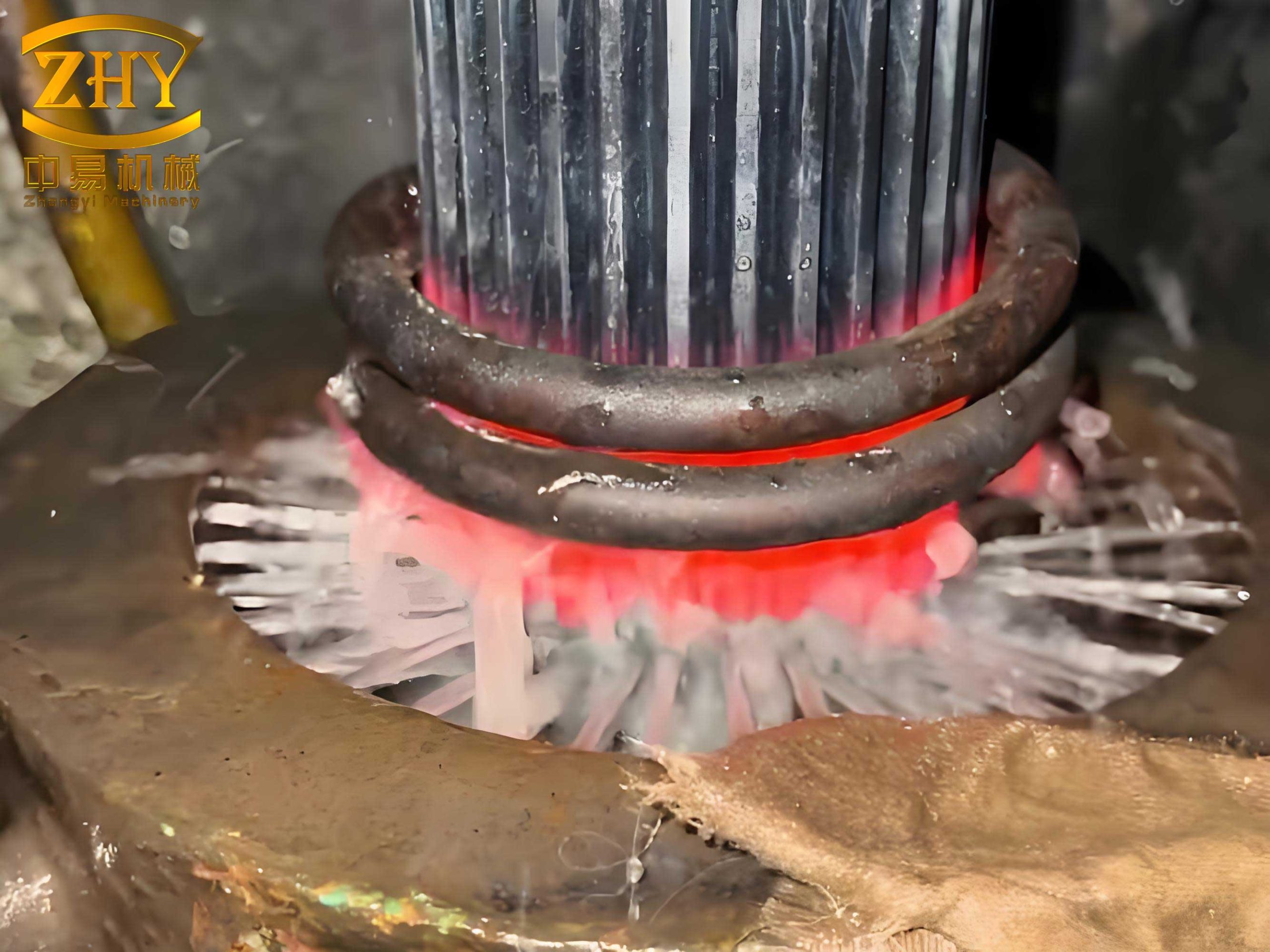
The image above illustrates typical heat treatment defects, such as cracks and distortion in gear teeth, underscoring the importance of process control. In the context of TPX619B gears, while overall reliability is high, occasional failures have been traced to heat treatment defects. For example, gears designated for carburizing (like those numbered 5-8, 13, 14 in the drive system) require a case depth of 0.9 mm. If this depth exceeds specifications, the core hardness rises beyond 45 HRC, reducing toughness and increasing susceptibility to fracture—a clear heat treatment defect. Conversely, if the depth is too shallow, wear resistance diminishes, leading to another form of heat treatment defect. Similarly, induction-hardened gears (e.g., those made from 40Cr) aim for 48 HRC; undershooting this due to fast tempering or inadequate quenching results in soft surfaces prone to deformation, again a heat treatment defect.
To mitigate heat treatment defects, several strategies can be employed. First, material selection must be precise, with controlled carbon content—for instance, limiting 45 steel to 0.42-0.47% C and 40Cr to 0.37-0.42% C for induction hardening. Second, process optimization is key. For carburizing, temperature (T), time (t), and carbon potential (C_p) must be carefully regulated. The case depth d can be estimated using the Harris formula: $$ d = k \sqrt{t} \cdot e^{-Q/(RT)} $$ where k is a constant, Q is activation energy, R is the gas constant, and T is absolute temperature. Deviations here cause heat treatment defects like shallow or deep cases. Third, post-heat treatment inspections, including hardness testing and microstructural analysis, help detect heat treatment defects early. Non-destructive methods like magnetic particle inspection can reveal surface cracks.
Another aspect is the interaction between heat treatment defects and gear geometry. Stress concentration at tooth roots exacerbates issues like cracking. The bending stress (σ_b) at the root can be calculated using the Lewis formula: $$ \sigma_b = \frac{F_t}{b m Y} $$ where F_t is tangential force, b is face width, m is module, and Y is the form factor. If heat treatment defects such as decarburization or soft zones are present at the root, the effective strength drops, leading to fatigue failures. Therefore, ensuring uniform heat treatment across the gear profile is crucial to avoid these heat treatment defects.
In practice, for the TPX619B main drive gears, a combination of induction hardening and carburizing is used based on load conditions. Table 2 outlines the specific processes and potential heat treatment defects for key gear groups, derived from operational data.
| Gear Group (Based on Load) | Material | Heat Treatment | Target Parameters | Typical Heat Treatment Defects Observed |
|---|---|---|---|---|
| High-impact, shifting gears | 20Cr | Carburize (0.9 mm) + Quench + Temper | Surface: 58-59 HRC, Core: 30-45 HRC | Tooth breakage (brittle core), distortion from quenching |
| General transmission gears | 40Cr | High-Frequency Hardening + Temper | Surface: 48 HRC, Core: As-rolled or normalized | Soft spots, cracking due to rapid cooling |
| Precision, low-load gears | 16MnCr5 | Carbonitriding + Quench + Temper | Surface: 60-64 HRC, Case: 0.3-0.5 mm | Dimensional changes, porosity in case |
Heat treatment defects are not limited to mechanical properties; they also affect gear noise and vibration. Irregular hardness or residual stresses can cause micro-geometric deviations, leading to meshing errors and acoustic emissions. This is often seen in gears where grinding after heat treatment is insufficient to correct distortions—another manifestation of heat treatment defects. In TPX619B applications, controlling grinding processes to remove decarburized layers or correcting warpage is essential to minimize such heat treatment defects.
Advanced heat treatment techniques, such as plasma nitriding or low-temperature electrolytic sulfonation, can reduce some heat treatment defects by offering better control over case depth and lower distortion. For instance, nitriding at temperatures around 500°C introduces compressive stresses, enhancing fatigue resistance without the quenching risks associated with traditional methods. However, these processes require precise parameter control to avoid heat treatment defects like white layer formation or spalling.
From a metallurgical perspective, the microstructure after heat treatment is critical. For induction-hardened gears, the desired surface structure is tempered martensite, while the core remains pearlitic or ferritic from prior normalizing or quenching and tempering. Heat treatment defects such as excessive retained austenite or overtempered martensite can occur if tempering temperatures or times are off-spec. The volume fraction of retained austenite (V_γ) can be estimated by: $$ V_γ = f(T_q, C, t_t) $$ where T_q is quenching temperature, C is carbon content, and t_t is tempering time. High V_γ reduces hardness and dimensional stability, contributing to heat treatment defects.
In conclusion, heat treatment defects pose significant challenges in gear manufacturing for machine tools like the TPX619B boring and milling machines. Through careful material selection, process optimization, and rigorous inspection, these defects can be minimized. The interplay between gear design, material properties, and heat treatment parameters dictates performance, and even minor deviations can lead to failures. By understanding and addressing heat treatment defects—whether distortion, cracking, or hardness issues—engineers can enhance gear reliability and longevity. This comprehensive analysis, spanning material science to practical applications, underscores the importance of mastering heat treatment to mitigate heat treatment defects in heavy-duty mechanical systems.