
In my research, I have focused on understanding how carburizing heat treatment processes influence the microstructure and mechanical properties of gears, particularly in the context of automotive applications. Gears are critical components in transmission systems, and their failure often stems from fatigue-related issues such as tooth bending fatigue and surface pitting. The performance of gears is heavily dependent on the heat treatment applied, with carburizing being a prevalent method to enhance surface hardness and wear resistance. However, improper heat treatment can lead to various heat treatment defects, which significantly compromise gear life. This study aims to explore the effects of different carburizing schedules on gear quality, emphasizing the role of heat treatment defects like non-martensitic formations and grain growth. Throughout this work, I will present findings from experiments conducted on a new type of gear steel, using tables and formulas to summarize data, and I will integrate a visual reference to illustrate common heat treatment defects.
Carburizing involves diffusing carbon into the surface of low-carbon steel at elevated temperatures, followed by quenching to form a hard martensitic case. The process parameters, such as temperature, time, and carbon potential, must be precisely controlled to achieve optimal results. Deviations can introduce heat treatment defects, including excessive retained austenite, carbide networks, or non-martensitic phases, all of which degrade fatigue resistance. In this investigation, I compared a standard carburizing cycle with an extended one, analyzing how these variations affect microstructural features and, consequently, fatigue performance. The core of this work lies in identifying how subtle changes in heat treatment can precipitate significant heat treatment defects, ultimately impacting gear reliability.
Experimental Methodology
I selected a batch of gear steel, specifically 20CrNi2MoH, which is commonly used in automotive transmissions due to its excellent hardenability and toughness. The chemical composition of the steel was verified through spectrometry, and the results are summarized in Table 1. This composition ensures a good balance between core toughness and case hardness after carburizing.
| C | Mn | Si | Cr | Ni | Mo | P | S | Fe |
|---|---|---|---|---|---|---|---|---|
| 0.23 | 0.61 | 0.08 | 0.79 | 1.70 | 0.33 | 0.012 | 0.033 | Bal. |
The gears were machined into spiral bevel gears with a diameter of approximately 55 mm. I subjected these gears to two distinct carburizing and quenching protocols in a controlled atmosphere furnace. The furnace used propane as a enriching gas, methanol and nitrogen as carrier gases, and was equipped with oxygen probes and thermocouples for precise regulation of carbon potential and temperature. The two heat treatment cycles are detailed in Table 2. The “normal” cycle represents the standard industrial practice, while the “extended” cycle involved an additional hour in the carburizing stage to assess its impact.
| Process Stage | Temperature (°C) | Time (min) – Normal | Time (min) – Extended |
|---|---|---|---|
| Strong Carburizing | 915 | 195 | 255 |
| Diffusion | 915 | 37 | 37 |
| Quenching (Holding) | 850/870 | 145 | 145 |
After heat treatment, I evaluated the gears using metallographic examination, microhardness testing, and fatigue bench testing. Microhardness profiles were measured from the surface to the core using a Vickers hardness tester with a 30 kgf load (HV30). The effective case depth was defined as the distance from the surface to the point where hardness reaches 550 HV1. Microstructural analysis involved etching samples with nital and observing them under an optical microscope to identify phases like martensite, retained austenite, carbides, and any non-martensitic structures. Fatigue testing was conducted on a bench rig under a torque of 535.5 N·m and a speed of 345 rpm, simulating real-world operating conditions.
Results and Analysis
The carbon concentration profiles obtained from layer-by-layer chemical analysis are presented in Table 3. Both heat treatment cycles produced similar carbon distributions, indicating that the extended carburizing time did not significantly increase the case depth. This can be explained by the diffusion kinetics governed by Fick’s laws. The carbon flux during carburizing is described by:
$$ \frac{\partial C}{\partial t} = D \frac{\partial^2 C}{\partial x^2} $$
where \( C \) is the carbon concentration, \( t \) is time, \( x \) is the distance from the surface, and \( D \) is the diffusion coefficient. For a given temperature, extending time beyond a certain point yields diminishing returns in depth due to decreasing concentration gradients. The effective case depths, measured via hardness, were 0.96 mm for the normal process and 0.94 mm for the extended process, confirming this trend. However, the extended cycle introduced notable heat treatment defects, as seen in the microstructural evaluation.
| Distance from Surface (mm) | Carbon Content (Normal) – wt.% | Carbon Content (Extended) – wt.% |
|---|---|---|
| 0.00-0.05 | 0.84 | 0.86 |
| 0.05-0.15 | 0.89 | 0.83 |
| 0.15-0.25 | 0.77 | 0.76 |
| 0.25-0.35 | 0.74 | 0.72 |
| 0.35-0.45 | 0.67 | 0.67 |
| 0.45-0.65 | 0.59 | 0.58 |
| 0.65-0.85 | 0.47 | 0.48 |
| 0.85-1.05 | 0.44 | 0.37 |
| 1.05-1.25 | 0.35 | 0.33 |
| 1.25-1.45 | 0.32 | 0.27 |
Microstructural observations revealed that gears from the normal cycle exhibited a fine martensitic structure at the surface with minimal retained austenite and carbides, meeting technical specifications. In contrast, gears from the extended cycle showed non-martensitic phases at the tooth root surface, typically less than 0.01 mm thick, which are classic heat treatment defects. These non-martensitic areas likely consist of bainite or ferrite, resulting from insufficient quenching severity or carbon depletion, and they act as stress concentrators. Additionally, grain size analysis of fatigue fracture surfaces indicated abnormal grain growth in the extended cycle samples. The normal process gears had relatively uniform grain sizes, while the extended process gears displayed localized regions with coarse grains, another form of heat treatment defect that reduces toughness and fatigue resistance.
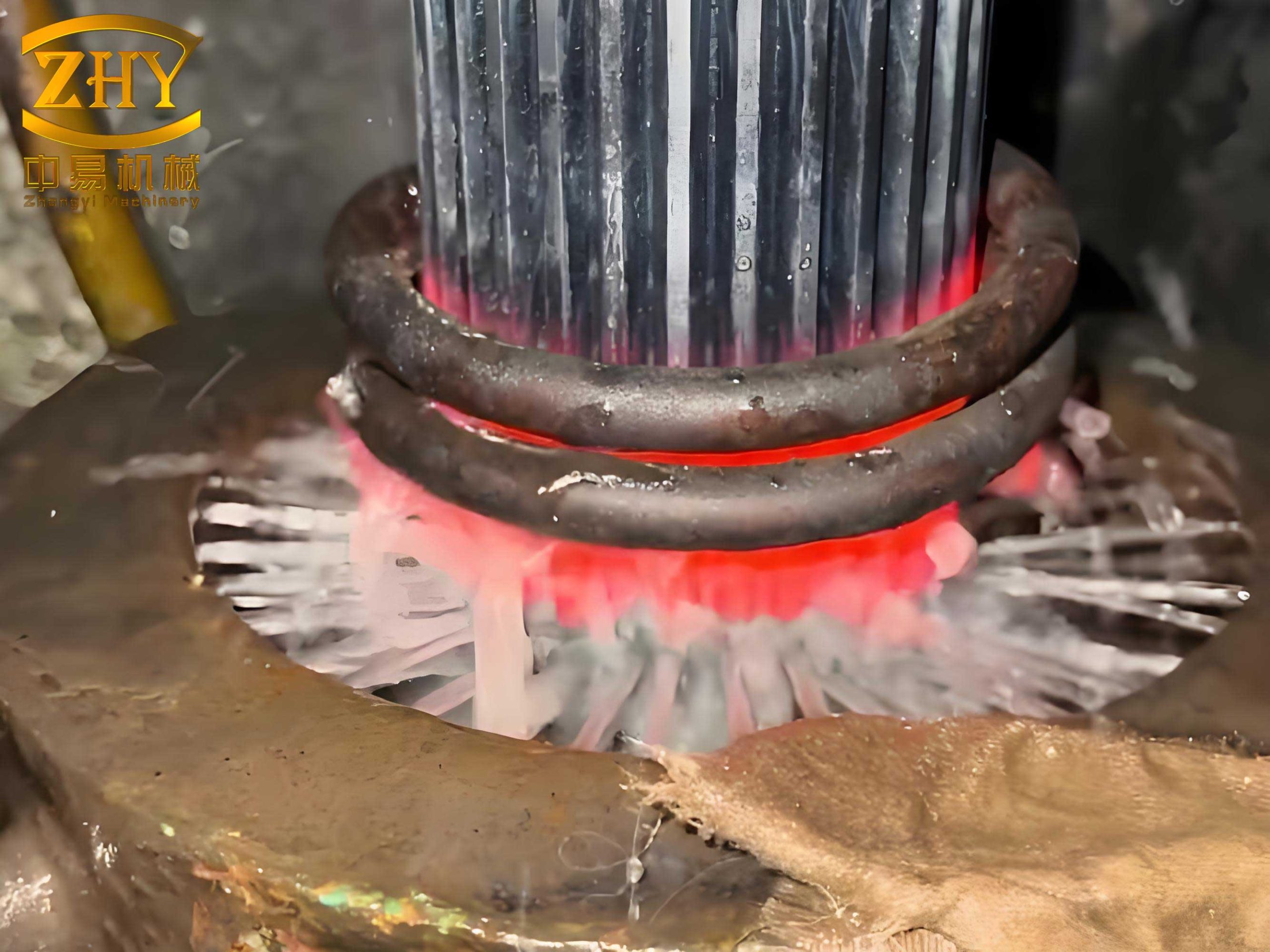
The microhardness data is summarized in Table 4. Surface hardness values were similar for both processes, but the presence of non-martensitic structures in the extended cycle could lead to microhardness variations at specific locations. The core hardness remained consistent, indicating that the extended time did not affect the transformation in the interior. However, the key difference lies in the heat treatment defects introduced, which directly influenced fatigue performance.
| Process | Surface Hardness (HV30) | Core Hardness (HV30) | Effective Case Depth (mm at 550 HV1) | Microstructural Notes |
|---|---|---|---|---|
| Normal Carburizing | 733-734 | 442-443 | 0.96 | Fine martensite, minimal retained austenite, no non-martensitic phases. |
| Extended Carburizing | 711-713 | 444 | 0.94 | Non-martensitic phases at tooth root surface, coarse grains observed. |
Fatigue bench test results, shown in Table 5, demonstrated a significant reduction in life for gears subjected to the extended carburizing cycle. The average fatigue life dropped by over 30% compared to the normal cycle. This degradation can be attributed to the combined effects of heat treatment defects. The non-martensitic zones at the tooth root serve as initiation sites for cracks due to their lower hardness and strength. Moreover, abnormal grain growth reduces the material’s resistance to crack propagation, as larger grains facilitate easier dislocation movement and lower fracture toughness. The relationship between fatigue life and these defects can be approximated using models like the Paris-Erdogan law for crack growth:
$$ \frac{da}{dN} = C (\Delta K)^m $$
where \( da/dN \) is the crack growth rate, \( \Delta K \) is the stress intensity factor range, and \( C \) and \( m \) are material constants. Heat treatment defects such as non-martensitic structures and coarse grains increase \( C \) or reduce the threshold \( \Delta K \), accelerating fatigue failure.
| Carburizing Process | Fatigue Life (hours) – Individual Tests | Average Fatigue Life (hours) |
|---|---|---|
| Normal | 8.00, 13.83, 14.25 | 12.03 |
| Extended | 7.50, 6.51, 9.50 | 7.84 |
To further quantify the impact of heat treatment defects, I analyzed the grain size using the ASTM grain size number \( G \), defined as:
$$ N = 2^{G-1} $$
where \( N \) is the number of grains per square inch at 100x magnification. For the normal process, \( G \) was around 8-9, indicating fine grains, while the extended process showed regions with \( G \) as low as 5-6, denoting coarse grains. This coarsening is a direct result of prolonged exposure to high temperatures during carburizing, which promotes grain boundary migration. Such microstructural instability is a critical heat treatment defect that undermines mechanical properties.
Discussion on Heat Treatment Defects and Their Mitigation
In this study, I observed that extending carburizing time beyond the optimal range does not enhance case depth but instead fosters heat treatment defects. These defects, including non-martensitic formations and abnormal grain growth, are detrimental to gear performance. Non-martensitic phases often arise from factors like low carbon potential at the surface during quenching or inadequate cooling rates. In the extended cycle, the additional time may have led to slight decarburization or segregation, resulting in localized areas with insufficient carbon for full martensite transformation. This highlights the importance of controlling atmosphere composition and quenching media to avoid such heat treatment defects.
Abnormal grain growth is another severe heat treatment defect linked to excessive time at high temperatures. The driving force for grain growth is the reduction in grain boundary energy, described by:
$$ \Delta G = \gamma \cdot \Delta A $$
where \( \Delta G \) is the change in Gibbs free energy, \( \gamma \) is the grain boundary energy, and \( \Delta A \) is the change in boundary area. Prolonged heating increases mobility of boundaries, leading to coalescence of grains. This defect not only reduces fatigue strength but also impacts toughness and wear resistance. To prevent these heat treatment defects, process optimization is essential. For instance, using lower carburizing temperatures or implementing grain refining elements in the steel chemistry can help. Additionally, post-carburizing treatments like shot peening can alleviate some surface defects by inducing compressive stresses, but they cannot rectify inherent microstructural flaws.
The fatigue life reduction observed aligns with the presence of heat treatment defects. Statistical analysis of the fatigue data shows a significant variance between the two processes. I calculated the coefficient of variation (CV) for the normal process as approximately 25% and for the extended process as around 20%, indicating consistent but lower life in the latter. This underscores that heat treatment defects introduce predictable failures, emphasizing the need for stringent quality control. In industrial settings, monitoring tools like non-destructive testing can detect such defects early, but prevention through optimized heat treatment schedules is paramount.
Conclusions
Based on my investigation, I conclude that the normal carburizing and quenching process yields gears with satisfactory microstructure and fatigue life, adhering to technical standards. However, extending the carburizing time by one hour introduces significant heat treatment defects, including non-martensitic phases at the tooth root surface and abnormal grain growth. These defects do not improve case depth but substantially reduce fatigue performance, with an average life decrease of over 30%. Therefore, precise control of heat treatment parameters is crucial to avoid such heat treatment defects and ensure gear reliability. Future work should explore advanced techniques like vacuum carburizing or low-pressure processes to minimize defect formation, and incorporate computational models to predict microstructural evolution under varying conditions.
In summary, this study underscores the delicate balance in heat treatment design and the severe consequences of deviations. Heat treatment defects are not merely cosmetic issues; they are fundamental flaws that compromise component integrity. By leveraging data from tables and formulas, I have demonstrated how empirical observations align with theoretical principles, providing a framework for optimizing gear manufacturing. As I continue research in this field, I aim to develop more robust heat treatment protocols that mitigate these defects, enhancing the durability and efficiency of automotive transmission systems.