
As a practitioner in the field of gear manufacturing and heat treatment, I have spent years focusing on the intricacies of motorcycle transmission gears. These components are critical for the performance, durability, and safety of motorcycles, and their heat treatment processes must be meticulously controlled to avoid common heat treatment defects. In this article, I will delve into the key technical parameters, measurement methods, and quality control strategies, emphasizing how to mitigate heat treatment defects through proper practices. Motorcycle gears, compared to automotive gears, are smaller in size, lighter in load, and operate at higher speeds, which demands superior impact resistance and fatigue performance. Materials like 20CrMo and 20CrMnTi are commonly used, with carbon content ranging from 0.17% to 0.24%. The challenge lies in achieving optimal hardening while avoiding pitfalls such as excessive brittleness or insufficient strength, which are typical heat treatment defects.
To begin, let’s consider the surface hardness of carburized and quenched gears. Surface hardness should be controlled within HRC 78–83 (equivalent to approximately 780–830 HV). This range ensures adequate wear resistance and contact fatigue strength. Measurements must be taken on the gear surface and tooth root, as these areas experience the highest stresses during operation. Deviations from this range can lead to heat treatment defects like spalling or accelerated wear. For instance, if surface hardness is too low, it may result in premature failure due to inadequate resistance to friction. Conversely, excessive hardness can cause micro-cracking, a severe heat treatment defect that compromises gear integrity. The relationship between hardness and fatigue life can be expressed using empirical formulas, such as the Basquin equation for fatigue strength: $$ \sigma_a = \sigma_f’ (2N_f)^b $$ where $\sigma_a$ is the stress amplitude, $\sigma_f’$ is the fatigue strength coefficient, $N_f$ is the number of cycles to failure, and $b$ is the fatigue strength exponent. Controlling surface hardness within the specified range helps optimize these parameters and avoid heat treatment defects.
| Hardness Range (HRC) | Recommended Application | Potential Heat Treatment Defects if Out of Range |
|---|---|---|
| 78–80 | High-speed gears with moderate load | Increased wear, pitting fatigue |
| 80–83 | Heavy-duty or high-impact gears | Brittle fracture, crack propagation |
| Below 78 | Not recommended | Softening, rapid degradation |
| Above 83 | Not recommended | Over-hardening, residual stress issues |
Next, core hardness is equally vital. It should be maintained between HRC 25 and 40. The core hardness influences the bending strength of the gear tooth; if too high, it reduces surface compressive stress and increases脆性, leading to heat treatment defects like脆断. If too low, it may cause plastic deformation in the transition zone, overloading the surface and reducing fatigue resistance. This balance is crucial to prevent heat treatment defects related to inadequate support for the hardened layer. The core hardness can be related to material properties through the equation for yield strength: $$ \sigma_y = H \cdot k $$ where $\sigma_y$ is the yield strength, $H$ is the hardness in suitable units, and $k$ is a material constant. Monitoring core hardness ensures that gears withstand operational stresses without succumbing to heat treatment defects.
Effective hardened case depth is another critical parameter. It provides a direct reflection of surface strengthening, material hardenability, and the quality of carburizing and quenching processes. For motorcycle gears, due to their small size, it’s preferable to measure effective case depth using low-load microhardness values. According to standards like GB 9450–87 (equivalent to ISO 2639), effective case depth is defined as the distance from the surface to the point where hardness drops to 550 HV (or 513 HV for low-load tests). This depth typically ranges from 0.3 mm to 0.5 mm for motorcycle gears. Inadequate case depth is a common heat treatment defect that leads to insufficient wear resistance, while excessive depth can cause embrittlement. The hardness gradient can be modeled using a diffusion-based equation: $$ C(x,t) = C_s – (C_s – C_0) \cdot \text{erf}\left(\frac{x}{2\sqrt{Dt}}\right) $$ where $C(x,t)$ is the carbon concentration at depth $x$ and time $t$, $C_s$ is the surface concentration, $C_0$ is the initial concentration, $D$ is the diffusion coefficient, and erf is the error function. This helps in predicting case depth and avoiding heat treatment defects related to improper carburizing.
| Case Depth Range (mm) | Measurement Method | Typical Heat Treatment Defects if Non-Compliant |
|---|---|---|
| 0.3–0.4 | Microhardness (HV0.3) | Shallow case: accelerated surface wear |
| 0.4–0.5 | Microhardness (HV0.3) | Deep case: reduced toughness, cracking |
| Below 0.3 | Not acceptable | Insufficient hardening, early failure |
| Above 0.5 | Not acceptable | Excessive residual stress, distortion |
Metallurgical microstructure examination is essential for identifying heat treatment defects. Key aspects include surface carbon content, carbide morphology, retained austenite, martensite structure, and core microstructure. Surface carbon content should be 0.8% to 1.0%; deviations can cause heat treatment defects like networked carbides or soft layers. Carbides should be fine and uniformly dispersed—excessive or coarse carbides lead to脆性 and spalling. Retained austenite should be controlled between 15% and 25%; too much reduces hardness and fatigue strength, a subtle heat treatment defect. Martensite should be fine-grained; coarse martensite indicates overheating, another heat treatment defect. Core microstructure should consist of low-carbon lath martensite with minimal ferrite; excessive ferrite bands are heat treatment defects that cause catastrophic failure. These microstructural features can be quantified using phase transformation models, such as the Koistinen-Marburger equation for retained austenite: $$ V_\gamma = V_0 \cdot \exp(-k \cdot M_s) $$ where $V_\gamma$ is the volume fraction of retained austenite, $V_0$ is the initial fraction, $k$ is a constant, and $M_s$ is the martensite start temperature. Proper control minimizes heat treatment defects.
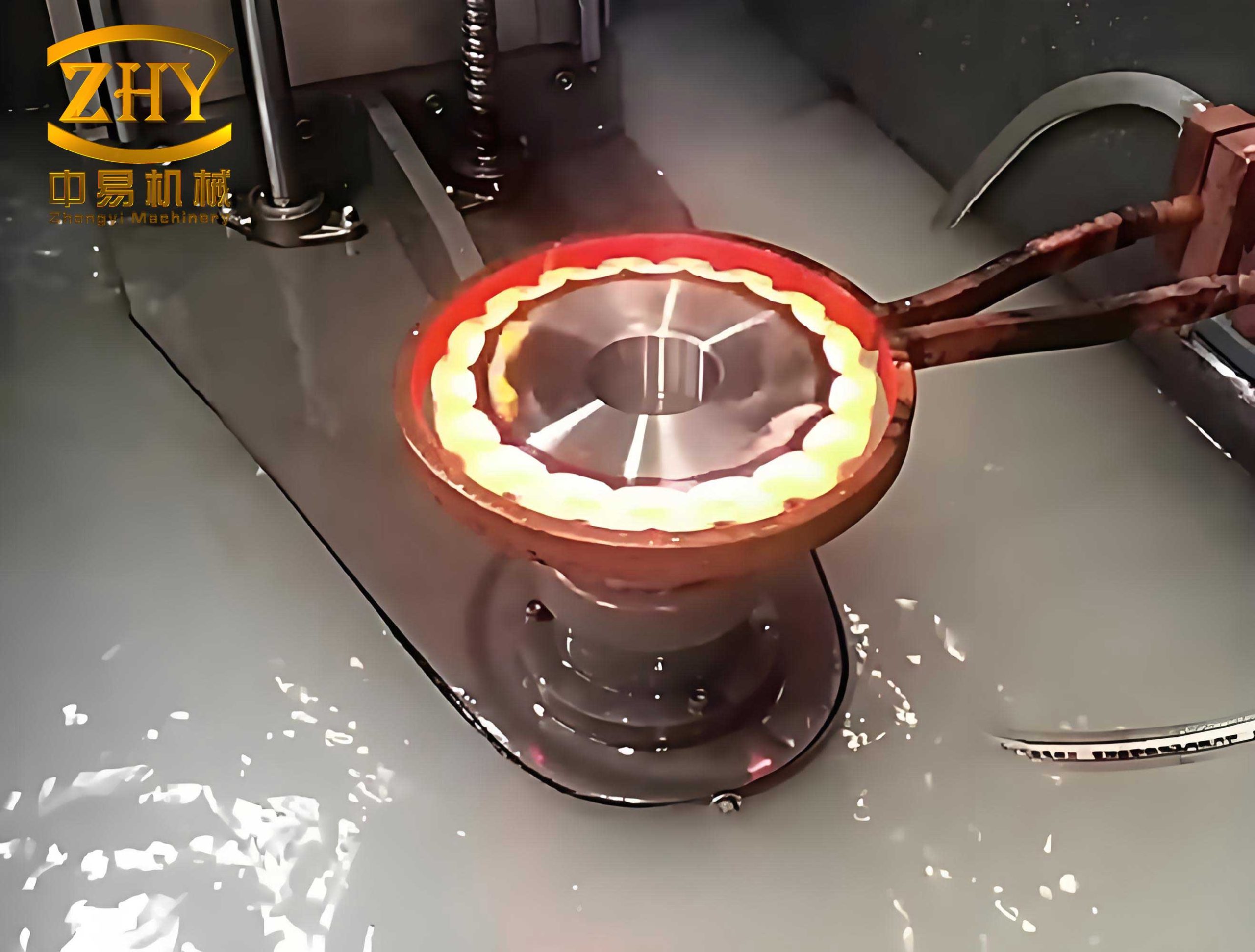
In my experience, preventing heat treatment defects requires integrated process control. For example, during carburizing, temperature and atmosphere must be precisely regulated to avoid decarburization or excessive carbon uptake, both of which are prevalent heat treatment defects. Quenching media and rates should be optimized to prevent distortion or cracking—common heat treatment defects in thin gears. Tempering parameters must be set to relieve stresses without over-softening. I often use statistical process control (SPC) charts to monitor key variables like hardness and case depth, ensuring early detection of heat treatment defects. The interaction between process parameters can be expressed through response surface methodology (RSM) equations: $$ y = \beta_0 + \sum \beta_i x_i + \sum \beta_{ii} x_i^2 + \sum \sum \beta_{ij} x_i x_j $$ where $y$ is a quality metric (e.g., hardness), $x_i$ are process factors (e.g., temperature, time), and $\beta$ are coefficients. This helps in optimizing processes to mitigate heat treatment defects.
Furthermore, measurement techniques play a crucial role in identifying heat treatment defects. I recommend using automated microhardness testers for accurate case depth assessment, as manual methods can introduce errors leading to overlooked heat treatment defects. For microstructure analysis, scanning electron microscopy (SEM) combined with energy-dispersive X-ray spectroscopy (EDS) can detect subtle heat treatment defects like micro-segregation. Non-destructive testing methods, such as eddy current or ultrasonic inspection, are valuable for detecting internal heat treatment defects like voids or inclusions. The relationship between defect size and fatigue life can be described using fracture mechanics: $$ \frac{da}{dN} = C (\Delta K)^m $$ where $da/dN$ is the crack growth rate, $\Delta K$ is the stress intensity factor range, and $C$ and $m$ are material constants. Early detection of heat treatment defects through advanced measurement is key to ensuring gear reliability.
| Defect Type | Description | Root Cause | Prevention Strategy |
|---|---|---|---|
| Surface Softening | Inadequate hardness leading to wear | Low carburizing potential or over-tempering | Control atmosphere carbon potential; optimize tempering cycle |
| Excessive Retained Austenite | Reduced fatigue strength and dimensional instability | Insufficient quenching or high alloy content | Use deep-freeze treatment; adjust quenching media |
| Carbide Networking | Brittle surface with risk of spalling | Over-carburizing or slow cooling | Limit carburizing time; implement controlled cooling |
| Core Brittleness | High core hardness causing脆断 | Excessive alloying or rapid quenching | Modify material composition; use milder quenchants |
| Distortion | Geometric deviations affecting meshing | Uneven heating or quenching stresses | Use fixtures during heat treatment; pre-stress relief |
In conclusion, the heat treatment of motorcycle transmission gears is a complex balance of multiple parameters, and any deviation can result in severe heat treatment defects. From my perspective, a proactive approach involving precise control of surface and core hardness, effective case depth, and microstructure is essential. Regular monitoring using advanced measurement techniques helps in early identification of heat treatment defects. By integrating theoretical models, such as diffusion equations and fatigue laws, with practical process optimization, we can minimize heat treatment defects and enhance gear performance. Ultimately, understanding and addressing these heat treatment defects is paramount for producing reliable, high-quality motorcycle gears that meet the demands of modern riding conditions. As technology evolves, continuous improvement in heat treatment practices will further reduce the incidence of heat treatment defects, ensuring longer service life and better safety for riders worldwide.
To summarize key points, I’ve compiled a formula-based overview of critical relationships: Hardness conversion between HRC and HV can be approximated by: $$ HV \approx 3.2 \times HRC + 100 $$ for ranges near HRC 78–83. Case depth prediction using the Harris model: $$ d = k \sqrt{t} $$ where $d$ is case depth, $t$ is time, and $k$ is a constant dependent on temperature and material. Fatigue limit estimation based on hardness: $$ \sigma_e = 0.5 \times HV $$ for high-cycle fatigue. These formulas aid in setting process targets to avoid heat treatment defects. Remember, every step in heat treatment—from carburizing to tempering—must be meticulously managed to prevent heat treatment defects that could compromise the entire gear system. Through diligent application of these principles, we can achieve consistent quality and durability in motorcycle transmission gears.