
In my experience as a quality control engineer in the automotive industry, I have observed that gears are fundamental components in vehicle systems, and their performance and lifespan are directly influenced by heat treatment processes. Among various heat treatment methods, carburizing and carbonitriding are widely employed to enhance surface properties. However, the occurrence of heat treatment defects can severely compromise gear integrity. This article delves into the critical aspects of quality inspection, focusing on layer depth, hardness, microstructure, and common heat treatment defects, using tables and formulas for comprehensive summarization.
Gears undergo carburizing or carbonitriding to achieve a hard, wear-resistant surface while maintaining a tough core. The quality of this process is assessed through effective hardened layer depth, surface hardness, and metallographic structure. Any deviation can lead to premature failure, making rigorous inspection imperative. I will discuss these parameters in detail, emphasizing how heat treatment defects such as excessive carbides or non-martensitic structures arise and can be mitigated.
Layer Depth Measurement and Control
Layer depth is a pivotal parameter determining gear performance. Historically, the metallographic method was prevalent, but it has limitations. In this method, the sample is annealed to achieve equilibrium structure, and the total depth from the surface to the core is measured, including hypereutectoid, eutectoid, and transition zones. The surface carbon content should exceed 0.8%, and the combined hypereutectoid and eutectoid layers should constitute 50–75% of the total depth. However, this approach is indirect and fails to reflect functional properties if quenching microstructure is defective, highlighting potential heat treatment defects.
With industry standardization, the hardness method, aligned with ISO 2639 and GB/T 9450, is now preferred. It defines effective hardened layer depth as the vertical distance from the surface to where the Vickers hardness reaches 550 HV under a 9.81 N load (or 515 HV under 49.03 N). This method directly correlates with service performance, offering a more reliable assessment. For automotive gears, standards like QC/T 262 specify measurement at the pitch circle near the tooth width center.
Controlling layer depth is crucial to balance bending fatigue and contact fatigue resistance. Excessive depth increases brittleness, while insufficient depth leads to early pitting or crushing. Typically, depth is based on gear module. Key factors influencing depth include carbon potential, temperature, time, surface condition, and load quantity. Below is a table summarizing these factors:
| Factor | Effect on Layer Depth | Potential Heat Treatment Defects |
|---|---|---|
| Carbon Potential | Higher carbon potential increases depth but may cause excessive carbides. | Carbonide networks, reduced toughness. |
| Temperature | Elevated temperature accelerates diffusion, deepening layer. | Grain growth, distortion. |
| Time | Longer time increases depth; insufficient time leads to shallow layers. | Inadequate hardness, premature wear. |
| Surface State | Contaminants or oxidation can hinder carburizing. | Non-uniform layers, soft spots. |
| Load Quantity | Overloading reduces temperature uniformity and gas circulation. | Inconsistent depth, localized defects. |
The relationship between layer depth (d) and module (m) can be approximated by empirical formulas. For instance, for carburized gears, a common formula is:
$$ d = k \cdot m $$
where k is a coefficient typically ranging from 0.15 to 0.25, depending on application. Another more detailed model considers diffusion kinetics, based on Fick’s law:
$$ d = \sqrt{D \cdot t} $$
where D is the diffusion coefficient (in m²/s) and t is time (in seconds). D varies with temperature according to the Arrhenius equation:
$$ D = D_0 \exp\left(-\frac{Q}{RT}\right) $$
where D₀ is a pre-exponential factor, Q is activation energy, R is gas constant, and T is absolute temperature. These formulas help in optimizing processes to avoid heat treatment defects like shallow or uneven layers.
Surface Hardness and Its Implications
Surface hardness, measured at the pitch circle, is critical for wear resistance and contact fatigue strength. Automotive gears typically require HRC 58–63 or HV 700以上. In my inspections, I often encounter heat treatment defects related to hardness不足, which can stem from multiple causes. Insufficient carburizing time, surface decarburization during quenching, low quenching temperature, inadequate cooling rate, excessive retained austenite, over-tempering, or contaminated surfaces all contribute to suboptimal hardness.
To quantify hardness requirements, conversion between scales is essential. The relationship between Vickers (HV) and Rockwell C (HRC) hardness can be approximated by empirical equations. For example, a common conversion in the high-hardness range is:
$$ \text{HRC} \approx 0.1 \cdot \text{HV} – 3.5 $$
However, this is simplified; precise values depend on material composition. Below is a table outlining common hardness standards and associated defects:
| Hardness Scale | Target Range | Defects if Out of Range | Primary Causes |
|---|---|---|---|
| HRC | 58–63 | Reduced wear resistance, pitting | Decarburization, low quench temperature |
| HV | >700 | Early fatigue failure | Excessive retained austenite, over-tempering |
Retained austenite can be estimated using X-ray diffraction or metallographic analysis. Its volume fraction (V_γ) affects hardness, and excessive amounts soften the surface. A formula to relate hardness to austenite content is:
$$ \text{HV} = \text{HV}_m \cdot (1 – V_\gamma) + \text{HV}_\gamma \cdot V_\gamma $$
where HV_m is martensite hardness and HV_γ is austenite hardness. Controlling this is vital to prevent heat treatment defects.
Carbide Morphology and Distribution
Carbides in the渗层 significantly influence gear life. Based on standards like QC/T 262, carbides are graded from 1 to 8 based on size, shape, quantity, and distribution. For常啮合 gears, grades 1–5 are acceptable, while for换档 gears, grades 1–4 are allowed. Assessment is done at tooth tip corners and working surfaces. Blocky, networked, or连续网状 carbides act as stress concentrators, initiating cracks and accelerating fatigue pitting or剥落.
The debate on optimal carbide presence persists. Some argue for negligible carbides to enhance fatigue strength, while others advocate for fine, dispersed carbides to improve耐磨性. In practice, surface carbon concentration of 0.8–1.05% is considered ideal. Excess carbon leads to coarse carbides, a common heat treatment defect. The carbon concentration (C_s) at the surface can be modeled using diffusion equations, such as:
$$ C_s = C_0 + (C_g – C_0) \cdot \text{erfc}\left(\frac{x}{2\sqrt{Dt}}\right) $$
where C_0 is initial carbon content, C_g is gas carbon potential, x is depth, and erfc is the complementary error function. Maintaining C_s within range minimizes defects.
Below is a table summarizing carbide grades and implications:
| Grade | Description | Impact on Performance | Risk of Defects |
|---|---|---|---|
| 1–3 | Fine, dispersed particles | Good wear and fatigue resistance | Low |
| 4–5 | Moderate networking | Acceptable for some applications | Moderate |
| 6–8 | Coarse, continuous network | Reduced toughness, crack initiation | High, severe heat treatment defects |
Non-Martensitic Structures and Internal Oxidation
Non-martensitic structures, often appearing as black networks at the surface, are a critical heat treatment defect. According to standards, their depth should not exceed 0.02 mm. These structures typically consist of troostite, formed due to internal oxidation during carburizing. Oxygen atoms enrich at the surface, diffusing along grain boundaries and causing oxidation of alloying elements like chromium, manganese, and silicon. This depletes alloy content in adjacent areas, leading to troostite formation upon quenching.
The depth of non-martensitic layer (d_n) can be estimated based on oxidation kinetics. A simplified model is:
$$ d_n = \sqrt{k_p \cdot t} $$
where k_p is the parabolic rate constant dependent on atmosphere and temperature. Excessive non-martensitic structures reduce surface hardness and promote pitting. Below is a table outlining causes and remedies:
| Cause | Mechanism | Prevention Strategy |
|---|---|---|
| High oxygen potential in atmosphere | Internal oxidation of alloy elements | Use controlled atmospheres with low oxygen |
| Excessive carburizing time | Prolonged exposure to oxidizing species | Optimize time-temperature cycles |
| Alloy composition | Elements like Si and Mn prone to oxidation | Select alloys with lower oxidation susceptibility |
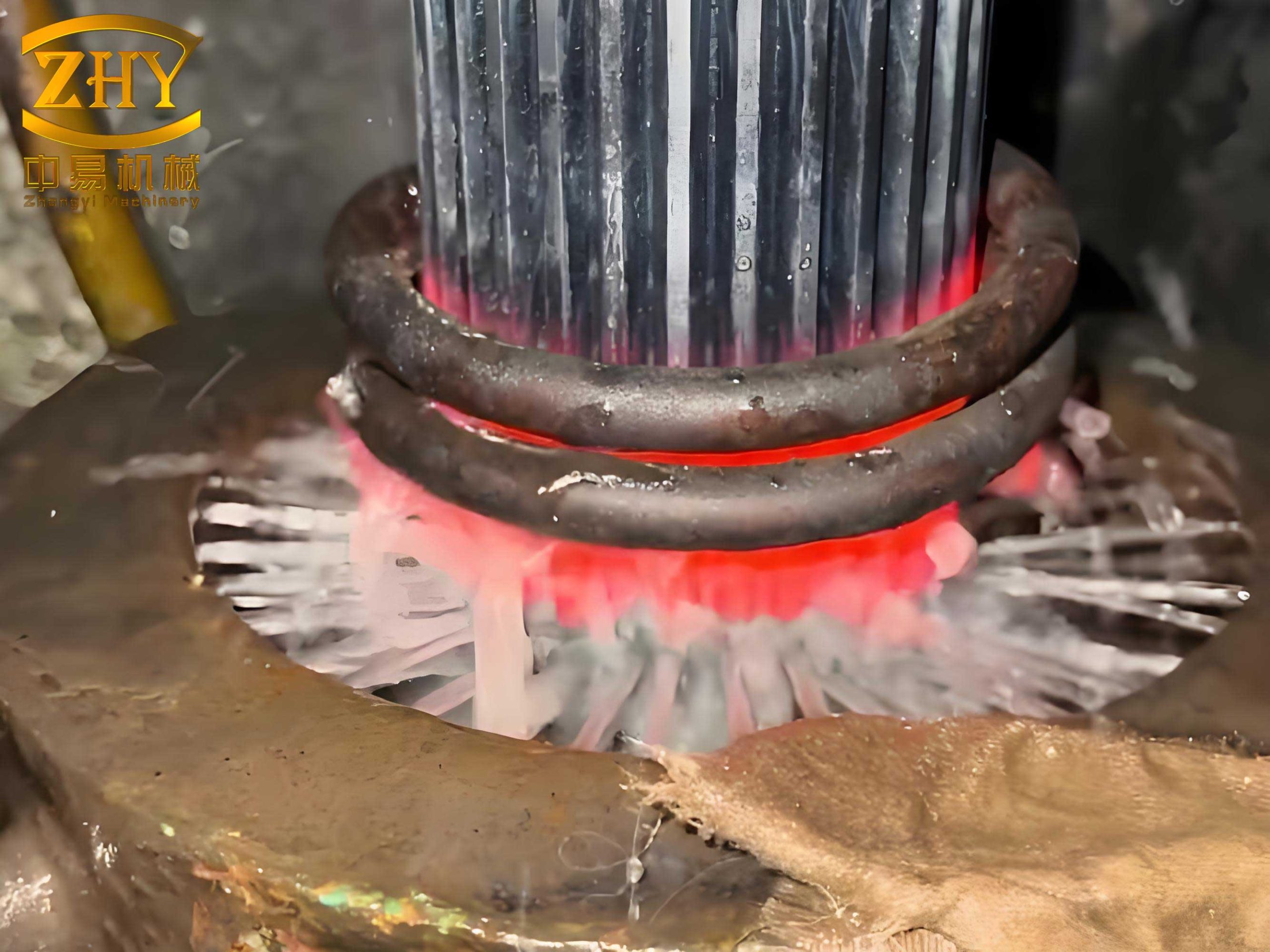
In my work, I often use metallographic inspection to detect these defects. The image below illustrates typical heat treatment defects including non-martensitic zones and carbide networks, which are critical for failure analysis. This visual aid complements quantitative assessments.
Extended Discussion on Heat Treatment Defects
Beyond the primary parameters, gears are susceptible to various other heat treatment defects that impact longevity. Distortion and cracking are common issues arising from thermal stresses during quenching. The risk can be quantified using stress analysis models. For instance, thermal stress (σ_th) during quenching can be approximated by:
$$ \sigma_{th} = E \cdot \alpha \cdot \Delta T $$
where E is Young’s modulus, α is thermal expansion coefficient, and ΔT is temperature gradient. Excessive stress leads to cracking, a severe defect.
Another defect is incomplete hardening, where certain areas fail to transform to martensite due to slow cooling. This can be analyzed using continuous cooling transformation (CCT) diagrams. The critical cooling rate (V_c) to avoid pearlite formation is:
$$ V_c = \frac{T_A – T_M}{t_s} $$
where T_A is austenitizing temperature, T_M is martensite start temperature, and t_s is the time to avoid pearlite nose. Inadequate cooling results in soft spots, compromising gear performance.
To comprehensively address heat treatment defects, statistical process control (SPC) is employed. For example, control charts for layer depth and hardness can monitor process stability. The capability index (C_pk) is used to assess performance:
$$ C_{pk} = \min\left(\frac{USL – \mu}{3\sigma}, \frac{\mu – LSL}{3\sigma}\right) $$
where USL and LSL are specification limits, μ is mean, and σ is standard deviation. Low C_pk indicates high defect rates, necessitating process adjustments.
Below is a summary table of common heat treatment defects and their effects:
| Defect Type | Description | Impact on Gear Life | Detection Method |
|---|---|---|---|
| Shallow hardened layer | Insufficient diffusion depth | Reduced bending fatigue, pitting | Hardness traverse, metallography |
| Excessive carbides | Coarse or networked carbides | Crack initiation, brittle fracture | Metallographic grading |
| Non-martensitic structures | Troostite networks at surface | Lower hardness, accelerated wear | Metallography, hardness testing |
| Distortion | Geometric changes from quenching stresses | Misalignment, noise, premature failure | Dimensional inspection, CMM |
| Cracking | Micro or macro cracks due to thermal stress | Catastrophic failure | Dye penetrant, ultrasonic testing |
| Retained austenite excess | High austenite content post-quench | Soft surface, dimensional instability | X-ray diffraction, metallography |
Conclusion
In summary, the quality of carburized and carbonitrided gears hinges on precise control of layer depth, hardness, and microstructure. Through my extensive involvement in inspection protocols, I emphasize that rigorous testing using hardness methods, metallographic analysis, and standardized grading is essential to mitigate heat treatment defects. The integration of empirical formulas, such as those for diffusion and stress analysis, alongside statistical tools, enhances process optimization. By understanding and addressing defects like carbide networks, non-martensitic structures, and distortion, manufacturers can ensure gear reliability and longevity. Continuous advancement in inspection technologies and process controls will further reduce the incidence of heat treatment defects, contributing to safer and more efficient automotive systems.
This comprehensive review underscores the importance of a holistic approach to quality assurance, where every parameter is scrutinized to prevent failures. As industries evolve, adherence to international standards and proactive defect management will remain paramount in producing high-performance gears.