
In the field of automotive gear manufacturing, controlling heat treatment defects is a critical challenge that directly impacts gear performance, longevity, and production costs. Heat treatment defects, such as distortion, residual stress non-uniformity, and hardness variations, can lead to increased noise, accelerated wear, and reduced fatigue strength in gears operating under high-speed and high-load conditions. This study focuses on comparing the heat treatment defects in gears made from two commonly used materials: 20CrMoH and 8620H. Through numerical simulation and material property analysis, we aim to provide insights into minimizing these defects and optimizing gear design. The investigation employs commercial software tools like DEFORM and JMATPRO to model the carburizing and quenching processes, enabling a detailed examination of distortion patterns, carbon content distribution, and hardness profiles. By understanding the underlying mechanisms of heat treatment defects, manufacturers can implement strategies to reduce post-treatment grinding allowances, improve consistency, and enhance gear reliability. This analysis is particularly relevant for automotive final drive gears, where precision and durability are paramount.
The occurrence of heat treatment defects is influenced by various factors, including material composition,淬透性 (hardenability), and process parameters. In this work, we delve into the thermodynamic and kinetic aspects of phase transformations during heat treatment, which are key drivers of distortion and other defects. We establish performance databases for both 20CrMoH and 8620H steels using JMATPRO, incorporating their chemical compositions and thermal properties. These databases serve as inputs for finite element simulations in DEFORM, where we model the entire carburizing, pre-cooling, and quenching sequence. The simulation outputs allow us to quantify heat treatment defects such as dimensional changes, surface carbon concentration, and hardness gradients. By comparing the two materials, we identify which one exhibits lower and more uniform distortion, thereby offering recommendations for material selection in gear production. Throughout this article, we emphasize the importance of addressing heat treatment defects to achieve higher-quality gears, and we repeatedly reference the term “heat treatment defects” to underscore its significance in manufacturing processes.
To set the foundation, let’s review the material compositions involved. The chemical compositions (in mass percentage) of 20CrMoH and 8620H are summarized in Table 1. These compositions play a crucial role in determining淬透性 and response to heat treatment, which in turn affect the severity of heat treatment defects.
| Material | C | Si | Mn | Cr | Mo | Ni | Al | P | S | Cu |
|---|---|---|---|---|---|---|---|---|---|---|
| 20CrMoH | 0.17 | 0.27 | 0.75 | 1.0 | 0.25 | 0.01 | 0.01 | 0.01 | 0.1 | 0.1 |
| 8620H | 0.17 | 0.25 | 0.78 | 0.5 | 0.2 | 0.55 | 0.01 | 0.01 | 0.01 | 0.1 |
Table 1: Chemical compositions of 20CrMoH and 8620H steels (mass %).
The physical properties of these materials, derived from JMATPRO, are presented in Table 2. These properties, such as thermal conductivity, specific heat, and Young’s modulus, are temperature-dependent and essential for accurate simulation of heat treatment defects. Variations in these properties can lead to differential thermal expansion and contraction, contributing to distortion and other heat treatment defects.
| Property | 20CrMoH Value | 8620H Value | Units |
|---|---|---|---|
| Yield Strength (σ0.2) | ≥1370 | ≥785 | MPa |
| Tensile Strength (σb) | ≥1020 | ≥980 | MPa |
| Elongation (δ) | ≥12 | ≥9 | % |
| Hardenability (J9) | 28-42 HRC | 22-35 HRC | HRC |
Table 2: Physical properties of 20CrMoH and 8620H steels.
The heat treatment process simulated in this study involves carburizing at 870°C with a carbon potential of 0.65% C, followed by quenching at 820°C in oil at 120°C, air cooling, and low-temperature tempering at 170°C. This cycle is typical for automotive gears and is prone to inducing heat treatment defects if not controlled properly. To model this process, we consider multiple physical fields: temperature, phase transformation, carbon diffusion, and stress-strain. Each field is governed by mathematical equations that capture the complex interactions leading to heat treatment defects.
First, the temperature field during heat treatment is crucial because non-uniform heating and cooling are primary sources of heat treatment defects. The three-dimensional heat conduction equation, based on energy conservation and Fourier’s law, is given by:
$$ \rho c_p \frac{\partial T}{\partial t} = \nabla \cdot (k \nabla T) + Q $$
where \( T \) is temperature (°C), \( \rho \) is density (kg/m³), \( c_p \) is specific heat capacity (J/(kg·°C)), \( k \) is thermal conductivity (W/(m·°C)), \( t \) is time (s), and \( Q \) represents heat sources such as phase transformation latent heat (J/kg). This equation is solved numerically to predict temperature distributions that drive thermal stresses and phase changes, both of which contribute to heat treatment defects.
Boundary conditions for heat transfer include convection with the quenching medium, described by:
$$ -k \frac{\partial T}{\partial n} = h(T – T_{\text{medium}}) $$
where \( h \) is the heat transfer coefficient (W/(m²·°C)) and \( T_{\text{medium}} \) is the oil temperature. The heat transfer coefficient varies with temperature, as shown in Figure 4 of the original study, and significantly influences cooling rates and resulting heat treatment defects. For our simulation, we use experimentally determined values for fast oil quenching to ensure accuracy in predicting defects like distortion and residual stresses.
Phase transformations during heat treatment are another critical aspect affecting heat treatment defects. The transformation of austenite to other phases (e.g., ferrite, pearlite, bainite, martensite) involves volume changes that induce internal stresses. For diffusion-controlled transformations, the Johnson-Mehl-Avrami equation is employed:
$$ f(t) = 1 – \exp(-K t^n) $$
where \( f(t) \) is the transformed volume fraction, \( K \) and \( n \) are temperature-dependent parameters. For martensitic transformation, which is diffusionless, the Koistinen-Marburger equation is used:
$$ f_M = 1 – \exp(-\alpha (M_s – T)) $$
where \( f_M \) is martensite volume fraction, \( M_s \) is martensite start temperature, and \( \alpha \) is a material constant (typically \( 1.1 \times 10^{-2} \, \text{K}^{-1} \)). These transformations contribute to strain rates, which are summed in the total strain rate equation:
$$ \dot{\epsilon}_{\text{total}} = \dot{\epsilon}_{\text{thermal}} + \dot{\epsilon}_{\text{elastic}} + \dot{\epsilon}_{\text{plastic}} + \dot{\epsilon}_{\text{phase}} + \dot{\epsilon}_{\text{transformation plasticity}} $$
This comprehensive approach allows us to capture the multi-faceted nature of heat treatment defects, including distortion due to uneven phase changes.
Carbon diffusion during carburizing is modeled using Fick’s second law:
$$ \frac{\partial C}{\partial t} = D \frac{\partial^2 C}{\partial x^2} $$
where \( C \) is carbon concentration (kg/m³), \( D \) is diffusion coefficient (m²/s), and \( x \) is distance (m). The boundary condition accounts for carbon transfer at the surface:
$$ D \frac{\partial C}{\partial x} = h_c (C_g – C_s) $$
with \( h_c \) as carbon transfer coefficient, \( C_g \) as gas carbon potential, and \( C_s \) as surface carbon concentration. Non-uniform carbon profiles can lead to hardness gradients and residual stresses, which are common heat treatment defects affecting gear performance.
The stress-strain field is computed considering thermal, elastic, plastic, phase transformation, and transformation plasticity strains. The flow stress depends on strain, strain rate, and temperature:
$$ \sigma = \sigma(\epsilon, \dot{\epsilon}, T) $$
This relation is implemented in DEFORM using material data from JMATPRO. The resulting stresses and strains help quantify distortion and other heat treatment defects, such as cracking or warping.
For our simulation, we use a finite element model of a single tooth from a final drive gear with modulus 2.35 mm, 68 teeth, and pressure angle 20°. The mesh consists of 86,586 elements and 17,490 nodes, ensuring sufficient resolution to capture local heat treatment defects. The model incorporates the material databases for 20CrMoH and 8620H, allowing direct comparison of their behavior under identical process conditions. This approach isolates material effects on heat treatment defects, providing clear insights for material selection.
Now, let’s discuss the results from our simulations. The carbon content and hardness distributions after carburizing are key indicators of potential heat treatment defects. For 20CrMoH, the surface carbon content reaches approximately 0.73% by mass, while the core remains at 0.17%. In contrast, 8620H exhibits a slightly lower surface carbon content of 0.72% with the same core value. This difference may seem small, but it influences hardness and residual stress patterns, contributing to heat treatment defects like spalling or fatigue. The hardness profiles show that 20CrMoH achieves a surface hardness of 62 HRC and core hardness of 44 HRC, whereas 8620H has a surface hardness of 60 HRC and core hardness of 40 HRC. Lower hardness in 8620H might reduce susceptibility to certain heat treatment defects, such as cracking during quenching, but it could also affect wear resistance. We must balance these factors when assessing overall gear performance.
Distortion is a major heat treatment defect that affects gear geometry and meshing accuracy. Our simulations reveal that 20CrMoH gears experience an overall expansion with significant tooth distortion, resulting in an end-face runout of 0.09 mm. On the other hand, 8620H gears show more uniform expansion with a lower end-face runout of 0.06 mm. This suggests that 8620H is less prone to distortion-related heat treatment defects, which can translate to reduced grinding allowances and better consistency in mass production. The uniformity of distortion in 8620H also implies more predictable residual stress distributions, mitigating other heat treatment defects like noise and vibration in service. To visualize the gear heat treatment process, consider the following image that illustrates typical gear heating and quenching, which can lead to various heat treatment defects if not optimized:
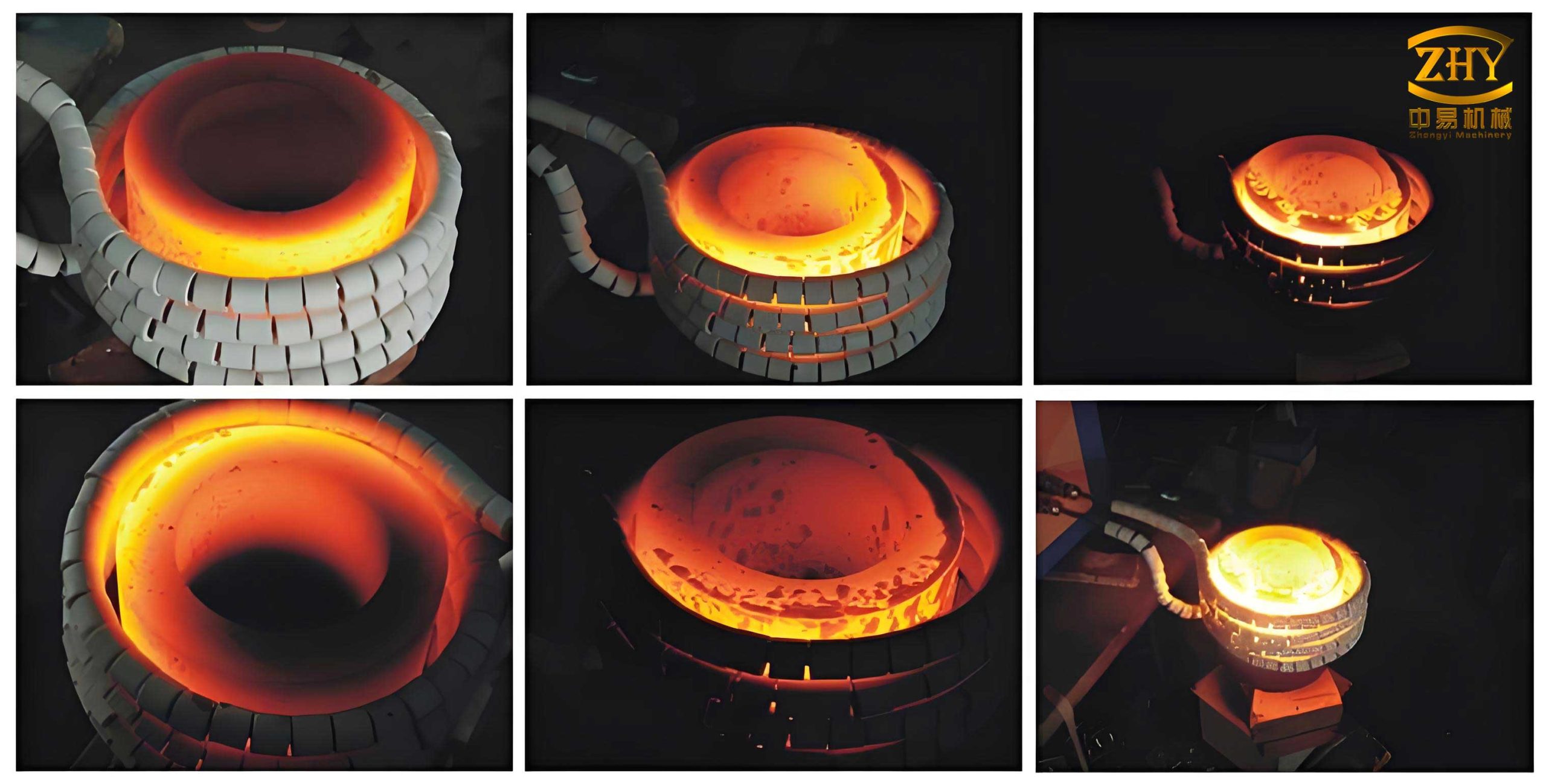
This image underscores the importance of controlling process parameters to minimize heat treatment defects. In our analysis, we further explore the mechanisms behind these differences. The淬透性 of 20CrMoH is higher (28-42 HRC) compared to 8620H (22-35 HRC), which generally leads to greater distortion due to more severe phase transformation stresses. This aligns with the observation that higher淬透性 materials tend to exhibit more pronounced heat treatment defects. Additionally, the chemical composition differences, particularly in chromium and nickel content, affect carbon diffusion rates and phase transformation kinetics, influencing the development of heat treatment defects. For instance, higher chromium in 20CrMoH may enhance hardenability but also increase residual stresses, exacerbating distortion defects.
To quantify the impact of material properties on heat treatment defects, we can derive a simplified model for distortion based on thermal and transformation strains. The total distortion \( \Delta L \) can be expressed as:
$$ \Delta L = \int_0^L \alpha \Delta T \, dx + \sum_i \beta_i \Delta f_i $$
where \( \alpha \) is thermal expansion coefficient, \( \Delta T \) is temperature change, \( \beta_i \) is transformation strain coefficient for phase i, and \( \Delta f_i \) is change in volume fraction of phase i. By integrating this over the gear geometry, we can estimate the contribution of each factor to heat treatment defects. For 20CrMoH, the higher淬透性 leads to larger \( \Delta f_i \) values during quenching, resulting in greater \( \Delta L \) and thus more severe distortion defects. In contrast, 8620H’s lower淬透性 yields smaller \( \Delta f_i \), reducing distortion defects.
Another aspect of heat treatment defects is residual stress, which can be approximated using the following relation:
$$ \sigma_{\text{res}} = E \left( \epsilon_{\text{thermal}} + \epsilon_{\text{phase}} – \epsilon_{\text{yield}} \right) $$
where \( E \) is Young’s modulus, \( \epsilon_{\text{thermal}} \) is thermal strain, \( \epsilon_{\text{phase}} \) is phase transformation strain, and \( \epsilon_{\text{yield}} \) is yield strain. Non-uniform residual stresses are a type of heat treatment defect that can cause fatigue failure. Our simulations show that 8620H gears have more uniform residual stress distributions, reducing the risk of such defects.
We also examine the effect of cooling rates on heat treatment defects. The heat transfer coefficient \( h \) in oil quenching is temperature-dependent, and faster cooling can increase thermal gradients, leading to higher stresses and distortion defects. However, slower cooling might not achieve desired hardness, creating other defects like soft spots. For both materials, we use the same quenching conditions to ensure fair comparison. The results indicate that 8620H’s lower thermal conductivity (as seen in Table 3 and 4 derivatives) may moderate cooling rates, reducing thermal gradients and associated heat treatment defects. This highlights the interplay between material properties and process parameters in governing heat treatment defects.
Expanding on material databases, the JMATPRO-generated data for 20CrMoH and 8620H include temperature-dependent properties like specific heat, thermal conductivity, and Young’s modulus. These are essential for accurate simulation of heat treatment defects. For brevity, we summarize key values in Table 3 for 20CrMoH and Table 4 for 8620H, focusing on how variations influence defect formation.
| Temperature (°C) | Specific Heat (J/(kg·°C)) | Thermal Conductivity (W/(m·°C)) | Young’s Modulus (GPa) |
|---|---|---|---|
| 25 | 446.51 | 64.75 | 212.90 |
| 100 | 479.89 | 60.29 | 209.50 |
| 200 | 527.62 | 53.97 | 203.55 |
| 300 | 574.17 | 47.86 | 195.44 |
| 400 | 633.79 | 42.77 | 185.30 |
| 500 | 704.25 | 38.48 | 173.31 |
| 600 | 808.75 | 34.96 | 159.90 |
| 700 | 967.23 | 32.28 | 145.36 |
| 800 | 938.22 | 27.97 | 128.13 |
| 900 | 606.63 | 27.47 | 117.35 |
| 1000 | 622.37 | 28.66 | 107.46 |
Table 3: Thermal properties of 20CrMoH steel (excerpt).
| Temperature (°C) | Specific Heat (J/(kg·°C)) | Thermal Conductivity (W/(m·°C)) | Young’s Modulus (GPa) |
|---|---|---|---|
| 25 | 455.36 | 69.20 | 211.96 |
| 100 | 484.50 | 64.00 | 208.65 |
| 200 | 528.16 | 56.27 | 202.69 |
| 300 | 588.64 | 48.92 | 194.66 |
| 400 | 627.24 | 43.19 | 184.52 |
| 500 | 718.48 | 38.59 | 172.51 |
| 600 | 802.11 | 34.92 | 159.03 |
| 700 | 967.72 | 32.35 | 144.39 | 800 | 1017.89 | 26.85 | 127.62 |
| 900 | 609.77 | 27.51 | 117.42 |
| 1000 | 625.25 | 28.71 | 107.46 |
Table 4: Thermal properties of 8620H steel (excerpt).
These tables show that 8620H generally has higher thermal conductivity at lower temperatures, which can promote more uniform cooling and reduce thermal gradients, thereby mitigating heat treatment defects like distortion. However, at higher temperatures, the differences diminish, emphasizing the need for comprehensive simulation across the entire process to accurately predict heat treatment defects.
In addition to numerical results, we can discuss the practical implications of heat treatment defects in gear manufacturing. For instance, excessive distortion may require additional grinding operations, increasing cost and time. Non-uniform hardness can lead to premature wear or pitting, which are severe heat treatment defects that compromise gear life. By choosing 8620H over 20CrMoH, manufacturers may achieve better control over these heat treatment defects, leading to more consistent product quality. This is especially important for high-volume production where slight reductions in defect rates can yield significant savings.
Furthermore, we explore the role of simulation software in predicting and minimizing heat treatment defects. DEFORM’s ability to couple thermal, metallurgical, and mechanical phenomena allows for virtual testing of different material and process combinations. This reduces the need for physical trials, which are expensive and time-consuming. By simulating heat treatment defects upfront, engineers can optimize parameters such as carburizing time, quenching medium, and tempering temperature to achieve desired outcomes. For example, adjusting the carbon potential during carburizing could balance surface hardness and distortion, addressing multiple heat treatment defects simultaneously.
Another key point is the effect of material homogeneity on heat treatment defects. Variations in chemical composition within a batch can lead to inconsistent淬透性, causing scatter in distortion and hardness. This is why material standards specify composition ranges, but tight control is essential to minimize heat treatment defects. Our study assumes ideal homogeneity, but in practice, statistical analysis of material properties should be incorporated to account for variability in heat treatment defects.
We also consider the economic aspects of heat treatment defects. Defective gears may need rework or scrap, adding to manufacturing costs. By selecting materials like 8620H that exhibit lower distortion, companies can reduce waste and improve yield. Moreover, gears with fewer heat treatment defects tend to have longer service lives, enhancing customer satisfaction and reducing warranty claims. Thus, addressing heat treatment defects is not only a technical issue but also a business imperative.
To deepen the analysis, let’s derive a formula for the distortion energy per unit volume during quenching, which correlates with heat treatment defects. The energy \( U \) due to thermal and transformation strains can be written as:
$$ U = \frac{1}{2} \sigma \epsilon = \frac{1}{2} E \epsilon^2 $$
where \( \epsilon = \alpha \Delta T + \beta \Delta f \). Higher \( U \) indicates greater potential for distortion and other heat treatment defects. For 20CrMoH, the larger \( \beta \Delta f \) term (due to higher淬透性) results in higher \( U \), explaining its greater distortion. This energy-based approach provides a quantitative metric for comparing heat treatment defects between materials.
Additionally, we can model the carbon profile after carburizing using an error function solution to Fick’s law:
$$ C(x,t) = C_s – (C_s – C_0) \text{erf} \left( \frac{x}{2\sqrt{Dt}} \right) $$
where \( C_0 \) is initial carbon concentration, \( C_s \) is surface concentration, and erf is the error function. Non-ideal profiles, such as those with excessive carbon at the surface, can cause brittleness and cracking—common heat treatment defects. Our simulations show that both materials achieve similar profiles, but 8620H’s slightly lower surface carbon may reduce the risk of such defects.
In terms of future work, investigating other materials like 16MnCrS5 or 20MnCrS5 could provide broader insights into heat treatment defects. Also, experimental validation of our simulation results would strengthen the conclusions. However, based on current findings, we recommend 8620H for applications where minimizing heat treatment defects is a priority. This material offers a good balance of hardness, toughness, and distortion control, making it suitable for demanding gear applications.
In conclusion, this study highlights the importance of material selection in mitigating heat treatment defects in gears. Through detailed simulation of 20CrMoH and 8620H steels, we demonstrate that 8620H exhibits lower and more uniform distortion, lower surface carbon content, and slightly lower hardness compared to 20CrMoH. These characteristics contribute to reduced heat treatment defects, such as distortion and residual stress non-uniformity, leading to better gear performance and manufacturability. By leveraging advanced simulation tools, manufacturers can proactively address heat treatment defects, optimize processes, and enhance product quality. Ultimately, understanding and controlling heat treatment defects is essential for producing reliable, high-performance gears in the automotive industry and beyond.