
As a professional involved in the manufacturing of railway traction gears, I have witnessed firsthand the transformative impact of advanced heat treatment technologies on the performance and reliability of locomotive components. The successful implementation of high-speed and heavy-haul railway operations hinges on the precision and durability of gears, where heat treatment processes play a pivotal role. However, the journey is fraught with challenges, primarily centered around heat treatment defects such as distortion, inconsistent surface carbon content, and undesirable microstructural formations. These heat treatment defects can compromise gear integrity, leading to reduced service life and potential failures. In this article, I will delve into the advancements in heat treatment equipment and process control that have enabled significant reductions in heat treatment defects, drawing from extensive experience in producing gears for various locomotive models. By leveraging modern furnaces, sophisticated control systems, and a deep understanding of material behavior, we have made strides in minimizing these heat treatment defects, ensuring gears meet stringent international standards like ISO 6336-5:2003.
The evolution of heat treatment equipment has been a game-changer in addressing heat treatment defects. Traditionally, gears made from medium-carbon steels underwent quenching and tempering with surface hardening, but the shift to carburizing and hardening of low-alloy steels demanded more precise control. To this end, our facility integrated advanced furnace systems, including a sealed quench furnace line and a pit-type controlled atmosphere furnace line. These systems employ real-time monitoring and feedback loops to regulate carbon potential and temperature uniformity, which are critical in preventing heat treatment defects like decarburization or excessive carburization. For instance, the sealed quench furnace uses a direct atmosphere generation method, where propane and air are mixed externally and introduced into the heating chamber. This approach simplifies operations and reduces costs while maintaining carbon potential uniformity within ±0.05% and temperature uniformity within ±5°C across the workload. Similarly, the pit-type furnace utilizes a nitrogen-methanol carrier gas with variable propane and air inputs, controlled by a dedicated process system that simulates carburization depth and diagnoses faults. The enhanced control capabilities allow for quantitative management of process parameters, directly influencing the mitigation of heat treatment defects by ensuring consistent surface carbon levels and microstructure.
One of the most pervasive heat treatment defects in gear manufacturing is distortion, which manifests as taper, ovality, and warping in cylindrical gears or rings. Distortion arises from the complex interplay of thermal stresses and transformation stresses during heating and cooling phases. Thermal stresses occur due to temperature gradients, while transformation stresses result from microstructural changes, such as the formation of martensite. These stresses can be quantified using simplified models; for example, thermal stress (σ_th) can be expressed as: $$\sigma_{th} = E \alpha \Delta T$$ where E is Young’s modulus, α is the coefficient of thermal expansion, and ΔT is the temperature difference. Transformation stress (σ_tr) relates to volume changes during phase transformations: $$\sigma_{tr} = K \Delta V$$ where K is a material constant and ΔV is the volume change. The combined effect leads to distortion, which is exacerbated by factors like material hardenability, gear geometry, and cooling conditions. To combat this heat treatment defect, we have implemented a multifaceted strategy. First, material homogeneity is ensured through controlled forging and pre-treatment processes, such as normalizing or tempering, to refine austenite grain size. Second, heating rates are moderated with preheating stages to minimize thermal gradients. Third, controlled cooling after carburizing, using slow cooling in pit-type furnaces with adjustable fans, helps reduce thermal shocks. Fourth, quenching in oil with uniform agitation—achieved through cylindrical oil tanks with distributed stirrers—promotes even cooling and lowers distortion risks. These measures collectively address the root causes of this heat treatment defect, as evidenced by distortion data from production batches.
The following table summarizes distortion measurements for two types of cylindrical gears, highlighting the effectiveness of different furnace setups in mitigating this heat treatment defect. Gear A, processed in a sealed quench furnace, exhibits higher distortion variability due to asymmetric heating and cooling, while Gear B, treated in a pit-type furnace, shows more consistent results, underscoring the importance of equipment symmetry.
| Gear Type | Maximum Taper (mm) | Maximum Ovality (mm) | Maximum Warping (mm) | Furnace Type |
|---|---|---|---|---|
| Gear A (Example from production) | 0.35 | 0.86 | 0.80 | Sealed Quench Furnace |
| Gear B (Example from production) | 0.30 | 0.30 | 0.20 | Pit-Type Controlled Atmosphere Furnace |
Beyond distortion, other heat treatment defects involve surface and subsurface characteristics, such as carbon content gradients and carbide morphology. According to ISO 6336-5:2003, for high-alloy steels with total alloy content >1.5%, surface carbon should be controlled between 0.65% and 0.90% to optimize wear resistance and fatigue strength. Carbides should be dispersed rather than networked to prevent brittleness. The control of these aspects is facilitated by advanced atmosphere systems that adjust carbon potential dynamically. The carbon potential (C_p) in a furnace can be modeled using the equilibrium constant for reactions like: $$2CO \leftrightarrow C_{(in steel)} + CO_2$$ where the carbon activity is derived from oxygen probe measurements. By maintaining C_p within tight bounds, we minimize heat treatment defects like excessive carbon uptake or depletion. Additionally, microstructural control targets residual austenite levels and non-martensitic surface layers, which are critical for contact fatigue performance. The integration of simulation software allows for real-time prediction of case depth and concentration gradients, enabling proactive adjustments to curb these heat treatment defects.
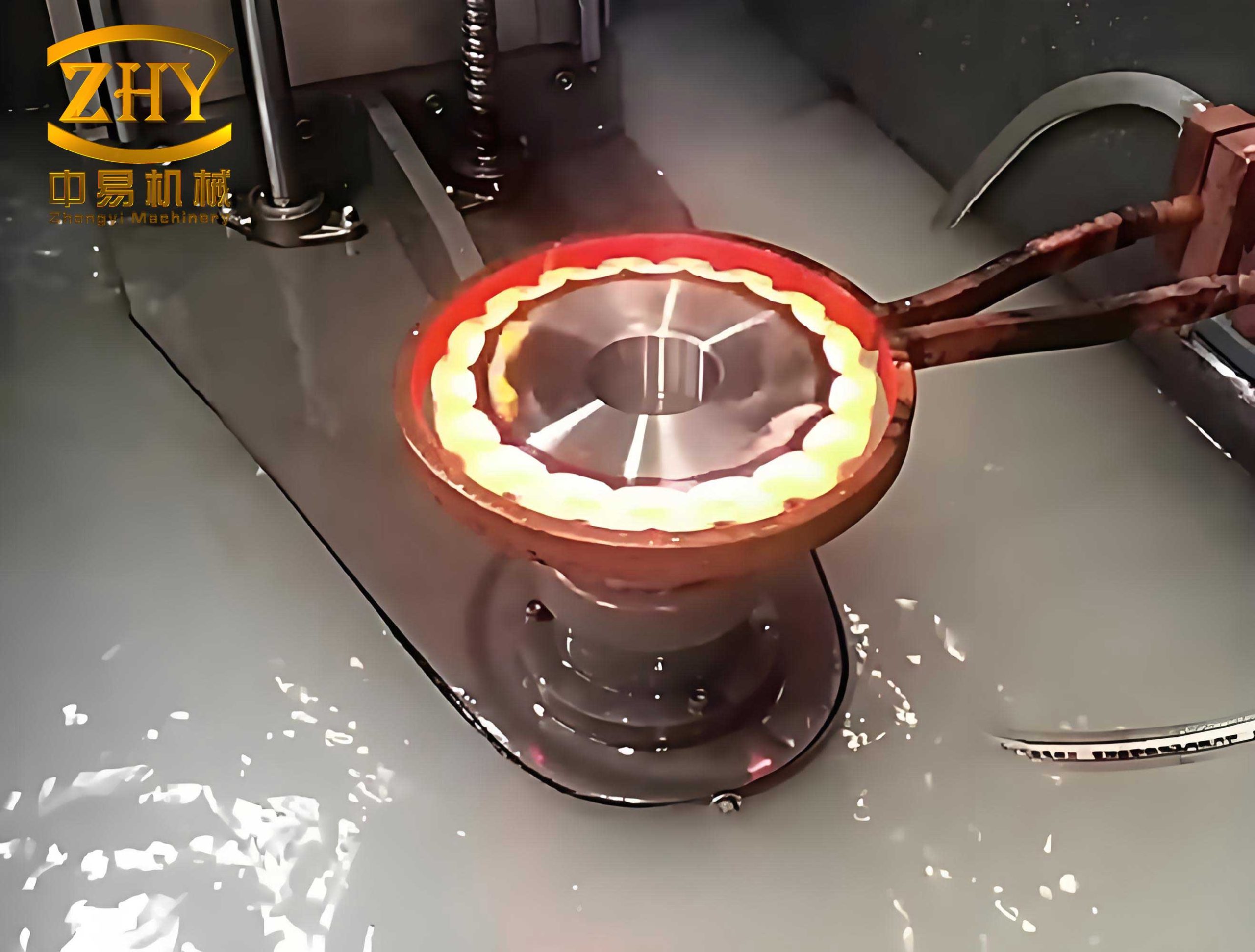
To visualize the broader context of heat treatment defects in gear manufacturing, consider the following image, which illustrates common issues such as cracking, distortion, and microstructural anomalies. This representation underscores the importance of comprehensive quality control measures.
The prevention of heat treatment defects extends beyond equipment to process parameter optimization. For carburizing, the diffusion-controlled carbon profile can be approximated by Fick’s second law: $$\frac{\partial C}{\partial t} = D \frac{\partial^2 C}{\partial x^2}$$ where C is carbon concentration, t is time, D is the diffusion coefficient, and x is depth. By solving this with boundary conditions for surface carbon potential, we can design cycles that achieve desired case depths while minimizing concentration spikes that lead to heat treatment defects like grain boundary carbides. Furthermore, quenching analysis involves calculating cooling rates to avoid martensite transformation stresses that cause distortion. The critical cooling rate (V_c) for martensite formation depends on alloy composition: $$V_c = f(C, Mn, Cr, Ni, Mo)$$ where f represents a function of element concentrations. By tailoring oil quenching intensity to match V_c, we reduce the risk of cracking and distortion—two prevalent heat treatment defects. Empirical data from production runs show that using oils with high thermal stability and controlled agitation lowers distortion magnitudes by up to 30% compared to conventional methods.
A holistic approach to mitigating heat treatment defects also considers gear design and material selection. Narrow hardenability bands in steels, achieved through precise alloying, reduce variability in transformation behavior, thus lowering distortion tendencies. The hardenability can be expressed using ideal critical diameter (D_I) formulas, such as: $$D_I = \sum (k_i \cdot w_i)$$ where k_i are coefficients and w_i are weight percentages of alloying elements. By specifying steels with tight D_I ranges, we enhance consistency in quenching response, directly addressing heat treatment defects related to uneven hardening. Additionally, finite element analysis (FEA) simulations of thermal and stress fields during heat treatment provide insights into distortion patterns, allowing for pre-emptive design modifications. For instance, optimizing gear geometry to balance mass distribution can mitigate warping, a common heat treatment defect in large-diameter rings.
The table below compares key process parameters and their impact on specific heat treatment defects, summarizing best practices derived from our experience. This underscores the multifaceted nature of defect control.
| Process Parameter | Target Range | Associated Heat Treatment Defects | Control Measure |
|---|---|---|---|
| Carburizing Temperature | 920-950°C | Excessive grain growth, distortion | Use preheating stages, monitor with thermocouples |
| Carbon Potential | 0.65-0.90% | Surface decarbonization or carburization | Oxygen probe feedback, adjust atmosphere flow |
| Quenching Oil Temperature | 60-80°C | Cracking, distortion | Maintain uniform agitation, use cylindrical tanks |
| Cooling Rate after Carburizing | ≤10°C/min | Secondary carbide precipitation, distortion | Controlled slow cooling in pit furnaces |
In conclusion, the battle against heat treatment defects in railway traction gears is an ongoing endeavor that requires continuous improvement in technology and process understanding. Through the adoption of advanced furnaces with precise control systems, coupled with rigorous material and design considerations, we have made significant progress in reducing distortion, optimizing surface characteristics, and ensuring microstructural integrity. However, heat treatment defects remain a complex challenge influenced by numerous variables, from alloy composition to gear geometry. Future directions include the integration of artificial intelligence for predictive process control and the development of new steel grades with enhanced hardenability consistency. By sharing these insights, I hope to contribute to the broader industry effort to minimize heat treatment defects, ultimately supporting the reliability and efficiency of railway transportation systems. The journey underscores that while heat treatment defects are inherent to manufacturing, they can be effectively managed through innovation and diligence, paving the way for next-generation gear performance.