
The widespread adoption of ferrous Powder Metallurgy (P/M) components, particularly gears, in demanding applications such as automotive transmissions, motorcycle drivetrains, and industrial machinery, underscores their economic and performance advantages. However, the transition from sintered compact to finished, high-performance part often necessitates a subsequent heat treatment process to achieve the required surface hardness, wear resistance, and core toughness. This step introduces a significant technical challenge: a pronounced susceptibility to cracking, a primary category of heat treatment defects. These heat treatment defects are far more prevalent and severe in P/M parts compared to their wrought steel counterparts, primarily due to the intrinsic porosity inherent in the sintered microstructure. This article, from my perspective as a practitioner in the field, provides a detailed examination of the root causes behind these failures and outlines a systematic, multi-faceted process strategy developed to effectively eliminate them, with a specific focus on high-frequency induction hardening.
The fundamental distinction of P/M materials lies in their composite nature, consisting of a metal matrix interspersed with pores. This porosity drastically alters the material’s response to thermal cycles. The following table summarizes the key detrimental effects of porosity that predispose P/M parts to heat treatment defects:
| Property Influence | Mechanism Leading to Heat Treatment Defects | Consequence |
|---|---|---|
| Reduced Thermal Conductivity (k) | Porosity acts as an insulator. Heat flow becomes non-uniform, especially in parts with density gradients. | Steep thermal gradients during heating/cooling generate severe thermal stresses ($\sigma_{thermal} \propto E \cdot \alpha \cdot \Delta T$, where E is Young’s modulus, α is CTE, and ΔT is the temperature difference). |
| Localized Stress Concentration | Pores, particularly irregular or interconnected ones, act as intrinsic notch-like features. | Applied stresses (thermal or transformational) are amplified at pore edges, facilitating crack initiation even under moderate nominal stress levels. The stress concentration factor $K_t$ can be significantly high. |
| Lower Effective Mechanical Properties | Porosity reduces the load-bearing cross-sectional area and can act as a crack propagation path. | Lower fracture toughness and tensile strength mean the material can withstand less internal stress before failure, making it prone to heat treatment defects. |
| Non-uniform Density Distribution | Complex part geometry leads to varying powder compaction, hence variable local density and porosity. | Creates zones with different thermal and mechanical properties, leading to mismatched expansion/contraction and transformation behavior, a direct cause of heat treatment defects. |
The interplay of these factors makes the heat treatment of P/M parts, particularly surface hardening processes like induction hardening, a delicate operation. The rapid heating inherent to induction hardening exacerbates thermal gradients. Furthermore, the subsequent martensitic transformation, accompanied by a volumetric expansion, induces transformation stresses. In a porous, heterogeneous material, the superposition of thermal and transformation stresses often reaches critical levels, manifesting as cracks—the most catastrophic of heat treatment defects.
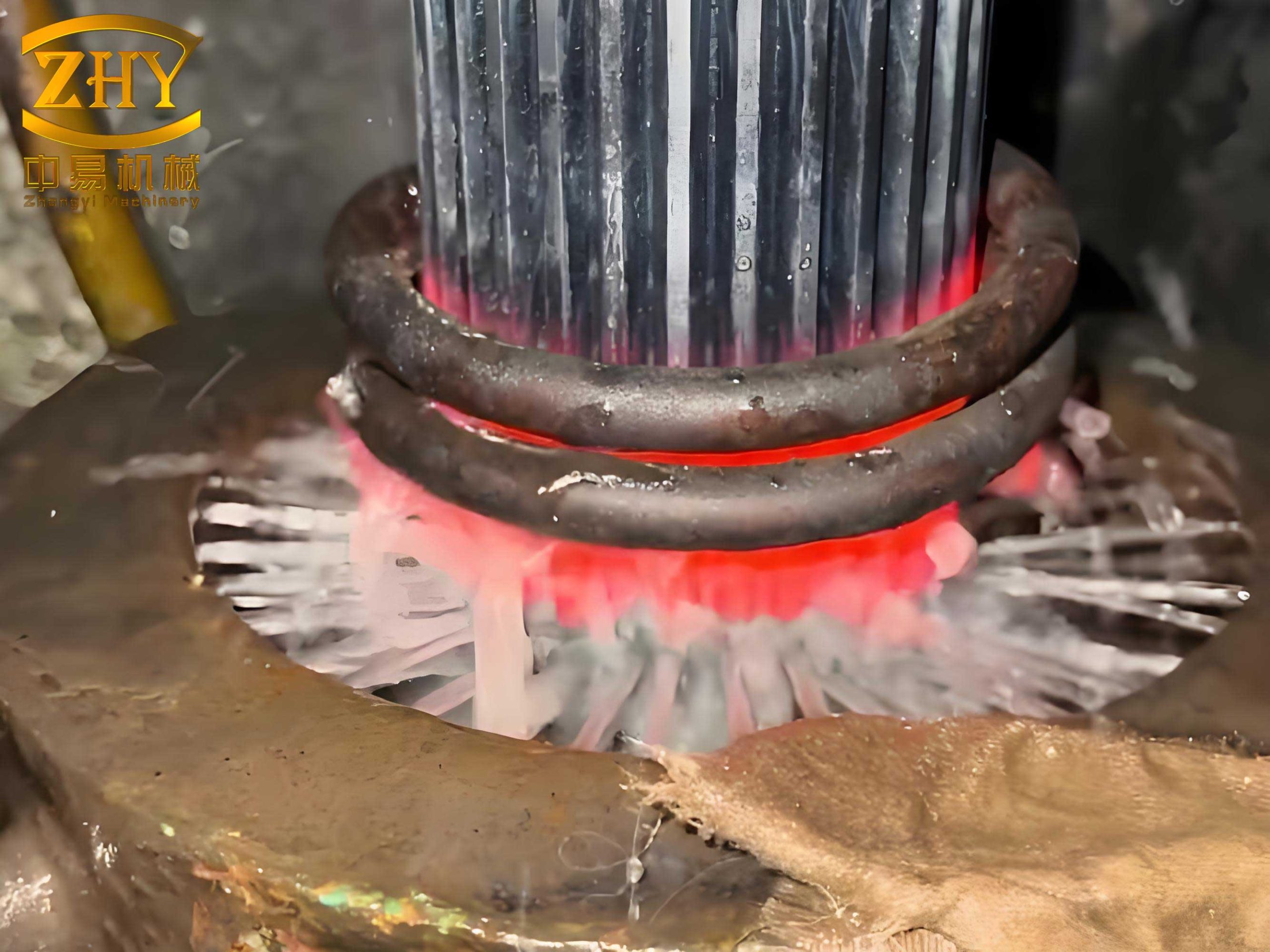
To formulate an effective solution, a specific case of a large-diameter, low-height ferrous P/M driven gear is analyzed. The geometry itself presents several challenges that aggravate heat treatment defects:
- High Diameter-to-Height Ratio: Makes uniform powder filling and compaction difficult, promoting density gradients.
- Presence of Multiple Holes: Small, closely spaced holes hinder powder flow during filling, creating low-density zones and further disrupting heat transfer during induction heating.
- Step Features: Can lead to “hidden” separation lines or density discontinuities after compaction, which become preferred sites for crack initiation during thermal cycling.
The core of the strategy to eliminate these heat treatment defects rests on two pillars: achieving supreme density uniformity and managing the thermal/transformational stresses during processing.
I. Foundational Strategy: Achieving Optimal and Uniform Density
The first and most critical line of defense against heat treatment defects is maximizing density and its uniformity. This begins at the powder compaction stage. For complex parts, conventional die filling is insufficient. The implemented method involves a combination of compensated tooling and vibration-assisted die filling.
The compaction pressure $P$ and resulting green density $\rho_g$ have a logarithmic relationship often described by:
$$\rho_g = A + B \cdot \log(P)$$
where A and B are material constants. However, for uniform density in a multi-level part, the fill ratio (height of powder fill to final part height) must be constant across all sections. This requires precise control of the lower punch positions in a multi-action press. The goal is to ensure an equal compression ratio $C_r$ for all vertical zones:
$$C_r = \frac{H_{fill}}{H_{part}} = \text{constant}$$
Vibration during filling fluidizes the powder, drastically reducing inter-particle friction and enabling it to flow readily into intricate features and corners, eliminating “unfilled” zones that lead to low-density defects. The table below contrasts the outcomes of standard and advanced filling techniques:
| Filling/Compaction Method | Density Distribution | Typical Green Density (g/cm³) | Impact on Heat Treatment Defects |
|---|---|---|---|
| Standard Gravity Fill | Highly non-uniform; low density in thin webs and around holes. | 6.4 – 6.8 (variable) | High probability of cracks originating from low-density zones. |
| Compensated Tooling + Vibration Fill | Highly uniform; minimal density gradient. | 7.0 – 7.2 (consistent) | Dramatically reduced thermal and stress gradients, minimizing heat treatment defects. |
Subsequent sintering must be optimized to ensure good inter-particle bonding without introducing distortion. A high-temperature sintering cycle (e.g., 1120-1150°C) in a controlled atmosphere is often employed to enhance ductility and toughness, providing a more robust base material that is more resistant to heat treatment defects.
II. Process-Centric Strategy: Managing the Heat Treatment Cycle
Even with a uniform starting density, the high-frequency heat treatment process itself must be meticulously controlled to avoid heat treatment defects. The strategy involves specialized tooling and a modified thermal cycle.
A. Dedicated Induction Heating Fixture:
A critical innovation is the use of a conductive fixture or “mandrel” specifically designed for the gear during induction heating. The part is mounted onto this fixture, which serves multiple purposes:
- Thermal Mass Regulation: The fixture acts as a heat sink, slowing down the initial heating rate of the part’s core and bore area, thereby reducing the thermal gradient between the surface (being rapidly heated) and the interior.
- Mechanical Constraint: It provides gentle but firm support to counteract thermal warping and distortion during the heating phase. This prevents the development of asymmetric stresses that can initiate heat treatment defects.
- Uniform Quenching Path: The fixture allows for consistent and repeatable immersion into the quenchant.
B. Modified Thermal Cycle – Graded Quenching:
The standard practice of quenching directly into room-temperature oil is a direct cause of heat treatment defects in P/M parts due to the severe thermal shock. The implemented cycle is a two-stage process:
- Induction Heating: The part, on its fixture, is heated to the austenitizing temperature ($A_{c3} + 30-50°C$). The heating time/power is controlled to achieve a desired case depth without overheating thin sections.
- Hot-Oil Quench (First Stage): Immediately after heating, the assembly is quenched into oil pre-heated to an elevated temperature (e.g., 80-120°C). This markedly reduces the cooling severity ($H$-value), lowering the martensite start ($M_s$) temperature cooling rate and the associated thermal stress. The transformation to martensite begins in a more controlled manner.
- Final Quench and Tempering: After a brief dwell in the hot oil, the part is transferred to room-temperature oil for final cooling. This is followed promptly by a low-temperature tempering (e.g., 150-180°C for 60-90 minutes) to relieve residual stresses and improve toughness, further stabilizing the part against delayed heat treatment defects.
The effectiveness of this graded quenching can be partially understood by comparing the temperature gradients and cooling rates. The heat transfer during quenching is governed by:
$$q = h \cdot A \cdot (T_{surface} – T_{quenchant})$$
where $q$ is heat flux, $h$ is the heat transfer coefficient, and $A$ is area. Using hot oil significantly reduces $(T_{surface} – T_{quenchant})$, thereby reducing $q$ and the associated thermal stress. The following table compares the two quenching approaches:
| Quenching Parameter | Direct Quench (Room Temp Oil) | Graded Quench (Hot Oil then Cold Oil) |
|---|---|---|
| Initial Heat Flux (q) | Very High | Moderate |
| Thermal Stress ($\sigma_{thermal}$) | Very High, risk of exceeding UTS | Substantially Reduced |
| Martensite Formation Rate | Rapid, concentrated in a narrow temp band | Slower, over a broader temp range |
| Resulting Risk of Heat Treatment Defects | Extremely High | Very Low |
III. Holistic Process Flow and Quality Assurance
Eliminating heat treatment defects is not about a single silver bullet but integrating complementary strategies into a coherent process flow. The successful methodology can be summarized in the following step-by-step sequence, with key control points:
- Powder Selection: Use pre-alloyed or diffusion-bonded powder with consistent characteristics (flow, apparent density) to ensure reproducible filling.
- Advanced Compaction: Employ compensated tooling design and vibration-assisted die filling to achieve green density >7.0 g/cm³ with a uniformity variation of <0.15 g/cm³ across the part.
- High-Temperature Sintering: Sinter in a well-controlled atmosphere (e.g., N₂-H₂ or vacuum) at optimal temperature to achieve high strength and ductility in the sintered state. The sintered density $\rho_s$ should meet specified targets.
- Pre-Heat Treatment Machining (if required): Perform any necessary machining operations before hardening to avoid creating stress concentrators on a hardened surface.
- Fixture-Based Induction Hardening: Mount the part on the dedicated conductive fixture. Apply a controlled high-frequency cycle to achieve the target case depth. The power density and time are critical parameters to avoid surface overheating, another potential source of heat treatment defects.
- Graded Quenching: Quench the fixtured part first into hot oil (80-120°C), then into room-temperature oil.
- Immediate Tempering: Perform tempering without delay to relieve quenching stresses. The tempering parameter, often expressed via the Hollomon-Jaffe equation, should be optimized:
$$P = T \cdot (k + \log t)$$
where $T$ is temperature in Kelvin, $t$ is time in hours, and $k$ is a material constant. - Non-Destructive Testing (NDT): Implement 100% inspection for heat treatment defects using methods like fluorescent magnetic particle inspection or eddy current testing to validate process effectiveness.
Conclusion
The propensity for heat treatment defects in ferrous powder metallurgy components, particularly during high-frequency induction hardening, stems directly from the material’s porous architecture and the resulting inhomogeneities in thermal and mechanical properties. A successful mitigation strategy must be holistic, attacking the problem at its root causes. The core of the solution lies in a two-pronged approach: first, achieving exceptional density uniformity through advanced powder compaction techniques like vibration-assisted filling with compensated tooling; and second, meticulously managing the thermal and transformational stresses during the hardening cycle itself via the use of dedicated fixtures and a graded quenching process involving an initial hot-oil quench. This integrated methodology transforms the heat treatment process from a high-risk operation into a reliable, high-yield manufacturing step. By systematically addressing the material’s inherent vulnerabilities, it is entirely possible to produce complex, high-performance P/M gears and components free from the debilitating heat treatment defects that have historically constrained their application in the most demanding engineering contexts. The consistent achievement of a defect rate well below 1% in production validates this comprehensive, physics-based approach to process design.