
In my extensive experience within the automotive transmission industry, addressing heat treatment defects, particularly deformation in critical components like final drive gears, has been a persistent challenge. These defects, if not controlled, can lead to premature failure, noise, and reduced efficiency in drivetrains. This article presents a comprehensive analysis based on experimental investigations aimed at mitigating face deformation in such gears after heat treatment. I will delve into the multifaceted factors influencing this deformation, including raw material microstructure, heat treatment process parameters, furnace loading methods, and component design. Through systematic tracking and data analysis, I have identified key levers for controlling these heat treatment defects, and the findings have been validated in production. The goal is to provide a detailed technical resource that underscores the complexity of heat treatment deformation and offers practical solutions.
The core of this study revolves around the fact that heat treatment defects are not caused by a single factor but are the result of interactions between material behavior and process conditions. For gear components, face flatness after carburizing and quenching is a critical quality metric. Deviation beyond specified limits necessitates costly corrective machining or leads to scrap. Therefore, understanding and controlling the sources of deformation is paramount for manufacturing economy and product reliability.
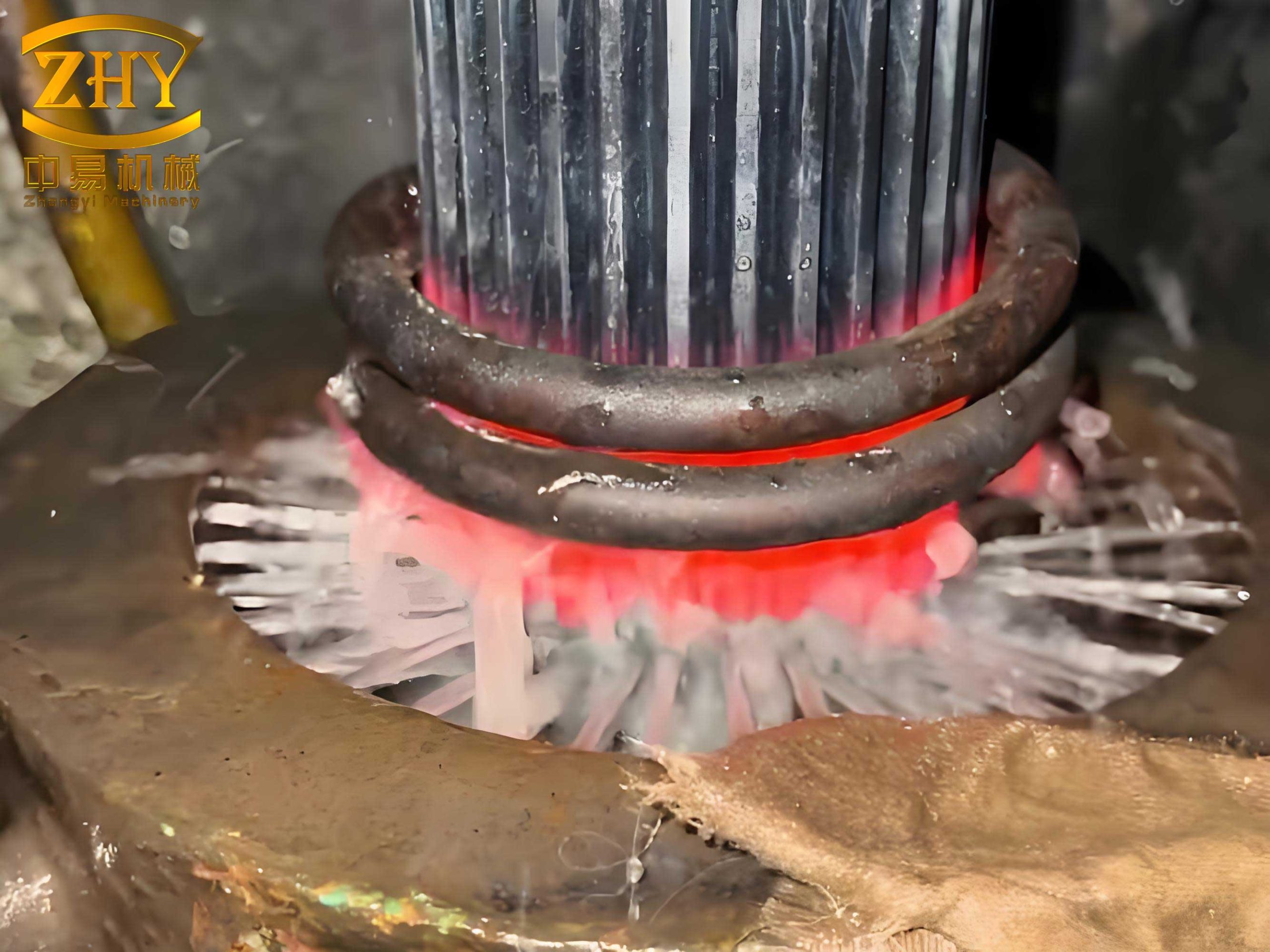
To systematically investigate these heat treatment defects, I designed and executed a series of experiments under actual production conditions. The focus was on gears made from a low-carbon carburizing steel, analogous to SAE 8620 or similar grades. All test specimens were actual production parts, subjected to a normalizing treatment as a preliminary step to ensure a consistent starting condition. Sampling was random for each furnace batch, with a sample size of 15 to 20 pieces per run to ensure statistical significance. The heat treatment was conducted in a modern multi-chamber furnace, and quenching was performed in a high-quality quenching oil. The primary measurement for assessing heat treatment defects was face flatness, measured using a precision height gauge with a three-point support fixture to eliminate backing plane errors. The specified tolerance for face flatness was stringent, typically requiring deviations to be less than a few hundredths of a millimeter, as illustrated in the conceptual diagram.
| Investigation Factor | Variable Levels | Constant Parameters |
|---|---|---|
| Material Microstructure | Band structure (Grade 0-1, 2-3, 3-4), Widmanstätten structure presence | Steel grade, part geometry, heat treatment cycle |
| Furnace Loading | Production-style stacking vs. Individual isolation | Material batch, furnace, quenching medium |
| Heat Treatment Process | Conventional Carburizing vs. Carbonitriding | Case depth target, core hardness requirement |
| Component Geometry | Original design vs. Modified design (wider rib) | Material, pre-treatment, heat treatment process |
The first major factor contributing to heat treatment defects is the initial microstructure of the gear blank after forging and normalizing. The ideal normalized structure for carburizing steels is a uniform, equiaxed mixture of ferrite and pearlite. However, processing inconsistencies can lead to residual banding (segregation of alloying elements) or the formation of Widmanstätten ferrite, which is an acicular structure. These inhomogeneities create anisotropic properties, leading to non-uniform transformation stresses during quenching and consequent distortion. I conducted metallographic analysis on pre-treated blanks and correlated the findings with post-heat-treatment flatness data.
| Banding Structure Grade | Widmanstätten Structure Grade | Percentage of Parts with Flatness ≤ 0.05 mm | Percentage of Parts with Flatness 0.05–0.10 mm | Percentage of Parts with Flatness > 0.10 mm |
|---|---|---|---|---|
| 3-4 | Present | 12.5% | 21.2% | 66.3% |
| 2 | Absent | 50.0% | 21.4% | 28.6% |
| 0-1 | Absent | 94.0% | 5.0% | 1.0% |
The data is compelling: superior initial microstructure (low banding, no Widmanstätten structure) drastically reduces the incidence of severe heat treatment defects. The mechanism can be linked to the transformation plasticity. During heating and quenching, the volumetric change associated with the austenite-to-martensite transformation, $$ \Delta V/V \approx 0.04 \times (\%C) $$, is more uniform in a homogeneous structure. In banded structures, regions with different hardenability transform at different times, setting up internal stresses that warp the component. This underscores the necessity of strict control over forging and normalizing processes to minimize these foundational heat treatment defects.
The second critical factor is the method of loading parts into the furnace and quenching fixture. In mass production, gears are often stacked or densely packed to maximize throughput. However, this practice can exacerbate heat treatment defects due to uneven heating, cooling, and mechanical constraint. I compared two methods: a traditional production stacking method and an experimental method where parts were individually isolated on the fixture to ensure free thermal expansion and contraction.
| Loading Configuration | Percentage of Parts with Flatness ≤ 0.05 mm | Percentage of Parts with Flatness 0.05–0.10 mm | Percentage of Parts with Flatness > 0.10 mm |
|---|---|---|---|
| Production Stacking | 17.7% | 48.6% | 33.7% |
| Individual Isolation | 92.5% | 6.3% | 1.2% |
The results are stark. The individual isolation method significantly reduced distortion. The physics behind this involves minimizing external constraints during the phase transformation. When parts are stacked, they can mechanically constrain each other’s natural dimensional changes during heating and cooling. Furthermore, fluid flow during quenching is impeded in a stack, leading to non-uniform heat extraction and increased thermal gradients, which are primary drivers of heat treatment defects. The stress state can be approximated by considering thermal stress: $$ \sigma_{thermal} = E \cdot \alpha \cdot \Delta T $$, where \(E\) is Young’s modulus, \(\alpha\) is the coefficient of thermal expansion, and \(\Delta T\) is the temperature gradient. Non-uniform cooling creates large local \(\Delta T\), hence high stress and distortion. Isolating parts promotes more uniform quenching and reduces these gradients.
The third pivotal area is the heat treatment process parameters themselves. Conventional gas carburizing involves high temperatures (e.g., 930°C) for rapid carbon diffusion, followed by quenching from around 850°C. Both high temperature and intense oil agitation contribute to greater distortion. Carbonitriding, which introduces nitrogen into the surface, offers a beneficial alternative. Nitrogen lowers the Ac1 point, allowing effective case hardening at lower temperatures. It also enhances hardenability, permitting a lower quench temperature and milder agitation.
I evaluated both processes for gears requiring a case depth of 0.6–0.8 mm. The conventional carburizing cycle used a boost temperature of 930°C and a quench temperature of 850°C with vigorous oil agitation. The carbonitriding cycle used a boost temperature of 880°C and a quench temperature of 830°C with reduced agitation. The diffusion kinetics for carburizing can be described by the empirical law: $$ d = k \sqrt{t} $$, where \(d\) is case depth, \(k\) is a temperature-dependent constant, and \(t\) is time. For carbonitriding, the constant \(k\) is effectively modified by the presence of nitrogen, enabling adequate diffusion at lower temperatures.
| Process Type | Boost Temperature (°C) | Quench Temperature (°C) | Intense Agitation Time (s) | Percentage of Parts with Flatness ≤ 0.05 mm | Percentage of Parts with Flatness 0.05–0.10 mm | Percentage of Parts with Flatness > 0.10 mm |
|---|---|---|---|---|---|---|
| Conventional Carburizing | 930 | 850 | 180 | 41.8% | 38.6% | 19.6% |
| Carbonitriding | 880 | 830 | 60 | 87.5% | 9.7% | 2.8% |
The carbonitriding process markedly reduced the incidence of heat treatment defects related to flatness. The lower temperatures decrease the thermal energy available for distortion, and the reduced thermal gradient during quenching, aided by lower quench temperature and milder agitation, minimizes transformation stresses. The role of nitrogen in stabilizing austenite also contributes to a more controlled martensitic transformation, reducing the risk of quench cracking, another severe category of heat treatment defects.
Finally, the inherent design of the gear component plays a substantial role in its susceptibility to heat treatment defects. Gears often have thin webs or ribs to reduce weight. However, these features can create significant stress concentrations and asymmetrical mass distribution, leading to non-uniform cooling and distortion. I investigated a design modification where the rib connecting the gear face to the hub was widened within permissible limits, increasing its stiffness and improving symmetry.
| Rib Design | Percentage of Parts with Flatness ≤ 0.05 mm | Percentage of Parts with Flatness 0.05–0.10 mm | Percentage of Parts with Flatness > 0.10 mm |
|---|---|---|---|
| Original (Thinner Rib) | 65.8% | 24.7% | 9.5% |
| Modified (Wider Rib) | 90.0% | 8.0% | 2.0% |
The modified, more robust geometry demonstrated superior resistance to deformation. This can be analyzed through the lens of structural rigidity. The bending stiffness of a plate-like section is proportional to the cube of its thickness. A modest increase in rib width significantly increases the moment of inertia, $$ I \propto b h^3 $$ (for a rectangular section), making the structure more resistant to the bending moments induced by transformation stresses. This simple design change effectively mitigates one of the root causes of geometric heat treatment defects.
Synthesizing these experimental findings, it becomes clear that controlling heat treatment defects in final drive gears requires a holistic approach. No single adjustment is sufficient; rather, an integrated strategy addressing material, process, tooling, and design is necessary. Based on this analysis, I implemented a comprehensive improvement program in the production environment. The key measures included: mandating a stricter acceptance criterion for blank microstructure, specifically limiting banding to Grade 1 or better and eliminating Widmanstätten structure; changing the furnace loading practice to the individual isolation method; switching from conventional carburizing to carbonitriding for applicable case depth specifications; and, where design allowances permitted, widening the gear rib. The cumulative effect of these changes was transformative. Over a production run of several thousand parts, the rate of face flatness rejection due to heat treatment defects fell to within acceptable limits, validating the experimental conclusions.
In conclusion, the journey to mitigate heat treatment defects is fundamentally about managing stresses—thermal, transformational, and mechanical—throughout the heat treatment cycle. This investigation illustrates that by deeply understanding the influence of raw material homogeneity, furnace loading dynamics, thermal process parameters, and component geometry, manufacturers can exert significant control over distortion. The formulas and data tables presented here provide a quantitative framework for diagnosing and addressing these challenges. Future work could involve finite element modeling to predict distortion based on these factors, further optimizing the process. Nevertheless, the practical measures outlined have proven highly effective in bringing a persistent quality issue under control, ensuring the reliability and performance of critical automotive transmission components.