
In my extensive experience with mechanical equipment, particularly in the development of snow remover rolling brush gears, I have consistently encountered challenges related to the integrity and durability of welded components. The transition from monolithic forged gears to welded structures for the 2011-model snow remover was driven by the need for cost-effective, scalable production and improved performance under harsh, cold, and humid operational conditions. However, this shift introduced significant concerns regarding heat treatment defects, which can severely compromise mechanical properties and lead to premature failure. In this comprehensive study, I will detail the innovative heat treatment and surface zinc plating protocols we developed to address these issues, with a particular focus on identifying, preventing, and mitigating common heat treatment defects such as softening, embrittlement, hardening, cracking, and distortion. The core objective is to enhance the comprehensive mechanical performance and corrosion resistance of welded gears, ensuring reliability in demanding applications.
The base materials for the gear assembly are critical: the gear ring is fabricated from 34CrNiMo steel, while the shaft is made of 42CrMo steel. Both alloys are selected for their high strength, excellent wear resistance, and good weldability. However, the welding process itself induces a heat-affected zone (HAZ) where microstructural changes occur, leading to potential heat treatment defects. These defects are primarily a result of non-uniform heating and cooling during welding and subsequent heat treatment, which can cause localized variations in hardness, toughness, and residual stress. Understanding and controlling these phenomena is paramount to achieving a robust final product.
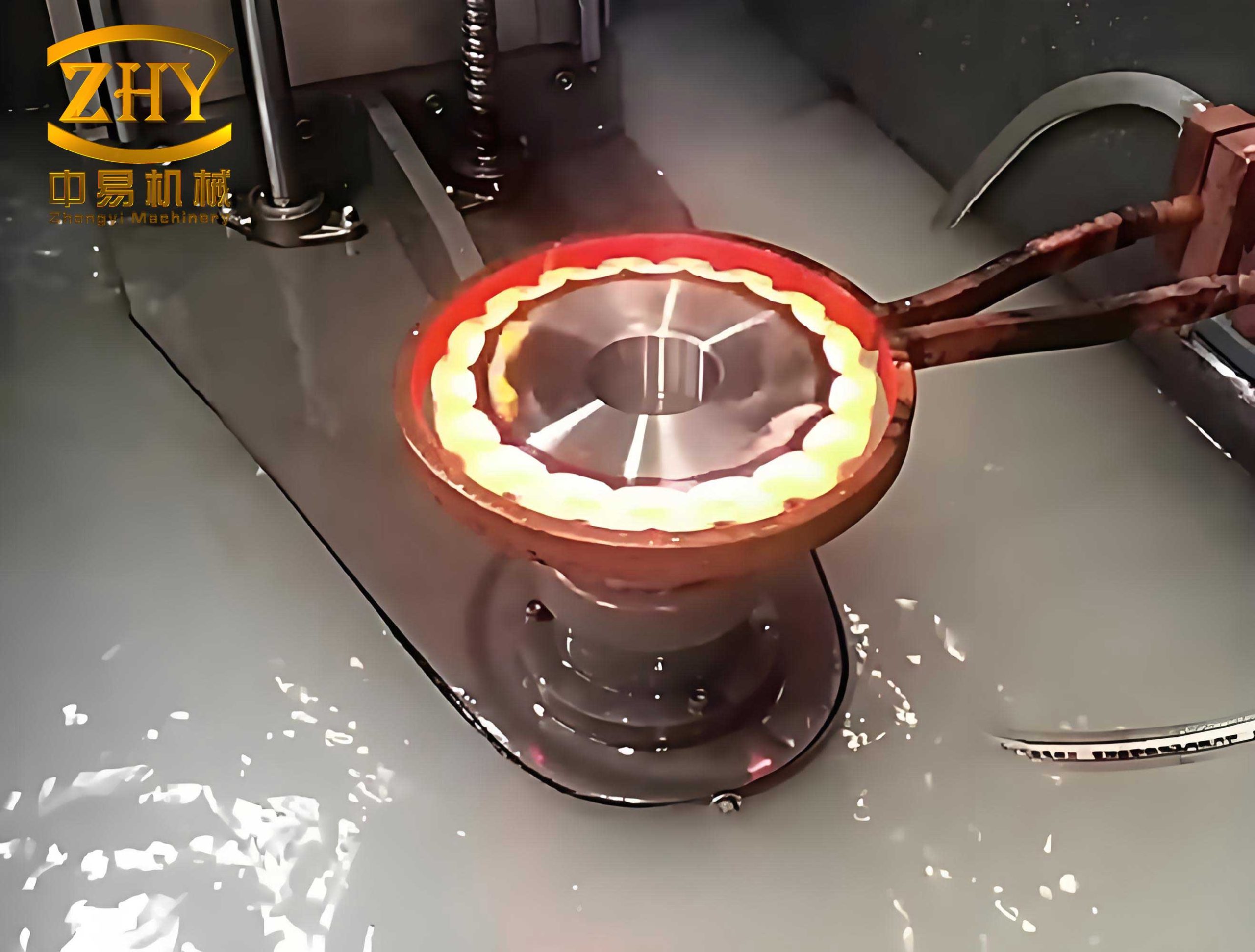
The initial heat treatment strategy was formulated to preemptively address potential heat treatment defects. Prior to any welding, individual components underwent a preliminary quenching and tempering process to achieve a uniform hardness of 230–270 HBW. This step aims to refine the grain structure and homogenize the material, thereby reducing the susceptibility to distortion and cracking during subsequent welding and final heat treatment—common heat treatment defects that arise from internal stresses. A key innovation was the decision to leave a 0.4 mm grinding allowance on the gear tooth surfaces before the final heat treatment. This allowance accommodates any minor dimensional changes or distortions that might occur, effectively decoupling the machining precision from the thermal processes and simplifying production for multiple specifications. Without this allowance, the risk of heat treatment defects like warping could render gears unusable after hardening.
Following the welding of the gear ring to the shaft, the assembly is immediately subjected to a stress-relief annealing in a vertical pit furnace. This rapid intervention is crucial to dissipate the thermal stresses introduced by welding, another source of potential heat treatment defects such as residual stress-induced cracking. The gear is placed vertically to minimize distortion due to its own weight, a practical measure against geometric heat treatment defects. The quenching process involves rapid heating to 900°C, followed by soaking at 860°C to achieve austenitization, and then oil quenching. To mitigate quenching-related heat treatment defects like excessive martensitic transformation stresses, the oil agitation is stopped once the component cools below the martensite start (Ms) temperature, allowing for a slower cooling rate. This controlled cooling helps in reducing the likelihood of cracking, a severe heat treatment defect. Immediately after quenching, the gear is tempered to eliminate internal stresses and achieve the desired toughness, completing the overall quenching and tempering cycle. The entire thermal cycle can be conceptually represented by the following relationship for temperature evolution:
$$ T(t) = T_{\text{ambient}} + (T_{\text{soak}} – T_{\text{ambient}}) \cdot \left(1 – e^{-t/\tau}\right) \quad \text{for heating phase} $$
$$ \frac{dT}{dt} = -k (T – T_{\text{quenchant}}) \quad \text{for cooling phase} $$
where \( T(t) \) is the temperature at time \( t \), \( T_{\text{soak}} \) is the soaking temperature (860°C), \( \tau \) is the thermal time constant of the furnace, and \( k \) is a cooling coefficient dependent on the quenchant. Precise control over these parameters is essential to avoid heat treatment defects related to uneven thermal gradients.
To further combat heat treatment defects in the weld zone, we experimented with depositing a transition layer of low-carbon steel via bead welding before the final assembly weld. This approach is designed to buffer the compositional gradient between the dissimilar steels, promoting a more gradual microstructural transition and reducing the risk of localized heat treatment defects like hardening and embrittlement in the HAZ. The effectiveness of this strategy, along with the standard weld-and-temper process, was rigorously evaluated through metallographic and mechanical testing, as summarized in the tables below. These results clearly highlight the impact of different processing routes on mitigating heat treatment defects.
| Sample ID | Pre-weld Condition | Post-weld Heat Treatment | Predominant Microstructure in Weld Metal | Predominant Microstructure in HAZ | Noted Heat Treatment Defects |
|---|---|---|---|---|---|
| 1 (Baseline) | As-received (untreated) | None | Bainite (B) + Martensite (M, trace) | Bainite (B) + Ferrite (F) + Martensite (M, few) | High residual stress, potential for quench cracking. |
| 2 (Direct Tempering) | Normalized | 860°C Quench + 500°C Temper | Tempered Sorbitte (S) | Tempered Sorbitte (S) | Minimal defects; uniform structure avoids softening/embrittlement. |
| 3 (Transition Layer) | Normalized + Low-Carbon Bead Weld | 860°C Quench + 500°C Temper | Tempered Sorbitte (S) + Ferrite (F) + Pearlite (P) | Tempered Sorbitte (S) + Ferrite (F) + Pearlite (P, few) | Best overall; no observed defects like HAZ softening or cracking. |
The microstructural data underscores how targeted heat treatment can transform potentially defective zones into regions of fine, uniform tempered sorbitte, which is associated with excellent strength and toughness. The presence of mixed phases in Sample 3 indicates a more forgiving microstructure, less prone to the abrupt property changes that characterize heat treatment defects.
| Sample ID | Processing Route | Tensile Strength (MPa) | Elongation (%) | Impact Toughness (J) | Inference on Heat Treatment Defects |
|---|---|---|---|---|---|
| 1 | As-welded, no final HT | 973.2 | 7.1 | 37.1 | Lower strength and toughness indicate residual stress and brittle phases—classic heat treatment defects from inadequate thermal processing. |
| 2 | Direct quench and temper | 1218.2 | 6.5 | 40.6 | Improved properties; some reduction in elongation may hint at minor embrittlement, a subtle heat treatment defect. |
| 3 | Bead weld transition layer + quench and temper | 1369.4 | 5.5 | 66.3 | Superior strength and exceptional impact toughness; the slight drop in elongation is offset by high toughness, showing effective suppression of embrittlement defects. |
The mechanical tests conclusively demonstrate that the integrated approach of using a transition layer followed by optimized quenching and tempering yields the best comprehensive performance. This process effectively circumvents the heat treatment defects commonly observed in welded joints, such as softened HAZ areas or brittle microconstituents. The significant jump in impact toughness for Sample 3 is particularly telling, as it indicates a microstructure resistant to crack propagation—a direct counter to embrittlement-type heat treatment defects.
Following the successful mitigation of heat treatment defects through thermal processing, attention turned to surface protection. The operational environment for snow remover gears is corrosive, necessitating a high-quality zinc coating. Traditional electroplating methods often led to subpar results on heat-treated steels, including poor adhesion, hydrogen embrittlement (itself a severe type of defect related to plating processes), and non-uniform coverage. To address this, we developed a novel alkaline zinc plating bath and a meticulous multi-step process.
The electroplating sequence comprises five stages: pretreatment, activation, electroplating, passivation, and drying. Pretreatment involves alkaline degreasing in a solution at 60–65°C containing 12 wt% NaOH, 5 wt% Na₂CO₃, 7 wt% Na₃PO₄, and 0.5 wt% OP-10 emulsifier for 20 minutes, followed by acid pickling in a room-temperature solution of 18 wt% HCl, 0.2 wt% hexamethylenetetramine, and 0.2 wt% OP-10 for 15 minutes. Activation is done in a 5% HCl bath for about 8 seconds. The core of the process is the proprietary zinc plating bath, whose composition we optimized to ensure excellent throwing power and coverage, even on complex geometries and in the recesses near weld zones—areas sometimes vulnerable due to prior heat treatment defects altering surface reactivity.
The plating bath formulation is as follows:
- Potassium Chloride (KCl): 60 g/L
- Zinc Chloride (ZnCl₂): 40 g/L
- Ammonium Chloride (NH₄Cl): 20 g/L
- Malic Acid (C₄H₆O₅): 3 g/L
- OP-20 Emulsifier: 1 g/L
- Cinnamic Acid (C₉H₈O₂): 0.1 g/L
- Primary Brightener (Benzylideneacetone, C₁₀H₁₀O): 0.2 g/L
- Polyethylene Glycol (PEG): 1 g/L
- pH: Maintained between 1.8 and 2.4
The role of benzylideneacetone as the primary brightener was established through comparative studies with vanillin and o-nitrobenzaldehyde; it provided the most consistent, bright, and adherent deposits on heat-treated substrates, minimizing defects like roughness or burning. The electroplating is conducted with the gear attached to a fixture. A initial current density (\( J_k \)) of 0.5 A/dm² is applied for 5 minutes for strike plating, followed by a main plating stage at \( J_k = 1.0 \, \text{A/dm}^2 \) for 20–30 minutes. The relationship for deposited mass (and thus thickness) can be approximated by Faraday’s law:
$$ m = \frac{Q \cdot M}{n \cdot F} = \frac{J_k \cdot A \cdot t \cdot M}{n \cdot F} $$
where \( m \) is the mass of zinc deposited, \( Q \) is the total charge, \( M \) is the molar mass of zinc, \( n \) is the number of electrons transferred (2 for Zn²⁺), \( F \) is Faraday’s constant, \( A \) is the surface area, and \( t \) is time. Maintaining a stable \( J_k \) and bath chemistry is critical to achieve a uniform coating thickness and avoid plating defects such as burning or poor adhesion, which could be exacerbated by underlying surface conditions stemming from heat treatment defects.
Post-plating, the gear is passivated in a solution containing 1 g/L H₂SO₄, 0.2 g/L HNO₃, and 60 g/L CrO₃ for 8 seconds to enhance corrosion resistance, then rinsed in hot water and dried at 60°C for 15 minutes.
The quality of the final product—both in terms of bulk properties and surface coating—was rigorously assessed. Gears manufactured using the bead-weld transition layer and the full heat treatment cycle were inspected for dimensional accuracy and hardness, as shown below. All parameters fell within strict specifications, proving that the heat treatment defects of distortion and size instability were successfully controlled.
| Inspection Parameter | Technical Requirement | Measured Result Range | Comment on Heat Treatment Defects |
|---|---|---|---|
| Radial Runout (mm) | < 0.40 | 0.30 – 0.40 | Within limit; distortion defect is minimal. |
| Face Runout (mm) | < 2.0 | 1.0 – 1.1 | Well within limit; indicates excellent geometric stability. |
| Tooth Axis Bending (mm) | < 2.5 | 1.5 – 1.8 | Acceptable; no significant warping observed. |
| Hardness (HBW) | 350 – 380 | 370 – 380 | Uniformly achieved; no soft spots—a common heat treatment defect is avoided. |
The surface coating was analyzed using scanning electron microscopy (SEM) and energy-dispersive X-ray spectroscopy (EDS). The SEM examination at high magnification (5000x) revealed a dense, continuous zinc layer with an average thickness of 6–8 μm, uniformly covering the substrate. The EDS line scan across the coating cross-section showed a compositional gradient: the weight percentage of zinc increased from the substrate-coating interface towards the outer surface, while iron decreased. This gradient indicates initial alloying between zinc and the steel substrate, promoting excellent adhesion and providing a barrier against corrosion. The coating composition at a representative point is given by:
$$ \text{Composition: } \text{Zn} = 95.17\% \, (94.61 \, \text{at.%), } \text{Fe} = 4.83\% \, (5.39 \, \text{at.%)} $$
The dense, pore-free morphology observed is a direct result of the optimized plating bath and parameters, which prevented coating defects that could have been initiated by surface irregularities from prior heat treatment defects.
Adhesion tests according to GB/T 5270–2005, including peel and cross-cut tests, confirmed strong bonding between the zinc layer and the gear substrate, with no delamination or flaking. This is crucial, as poor adhesion can be a failure mode linked indirectly to surface conditions altered by heat treatment defects like decarburization or excessive roughness. Salt spray testing per GB/T 10125–1997 demonstrated outstanding corrosion resistance, with no white rust or red corrosion spots appearing after 96 hours of exposure. This performance validates the entire process chain: the heat treatment created a sound, defect-free substrate, and the electroplating deposited a protective, adherent coating.
In reflection, the journey from a forging-based design to a welded gear assembly required a deep understanding of the interplay between material science, thermal processing, and surface engineering. The most persistent challenges were undoubtedly related to heat treatment defects. These defects—whether manifesting as soft zones in the HAZ, embrittled microstructures, quench cracks, or dimensional distortions—posed significant risks to gear performance and longevity. Our systematic approach, involving pre-weld normalizing, strategic use of a bead-welded transition layer, controlled quenching and tempering with vertical fixturing, and a precise post-weld stress relief, proved highly effective in suppressing these heat treatment defects. The mechanical and microstructural data irrefutably show that the final product possesses superior and stable properties, with the weld zone matching or exceeding the base material performance.
Furthermore, the developed zinc electroplating process, centered on a benzylideneacetone-brightened chloride-based bath, complements the robust substrate by providing a uniform, dense, and highly protective coating. This synergy between bulk property enhancement and surface protection is essential for components operating in corrosive environments. The methodologies outlined here, particularly the focus on preemptive measures against heat treatment defects, have broad applicability beyond snow remover gears. They can be adapted to other welded machinery components where dynamic loading and environmental exposure are concerns. Continuous monitoring and refinement of these processes remain vital, as even minor deviations in temperature, time, or chemistry can reintroduce the very heat treatment defects we strive to eliminate. Future work may explore computational modeling of thermal stresses to further optimize heating and cooling cycles, pushing the boundaries of defect-free manufacturing for high-performance welded assemblies.