
In my extensive experience within the gear manufacturing industry, I have come to understand that motorcycle gears are among the most critical components in powertrain systems. Their performance directly impacts durability, efficiency, and safety. The selection of appropriate steel materials and the implementation of precise heat treatment processes are paramount to achieving the necessary mechanical properties, such as high contact fatigue strength, bending fatigue resistance, and wear resistance. Over the years, our facility has dedicated significant effort to optimizing these aspects, particularly in mitigating common heat treatment defects that can compromise gear life. This article consolidates my firsthand knowledge and insights, focusing on steel grades, carburizing and carbonitriding techniques, effective case depth control, and the persistent challenge of heat treatment defects. I will employ tables and formulas to elucidate key concepts, ensuring a comprehensive guide for practitioners.
The foundation of a reliable gear lies in the choice of steel. We have evaluated numerous alloy steels for motorcycle gear applications, with a preference for those offering a balance of hardenability, toughness, and process stability. The most prevalent grades in our production include 20CrMnTi, 20CrMo, 20CrMnMo, and 25MnTiBRE. Each has distinct characteristics that influence the final gear performance and susceptibility to heat treatment defects. For instance, 20CrMnTi is widely used due to its good hardenability and resistance to overheating during carburizing. However, we have observed that it is prone to distortion and internal oxidation, which are significant heat treatment defects. On the other hand, 20CrMo exhibits better淬透性 stability, resulting in less distortion, making it suitable for small-module gears, though it requires careful process control to avoid other heat treatment defects like insufficient surface hardness. The table below summarizes the key properties and common heat treatment defects associated with these steels.
| Steel Grade | Primary Alloying Elements | Typical Hardenability (DI in oil, mm) | Main Applications in Motorcycle Gears | Common Heat Treatment Defects Encountered |
|---|---|---|---|---|
| 20CrMnTi | Chromium, Manganese, Titanium | Approximately 40 | Gears for medium to high loads, sections under 30 mm | Distortion, internal oxidation, non-martensitic surface layers |
| 20CrMo | Chromium, Molybdenum | Good and stable | Small-module gears requiring minimal distortion | Surface decarburization, occasional cracking if cooled improperly |
| 20CrMnMo | Chromium, Manganese, Molybdenum | Higher than 20CrMnTi | Heavier-duty gears, larger sections | Grinding cracks, excessive distortion if carburizing gradient is steep |
| 25MnTiBRE | Manganese, Titanium, Boron, Rare Earth | Excellent | High-performance gears with demanding strength requirements | Pronounced but predictable distortion, sensitivity to heating rates |
Carburizing remains the cornerstone of gear surface hardening. Our standard practice involves gas carburizing in pit-type furnaces using drip-feed methods. The goal is to achieve a shallow case depth, typically between 0.4 mm to 0.9 mm, which is sufficient for the moderate module gears common in motorcycles. A critical parameter is the effective case depth (ECD), defined as the perpendicular distance from the surface to the point where hardness reaches 550 HV under a 9.8 N (1 kgf) load, as per standards like GB 9450-88. This ECD is more representative of functional performance than the total case depth measured metallographically. The relationship between carburizing time and case depth can be approximated by a parabolic diffusion law:
$$d = k \sqrt{t}$$
where \(d\) is the case depth (in mm), \(t\) is the time (in hours), and \(k\) is a temperature-dependent diffusion constant. For temperatures around 910-930°C, \(k\) typically ranges from 0.3 to 0.35 mm/√h. Controlling surface carbon concentration is vital to prevent heat treatment defects such as brittle carbide networks. We aim for a surface carbon content of 0.75% to 0.95%. Excessive carbon above 1.05% can reduce bending fatigue strength by 10-15% and contact fatigue strength by 20-30%, manifesting as severe heat treatment defects. The process involves a boost-diffuse cycle: a high-carbon-potential boost stage followed by a lower-potential diffusion stage to smooth the carbon gradient. The oil drip rate (\(Q\)) in mL/min is often estimated based on the total surface area (\(A\) in m²) of the workload: during boost, \(Q_{boost} \approx 1.0 \times A\) mL/min, and during diffuse, \(Q_{diffuse} \approx (0.33 \text{ to } 0.5) \times Q_{boost}\). Inadequate control here directly leads to heat treatment defects like shallow case or excessive surface carbon.
Carbonitriding has emerged as a compelling alternative, especially for gears where minimal distortion is critical. In our trials, we processed 20CrMnTi and 20CrMo gears using carbonitriding at temperatures 60-80°C lower than conventional carburizing (typically 820-850°C). The simultaneous infusion of carbon and nitrogen enhances the diffusion coefficient of carbon and results in a hard, wear-resistant case with finer austenite grains. The fatigue strengths, both in bending and contact, were found to be higher than those of carburized gears. However, carbonitriding introduces its own set of potential heat treatment defects, most notably the formation of “black networks” – non-etching constituents like oxides or nitrides at the grain boundaries. To suppress this, we adjusted the process to aim for a surface carbon content ≥0.75% and nitrogen content ≥0.15%, and we accept a surface layer free of massive carbonitrides. Furthermore, any black network within 0.04 mm of the surface is deemed acceptable for our motorcycle gears, as it can often be removed during subsequent honing or grinding operations. The table below compares key aspects of carburizing and carbonitriding for shallow-case gears.
| Process Parameter | Carburizing | Carbonitriding |
|---|---|---|
| Typical Temperature Range | 880°C – 930°C | 820°C – 850°C |
| Primary Active Species | Carbon (from CnHm like oil) | Carbon and Nitrogen (from CnHm and NH3) |
| Effective Case Depth Range for Motorcycle Gears | 0.4 – 0.9 mm (DC) | 0.3 – 0.8 mm (economical) |
| Typical Surface Hardness | 58-63 HRC (≈700-800 HV) | 58-65 HRC (often higher due to N) |
| Advantages | Deep case capability, excellent fatigue strength | Lower distortion, higher hardness, better wear resistance |
| Common Heat Treatment Defects | Distortion, internal oxidation, grain growth, excessive retained austenite | Black network formation, porosity, control of N concentration |
Despite meticulous planning, heat treatment defects remain a pervasive challenge in gear manufacturing. I have categorized the most frequent issues we face into three primary types: cracking, distortion, and insufficient hardness. Each is a direct consequence of deviations in material, process, or cooling. Cracking can be macroscopic, such as longitudinal cracks along the axis of a gear shaft, often caused by overly rapid cooling after carburizing, especially in steels like 20CrMnMo which are prone to air-cooling cracks. Another form is micro-cracking, typically appearing after grinding as fine, perpendicular cracks on the tooth flank. These grinding cracks are themselves a secondary heat treatment defect, often triggered by high residual stresses from quenching combined with aggressive grinding parameters. The relationship between residual stress (\(\sigma_r\)) and grinding-induced heat can be modeled, but fundamentally, it’s a failure mode rooted in prior heat treatment defects. Distortion, perhaps the most costly heat treatment defect, involves dimensional changes like bore shrinkage, tooth profile deviation, and out-of-roundness. For example, we have documented bore shrinkage of up to 0.062 mm in H7 tolerance gears. This distortion stems from thermal gradients and transformation stresses during quenching. We mitigate this by using symmetrical fixtures, dedicated quenching mandrels, and optimizing the carburizing temperature. For thin-walled gears requiring a 0.4-0.7 mm case, we found that carburizing at 880°C instead of 930°C significantly reduces this heat treatment defect while still achieving the required depth, albeit with a slightly longer cycle. The third major category, insufficient surface hardness, is a heat treatment defect that directly compromises wear resistance. It can arise from surface decarburization during reheating, inadequate quenching speed (especially in the core of large sections), or low surface carbon concentration due to poor atmosphere control. In salt bath reheating, insufficient deoxidation is a common culprit for this heat treatment defect.
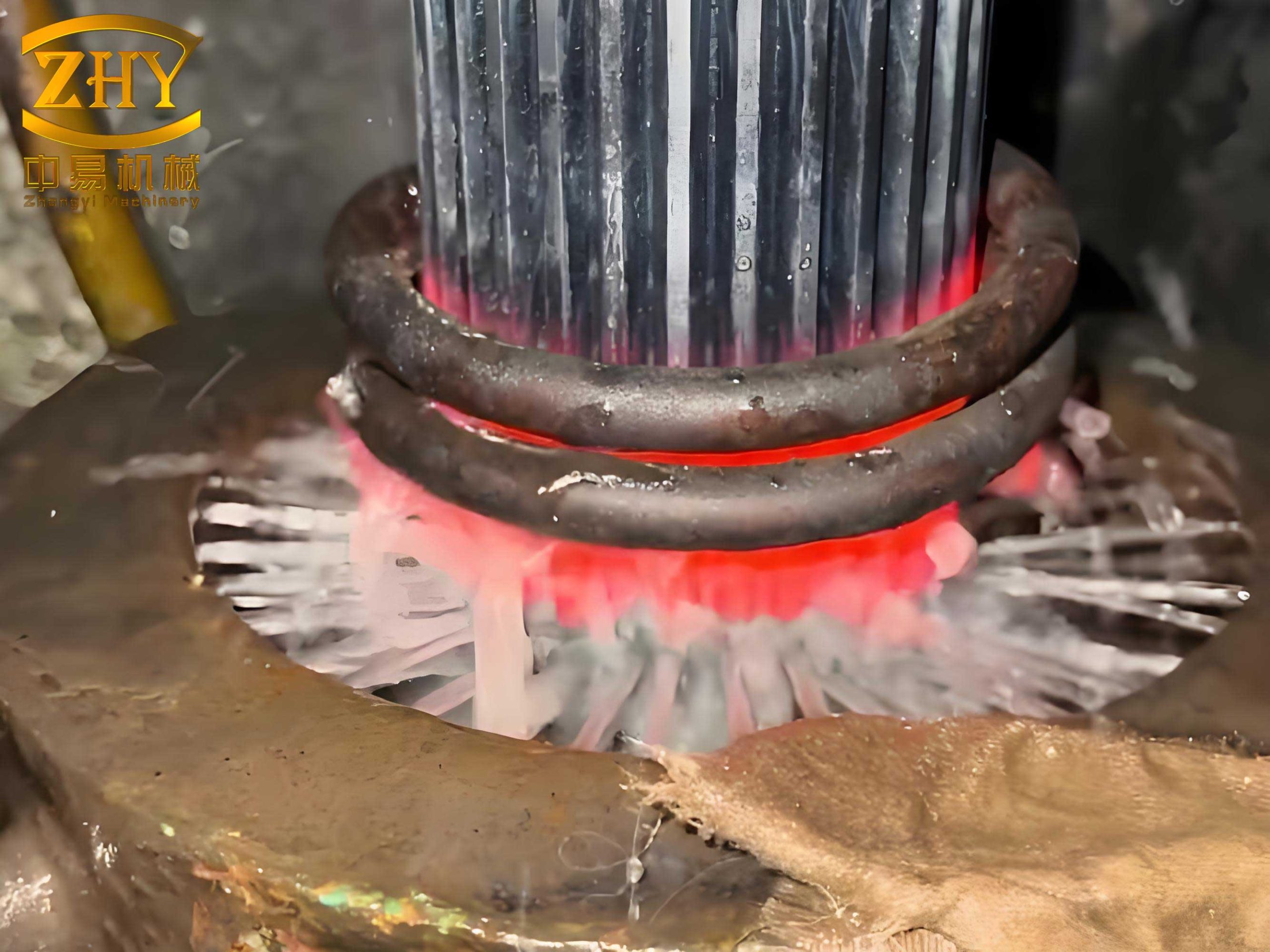
The image above illustrates a typical manifestation of heat treatment defects, underscoring the need for rigorous process control. To combat these heat treatment defects, we have implemented several process adjustments based on empirical data. For carburizing, we now strictly control furnace atmosphere pressure between 2000 to 4000 Pa and monitor flame color and height (80-150 mm, stable yellow) as indirect indicators of carbon potential. When dealing with furnaces that have been idle or used for other processes, we perform a “pot conditioning” cycle to re-saturate the muffle with carbon before loading production parts, preventing a heat treatment defect of inconsistent case depth. For distortion control, the quenching medium and agitation are critical. We use hot oil with controlled agitation and, for critical gears, employ press quenching fixtures. The quenching cooling rate must be sufficient to avoid the formation of soft transformation products like pearlite or bainite, which are heat treatment defects that lower hardness. The continuous cooling transformation (CCT) diagram for each steel guides this. For instance, the critical cooling rate (\(V_{cr}\)) to avoid ferrite-pearlite formation in 20CrMnTi is approximately:
$$V_{cr} \approx \frac{800°C – 500°C}{t_{8/5}}$$
where \(t_{8/5}\) is the time in seconds to cool from 800°C to 500°C, which must be shorter than a material-specific threshold. Post-quench tempering is another lever to alleviate heat treatment defects. Increasing the tempering temperature to 220°C for 20CrMnMo gears, for example, helps relieve stresses and prevents grinding cracks, another secondary heat treatment defect. Furthermore, we have adopted a systematic approach to measuring effective case depth via hardness traverses instead of relying solely on metallography, providing a more reliable check against the heat treatment defect of inadequate hardening depth. The hardness profile from surface to core can be described by an error function complement solution to Fick’s second law for diffusion, but in practice, we use standard hardness testers and correlate with performance.
Looking forward, the evolution of gear steels continues. We are observing a trend toward cleaner, restriction-hardenability steels like 16MnCr5 and SCM420H, which are specified in many imported motorcycle designs. These steels offer narrower hardenability bands, finer grain size, and higher purity, which inherently reduce several heat treatment defects such as distortion variability and non-martensitic surface layers. Their use, combined with advanced atmosphere control (e.g., oxygen probe and CO2 infrared control) and vacuum carburizing, promises further reduction in heat treatment defects. However, the fundamental principles remain: understanding material behavior, controlling diffusion processes, and managing thermal stresses. In conclusion, the journey to producing high-integrity motorcycle gears is a continuous battle against heat treatment defects. Through careful steel selection, precise control of carburizing and carbonitriding parameters, vigilant monitoring of effective case depth, and proactive adjustments based on root-cause analysis of defects, we can significantly enhance gear life and reliability. The tables and formulas presented here are tools distilled from our experience to aid in this endeavor. Remember, every heat treatment defect is an opportunity for process refinement, and mastering these details is what separates adequate gears from exceptional ones.
To further elaborate on the quantitative aspects, let’s consider the fatigue performance. The bending fatigue strength (\(\sigma_{fb}\)) of a case-hardened gear tooth is influenced by core strength, case depth, and surface condition. An empirical relationship often used in design is:
$$\sigma_{fb} = K_1 \cdot \sigma_{core} + K_2 \cdot (ECD)^m$$
where \(\sigma_{core}\) is the core tensile strength, \(ECD\) is the effective case depth, and \(K_1\), \(K_2\), and \(m\) are constants derived from material and testing. The presence of heat treatment defects like non-martensitic layers or grinding cracks introduces stress concentrators, effectively reducing the fatigue strength by a factor \(K_f\) (fatigue notch factor). For instance, a sharp grinding crack can lead to \(K_f > 3\), drastically shortening life. Similarly, the contact fatigue strength (pitting resistance) depends on surface hardness and the hardness gradient. The maximum shear stress (\(\tau_{max}\)) occurs slightly below the surface (at a depth of approximately 0.4-0.6 times the Hertzian contact half-width \(b\)). The required case depth must exceed this depth to ensure the material at \(\tau_{max}\) has sufficient strength. If the case is too shallow, subsurface initiated spalling becomes a dominant failure mode—a direct heat treatment defect related to insufficient depth. We calculate \(b\) for gear contact as:
$$b = \sqrt{\frac{2F}{\pi L} \cdot \frac{(1-\nu_1^2)/E_1 + (1-\nu_2^2)/E_2}{1/R_1 + 1/R_2}}$$
where \(F\) is the normal load, \(L\) is the face width, \(\nu\) is Poisson’s ratio, \(E\) is Young’s modulus, and \(R\) is the radius of curvature at the contact point. Ensuring the effective case depth is greater than the depth of \(\tau_{max}\) is a key design criterion to avoid this subsurface heat treatment defect. In our practice, for motorcycle gears with module 2.5 to 4.0, an ECD of 0.5 to 0.8 mm generally satisfies this, provided the hardness gradient is smooth. A steep gradient, another potential heat treatment defect from improper diffusion, can cause spalling even with adequate depth. Therefore, monitoring the entire hardness profile, not just the 550 HV point, is essential. We often specify a surface hardness of 58-62 HRC and a core hardness of 30-45 HRC for 20CrMnTi gears, with a gradual transition. Any deviation from this profile, such as a sudden drop in hardness, is recorded as a heat treatment defect and investigated. Finally, statistical process control (SPC) charts for key parameters like case depth, surface carbon, and distortion magnitude are maintained to preemptively identify trends that could lead to heat treatment defects, ensuring consistent quality in high-volume motorcycle gear production.