
In the automotive industry, transmission gear shafts are critical components subjected to significant tensile, compressive, and frictional loads during operation. To ensure durability and performance, these shafts must exhibit superior mechanical properties and wear resistance. Heat treatment is a pivotal process for enhancing the comprehensive properties of metallic materials, but it often introduces heat treatment defects such as distortion, cracking, residual stresses, and microstructural inhomogeneities. These heat treatment defects can compromise component integrity and lifespan. In this study, I focus on optimizing the heat treatment process for 20CrMnTi steel, commonly used in automotive transmission gear shafts, to achieve strengthening and toughening while minimizing heat treatment defects. The traditional process route involves forging, normalizing, machining, carbonitriding, quenching, tempering, fine grinding, and shot peening. However, direct oil quenching after carbonitriding at the same temperature can lead to heat treatment defects like excessive distortion and reduced toughness. Through modifications in normalizing and quenching parameters, I aim to develop an improved heat treatment strategy that enhances performance and reduces heat treatment defects.
The material under investigation is 20CrMnTi steel, with its chemical composition detailed in Table 1. Understanding the composition is crucial as it influences phase transformations and susceptibility to heat treatment defects such as decarburization or grain growth.
| C | Si | Mn | Cr | Ti | S | P | Fe |
|---|---|---|---|---|---|---|---|
| 0.194 | 0.303 | 1.012 | 1.194 | 0.084 | 0.016 | 0.014 | Balance |
To quantify the impact of heat treatment defects, I consider factors like distortion and residual stress, which can be modeled using thermal expansion coefficients and phase transformation kinetics. For instance, the volumetric change during martensitic transformation contributes to distortion, a common heat treatment defect. The strain due to phase transformation can be expressed as:
$$ \epsilon_{tr} = \beta \cdot \Delta V / V_0 $$
where $\epsilon_{tr}$ is the transformational strain, $\beta$ is a material constant, and $\Delta V / V_0$ is the relative volume change. Minimizing such strains is key to reducing heat treatment defects.
The conventional heat treatment process prior to optimization involved normalizing at 875°C for 1.5 hours followed by air cooling, carbonitriding at 870°C for 4 hours with direct oil quenching, and tempering at 200°C for 2 hours. This approach, while standard, often results in heat treatment defects like high residual stresses and non-uniform hardness due to rapid cooling. In contrast, the optimized process incorporates isothermal normalizing and step quenching to mitigate these heat treatment defects. The optimized parameters are: isothermal normalizing at 875°C for 1.5 hours followed by 650°C for 0.5 hours and air cooling; carbonitriding at 870°C for 3.5 hours; step quenching at 560°C for 0.5 hours before oil cooling; and tempering at 180°C for 1.5 hours. This revised sequence aims to reduce thermal gradients and phase transformation stresses, thereby addressing heat treatment defects.
Heat treatment defects such as cracking often arise from high cooling rates. The cooling rate during quenching can be described by Newton’s law of cooling:
$$ \frac{dT}{dt} = -h \cdot (T – T_{\text{medium}}) $$
where $h$ is the heat transfer coefficient, $T$ is the temperature of the material, and $T_{\text{medium}}$ is the temperature of the quenching medium. By using step quenching at 560°C, I reduce the cooling rate in the critical temperature range, minimizing thermal shock and associated heat treatment defects.
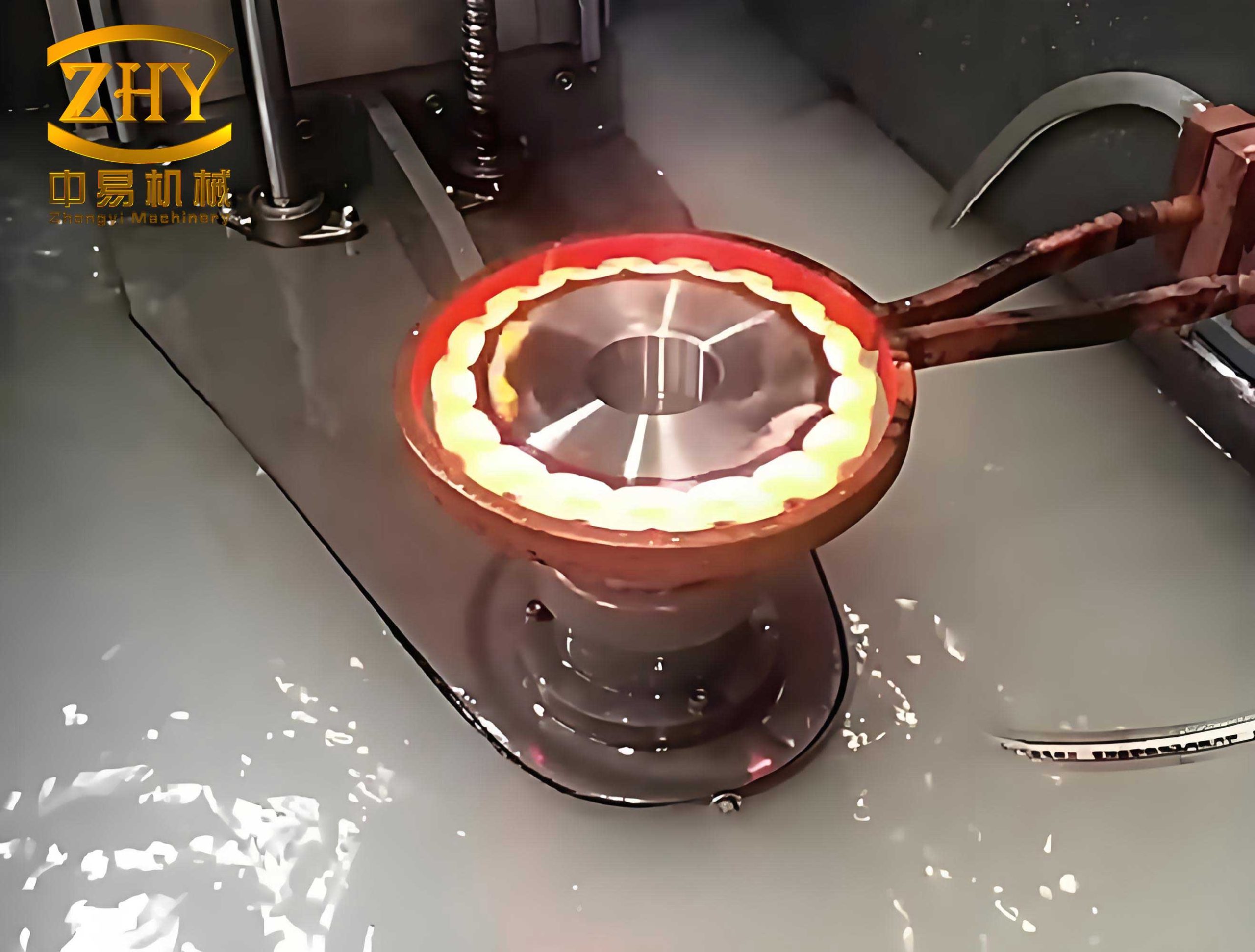
The image above illustrates common heat treatment defects like distortion and cracks, which are critical to avoid in precision components like gear shafts. In my study, I evaluate mechanical and wear properties to assess the reduction in heat treatment defects. Tensile tests were conducted at 25°C and 350°C using a UH4000GD testing machine, with specimens prepared as rectangular sections. Wear tests were performed on an MG-2000 tester under specified conditions. The results, summarized in Table 2, show significant improvements with the optimized process, indicating fewer heat treatment defects.
| Property | Test Temperature | Before Optimization | After Optimization | Improvement (%) |
|---|---|---|---|---|
| Tensile Strength (MPa) | 25°C | 1092 | 1186 | 8.6 |
| Tensile Strength (MPa) | 350°C | 724 | 1035 | 43.0 |
| Yield Strength (MPa) | 25°C | 838 | 903 | 7.8 |
| Yield Strength (MPa) | 350°C | 511 | 842 | 64.8 |
| Elongation (%) | 25°C | 10.6 | 13.8 | 30.2 |
| Elongation (%) | 350°C | 18.8 | 29.7 | 57.9 |
| Wear Volume (10-3 mm3) | 25°C | 74 | 28 | 62.2 reduction |
| Wear Volume (10-3 mm3) | 350°C | 219 | 63 | 71.2 reduction |
The enhancement in properties can be attributed to reduced heat treatment defects. For example, the optimized normalizing promotes a finer and more uniform microstructure, decreasing the likelihood of heat treatment defects like banding or segregation. The step quenching reduces residual stresses, a prevalent heat treatment defect that can lead to premature failure. The relationship between residual stress $\sigma_r$ and distortion can be modeled as:
$$ \sigma_r = E \cdot \alpha \cdot \Delta T $$
where $E$ is Young’s modulus, $\alpha$ is the thermal expansion coefficient, and $\Delta T$ is the temperature gradient. By minimizing $\Delta T$ through controlled cooling, I mitigate this heat treatment defect.
Microstructural analysis further supports the reduction in heat treatment defects. Scanning electron microscopy of tensile fractures at 350°C revealed that the optimized process produced finer and deeper dimples, indicating better ductility and fewer micro-cracks—a common heat treatment defect. Similarly, wear surface observations showed less peeling and脱落 in optimized samples, suggesting improved resistance to wear-induced heat treatment defects like surface spalling.
To quantify the impact on heat treatment defects, I consider the distortion measurement. The distortion $\delta$ can be expressed as a function of processing parameters:
$$ \delta = f(T, t, C) $$
where $T$ is temperature, $t$ is time, and $C$ is cooling rate. The optimized process reduces $\delta$ by lowering $C$ during critical phases, thereby addressing heat treatment defects related to dimensional instability.
In terms of wear resistance, the Archard wear equation is relevant:
$$ V = k \cdot \frac{F \cdot s}{H} $$
where $V$ is wear volume, $k$ is a wear coefficient, $F$ is load, $s$ is sliding distance, and $H$ is hardness. The optimized heat treatment increases $H$ and reduces $k$ by minimizing heat treatment defects like soft spots or inhomogeneous hardening, leading to lower wear volume.
The carbonitriding process itself can introduce heat treatment defects such as excessive carbon or nitrogen gradients, causing brittleness. By shortening the carbonitriding time from 4 to 3.5 hours and adjusting quenching, I achieve a more controlled diffusion, reducing such heat treatment defects. The diffusion equation for carbon concentration $C(x,t)$ is:
$$ \frac{\partial C}{\partial t} = D \frac{\partial^2 C}{\partial x^2} $$
where $D$ is the diffusion coefficient. Optimizing time and temperature helps maintain a desirable profile, minimizing heat treatment defects related to case depth variations.
Table 3 summarizes the key heat treatment defects addressed by the optimized process, highlighting how each modification contributes to performance enhancement.
| Heat Treatment Defect | Cause in Conventional Process | Solution in Optimized Process | Impact on Properties |
|---|---|---|---|
| Distortion | Rapid cooling during oil quenching | Step quenching at 560°C to reduce thermal stress | Improved dimensional accuracy and reduced residual stress |
| Cracking | High martensitic transformation stresses | Isothermal normalizing and controlled quenching rates | Enhanced toughness and elongation |
| Residual Stresses | Non-uniform cooling and phase changes | Gradual cooling through step quenching and tempering | Increased fatigue resistance and mechanical stability |
| Microstructural Inhomogeneity | Inadequate normalizing leading to banding | Isothermal normalizing for uniform grain refinement | Better wear resistance and tensile strength |
| Excessive Case Depth | Prolonged carbonitriding time | Reduced carbonitriding duration to 3.5 hours | Balanced surface and core properties, reducing brittleness |
The mechanical performance improvements are directly linked to the reduction in heat treatment defects. For instance, the increase in tensile strength at 350°C from 724 MPa to 1035 MPa reflects better microstructural stability, as heat treatment defects like grain boundary weakening are minimized. The yield strength improvement of 64.8% at 350°C indicates enhanced resistance to deformation, often compromised by heat treatment defects such as residual stresses. Elongation improvements signify greater ductility, which is typically reduced by heat treatment defects like quench cracking or embrittlement.
Wear resistance is similarly enhanced by addressing heat treatment defects. The wear volume reduction of 71.2% at 350°C demonstrates that the optimized process minimizes surface defects like spalling or abrasion, which are exacerbated by heat treatment defects such as incomplete hardening or soft zones. The relationship between hardness $H$ and wear resistance can be expressed as:
$$ H = H_0 + \Delta H_{\text{HT}} – \Delta H_{\text{defects}} $$
where $H_0$ is the base hardness, $\Delta H_{\text{HT}}$ is the gain from heat treatment, and $\Delta H_{\text{defects}}$ is the loss due to heat treatment defects. By reducing $\Delta H_{\text{defects}}$, the net hardness increases, improving wear performance.
In conclusion, the optimized heat treatment process for 20CrMnTi automotive transmission gear shafts effectively reduces heat treatment defects while enhancing mechanical and wear properties. Key steps include isothermal normalizing at 875°C for 1.5 hours followed by 650°C for 0.5 hours, and step quenching at 560°C after carbonitriding. These modifications mitigate common heat treatment defects like distortion, cracking, and residual stresses, leading to significant improvements in strength, toughness, and durability. Future work could explore further refinements to eliminate heat treatment defects in other alloy systems, advancing automotive component reliability. The continuous focus on minimizing heat treatment defects is essential for achieving high-performance materials in demanding applications.
To generalize the findings, the optimized process can be modeled using a performance index $P$ that accounts for heat treatment defects:
$$ P = \frac{\sigma_y \cdot \epsilon}{\delta \cdot V_w} $$
where $\sigma_y$ is yield strength, $\epsilon$ is elongation, $\delta$ is distortion, and $V_w$ is wear volume. By maximizing $P$ through reduced heat treatment defects, the overall component quality is enhanced. This approach underscores the importance of systematic heat treatment design to avoid heat treatment defects and achieve optimal material performance.