
In my experience with manufacturing and refining processes for critical automotive components, few challenges are as persistent and costly as those arising from improper heat treatment. The case of the engine oil pump drive gear, initially manufactured using a high-frequency induction hardening process followed by water quenching, serves as a profound lesson. The goal was clear: achieve a hardened tooth flank and tip with a specified surface hardness of 48-53 HRC, while maintaining minimal face runout relative to the pitch diameter. The initial process seemed technically sound on paper, utilizing a specialized setup for simultaneous rotation and heating within an annular inductor, followed by a rapid immersion into a flowing water quench tank. However, the reality in field operation was starkly different – we encountered catastrophic failures in the form of tooth spalling and breakage. This was the direct and undeniable manifestation of severe heat treatment defects.
The core of the problem was identified as the formation of radial cracks propagating through the tooth root and rim area. These cracks are the ultimate failure mode stemming from excessive thermal and transformational stresses during quenching. Our investigation confirmed that the water quench, while excellent for achieving high hardness, was far too severe for the geometric complexity of the gear. The intense and non-uniform cooling created steep thermal gradients and massive internal stresses that exceeded the material’s fracture strength. The scrap rate due to this cracking alone was an unacceptable 3-5%. Furthermore, we observed other related heat treatment defects such as inconsistent hardness with “soft spots,” and excessive runout beyond the 0.1 mm specification, indicating significant distortion.
The physics behind these heat treatment defects can be summarized by the interplay of cooling intensity and stress generation. The primary objective of quenching is to achieve a martensitic transformation, which follows a temperature-dependent kinetic model often approximated by the Avrami equation:
$$ V_f = 1 – \exp(-k t^n) $$
where $V_f$ is the volume fraction of martensite, $t$ is time, and $k$ and $n$ are material-dependent constants. However, the rapid cooling necessary to bypass the pearlite and bainite “noses” in the TTT diagram also generates stress. The thermal stress ($\sigma_{th}$) is proportional to the thermal gradient ($\nabla T$), material properties like the coefficient of thermal expansion ($\alpha$) and Young’s modulus ($E$):
$$ \sigma_{th} \propto -E \cdot \alpha \cdot \nabla T $$
Simultaneously, transformational stress ($\sigma_{tr}$) arises from the volume expansion associated with the austenite-to-martensite change. The total stress state, if not managed, leads to plastic deformation (distortion/runout) or brittle fracture (cracking).
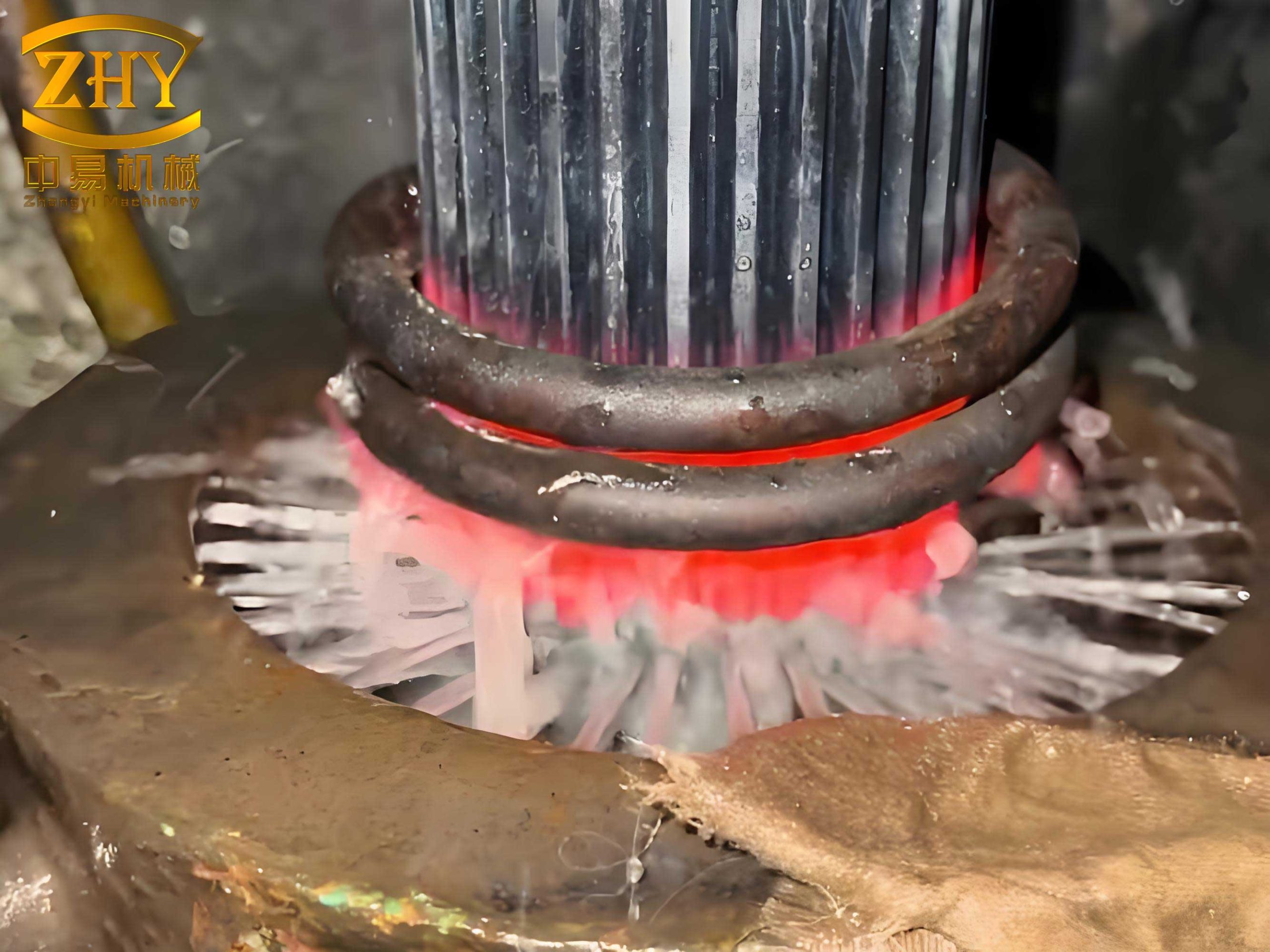
The first and most critical corrective action was to fundamentally change the quenching medium. We replaced water with Industrial Oil (GOST 20799-75). The cooling curves for water and oil are drastically different. Water exhibits a rapid vapor blanket stage, a violent boiling stage with very high heat extraction, and a slower convective stage. Oil, in contrast, has a more stable vapor blanket and a much less aggressive boiling stage, leading to a significantly reduced cooling rate, especially in the critical temperature range (approx. 600°C to Ms) where martensite starts to form. This slower cooling allows thermal gradients to equalize, dramatically reducing $\sigma_{th}$ and mitigating the root cause of quench cracks. However, this change necessitated a complete re-design of the quenching operation itself, moving from an automated press-quench in a small tank to a manual, free-quench in a large-volume oil bath to eliminate fire hazards and ensure proper part orientation.
| Cooling Medium | Max Cooling Rate (°C/s) | Temperature Range of High Cooling | Primary Risk of Defect |
|---|---|---|---|
| Water (20°C) | > 200 | 300-100°C | Severe Cracking, High Distortion |
| Hot Water (40-60°C) | ~150 | 300-100°C | Reduced but significant cracking risk |
| Fast Quench Oil | ~80-100 | 600-400°C | Low cracking, moderate distortion |
| Industrial Oil (Used) | ~50-70 | 600-400°C | Minimal cracking, controlled distortion |
The quenching technique was equally vital. To prevent non-uniform stress distribution, the heated gear must be immersed vertically into the oil bath. A slanted or horizontal entry creates an immediate asymmetry in cooling, leading to bowing and increased runout. Furthermore, agitating the part or the oil is essential to break down the insulating vapor blanket that forms instantly, ensuring a consistent and repeatable cooling rate across all tooth surfaces. The cooling must continue until the part temperature is well below the martensite finish (Mf) temperature, typically below 100°C, to ensure complete transformation before any subsequent handling or tempering.
Let’s formalize the optimized heating and quenching parameters. The induction heating power ($P$) must be sufficient to austenitize the齿廓 to a precise depth. For a carbon steel like the one used, the required specific power $p_0$ (W/cm²) and time $t_h$ are interrelated:
$$ P = p_0 \cdot A, \quad \text{and} \quad \delta \propto \sqrt{\alpha \cdot t_h} $$
where $A$ is the heated area and $\delta$ is the austenitization depth. We established that a gap of 3.0-4.5 mm between the齿顶 and inductor, combined with a part rotation speed of 125-160 rpm for 40 seconds at a generator current of 3.2-3.5 kA, produced a consistent and homogeneous austenitization to the required depth at a temperature of 880-900°C.
The subsequent tempering process is the final, crucial step for stabilizing the microstructure and relieving the residual stresses that remain even after oil quenching. Tempering transforms the brittle, as-quenched martensite into tougher tempered martensite. The effect of tempering temperature ($T_{tem}$) and time ($t_{tem}$) on final hardness ($H$) can be described by an empirical Hollomon-Jaffe type parameter:
$$ P_{HJ} = T_{tem} \cdot (C + \log t_{tem}) $$
where $C$ is a constant. The final hardness has an inverse logarithmic relationship with this parameter. Our optimized process used a tempering temperature of 180-200°C for 15-20 minutes, followed by air cooling. This cycle effectively reduced hardness from the as-quenched 56-60 HRC down to the specified 48-53 HRC range, while maximizing toughness and stress relief without over-softening the component.
| Process Step | Key Parameters | Control Objective | Defect Mitigated |
|---|---|---|---|
| Pre-Cleaning | AK-20 medium, 70-80°C, 15-20 min | Remove oil, prevent soft spots | Surface contamination-related soft spots |
| Induction Heating | Gap: 3.0-4.5mm, Rot: 125-160 rpm, Time: 40s, Temp: 880-900°C | Uniform austenitization to specified depth | Incomplete hardening, localized overheating |
| Quenching | Vertical immersion in Industrial Oil, agitate, cool to <100°C | Controlled martensitic transformation with minimal stress | Quench cracks, excessive distortion (runout) |
| Post-Quench Cleaning | Repeat pre-cleaning step | Remove oil for inspection and further processing | N/A |
| Tempering | 180-200°C, 15-20 min, Air Cool | Stress relief, achieve target toughness/hardness | Brittle fracture, residual stress failure |
| Final Inspection | Hardness: 48-53 HRC, Runout: ≤0.08 mm, Magnetic Particle Inspection (MPI) | Verify absence of all heat treatment defects | Shipping defective parts |
A comprehensive quality control regimen is non-negotiable to prevent heat treatment defects from reaching the end user. 100% inspection was implemented. Hardness was verified on the齿廓 using a Rockwell tester. Runout was meticulously checked with dial indicators. Most importantly, every single gear underwent Magnetic Particle Inspection (MPI) using a modern flaw detector. MPI is supremely effective at revealing even hairline cracks that are invisible to the naked eye, the most critical of all heat treatment defects. Only parts passing all these checks proceeded to final passivation cleaning.
The root causes of the initial failures were multifaceted, but all fall under the umbrella of heat treatment defects:
- Quench Medium Mismatch: Water’s high cooling rate generated catastrophic thermal stress.
- Inadequate Stress Relief: The initial process did not adequately address residual stresses post-quench.
- Process Control Gaps: Inconsistent heating or quenching orientation led to hardness variation and distortion.
- Surface Condition: Residual machining burrs or contaminants acted as stress concentrators, initiating cracks during the severe water quench.
The financial impact of resolving these heat treatment defects was substantial. For an annual production volume of 300,000 gears, the savings from drastically reduced scrap rates, eliminated warranty claims for field failures, and improved production efficiency amounted to significant monetary value. More importantly, it ensured reliability and safety for the end-user. The optimized protocol became the standard: a mandatory pre-cleaning, precise induction heating, a controlled oil quench with proper technique, a defined tempering cycle, and a rigorous, multi-stage inspection barrier. This holistic approach, where every parameter from initial cleanliness to final inspection is controlled, is the only reliable defense against the costly and dangerous spectrum of heat treatment defects. The journey from a 5% scrap rate to virtually zero critical failures underscored a fundamental principle: in heat treatment, achieving the target hardness is only half the battle; managing the associated stresses is what separates a robust component from a defective one.
Further analytical consideration can be given to predicting the risk of such heat treatment defects. The tendency for cracking can be modeled by comparing the fracture strength of the material ($\sigma_f$) against the developed tensile stress ($\sigma_{total}$). A simple cracking criterion can be stated as:
$$ \text{Cracking Risk Factor } (CRF) = \frac{\sigma_{total}}{\sigma_f} $$
where $\sigma_{total} = \sigma_{th} + \sigma_{tr}$. If $CRF \geq 1$, cracking is probable. For water quenching, our $CRF$ was significantly greater than 1. For the optimized oil quench, careful control of gradients and transformation brought $CRF$ well below 1, into the safe operating regime. This conceptual model, though simplified, guides the selection of cooling severity. It also explains why seemingly minor issues like burrs are critical—they locally reduce the effective $\sigma_f$, increasing the local $CRF$ and initiating failure even if the bulk stress is acceptable.
In conclusion, the resolution of this case was not merely a process adjustment but a complete philosophical shift in managing the heat treatment of precision gears. It moved the focus from simply achieving a hardness number to comprehensively managing the entire thermal-mechanical-metallurgical cycle to suppress all potential heat treatment defects. The final, stabilized process flow is a testament to the fact that preventing heat treatment defects requires a synergistic approach combining material science, physics, mechanical engineering, and relentless process control. Every step, from the chemistry of the cleaning agent to the physics of induction heating and the fluid dynamics of the oil quench, plays an integral role in determining whether the final part is a reliable component or a testament to the costly consequences of heat treatment defects.