
In the realm of metallurgy and manufacturing, heat treatment stands as a critical process for imparting desired mechanical properties such as hardness, strength, toughness, and wear resistance to metallic components. By carefully controlling the thermal cycles of heating and cooling, engineers can manipulate the internal microstructure of a metal, thereby tailoring its performance for specific applications. However, this powerful technique is a double-edged sword. Inadequate control over process parameters, material inconsistencies, or unforeseen interactions can lead to a range of detrimental outcomes, collectively known as heat treatment defects. These defects can manifest as cracks, distortion, soft spots, or microstructural anomalies, often resulting in catastrophic in-service failures, significant economic losses, and serious safety hazards. This article delves into the complex world of heat treatment defects, exploring their root causes, underlying mechanisms, and diagnostic methodologies, with a particular focus on the insights gleaned from a detailed failure analysis case.
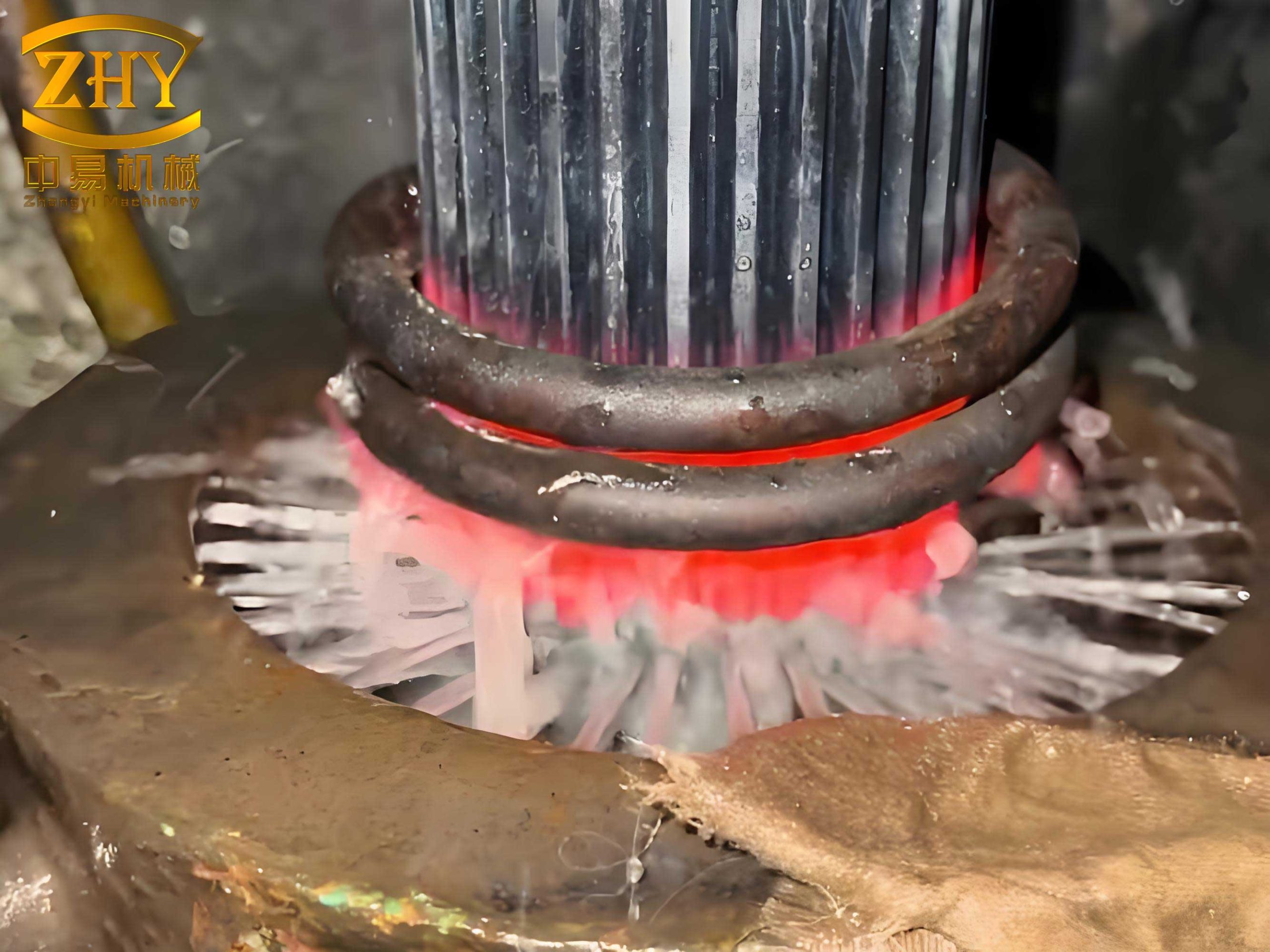
A pertinent example that underscores the severity of heat treatment defects involves the spontaneous cracking of large gear components during storage. The gears, manufactured from a case-hardening steel grade similar to 18CrNiMo7-6, underwent a standard quench and low-temperature tempering process. Post-treatment inspection confirmed they were sound, yet after a period in storage, several gears developed pronounced circumferential cracks originating from the inner bore. This delayed failure, occurring without any applied service load, points directly to a complex interplay of material properties and thermal processing—a classic scenario of heat treatment defects leading to hydrogen-assisted cracking and quench cracking.
The investigation into this failure provides a perfect framework for understanding broader categories of heat treatment defects. The analysis revealed that the direct cause was hydrogen-induced delayed cracking. The high tensile strength of the gear material, a direct result of its heat treatment, significantly increased its susceptibility to hydrogen embrittlement. Even a relatively low concentration of hydrogen, potentially introduced during prior processing like pickling or electroplating, or even from the atmosphere during heating, can become trapped in the metal lattice. Under the influence of high residual tensile stresses—another common heat treatment defect from non-uniform quenching—this hydrogen can accumulate at microstructural stress concentrators, leading to the initiation and subcritical propagation of cracks. The fracture surface in the crack initiation zone typically exhibits characteristic features like intergranular fracture with “river markings” or “tear lines” on the grain facets.
However, the hydrogen embrittlement was merely the trigger. The fundamental root cause was traced back to the material’s excessive hardenability. Hardenability, a key concept in avoiding one major class of heat treatment defects, refers to a steel’s ability to form martensite to a certain depth upon quenching. It is governed by the chemical composition. In this case, the failed gear material had a chemical composition at the upper limit of the specification for carbon and key alloying elements like chromium. This elevated alloy content resulted in a drastically higher hardenability than specified and than that of non-failed gears from the same batch. The consequence was that during quenching, a much larger volume of the gear transformed into high-carbon martensite. Martensitic transformation is accompanied by a significant volume expansion, and when it occurs throughout a thick section, it generates immense internal stresses. The excessive and potentially non-uniform formation of this hard, brittle phase created a state of high residual stress and, crucially, produced a final hardness and strength level that made the component extremely prone to other heat treatment defects like cracking, even from secondary factors like hydrogen.
This case elegantly ties together several critical heat treatment defects: excessive hardness/strength leading to low fracture toughness, high residual stresses, and undesired microstructure distribution. To systematically address such issues, it is essential to categorize and understand the common types of heat treatment defects.
Common Types and Mechanisms of Heat Treatment Defects
Heat treatment defects can be broadly classified based on their macroscopic manifestation and underlying cause. The following table summarizes the primary categories, their causes, and typical consequences.
| Category of Defect | Primary Causes | Typical Manifestations & Consequences |
|---|---|---|
| Cracking (Quench Cracking, Grinding Cracks) | Excessive thermal & transformational stresses during rapid cooling; High hardenability; Design with sharp corners/notches; Inadequate tempering. | Brittle fracture, often intergranular; Catastrophic part failure. |
| Distortion & Warping | Non-uniform heating or cooling; Residual stress relief during heating; Uneven support during thermal cycles. | Dimensional inaccuracy; Poor assembly fit; Loss of function. |
| Soft Spots & Inadequate Hardness | Insufficient quenching speed (poor agitation, wrong medium); Surface decarburization during heating; Improper austenitizing temperature/time. | Reduced wear resistance; Premature failure in service; Non-uniform properties. |
| Excessive Hardness & Brittleness | Overly rapid quenching (e.g., water quenching a high-hardenability steel); Insufficient or omitted tempering; Incorrect steel grade selection. | Low fracture toughness; High susceptibility to hydrogen embrittlement and cracking. |
| Microstructural Anomalies (Overheating, Burning, Abnormal Grain Growth) | Excessively high austenitizing temperature or time; Contaminated furnace atmosphere. | Coarse microstructure; Reduced toughness and strength; Intergranular oxidation (burning). |
| Residual Stresses | Thermal gradients and differential phase transformation during quenching. | Dimensional instability over time; Promotion of stress corrosion cracking (SCC) and hydrogen-assisted cracking. |
| Oxidation & Decarburization | Exposure to oxidizing atmospheres (air, water vapor) at high temperature without protective atmosphere or vacuum. | Loss of surface carbon (decarb), leading to a soft surface layer; Scale formation, causing dimensional loss and surface pitting. |
Many of these heat treatment defects are interlinked. For instance, high residual stress (a defect) can promote cracking (another defect) in the presence of hydrogen. The risk of these heat treatment defects can be quantified and predicted using engineering models. The development of thermal stress ($\sigma_{th}$) during quenching is a function of the thermal gradient and material properties:
$$\sigma_{th} \propto E \cdot \alpha \cdot \Delta T$$
where $E$ is Young’s modulus, $\alpha$ is the coefficient of thermal expansion, and $\Delta T$ is the temperature difference between the surface and core. Adding to this are transformational stresses ($\sigma_{tr}$) caused by the volume change $\Delta V$ associated with the austenite-to-martensite transformation:
$$\sigma_{tr} \propto E \cdot \frac{\Delta V}{V}$$
The total stress state leading to quench cracking, a severe heat treatment defect, is a complex superposition $\sigma_{total} = f(\sigma_{th}, \sigma_{tr})$. When this exceeds the fracture strength of the untempered martensite at a given location, cracking initiates.
Hardenability, a central factor in the gear case, is best predicted using the ideal critical diameter ($D_I$) concept. The Grossmann method uses a multiplying factor approach based on composition. A more precise and modern method is based on the work of Kirkaldy and others, where the hardenability can be modeled. The critical cooling rate to avoid forming soft pearlite or bainite, and thus achieve martensite, is a key metric. The time-temperature-transformation (TTT) and continuous-cooling-transformation (CCT) diagrams are the fundamental maps to avoid microstructural heat treatment defects. To achieve a desired hardness (HV) or strength ($R_m$), the cooling curve must avoid the “nose” of these transformation diagrams. Failure to do so results in soft spots—a critical heat treatment defect.
Diagnostic Techniques for Investigating Heat Treatment Defects
Identifying the root cause of heat treatment defects requires a systematic, multi-technique investigative approach, as demonstrated in the gear failure. The following table outlines the key diagnostic methods and the specific information they yield relevant to heat treatment defects.
| Diagnostic Technique | Purpose & Information Gained | Relevance to Heat Treatment Defects |
|---|---|---|
| Macroscopic Examination | Document crack location, orientation, and overall part deformation. | Distinguishes between quench cracks (often from stress concentrators), grinding cracks (perpendicular to grinding direction), and service-induced cracks. |
| Non-Destructive Testing (NDT) | Detect internal cracks, inclusions, or voids without damaging the part. | Ultrasonic testing can map internal crack depth; Magnetic particle inspection reveals surface-breaking cracks. Essential for assessing the extent of the defect. |
| Chemical Analysis | Verify material grade and identify off-spec elements. | High carbon or alloy content explains excessive hardenability and hardness, a root cause of many heat treatment defects. Analysis of hydrogen, oxygen, nitrogen is crucial for embrittlement cases. |
| Fractography (SEM/EDS) | Examine the fracture surface morphology at high magnification. | Intergranular fracture suggests hydrogen embrittlement, overheating, or temper embrittlement. Cleavage indicates brittle failure. Dimpled rupture indicates ductile overload. Inclusions at the origin can be chemically analyzed. |
| Metallography (Light/Electron Microscopy) | Reveal microstructure, grain size, case depth, decarburization, and non-metallic inclusions. | Identifies microstructural heat treatment defects: martensite vs. non-martensitic products, grain size (ASTM number), banding, surface decarb, evidence of overheating (coarse grains, ghost lines). |
| Hardness & Microhardness Testing | Measure bulk and localized hardness profiles (surface to core). | Reveals soft spots, inadequate case depth, or excessive core hardness. A steep hardness gradient can indicate high residual stress. Maps the success or failure of the heat treatment process. |
| Mechanical Testing | Determine tensile strength, yield strength, elongation, impact toughness. | Quantifies the final properties. Low toughness with high strength is a hallmark of embrittlement heat treatment defects. Compares achieved properties against specifications. |
| Hardenability Testing (Jominy End-Quench) | Quantify the steel’s inherent ability to harden. | The single most important test to predict susceptibility to quench cracking and distortion. A high hardenability (> specification) directly links to high transformational stresses and cracking risk. |
| Residual Stress Measurement (XRD) | Quantify the magnitude and distribution of internal stresses. | Directly measures the stress state resulting from quenching, a key driver for distortion and cracking heat treatment defects. |
In the gear analysis, the diagnostic flow was classic: macroscopic observation revealed circumferential cracks. Ultrasonic testing mapped their depth. Chemical analysis showed the failed gear was at the high end of the specification. Fractography identified intergranular initiation with features suggestive of hydrogen assistance. Metallography showed a predominantly martensitic structure in the failed gear versus a more tempered sorbitic structure in a sound gear. Hardness was excessively high. Finally, the Jominy test conclusively proved the heat treatment defect root cause: the failed gear’s hardenability curve lay completely above the maximum allowable band specified for the steel grade, especially at distances greater than 20 mm from the quenched end.
This data allows for a quantitative assessment. The risk of quench cracking can be conceptually related to hardenability and cooling rate. A simplified cracking susceptibility parameter ($S_c$) might be expressed as:
$$S_c = \frac{D_I \cdot (HV_{mart})}{K \cdot \nu_{cr}}$$
where $D_I$ is the ideal critical diameter (representing hardenability), $HV_{mart}$ is the hardness of as-quenched martensite (a function of carbon content), $\nu_{cr}$ is the critical cooling rate to form martensite, and $K$ is a geometry/stress concentration factor. A high $S_c$ indicates a high propensity for this type of heat treatment defect.
Prevention and Mitigation Strategies for Heat Treatment Defects
Preventing heat treatment defects requires a holistic approach encompassing material selection, process design, and quality control. The insights from failure analysis directly feed into these preventive measures.
1. Material Selection and Pre-Checks:
The primary lesson from the gear case is the critical importance of verifying hardenability. For critical components, a Jominy end-quench test should be performed on material from each heat or batch prior to full-scale machining and heat treatment. This ensures the hardenability is within the specified band. Chemical composition must be tightly controlled, particularly for elements like carbon, chromium, molybdenum, and manganese that strongly influence hardenability. A minor upward shift can push the hardenability beyond safe limits, creating a latent condition for severe heat treatment defects.
2. Optimization of Quenching Process:
Quenching is the most critical and risk-prone stage for inducing heat treatment defects. The goal is to cool rapidly enough to form the desired martensite (avoiding soft spots) but not so rapidly or unevenly as to cause cracking or excessive distortion.
* Quenchant Selection and Control: For high-hardenability steels like the one in the case study, a slower quenchant like hot oil or a polymer solution is mandatory. The cooling power of a quenchant is described by its characteristic cooling curve, showing heat transfer in the vapor blanket, boiling, and convective stages. The cooling rate in the high-temperature range (e.g., 700°C to 500°C) and the martensite start (Ms) temperature range (e.g., 300°C to 200°C) are crucial. For the defective gear, switching from a potential water-based quench to an oil quench for that specific high-hardenability batch would have lowered the cooling rate in the high-temperature region, reducing thermal shock and transformational stresses. The quenchant temperature, agitation, and concentration (for polymers) must be strictly controlled and monitored.
* Mathematical Modeling: Finite Element Analysis (FEA) software can simulate the temperature, phase transformation, and stress evolution during quenching. These models can predict distortion and identify areas of high tensile stress prone to cracking, allowing for design or process modification before physical trials. The evolution of phase fraction ($\phi_i$) for martensite can be modeled using the Koistinen-Marburger relationship:
$$\phi_m = 1 – \exp[-\alpha (M_s – T)]$$
where $\alpha$ is a material constant, $M_s$ is the martensite start temperature, and $T$ is temperature. Coupling this with thermal and stress analysis is a powerful tool against heat treatment defects.
3. Tempering and Stress Relief:
Tempering is not merely a step to adjust hardness; it is a vital process to mitigate the brittleness and high residual stresses introduced by quenching—directly addressing two major heat treatment defects. Tempering allows carbon to precipitate from the supersaturated martensite, forming fine carbides and increasing toughness. The tempering temperature and time must be sufficient for the section size. For very high-strength components prone to hydrogen embrittlement, a “hydrogen baking” or “de-embrittlement” treatment at a slightly elevated temperature (e.g., 190-230°C for longer times) can be employed to allow trapped hydrogen to diffuse out of the steel.
4. Process Control and Atmosphere Protection:
Precise control of furnace temperature uniformity and atmosphere is essential to prevent heat treatment defects like decarburization and oxidation. The use of protective atmospheres (endothermic gas, nitrogen-methanol) or vacuum furnaces is standard for high-quality components. The carbon potential of the atmosphere must be controlled to match the steel’s carbon content to prevent carbon loss (decarb) or gain (carburization, unless intended). Time-at-temperature must be optimized: too short leads to non-uniform austenitization; too long leads to excessive grain growth, another microstructural heat treatment defect.
5. Design for Heat Treatment:
Component design greatly influences the risk of heat treatment defects. Sharp corners, sudden changes in section thickness, and thin sections adjacent to thick masses create inherent stress concentrators and cause non-uniform cooling. Design modifications such as adding fillets, smoothing transitions, and adding balancing holes can promote more uniform heat transfer and reduce stress concentrations, making the part more robust against quenching stresses.
In conclusion, heat treatment defects represent a significant challenge in manufacturing, but they are not inevitable. They arise from a quantifiable interplay between material properties, process parameters, and component geometry. The failure analysis of the cracked gear provides a comprehensive lesson: a material with excessive hardenability, when subjected to a standard quenching process, will develop high strength and high residual stress. This condition, often a direct result of such heat treatment defects, dramatically increases susceptibility to secondary failure mechanisms like hydrogen-assisted cracking. A robust defense against these costly and dangerous heat treatment defects is built on a foundation of rigorous material verification (especially hardenability), scientifically optimized quenching practices (using the appropriate medium and cooling rate), adequate tempering, and integrated design-for-manufacturability principles. Through diligent application of these strategies, the incidence of heat treatment defects can be minimized, ensuring the reliability and safety of critical engineered components.