
As an engineer deeply immersed in the field of mechanical power transmission, I have witnessed firsthand the pivotal role gears play in modern industry and the persistent challenges associated with their performance. The quest for gears that are lighter, more durable, and supremely reliable is a central focus of advanced manufacturing. This journey inevitably leads to the core of gear manufacturing: heat treatment. While traditional methods aimed primarily at achieving shape and basic hardness, the frontier has decisively shifted toward precision heat treatment as the foundational pillar of anti-fatigue manufacturing. This paradigm seeks not just to harden a surface but to meticulously engineer the subsurface layer—its hardness gradient, residual stress field, and microstructure—to dramatically enhance fatigue strength. The ultimate goal is to systematically eliminate weaknesses and heat treatment defects that serve as initiation points for failure. In this discussion, I will explore the evolution of gear manufacturing philosophy and delve into the key precision heat treatment technologies—carburizing, nitriding, and induction hardening—that are essential for building fatigue-resistant gears.
From Formative Manufacturing to Fatigue-Resistant Manufacturing: A Necessary Evolution
The history of gear manufacturing is a story of incremental but crucial advancements. Initially, the industry focused on formative manufacturing, where the primary objective was to achieve the correct geometric shape and basic material properties. This approach, while enabling mass production, often neglected the critical link between the manufacturing process and the gear’s in-service fatigue performance. Processes could inadvertently introduce stress concentrators, micro-cracks, or undesirable microstructural features—all classic heat treatment defects or machining-induced flaws that severely limit service life.
The recognition of these limitations led to the second generation: surface integrity manufacturing. Pioneered by guidelines such as those from the U.S. Air Force in the 1970s, this approach emphasized controlling the condition of the surface layer after machining and heat treatment. The goal was to produce a surface free from damage, with high hardness and precision. This was a significant step forward. The development of ultra-clean, high-strength gear steels processed via advanced metallurgy (e.g., VIM+VAR) and subjected to more controlled heat treatments yielded remarkable improvements. For instance, moving from a first-generation steel with a case hardness of ~58-62 HRC to advanced steels hardened to 68-72 HRC resulted in contact fatigue life improvements of up to two orders of magnitude. However, these high-strength materials often exhibit a heightened sensitivity to stress concentration, a weakness that must be addressed.
We are now in the era of the third generation: Anti-Fatigue Manufacturing. This is not merely an incremental improvement but a fundamental shift in philosophy. Anti-fatigue manufacturing is an interdisciplinary systems-engineering approach where fatigue performance is the primary design and manufacturing criterion throughout the entire product lifecycle. Its core principle is to create a component with “no stress concentration.” This is achieved by actively designing and controlling the surface metamorphic layer—the zone altered by hardening and finishing processes—to be defect-free and optimally strengthened. The objective is to manage the formation, evolution, and control laws of fatigue at every step, from material selection and design to final finishing.
The technical system of gear anti-fatigue manufacturing integrates design, materials, and processing, supported by two critical pillars: a detection technology system and an evaluation & testing system. Key technological branches within this system include:
- Surface/Case Hardening
- Anti-Fatigue Machining
- High-Energy Surface Modification
- Stress-Free Assembly
- Precision Heat Treatment
- and Long-term Corrosion Protection.
Within this framework, precision heat treatment is arguably the most vital foundational technology. It is the process through which we deliberately architect the gear’s “armor”—the hardened case. Moving from traditional, often variable, heat treatment to precision heat treatment is the key to solving the chronic issues of heavy weight, short life, and low reliability in gears. The essence of precision heat treatment is the precise control of phase transformation to achieve designated targets: a precise microstructure, a precise surface condition, a precise residual stress field, and precise dimensional control, all while minimizing heat treatment defects like distortion, undesirable phases, or soft spots.
| Manufacturing Generation | Primary Focus | Key Performance Indicator | Typical Limitations / Heat Treatment Defects Encountered |
|---|---|---|---|
| First: Formative Manufacturing | Achieving correct geometry and basic hardness. | Dimensional accuracy, static strength. | Uncontrolled residual stresses, micro-cracks from machining, variable case depth, distortion. |
| Second: Surface Integrity Manufacturing | Controlling surface finish and hardness after processing. | Surface hardness, roughness, absence of gross defects. | Stress concentration sensitivity in high-strength steels, potential for non-optimal microstructure (e.g., excessive retained austenite, grain boundary oxidation). |
| Third: Anti-Fatigue Manufacturing | Designing and controlling the subsurface layer for maximum fatigue life. | Fatigue strength (contact & bending), reliability, predictable service life. | Requires extreme control to avoid subtle defects like non-ideal hardness gradients, insufficient compressive stress, or brittle phases in the case. |
Engineering the Case: Precision Heat Treatment as the Foundation
Gears fail primarily through fatigue mechanisms: contact fatigue (pitting, spalling), bending fatigue (tooth breakage), and in some cases, scuffing. The dominant mode depends on operational conditions like load and speed. The purpose of surface hardening is to create a case that can withstand these specific fatigue loads.
The performance of this case is not defined by a single number like surface hardness. It is a system defined by three interdependent characteristics:
- Hardness Gradient: The variation in hardness from the surface to the core. An optimal gradient matches the decay of applied Hertzian contact stresses or bending stresses. The standard practice of defining case depth based on gear module is often inadequate. A precision approach uses mechanical criteria to design the gradient so that every subsurface depth has a sufficient safety factor against the local stress. The stress at a depth (z) below the surface for Hertzian contact can be expressed by equations like:
$$ \sigma_{h}(z) = p_{0} \sqrt{1 + \left(\frac{z}{b}\right)^{2}} $$
where $p_{0}$ is the maximum Hertzian pressure and $b$ is the half-width of the contact area. The designed hardness (and thus yield strength) at depth $z$ must exceed $\sigma_{h}(z)$ with a suitable safety margin. - Residual Stress Field: A beneficial compressive residual stress field in the case is paramount. It superimposes with applied tensile stresses, effectively lowering the mean stress experienced by the material. This can:
- Shift the origin of bending fatigue cracks from the surface to the subsurface.
- Significantly slow down or arrest the propagation of existing micro-cracks.
The improvement in fatigue limit ($\sigma_{f}^{‘}$) due to a compressive residual stress ($\sigma_{res}$) can be estimated using mean stress correction models like the Goodman relation:
$$ \frac{\sigma_{a}}{\sigma_{f}} + \frac{\sigma_{m} + \sigma_{res}}{\sigma_{u}} = 1 $$
where $\sigma_{a}$ is the stress amplitude, $\sigma_{m}$ is the mean applied stress, $\sigma_{f}$ is the fatigue limit for fully reversed loading, and $\sigma_{u}$ is the ultimate tensile strength. A large, deep compressive stress field is a hallmark of high-performance precision heat treatment. - Microstructure: A fine, homogeneous microstructure free of detrimental phases is essential. Defects like non-martensitic transformation products, coarse grains, or interconnected carbide networks act as stress risers and crack initiation sites—severe heat treatment defects.
Achieving the perfect synergy of these three elements while minimizing gear distortion is the art and science of precision heat treatment. Distortion itself is a major heat treatment defect, as it necessitates excessive grinding that can ruin the carefully engineered case, leaving an uneven depth or even exposing the soft core.
The image above illustrates a critical challenge: various heat treatment defects like cracks, distortion, and microstructural abnormalities that undermine gear performance. Precision heat treatment aims to eliminate these entirely.
Deep Dive: Key Precision Heat Treatment Technologies
1. Precision Carburizing and Quenching
Carburizing is the dominant process for high-load gears. Traditional gas carburizing, while effective, is prone to variability and defects like intergranular oxidation (IGO), which forms a brittle subsurface layer that drastically reduces fatigue strength.
Advanced precision methods have emerged:
- Low-Pressure Vacuum Carburizing (LPC) with High-Pressure Gas Quenching: This is a game-changer. Conducted at pressures of 150-3000 Pa using acetylene, it offers:
- No oxidation (eliminating IGO, a major defect).
- Excellent uniformity and case depth control.
- Ability to use higher temperatures (1000-1100°C) for faster processing.
- Significantly reduced distortion due to uniform heating and controlled gas quenching.
The absence of surface oxides and precise carbon profile control leads to a cleaner, more fatigue-resistant case. Advanced cycles like “Pre-Nit LPC” introduce nitrogen early to further accelerate diffusion and refine the process.
- Plasma (Ion) Carburizing: This technique uses a glow discharge in a hydrocarbon gas. Its advantages include:
- Elimination of defects related to atmosphere control (sooting, uneven carbon potential).
- Capability for “high-concentration carburizing,” where the surface carbon is pushed to very high levels, promoting fine carbide dispersion for extreme wear resistance without the soot associated with gas methods.
The Quest for the Optimal Microstructure: Precision carburizing isn’t just about depth. It’s about crafting the right microstructure at every point. The “best” surface carbon content (often between 0.8-0.9%) and amount of retained austenite (RA) are debated and depend on the application. Some RA can be beneficial for toughness and contact fatigue, but too much reduces hardness and promotes micropitting. Post-quench cryogenic treatment is a precision tool used to transform RA, increase hardness, and stabilize dimensions, but it must be controlled to avoid inducing micro-cracks.
| Carburizing Method | Key Advantages for Precision & Anti-Fatigue Goals | Potential Heat Treatment Defects if Not Controlled |
|---|---|---|
| Traditional Atmosphere | Well-understood, high-volume capability. | Intergranular Oxidation, sooting, uneven case, high distortion. |
| Low-Pressure Vacuum (LPC) | No oxidation, excellent control, low distortion, clean parts. | Potential for edge effect if fixturing/pulsing is not optimized; requires good vacuum integrity. |
| Plasma (Ion) Carburizing | Extremely clean, enables unique high-carbon microstructures, very efficient. | Complexity of equipment and process control; risk of arcing on sharp edges. |
2. Precision Nitriding
Nitriding, which introduces nitrogen to form hard compounds, offers distinct advantages: very high surface hardness (up to 1200 HV), excellent scuffing resistance, and minimal distortion as it is done at relatively low temperatures (typically 500-580°C). However, its traditional limitations are a shallow case depth and a softer core, which can lead to fatigue failures initiating at the case-core interface—a fundamental design defect for highly loaded applications.
Precision nitriding technology is overcoming these hurdles:
- Deep Nitriding: Advanced processes, particularly plasma nitriding, can now achieve case depths exceeding 1.2 mm, making them viable for medium-to-highly loaded gears and a potential substitute for carburizing where grinding is undesirable.
- Microstructural Control: The white layer (compound zone) at the surface is critical. A brittle, mixed-phase (ε + γ’) layer is a severe heat treatment defect for fatigue. Precision nitriding aims for a thin, controlled layer of the tougher γ’ (Fe4N) phase or a specific, optimized ratio. Research indicates that a dominant γ’ phase significantly improves contact fatigue performance.
- Material Synergy: The use of nitriding steels alloyed with elements like Al, Cr, V, and Mo (e.g., Nitralloy types) is standard. However, the future lies in precipitation-hardening nitriding steels. These steels are heat treated prior to nitriding to achieve a high core strength (e.g., 42-46 HRC). After nitriding, the surface is extremely hard, and the strong core provides robust support for the deep case, effectively solving the historical “egg-shell” problem.
Fatigue Performance Insights: When case depth and microstructure are properly controlled, nitrided gears can match or even exceed the contact fatigue limits of carburized gears in certain regimes. Their bending fatigue strength is comparable in the high-cycle regime, though they are less suitable for high-impact loads. Their superior anti-scuffing performance is well-documented.
The bending fatigue behavior can be modeled by S-N curves. For a nitrided gear, the equation of the finite-life region is often expressed as:
$$ \sigma_a^m \cdot N = C $$
where $\sigma_a$ is the stress amplitude, $N$ is the cycles to failure, and $m$ and $C$ are material constants. The key for nitrided gears is that their damage tolerance (the difference between the S-N curve and the “damage line” indicating initial crack formation) is smaller than for carburized gears, meaning quality and the absence of defects is even more critical.
3. Precision Induction Hardening
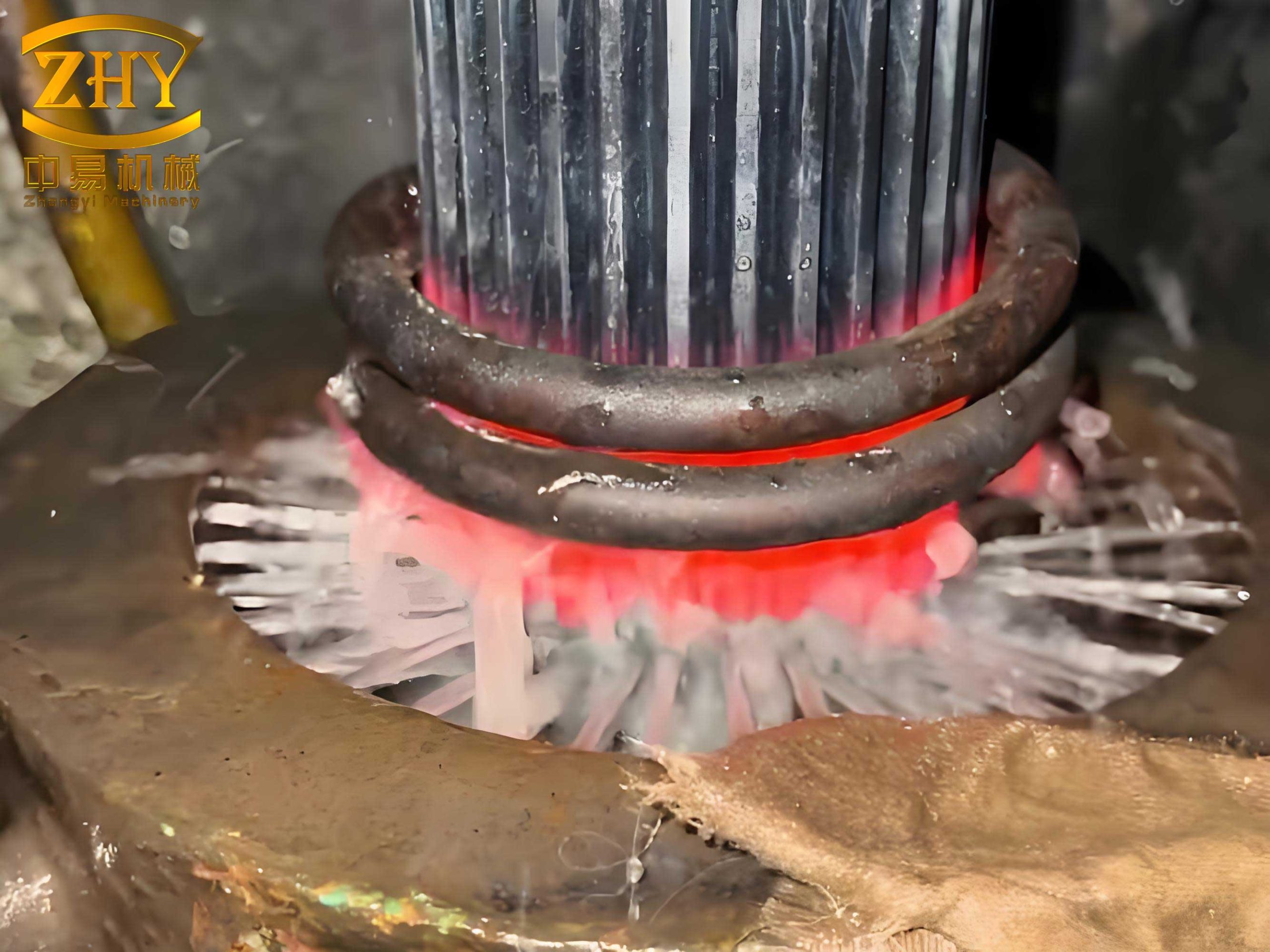
Induction hardening is a localized, energy-efficient process. The traditional challenge has been achieving a contour-hardened pattern that fully encompasses the tooth root, which is critical for bending strength. Inaccurate patterns lead to soft roots or, worse, tensile residual stresses in the root—a catastrophic heat treatment defect for bending fatigue.
Precision in this field is achieved through advanced electromagnetic control:
- Dual-Frequency Simultaneous Heating (Single-Shot): This state-of-the-art method uses two frequencies simultaneously from a single inductor. A lower frequency (e.g., 3-10 kHz) heats the tooth root deeply, while a higher frequency (e.g., 200-400 kHz) heats the tip and flank. This creates a perfectly conformal hardened pattern in a matter of seconds, optimizing the residual stress distribution and eliminating root cracking issues.
- Super-Rapid Induction Quenching (SRIQ): This involves ultra-high power density and heating times as short as 0.5 seconds. The extreme thermal gradient produces exceptional compressive stresses in the root (reportedly up to 1000 MPa). Techniques like “Double Hardening” (WIQ) involve two rapid cycles to create a refined, dual-layer microstructure with even higher performance.
The key formula governing induction heating depth is the skin depth ($\delta$):
$$ \delta = \sqrt{\frac{\rho}{\pi \mu f}} $$
where $\rho$ is resistivity, $\mu$ is magnetic permeability, and $f$ is frequency. Precision induction hardening uses this principle meticulously, selecting frequencies and power profiles to engineer the exact case profile needed for anti-fatigue performance.
| Induction Hardening Method | Process Description | Contribution to Anti-Fatigue Goals |
|---|---|---|
| Tooth-by-Tooth | Individual teeth are hardened sequentially. | Good for large gears; risk of non-uniform root hardening and thermal distortion affecting adjacent teeth. |
| Single-Frequency “Single-Shot” | Entire gear heated at one frequency and quenched. | Fast; but often results in non-conformal pattern (hard tip, soft root). |
| Dual-Frequency “Single-Shot” | Entire gear heated with two superimposed frequencies simultaneously. | Produces perfect contour hardening, optimal residual stress, maximum bending & contact strength, minimal distortion. |
| Super-Rapid (SRIQ) | Extremely fast, high-power heating. | Creates ultra-fine grain structure and very high compressive stress, pushing fatigue limits. |
The Future Trajectory: Integration and Extreme Performance
The evolution of gear precision heat treatment is moving towards more integrated, controlled, and extreme solutions to preempt all forms of heat treatment defects. The trends are clear:
- Super-Hardening: Developing processes and materials to achieve surface hardness levels beyond 70 HRC reliably, moving into the realm traditionally held by coatings, but as an integral part of the substrate.
- Deep Case Hardening: Pushing the boundaries of effective case depth for both carburizing and nitriding to support higher loads and larger module gears.
- Combined/Composite Hardening: This is a frontier area. Examples include:
- Carburizing + Nitriding (Duplex Hardening): Using a deep carburized case for core support and contact strength, followed by a nitrided surface for extreme hardness and scuffing resistance. This is used in aerospace bearing steels.
- Induction Hardening + Shot Peening: Using induction to create a hardened case, followed by stress peening to superimpose an even deeper, more intense compressive stress field.
- Vacuum and Ion-Based Processes: The shift towards vacuum (LPC) and plasma-based technologies will continue due to their superior control, reproducibility, and environmental benefits. They represent the ultimate toolset for avoiding atmospheric-related defects.
- Digitalization and AI: The future of precision lies in digital twins, real-time sensor feedback, and AI-driven process optimization. These systems will predict and compensate for distortion, automatically adjust parameters to achieve target hardness gradients, and ensure zero defects in every batch.
In conclusion, the path to superior gears is unequivocally through the mastery of precision heat treatment within the framework of anti-fatigue manufacturing. It is a demanding discipline that requires moving beyond empirical rules to a physics-based understanding and control of the metallurgical processes that create the gear’s functional surface. By relentlessly focusing on optimizing the hardness gradient, residual stress field, and microstructure—and by eliminating all sources of heat treatment defects—we can engineer gears that are not only harder but truly smarter: lighter, longer-lasting, and fundamentally more reliable. This is not merely an improvement in process; it is a transformation in philosophy essential for the next generation of advanced machinery.