
In the realm of automotive component manufacturing, the quest for materials that combine high strength, excellent wear resistance, and reliable longevity is perpetual. Engine timing gears, specifically the idler gear, represent a critical application where material failure is not an option. These components orchestrate the precise fuel delivery timing via the camshaft, demanding not only machining precision but also superior material properties. Traditionally, ductile iron (DI) has been the material of choice for such demanding parts. However, our production experience revealed significant challenges when using conventional high-carbon equivalent (CE) grades, leading us down a path of innovation toward a low-carbon equivalent solution and a meticulous refinement of its heat treatment protocol.
The conventional wisdom, well-documented in authoritative handbooks and technical literature, advocates for ductile iron with high carbon and silicon content. A typical composition is: C: 3.6–3.8%, Si: 2.3–2.7%, with a resultant carbon equivalent (CE) calculated as: $$CE = C\% + \frac{Si\%}{3} + \frac{P\%}{3}$$ yielding values between 4.3–4.7. In theory, such high-CE iron should possess excellent castability and graphitization potential, making it suitable for complex shapes. Yet, in our practical foundry environment, applying this to the production of the specific idler gear (a part with challenging thermal geometry) consistently resulted in a high scrap rate. The primary failure mode was the formation of shrinkage cavities and porosity, particularly concentrated at the root fillets of the gear teeth. This type of internal defect is a classic and severe heat treatment defect precursor, as it creates stress concentrations that can lead to catastrophic failure under cyclic loading. Scrap rates often exceeded 30%, severely disrupting production flow and economics.
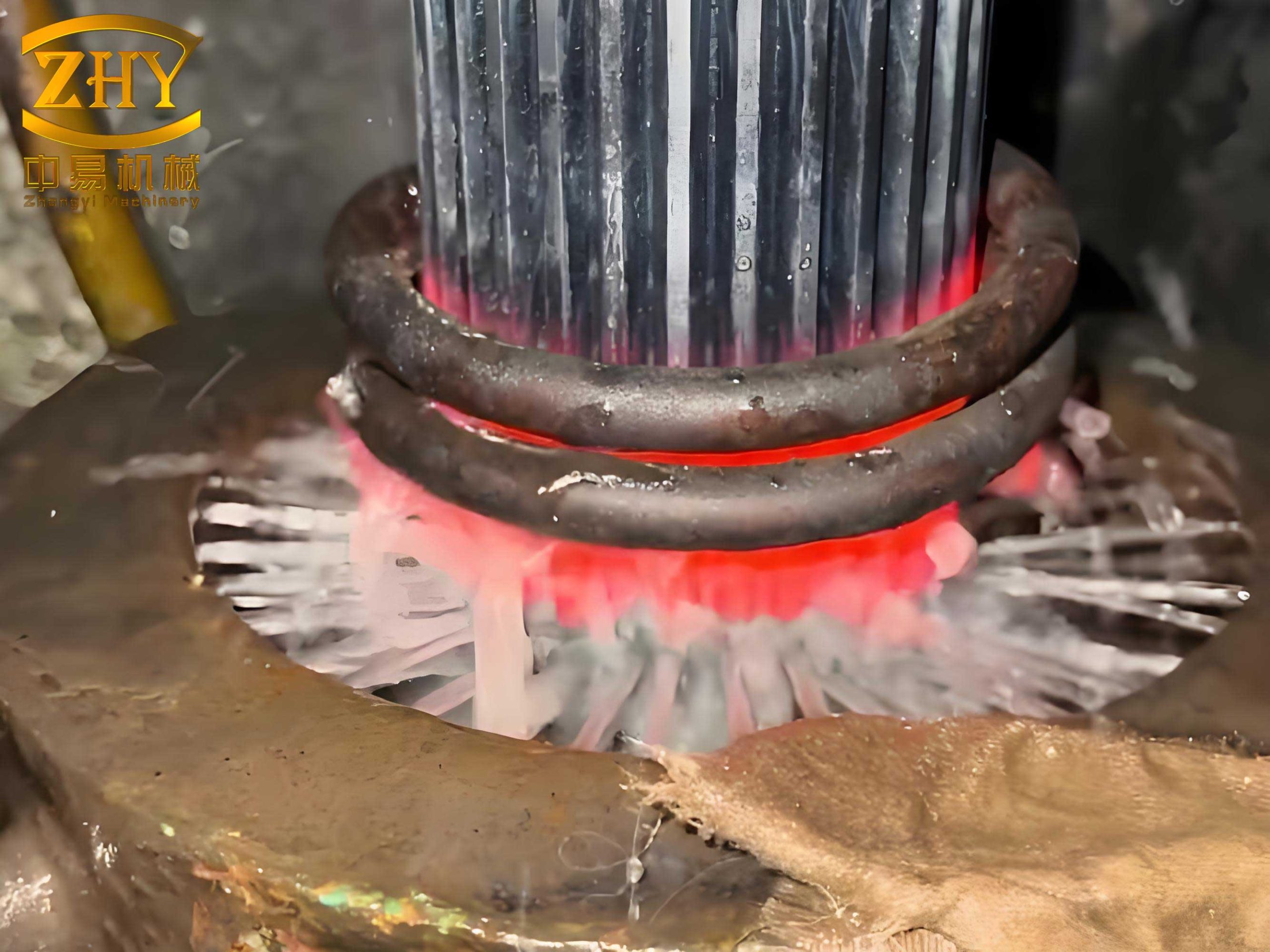
This predicament forced a fundamental re-evaluation. The shrinkage propensity in high-CE iron is linked to its solidification characteristics. A high CE promotes a long solidification range and a large graphitization expansion, which, if not properly compensated by feeding, leads to internal voids. Our hypothesis was that a reduction in the carbon equivalent would shorten the solidification range, reduce the magnitude of graphitization expansion, and ultimately improve the feeding efficiency during the crucial final stages of solidification, thereby mitigating shrinkage defects. Thus, we developed and trialed a low-carbon equivalent ductile iron. The target composition was significantly leaner: C: ~3.3%, Si: ~1.8%, Mn: <0.5%, P: <0.05%, Mg: 0.03–0.05%. This resulted in a CE of approximately 3.9. The shift was substantial.
The casting results were immediately encouraging. The switch to low-CE iron dramatically reduced the incidence of shrinkage cavities and porosity in the gear tooth roots. The machining合格率 (yield rate) soared to over 98%, validating our approach to solving this foundational casting issue. However, conquering the casting缺陷 was only half the battle. The mechanical properties of as-cast low-CE DI were inadequate for the application. The microstructure was predominantly ferritic, offering high ductility but insufficient strength and hardness. This is where the intricate dance with heat treatment defects truly began. The goal was to transform this sound but soft casting into a component with a strong, wear-resistant pearlitic matrix without introducing new heat treatment defects such as excessive distortion, cracking, or the formation of brittle phases like untempered martensite or excessive carbides.
The journey to a robust heat treatment process was iterative, involving three distinct工艺 trials. Each step taught us more about the response of low-CE DI to thermal cycles.
| Parameter | High-CE DI (Conventional) | Low-CE DI (Developed) |
|---|---|---|
| Carbon (C%) | 3.6 – 3.8 | ~3.3 |
| Silicon (Si%) | 2.3 – 2.7 | ~1.8 |
| Carbon Equivalent (CE) | 4.3 – 4.7 | ~3.9 |
| Primary Casting Defect | Severe shrinkage porosity | Minimal shrinkage |
| As-Cast Matrix | Ferritic + Pearlitic | Highly Ferritic |
| 热处理 Challenge | Less critical for matrix | Critical for developing strength |
Heat Treatment Protocol Evolution: A Three-Stage Development
Trial 1: Subcritical (Semi-Austenitizing) Normalizing
The first工艺, born from experience with higher-CE irons, involved heating to a temperature (880–900°C) within the austenite+ferrite phase field, holding, then air cooling (fan-assisted), followed by a high-temperature temper at 560°C. The intent was to achieve a good strength-ductility balance. The resulting microstructure, however, was comprised of ~80-85% ferrite with only a small amount of divorced pearlite and some carbides. The mechanical properties were telling: tensile strength (σ_b) languished around 650-700 MPa, hardness (HB) was only 207-220, while elongation (δ) was excessively high at >12%. The part failed hardness and strength specifications. This was a clear heat treatment defect of under-performance: insufficient driving force for austenitization led to inadequate pearlite formation upon cooling. The transformation kinetics can be partially described by the effect of silicon on carbon activity in austenite: $$a_C^{γ} \propto \frac{1}{[Si\%]}$$ Lower silicon increases carbon activity, but from a low starting carbon content in a subcritical heat treatment, the net carbon available in austenite for subsequent pearlite formation remains too low.
Trial 2: Full Austenitizing Normalizing
Learning from the under-performance, the second工艺 raised the austenitizing temperature to 920–940°C, ensuring complete transformation to austenite. The cooling protocol was also intensified: batches were smaller, and fan cooling with part agitation was strictly enforced. The回火 temperature was maintained at 560°C. This produced a marked improvement. The microstructure showed a “bull’s-eye” structure with ~60-70% pearlite surrounding the graphite nodules, encapsulated by ferrite. Strength rose to 750-800 MPa and hardness to 230-245 HB. This was close to specification but often at the lower boundary. The variability was a concern; achieving consistent results batch-to-batch was challenging. Inconsistent cooling, leading to varying pearlite fineness and ferrite fraction, represented a process control heat treatment defect risk. The need for even greater consistency and higher average properties was evident.
Trial 3: Optimized Full Austenitizing with Accelerated Cooling
The final and successful工艺 pushed the boundaries further. The austenitizing temperature was elevated to a stable 950°C. The冷却 strategy became highly controlled: very small batches (40-50 gears) were unloaded sequentially and placed upright in a dedicated fixture. Two opposing high-power fans provided balanced, forced-air cooling across all part surfaces. This maximized and standardized the cooling rate (V_c). The tempering temperature was strategically lowered to 500°C to preserve a higher hardness from the normalizing step. The relationship between cooling rate, undercooling (ΔT), and pearlite spacing (S) is key: $$S \propto \frac{1}{ΔT} \quad \text{and} \quad ΔT \propto V_c$$ By increasing V_c, we reduced S, leading to finer, stronger pearlite. The resulting microstructure contained 80-85% fine pearlite with the balance as broken, isolated ferrite at nodule boundaries and prior austenite grain boundaries. This structure delivered optimal properties consistently.
| Heat Treatment Trial | Austenitize Temp. (°C) | Cooling Method | Temper Temp. (°C) | Resulting Microstructure | Tensile Strength (MPa) | Hardness (HB) | Key Lesson / Defect Avoided |
|---|---|---|---|---|---|---|---|
| Trial 1 | 880-900 | Bulk Fan Cool | 560 | >80% Ferrite | 650-700 | 207-220 | Insufficient driving force = under-performance defect. |
| Trial 2 | 920-940 | Batch Fan Cool | 560 | 60-70% Pearlite (Bull’s-eye) | 750-800 | 230-245 | Full austenitization needed; inconsistent cooling is a defect risk. |
| Trial 3 (Optimal) | 950 | Controlled Forced Air | 500 | 80-85% Fine Pearlite | 820-870 | 250-270 | Maximized & uniform cooling yields consistent, superior properties. |
The quantitative improvement from the final工艺 was significant. Not only did new production achieve a yield near 100% for sound castings, but the subsequent heat treatment consistently met the stringent mechanical targets. Remarkably, this工艺 also proved to be an effective salvage remedy. Several thousand gears previously downgraded by the ineffective first heat treatment (a clear batch-level heat treatment defect) were successfully re-processed using the Trial 3 parameters. Their hardness was recovered to the specification range of 250-270 HB, reclaiming substantial value and demonstrating the robustness of the finalized approach.
Metallurgical Rationale and Broader Implications
The success of the low-CE iron coupled with the aggressive normalizing treatment can be dissected metallurgically. Low carbon and silicon reduce the stability of austenite and increase the critical cooling rate for martensite formation. This allows us to use accelerated air cooling without the heat treatment defect of martensite formation. The formula for the critical diameter (D_c) for martensite formation in an iron alloy gives insight: $$D_c = f(CE, \text{Alloying})$$ Lower CE generally reduces hardenability, pushing the Continuous Cooling Transformation (CCT) diagram to the left, making pearlite formation more likely at moderate cooling rates. Our forced air cooling sits perfectly in the regime to produce a high fraction of fine pearlite.
Furthermore, the low silicon content, while beneficial for reducing shrinkage, also affects the solid-state transformation. Silicon is a ferrite stabilizer and strongly inhibits carbide precipitation. Lower silicon reduces this inhibition, allowing for a more complete and rapid transformation to pearlite during cooling, which is precisely what we needed. The fine pearlite spacing (S) is inversely related to yield strength (σ_y) via a Hall-Petch type relationship for interlamellar spacing: $$\sigma_y = \sigma_0 + k_y \cdot S^{-1/2}$$ where σ_0 is the friction stress and k_y is a strengthening constant. Minimizing S through rapid cooling directly enhances strength and hardness.
From a production economics perspective, the low-CE approach offers profound advantages. It utilizes more common, lower-purity pig iron compared to the high-purity grades (like Benxi iron) often recommended for high-CE ductile iron to control trace elements. This translates to raw material cost savings of 15-20% and greater supply chain flexibility. The near-elimination of shrinkage-related scrap compounds these savings. Therefore, this methodology is not merely a technical solution but a comprehensive strategy enhancing both quality and cost-effectiveness.
In conclusion, the development and implementation of a low-carbon equivalent ductile iron for critical engine gears successfully addressed the pervasive issue of shrinkage porosity in complex castings. The subsequent, rigorous optimization of the heat treatment process—evolving from an under-performing subcritical normalizing to a highly controlled, fully austenitizing normalizing with accelerated cooling—was essential to unlock the required mechanical properties. This journey underscores a critical principle: solving a casting defect often unveils a new set of challenges in热处理, where improper cycles can themselves induce性能 heat treatment defects. The final, stable工艺 consistently produces a fine-pearlitic matrix with optimal strength and hardness, turning a challenging casting into a reliable, high-performance component. This work highlights the significant potential of lean-composition ductile irons when paired with precisely engineered thermal processing, offering a valuable pathway for manufacturing durable automotive components while achieving notable economic benefits.