
In my extensive experience as a heat treatment specialist, I have dedicated considerable effort to understanding and mitigating heat treatment defects, particularly distortion in carburized gears used in motorcycle engines. Distortion is one of the most pervasive heat treatment defects, directly impacting gear noise, stress concentration, and service life. As consumer demand for higher-quality motorcycles grows, controlling these heat treatment defects becomes paramount. This article delves into the influence of various heat treatment parameters on gear distortion and performance, drawing from practical observations and analyses. I will systematically explore the root causes of distortion and how specific process adjustments can minimize these heat treatment defects, thereby enhancing gear reliability. Throughout this discussion, I will emphasize the critical role of parameter optimization in suppressing heat treatment defects, using tables and formulas to summarize key relationships.
The phenomenon of gear distortion post-heat treatment is a complex interplay of internal stresses. Primarily, these distortions arise from residual stresses from prior manufacturing steps, thermal stresses during heating and cooling, and transformational stresses due to phase changes. Each contributor to these heat treatment defects must be understood to develop effective countermeasures. Residual stresses, if not relieved, superimpose with quenching stresses, exacerbating distortion. Thermal stresses occur due to non-uniform temperature distribution across the gear geometry—like between the tooth tip and the gear rim—leading to differential expansion and contraction. When these stresses exceed the material’s yield strength, plastic deformation, a classic heat treatment defect, ensues. Transformational stresses are perhaps the most intricate; during quenching, the surface transforms to martensite first, creating compressive stresses, but as the core transforms later, it expands, inducing tensile stresses on the surface and compressive stresses in the core, resulting in significant shape changes. Additionally, operational factors like improper loading in furnaces can cause sagging or挤压 at elevated temperatures, further contributing to heat treatment defects. The cumulative effect of these mechanisms defines the final geometric accuracy of the gear, influencing its meshing characteristics and longevity.
To quantify some of these effects, we can consider basic formulas. Thermal stress can be approximated by: $$\sigma_{thermal} = E \cdot \alpha \cdot \Delta T$$ where \(E\) is Young’s modulus, \(\alpha\) is the coefficient of thermal expansion, and \(\Delta T\) is the temperature gradient. Similarly, volume change during phase transformation contributes to distortion. The volumetric strain due to martensitic transformation is given by: $$\epsilon_v = \frac{\Delta V}{V} \approx \beta (C_{surface} – C_{core})$$ where \(\beta\) is a material constant related to lattice expansion, and \(C\) represents carbon concentration. These formulas underscore that controlling temperature gradients and carbon profiles is essential to minimize heat treatment defects.
| Cause of Defect | Mechanism | Typical Resulting Distortion | Mitigation Strategy |
|---|---|---|---|
| Residual Stress from Forging/Machining | Unrelieved stresses add to quenching stresses | Warping, size change | Normalize forging blanks; stress relief annealing if feasible |
| Thermal Stress | Non-uniform heating/cooling creates temperature gradients | Bending, out-of-roundness | Controlled heating/cooling rates; use of preheating stages |
| Phase Transformation Stress | Differential martensite formation between surface and core | Volume expansion, shape distortion | Optimize quenching temperature and cooling media |
| Operational Deformation | Sagging due to自重 at high temperature; fixture issues | Geometric inaccuracies | Proper fixture design; vertical hanging of gears |
Now, let’s examine specific heat treatment parameters that directly influence these heat treatment defects. The first parameter is forging practice. The start and finish forging temperatures significantly affect the initial microstructure. Excessive start temperature leads to coarse grains and even Widmanstätten structure, which is difficult to eliminate and increases brittleness—a latent heat treatment defect that manifests later. Conversely, too low a finish temperature can induce micro-cracks, becoming failure initiation sites. In my observations, employing medium-frequency induction heating ensures uniform temperature, but traditional methods often cause localized overheating. The optimal finish temperature should be low enough to refine grains via recrystallization but not so low as to cause cracking. This foundational step sets the stage for subsequent heat treatment and can predispose the component to heat treatment defects if not controlled.
Following forging, the normalizing of blanks is crucial. Normalizing eliminates forging stresses and refines the microstructure, improving machinability and homogenizing the material. This pretreatment reduces the propensity for distortion during carburizing and quenching, effectively addressing potential heat treatment defects at an early stage. Neglecting this step often amplifies distortion, as residual stresses compound with thermal and transformational stresses.
The carburizing temperature is a paramount parameter. Higher temperatures accelerate carbon diffusion but promote austenite grain growth. Coarse grains reduce strength and increase brittleness, while also magnifying distortion due to greater thermal gradients and transformational strains. For common gear steels like 20CrMo, the standard carburizing temperature is around 930°C. However, I have found that lowering it to 910°C or even 900°C for shallow case depths (e.g., 0.4-0.7 mm) is beneficial. This reduction minimizes heat treatment defects like distortion and refines the martensitic structure, enhancing core strength and case uniformity. The trade-off is increased process time, but the improvement in quality justifies it. The relationship between grain size \(d\) and carburizing temperature \(T\) can be described by the Arrhenius-type equation: $$d = d_0 \exp\left(-\frac{Q}{RT}\right)$$ where \(d_0\) is a constant, \(Q\) is the activation energy for grain growth, \(R\) is the gas constant, and \(T\) is absolute temperature. Lower \(T\) results in smaller \(d\), reducing brittleness and distortion.
| Parameter | Standard Value | Optimized Value | Impact on Distortion (Heat Treatment Defect) | Impact on Microstructure/Performance |
|---|---|---|---|---|
| Carburizing Temperature | 930°C | 910°C | Reduced | Finer martensite; improved toughness |
| Carbon Potential (Strong Carburizing) | 1.2% C | 1.0% C | Reduced (less case expansion) | Prevents grain boundary carbides; better wear resistance |
| Diffusion Time | Short | Extended by 20-30 min | Reduced (evens carbon gradient) | Lower surface carbon; reduced retained austenite |
| Case Depth | Upper specification limit | Lower specification limit | Reduced (less transformational stress mismatch) | Adequate for load capacity; less prone to spalling |
Carbon concentration in the case is another critical factor. High carbon potential during carburizing leads to elevated surface carbon, which increases distortion due to greater volume change upon quenching. Moreover, it can cause network carbides, embrittling the gear and exacerbating heat treatment defects like tooth fracture. Controlling carbon potential with sufficient diffusion time is essential. I typically reduce the strong carburizing carbon potential from 1.2% to 1.0% and extend diffusion, which flattens the carbon profile. The carbon gradient \(C(x)\) can be modeled by Fick’s second law: $$\frac{\partial C}{\partial t} = D \frac{\partial^2 C}{\partial x^2}$$ where \(D\) is the diffusion coefficient. A longer diffusion time at lower carbon potential reduces the surface concentration and gradient, diminishing transformational stresses and associated heat treatment defects.
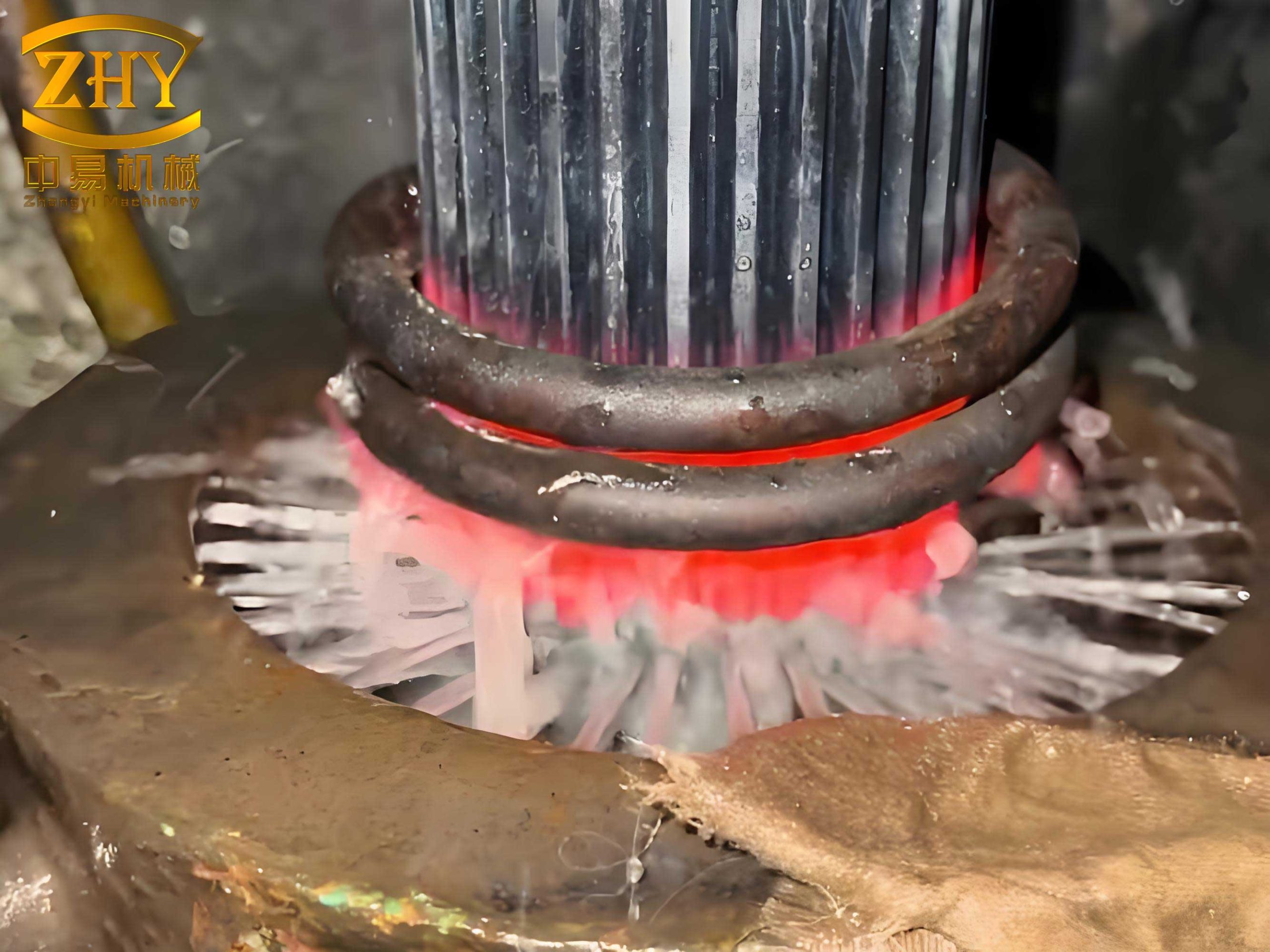
The image above visually represents common heat treatment defects, such as distortion and cracking, underscoring the importance of process control. In my work, such defects are constant reminders of the need for precision.
Quenching temperature directly influences distortion. Higher quenching temperatures increase thermal stresses and austenite stability, leading to more retained austenite and greater dimensional changes. For carburized gears, I recommend quenching from 830-850°C, which is lower than the carburizing temperature. This reduces heat treatment defects by minimizing thermal gradients and promoting finer martensite. The relationship between quenching temperature \(T_q\) and distortion \(\delta\) can be empirically expressed as: $$\delta \propto k (T_q – T_{ms})$$ where \(k\) is a proportionality constant, and \(T_{ms}\) is the martensite start temperature. Lower \(T_q\) reduces \(\delta\), alleviating this heat treatment defect.
Case depth also plays a role. Deeper case depths create a larger region undergoing martensitic transformation, increasing the mismatch with the core and thus distortion. Therefore, maintaining case depth at the lower end of the specification range helps control heat treatment defects. For motorcycle gears, a case depth of 0.4-0.7 mm is typical; aiming for 0.5 mm rather than 0.7 mm can significantly reduce distortion without compromising performance.
Quench oil temperature is often overlooked but vital. Oil temperature affects cooling kinetics and viscosity, influencing thermal stress distribution. I have observed that increasing oil temperature from 80°C to 120-140°C reduces distortion by moderating the cooling rate, especially in the martensitic transformation range. This minimizes thermal gradients and mitigates heat treatment defects. The cooling rate \(V\) as a function of oil temperature \(T_{oil}\) can be approximated by: $$V = \frac{h(T_{gear} – T_{oil})}{\rho c_p}$$ where \(h\) is the heat transfer coefficient, \(\rho\) is density, and \(c_p\) is specific heat. Higher \(T_{oil}\) reduces \(V\), decreasing thermal stress.
The choice between direct quenching and single reheating quenching also affects heat treatment defects. Direct quenching, after carburizing and pre-cooling, simplifies processing and reduces oxidation, but it may retain coarse austenite grains from high-temperature carburizing, potentially harming mechanical properties. Single reheating quenching involves cooling after carburizing and then reheating to 830-850°C before quenching. This refines both case and core microstructure but adds a heating cycle, increasing distortion risk. In my practice, for fine-grained steels like 20CrMo, direct quenching with optimized parameters is preferred to minimize heat treatment defects. However, for steels prone to grain growth or requiring high toughness, single reheating is necessary despite its contribution to distortion.
To illustrate, I recall a specific case where we adjusted the heat treatment process for 20CrMo gears. The original process involved carburizing at 930°C with a strong carbon potential of 1.2%, quenching from 850°C into 80°C oil. This led to significant distortion and sometimes coarse martensite (grade 3-4). To address these heat treatment defects, we modified the parameters: carburizing at 910°C, strong carbon potential at 1.0%, extended diffusion time by 20-30 minutes, and increased quench oil temperature to 120°C. The result was a marked reduction in distortion, with martensite refined to grade 1-2, surface carbides controlled, and core hardness maintained at 35-45 HRC. This optimization effectively curtailed heat treatment defects, meeting machining tolerances and performance specs.
| Process Parameter | Original Process | Optimized Process | Effect on Heat Treatment Defects |
|---|---|---|---|
| Carburizing Temperature | 930°C | 910°C | Reduced grain growth and thermal stress |
| Strong Carburizing Carbon Potential | 1.2% C | 1.0% C | Lower surface carbon; less distortion and carbide networks |
| Diffusion Time | Standard | Extended by 20-30 min | More uniform carbon profile; reduced transformational stress |
| Quenching Temperature | 850°C | 830-840°C | Lower thermal and transformational stresses |
| Quench Oil Temperature | 80°C | 120°C | Moderated cooling rate; reduced thermal gradients |
| Resulting Distortion | High (often out of tolerance) | Low (within machining limits) | Significant mitigation of heat treatment defects |
| Martensite Grade | 3-4 (coarse) | 1-2 (fine) | Improved toughness and fatigue resistance |
In conclusion, through meticulous control of heat treatment parameters, we can substantially reduce heat treatment defects like distortion in motorcycle carburized gears. Key strategies include lowering carburizing temperature, controlling carbon potential and case depth, optimizing quenching temperature and oil temperature, and selecting appropriate quenching methods. These adjustments not only minimize distortion but also enhance microstructural quality, leading to gears with better hardness profiles, refined martensite, and improved service life. The continuous battle against heat treatment defects requires a deep understanding of material science and process dynamics. By implementing these optimized parameters, we achieve gears that meet stringent technical requirements: case depth of 0.4-0.7 mm, surface hardness of 58-62 HRC, core hardness of 35-45 HRC, martensite and retained austenite within grade 1-2, and surface carbides not exceeding grade 1. Ultimately, reducing heat treatment defects is integral to advancing motorcycle performance and reliability, and it remains a focal point of my ongoing research and practice.