
In my years of experience focusing on advanced manufacturing techniques, I have observed a persistent challenge in power transmission engineering: enhancing the durability and load-bearing capacity of gears. During operation, the meshing teeth of a gear pair are subjected to a complex stress state. The contact point experiences high, pulsating Hertzian contact stresses, leading to subsurface shear stresses, while the root of the tooth endures cyclic bending stresses. This harsh service environment dictates the primary failure modes: pitting fatigue on the flanks and bending fatigue fracture at the root. To combat these failures, surface hardening is not merely an option but a fundamental requirement for high-performance gears.
For decades, the industry has relied on conventional surface hardening methods. These include case hardening via chemical heat treatment (e.g., carburizing and nitriding), induction hardening, and flame hardening. While effective to a degree, these processes are invariably accompanied by a set of well-documented and often costly heat treatment defects. The most prominent among these is significant component distortion and warpage. The large thermal mass heated during conventional processes leads to non-uniform cooling, inducing internal stresses that deform the precise geometry of the gear. This distortion almost always necessitates subsequent, expensive finishing operations like grinding to restore dimensional and geometrical accuracy, adding time and cost.
Another critical category of heat treatment defects relates to the hardened layer profile. Obtaining a contour-following, uniformly distributed hardened case, especially in the complex geometry of a gear tooth (including the critical root fillet region), is extremely difficult with conventional methods. Induction and flame hardening often produce patterns that do not perfectly conform to the tooth’s involute shape, leading to areas of over-hardening, undesirable tempering of adjacent zones, or insufficient hardening in high-stress regions. This inconsistency directly compromises the gear’s fatigue life and reliability.
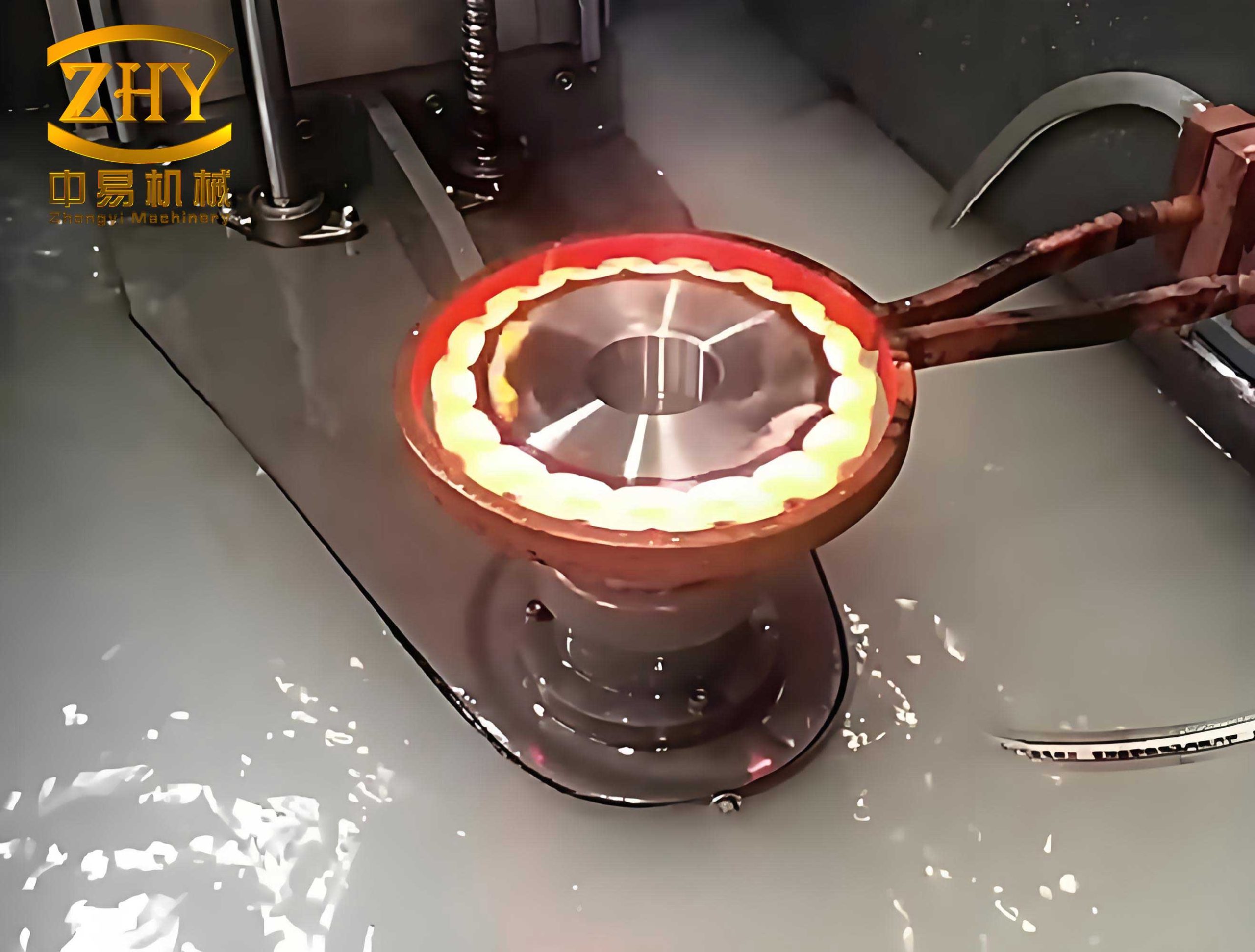
This landscape of inherent heat treatment defects has driven the search for more precise, controllable solutions. In my assessment, laser heat treatment, or laser transformation hardening, has emerged as a transformative technology that directly addresses these shortcomings. The principle is elegantly simple yet powerful: a high-energy-density laser beam is scanned across the metallic surface, rapidly heating a thin layer above the austenitizing temperature. The surrounding cold bulk material acts as an infinite heat sink, enabling extremely rapid self-quenching (cooling rates often exceeding the critical cooling rate for martensite formation) once the laser beam moves away. This results in a very hard martensitic layer with refined grain structure and high dislocation density.
The defining advantage, which fundamentally mitigates traditional heat treatment defects, is the localized nature of the energy input. The laser spot, often just a few millimeters in diameter, heats only the intended path. This minimizes the total heat input into the component, drastically reducing thermal distortion. In many cases, gears treated with laser hardening require no post-heat-treatment machining—they are “net-shape” hardened. Furthermore, by precisely controlling the beam’s path using computer-numerical-control (CNC), it is possible to trace the exact involute profile of the gear tooth, including the root, ensuring a uniform case depth along the contour. This level of control is unattainable with conventional methods and is key to eliminating the heat treatment defects related to poor case profile conformity.
The successful implementation of laser hardening for gears hinges on a deep understanding and optimization of several interdependent process parameters. These parameters govern the resulting hardened layer’s depth, width, hardness, and overall quality.
| Process Parameter | Physical Effect | Influence on Hardened Layer |
|---|---|---|
| Laser Power (P) | Total energy delivered per unit time. | Primary control for surface temperature. Higher power increases case depth and width, but excessive power can cause melting. |
| Beam Spot Size / Shape (D) | Area over which power is distributed. Defines power density. | A smaller spot increases power density, leading to shallower, harder layers. A rectangular or defocused spot can widen the track. |
| Scanning Speed (v) | Interaction time between beam and material. | Faster speeds reduce energy input per unit length, producing shallower layers and narrower tracks. |
| Beam Offset / Incidence Angle | Position and orientation relative to the tooth flank. | Critical for uniform energy absorption across the curved surface and for accessing the root fillet. |
A key derived parameter is the Energy Density, $E_d$, often expressed in J/mm², which combines power, speed, and spot dimension. For a Gaussian beam, a simplified relation is:
$$ E_d \approx \frac{P}{v \cdot D} $$
where $P$ is laser power (W), $v$ is scanning speed (mm/s), and $D$ is the effective spot diameter (mm). This parameter must be optimized within a specific window: too low leads to insufficient hardening (heat treatment defects of soft spots); too high causes surface melting or excessive thermal stress.
For gear hardening, specific scanning strategies are employed to cover the tooth surface completely. The two primary methods are Axial Helical Scanning (the beam spirals down the tooth flank) and Axial Tooth-by-Tooth Scanning (each tooth flank is treated individually with discrete tracks). Furthermore, within a single track strategy, one must choose between overlapping passes (for seamless coverage) or non-overlapping passes (for discrete hardening patterns). Overlap can introduce tempering in the previously hardened zone if not carefully managed, potentially creating a new type of heat treatment defect related to softened zones. A common practice is to use an auxiliary gas jet or even a liquid mist for enhanced quenching. This auxiliary cooling is crucial for two reasons: first, to guarantee the required cooling rate for martensite formation, especially on small teeth with low thermal mass; second, to prevent the heat from treating one flank from tempering an already-hardened adjacent flank, which is another potential source of heat treatment defects.
The hardened layer depth $d_h$ can be modeled based on heat conduction theory. A one-dimensional approximation for a moving heat source gives insight:
$$ T(z,t) – T_0 = \frac{2 \cdot q \cdot \sqrt{\alpha \cdot t}}{k} \cdot \text{ierfc}\left(\frac{z}{2\sqrt{\alpha t}}\right) $$
where $T(z,t)$ is temperature at depth $z$ and time $t$, $T_0$ is initial temperature, $q$ is absorbed power density (W/m²), $\alpha$ is thermal diffusivity (m²/s), and $k$ is thermal conductivity (W/m·K). The case depth is the depth $z$ where the peak temperature equals the austenitization temperature $A_{c3}$. This shows the depth’s dependence on $q$ and interaction time $t \approx D/v$.
| Aspect | Conventional Heat Treatment (e.g., Carburizing, Induction) | Laser Heat Treatment |
|---|---|---|
| Heat Input & Distortion | High bulk heating. Significant distortion common, leading to post-grinding. | Extremely localized heating. Minimal distortion, often eliminating finishing steps. |
| Case Profile Control | Limited. Hard to achieve uniform contour hardening, especially in root. Prone to heat treatment defects like soft roots or over-hardened tips. | Excellent. CNC-controlled path allows precise, conformal hardening exactly where needed. |
| Process Flexibility | Low for part-to-part changes. Hard tooling (induction coils) needed. | High. Programmable path allows rapid changeover for different gear geometries. |
| Energy Efficiency | Generally lower, heating furnaces or large workpieces. | High. Energy is directed only to the surface layer requiring treatment. |
| Environmental Impact | Chemical processes (carburizing) use gases/salts. Quenching oils may be used. | Clean process. Typically uses inert cover gas (N₂, Ar). No quenching oils if self-quenched. |
The core technology enabling this process rests on three pillars: high-power, reliable industrial lasers (CO₂, fiber, or diode lasers); sophisticated multi-axis CNC handling systems integrated with beam delivery optics; and, most importantly, a database of proven process parameters and strategies for various materials and geometries. Significant advancements in all three areas have made laser hardening a mature, production-ready technology. For instance, the laser hardening of engine cylinder bores is another highly successful, widespread application that validates the technology’s robustness. In the repair and remanufacturing sector for automotive, rail, and agricultural machinery, laser hardening of worn gear surfaces has demonstrated exceptional economic and performance benefits, often restoring components to a condition superior to their original state, all while avoiding the classic heat treatment defects associated with re-heating an entire component.
However, its adoption, particularly for high-volume gear manufacturing, still faces hurdles. The initial capital investment for a laser system is high. There is also a need for deeper material science understanding to predict phase transformations and residual stresses accurately for specific steel grades under ultra-fast thermal cycles. A lack of widespread hands-on experience and, in some quarters, an unwarranted perception of complexity or risk, have slowed its penetration. Education and continued dissemination of successful case studies are vital to overcome these barriers.
In conclusion, from my perspective, laser heat treatment represents a significant leap forward in surface engineering. It offers a direct and elegant solution to the long-standing heat treatment defects of distortion and poor case uniformity that plague conventional methods. By providing precise, localized, and controllable hardening, it extends gear life, improves reliability, and can reduce total manufacturing cost by eliminating secondary operations. As laser technology becomes more affordable and process knowledge more democratized, I am confident that laser hardening will transition from a specialized application to a mainstream manufacturing process, accelerating not only the improvement of mechanical components like gears but also the broader industrialization of laser-based manufacturing solutions.