
In the realm of modern industry, the demand for high-performance gears has escalated dramatically. As a professional deeply involved in heat treatment processes, I have witnessed the evolution from normalized or tempered soft-face gears to hardened face gears, which are essential for meeting stringent operational parameters. The transition is driven by strength calculations: for instance, alloy steel tempered to 300 HB offers an allowable contact stress of 850 MPa and bending stress of 300 MPa, whereas carburized and quenched gears at 60 HRC achieve 1600 MPa and 500 MPa, respectively. This underscores the critical role of advanced heat treatment techniques, particularly carburizing and nitriding, in enhancing gear durability. However, these processes are fraught with potential heat treatment defects, such as distortion, cracking, and microstructural inconsistencies, which must be meticulously managed to ensure optimal performance. In this comprehensive review, I will delve into the intricacies of gear heat treatment, emphasizing surface hardening methods, and explore how to mitigate common heat treatment defects through technological advancements.
The primary systems for manufacturing hardened face gears include: carburizing-quenching-grinding, gear hobbing or shaving followed by nitriding, and gear hobbing (or shaving) with contour induction hardening (and grinding). Among these, carburizing and nitriding stand out due to their ability to impart high surface hardness and wear resistance. Yet, each method carries inherent risks of heat treatment defects, which I will address throughout this discussion. My focus will be on the scientific principles, practical applications, and strategies to minimize issues like deformation and fatigue failure.
Carburizing and Carbonitriding of Gears
Despite its drawbacks—high temperature, long cycles, multiple steps, and significant distortion—carburizing and quenching remains the dominant heat treatment process for gears. Its superiority in load-bearing capacity and longevity has led to widespread adoption in automotive, industrial, and machinery gears. The key to success lies in controlling various factors that influence the outcome, especially those that lead to heat treatment defects. Below, I explore several critical aspects.
Control of Steel Metallurgical Quality
The metallurgical quality of gear steels profoundly impacts strength and processability. Two pivotal elements are purity and hardenability.
- Steel Purity: Primarily measured by oxygen content, purity affects fatigue strength and processing performance. Experimental data indicate that reducing oxygen content from 2.5 × 10⁻⁵ to 1.1 × 10⁻⁵ significantly enhances contact fatigue strength. For example, gears made from refined steel exhibit service life increases from 6000 hours to 10000 hours. Moreover, reduced oxide inclusions improve tool life; tests show a 25% increase in hob life with deoxidized steel. Current standards mandate a maximum oxygen content of 2.5 × 10⁻⁵, employing advanced non-metallic inclusion assessment methods. Impurities can initiate heat treatment defects like premature fatigue cracks, underscoring the need for high-purity materials.
- Steel Hardenability: This encompasses both the ability to achieve desired core hardness and the consistency of hardenability bands. Core hardness ensures adequate contact and bending fatigue resistance, while narrow hardenability bands facilitate distortion control—a crucial factor in mass production. The development of H-steels (guaranteed hardenability steels) addresses this. In China, market access conditions for vehicle gear steels specify a end-quench hardenability band width of ≤7 HRC. Variations in hardenability can lead to non-uniform hardening, a common source of heat treatment defects such as soft spots or excessive residual stress.
To summarize, steel quality parameters are vital for preventing heat treatment defects. Table 1 illustrates the relationship between oxygen content and fatigue performance.
| Oxygen Content (×10⁻⁵) | Contact Fatigue Strength (MPa) | Typical Service Life (hours) |
|---|---|---|
| 2.5 | Baseline | 6000 |
| 1.1 | Increased by ~30% | 10000 |
Preparatory Heat Treatment of Gear Blanks
Often overlooked, preparatory heat treatment is essential for machining quality and distortion control. For instance, with 20CrMnTi carburizing steel, forging at 1200–1250°C and air-cooling to room temperature results in coarse Widmanstätten structure, granular bainite, and pearlite, hardness 29 HRC. Subsequent carburizing and quenching yield coarse grains and mixed crystal structures—classic heat treatment defects. In contrast, isothermal normalizing at 580–650°C for 90 minutes after forging produces blocky ferrite and fine pearlite, leading to fine, uniform post-carburizing structures. Practical data from automotive manufacturers show that isothermal normalizing boosts quenching pass rates from 75% to 95%, effectively reducing distortions and other heat treatment defects.
The transformation kinetics can be described using the Avrami equation for phase change: $$ V_f = 1 – \exp(-k t^n) $$ where \( V_f \) is the volume fraction transformed, \( k \) is a rate constant, \( t \) is time, and \( n \) is an exponent. This model helps optimize normalizing parameters to avoid microstructural heat treatment defects.
Control of Effective Case Depth
Effective case depth, defined as the depth where hardness reaches 550 HV, is critical for mechanical performance. Traditional methods—metallographic or carbon determination—have limitations, as the boundary carbon content depends on alloy composition, quenching conditions, and part size. For example, Table 2 shows how boundary carbon content varies with steel type.
| Steel Type | Boundary Carbon Content (wt%) |
|---|---|
| 20MnCr5 | 0.45 |
| SCM420 | 0.39 |
| SAE8620 | 0.48 |
| SAE4320 | 0.28 |
| SCr420 | 0.47 |
| 20CrMnTi | 0.39 |
Quench cooling rate also influences this boundary; slower rates may require higher carbon content to achieve 550 HV, as seen in Table 3. Inadequate case depth can lead to subsurface fatigue, a severe heat treatment defect. Therefore, enterprises must establish correlations through testing under production conditions. The case depth \( d \) often follows a parabolic law with time \( t \): $$ d = \alpha \sqrt{t} $$ where \( \alpha \) is a diffusion-dependent constant. Controlling this is key to avoiding heat treatment defects like spalling or insufficient hardness.
| Steel Type | Boundary Carbon Content at 120°C/s (wt%) | Boundary Carbon Content at 18°C/s (wt%) |
|---|---|---|
| 20MnCr5 | 0.46 | 0.50 |
| SCM420 | 0.42 | 0.49 |
| SAE8620 | 0.44 | 0.61 |
| SAE4320 | 0.38 | 0.65 |
| SCr420 | 0.43 | 0.60 |
Quench Cooling for Carburized Gears
Quenching is pivotal for final properties and distortion control. Advanced quenching oils (fast, isothermal) coupled with agitated multi-function tanks enhance quality. For example, a 980 mm diameter gear ring with module 12 mm, when quenched in hot oil with stirring, saw reductions in outer diameter and base tangent length distortion by 64% and 37%, respectively. Computer simulation of quenching processes aids in predicting and minimizing heat treatment defects like warpage or cracking. The heat transfer during quenching can be modeled using Fourier’s law: $$ q = -k \nabla T $$ where \( q \) is heat flux, \( k \) is thermal conductivity, and \( \nabla T \) is temperature gradient. Optimizing cooling uniformity mitigates residual stresses, a common root of heat treatment defects.
Catalysis in Gear Carburizing
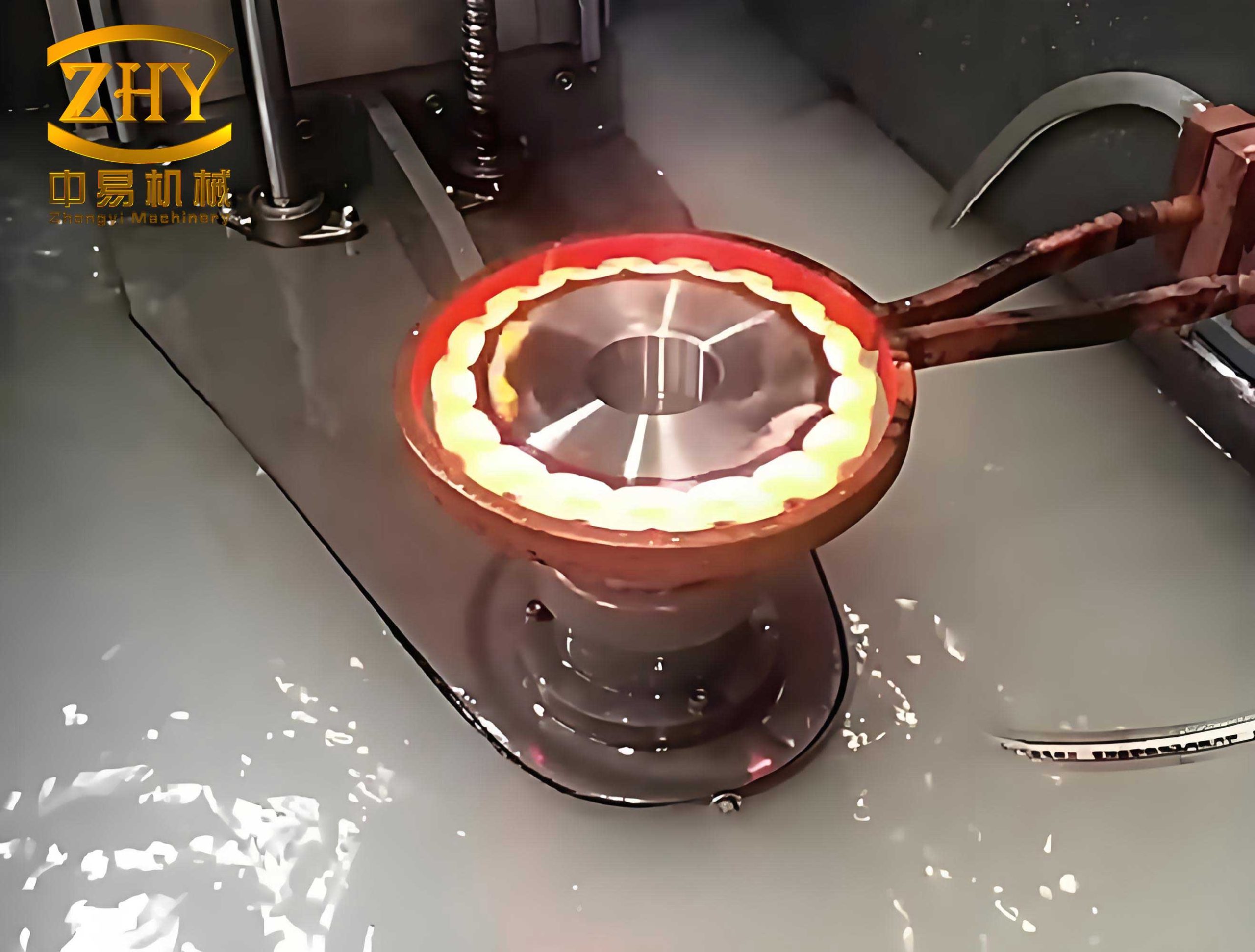
To address high temperatures and long cycles, catalysis techniques boost carburizing rates, allowing lower temperatures for finer microstructures and reduced distortion. In China, BH series catalysts and rare-earth catalysts have been successfully applied, refining carbides and cutting cycle times by about one-third or lowering temperatures by 30–50°C for same case depth. However, improper use can introduce heat treatment defects like excessive carbon buildup or uneven diffusion. The enhanced diffusion coefficient \( D \) with catalysis can be expressed as: $$ D = D_0 \exp\left(-\frac{Q}{RT}\right) \cdot f(C) $$ where \( D_0 \) is a pre-exponential factor, \( Q \) activation energy, \( R \) gas constant, \( T \) temperature, and \( f(C) \) a catalytic factor.
Deep Carburizing for Large Gears
Large gears in heavy machinery require deep case depths (3–8 mm), with process cycles up to 150–200 hours. Key challenges include rapid carburizing without excessive carbon content to avoid harmful carbides and retained austenite—both potential heat treatment defects. Initially, variable temperature and carbon potential drip methods were used; now, computer-controlled dynamic carbon potential systems prevail. For example, a “temperature and carbon potential varying” process with microcomputer control ensures consistency. Deep carburizing kinetics involve solving Fick’s second law with boundary conditions: $$ \frac{\partial C}{\partial t} = D \frac{\partial^2 C}{\partial x^2} $$ where \( C \) is carbon concentration, \( t \) time, \( x \) depth, and \( D \) diffusion coefficient. Mismanagement can lead to heat treatment defects like case crushing or distortion.
Carburizing of Large Welded Gears
Welded gears offer material savings but pose technical hurdles due to welding stresses, seam shielding, and non-uniform cooling. To prevent cracking and distortion—severe heat treatment defects—measures include sealing gears with covers, filling centers with material, and controlling quench end temperature to 160–180°C for isothermal martensitic transformation. The residual stress \( \sigma \) after welding and quenching can be approximated by: $$ \sigma = E \alpha \Delta T $$ where \( E \) is Young’s modulus, \( \alpha \) thermal expansion coefficient, and \( \Delta T \) temperature difference. Proper practices mitigate heat treatment defects and enhance reliability.
Low-Pressure Vacuum Carburizing
This emerging technology accelerates carburizing, improves case quality, and reduces distortion via high-pressure inert gas quenching. Applications in motorcycle gears show notable benefits. The vacuum environment minimizes oxidation, a common heat treatment defect. The process parameters can be optimized using statistical models to avoid issues like sooting or uneven hardening.
Nitriding and Nitrocarburizing of Gears
Nitriding, with its low temperature and minimal distortion, has gained traction despite initial skepticism about its load-bearing capacity. The precision loss is only 1–2 grades compared to 2–3 for carburizing, making it attractive for applications where heat treatment defects like distortion are critical. I will examine its strength aspects and methods to enhance performance.
Strength of Nitrided Gears
Strength evaluation focuses on bending fatigue, contact fatigue, and anti-scuffing capacity.
- Bending Fatigue Strength: Tests per standards show competitive limits. For instance, 42CrMo nitrided to 0.7 mm case depth achieves a bending fatigue limit \( \sigma_F \) of 280 MPa, comparable to carburized gears (Table 4). Inadequate case depth or poor microstructure can cause premature bending failures, highlighting heat treatment defects to avoid.
- Anti-Scuffing Strength: This depends on surface phase composition. As Table 5 shows, nitrided layers with γ′ phase (Fe₄N) offer higher scuffing resistance than α phase (nitrogen in ferrite) or mixed phases. Improper phase control leads to spalling, a typical heat treatment defect.
- Contact Fatigue Strength: Data in Table 6 indicate that nitrided gears can match carburized ones in contact fatigue limits, provided case depth is sufficient. For example, 25Cr2MoV nitrided to 0.55–0.60 mm depth shows a limit of 1648 MPa. However, if the case depth is less than the Hertzian stress depth, pitting occurs—a critical heat treatment defect.
| Material | Heat Treatment | Effective Case Depth (mm) | Bending Fatigue Limit \( \sigma_F \) (MPa) |
|---|---|---|---|
| 42CrMo | Nitriding | 0.7 | 280 |
| 25Cr2MoV | Nitriding | 0.7 | 335 |
| 20Cr2Ni4 | Carburizing | 1.2–1.3 | 325 |
| 20CrNi2Mo | Carburizing | 1.2–1.3 | 226 |
| Material | Heat Treatment | Case Depth and Phase | Anti-Scuffing Strength Grade |
|---|---|---|---|
| 25Cr2MoV | Ion Nitriding | 0.5 mm, α phase | 8 |
| 25Cr2MoV | Ion Nitriding | 0.5 mm, γ′ phase | 9 |
| 25Cr2MoV | Ion Nitriding | 0.5 mm, γ′ + ε | 12 |
| 20Cr2Ni4 | Carburizing | 1.2–1.3 mm | 5 |
| 20CrNi2Mo | Carburizing | 1.2–1.3 mm | 7 |
| Material | Heat Treatment | Effective Case Depth (mm) | Contact Fatigue Limit \( \sigma_H \) (MPa) |
|---|---|---|---|
| 42CrMo | Nitriding | 0.7 | 1533 |
| 25Cr2MoV | Nitriding | 0.55–0.60 | 1648 |
| 31CrMoV9 | Nitriding | 0.54 | 1560 |
| 20Cr2Ni4 | Carburizing | 1.2–1.3 | 1415 |
| 20CrNi2Mo | Carburizing | 1.2–1.3 | 1415 |
Methods to Enhance Nitrided Gear Strength
To combat heat treatment defects and improve performance, several strategies are employed.
- Increase Core Hardness: Core hardness supports the nitrided layer. Raising it from 240–260 HB to 310–340 HB boosts contact fatigue strength by 30% and ensures surface hardness around 50 HRC. Low core hardness can lead to case collapse, a serious heat treatment defect. The relationship between core hardness \( H_c \) and surface hardness \( H_s \) can be modeled as: $$ H_s = \beta H_c + \gamma $$ where \( \beta \) and \( \gamma \) are material constants.
- Increase Case Depth: For power transmission gears, depths ≥0.5 mm are needed, with “deep nitriding” targeting over 1 mm. Ion nitriding, combined with techniques like pre-oxidation, pulse aging, or pressurized pulse nitriding, accelerates the process. The case depth \( d_n \) in nitriding often follows: $$ d_n = \sqrt{D_n t} $$ where \( D_n \) is nitrogen diffusivity. Inadequate depth relative to Hertzian stress depth causes pitting, a common heat treatment defect.
- Improve Surface Metallographic Structure: Avoiding brittle white layers (e.g., ε-Fe₂₋₃N) is crucial for contact fatigue. Double-stage nitriding, vacuum low-pressure nitriding, and computer-controlled nitriding using nitrogen potential threshold values yield favorable structures. White layer formation, if excessive, acts as a heat treatment defect promoting spalling.
- Application Range by Module: Based on industrial experience, nitrided gears are suitable for modules up to 10 mm, with contact stresses of 1000–1300 MPa, core hardness ≥300 HB, and case depth >0.6 mm. Overload capacity is limited due to flat S-N curves, making them unsuitable for high-impact loads where heat treatment defects like sudden fracture may occur. Table 7 outlines application scopes.
| Application | Power (kW) | Module (mm) | Contact Stress (MPa) | Max Shear Stress Peak Depth (mm) |
|---|---|---|---|---|
| Turbine | 65–70 | 4.4 | 904 | 0.29 |
| Compressor | 45–88 | 4.2–3.8 | 905 | 0.39 |
| Coal Crusher | 33–62 | 4.7–8.4 | 835 | 0.45 |
| Cement Mill | 2375–7871 | 6.4–7.8 | 1014 | 0.44 |
| Warship Steam Turbine | 1190–? | 6.4–7.6 | 996 | 0.61 |
Conclusion
In summary, gear heat treatment, through carburizing and nitriding, is a cornerstone of modern machinery, enabling high load capacities and longevity. However, the processes are susceptible to various heat treatment defects, including distortion, cracking, microstructural anomalies, and inadequate case properties. My analysis highlights that controlling steel quality, optimizing preparatory treatments, precise case depth management, advanced quenching, catalysis, and tailored techniques for large or welded gears are essential to mitigate these heat treatment defects. Similarly, for nitriding, enhancing core hardness, increasing case depth, improving surface structure, and adhering to application limits are key strategies. The integration of computer simulations and dynamic controls further reduces risks. As industry advances, continuous innovation in heat treatment technologies will be vital to minimizing heat treatment defects and pushing the boundaries of gear performance. Through diligent practice and research, we can achieve more reliable and efficient gear systems, ensuring they meet the escalating demands of tomorrow’s applications.