
In the field of heavy-duty machine tools, achieving high precision and dynamic performance is paramount. As a researcher focused on servo system design, I have extensively studied the application of rack and pinion gear mechanisms, particularly dual rack and pinion gear configurations, for large-scale数控机床. Traditional systems like ball screw pairs often fall short in heavy-duty applications due to performance limitations and high costs. Therefore, the dual rack and pinion gear servo mechanism has emerged as a critical solution. This article details my approach to optimizing the design parameters of such systems, with an emphasis on maximizing servo acceleration capability and minimizing moment of inertia to enhance natural frequency, improve tracking performance, and reduce displacement and machining errors. I will present a comprehensive framework, incorporating mathematical models, constraints, and computational methods, all aimed at refining the dual rack and pinion gear mechanism.
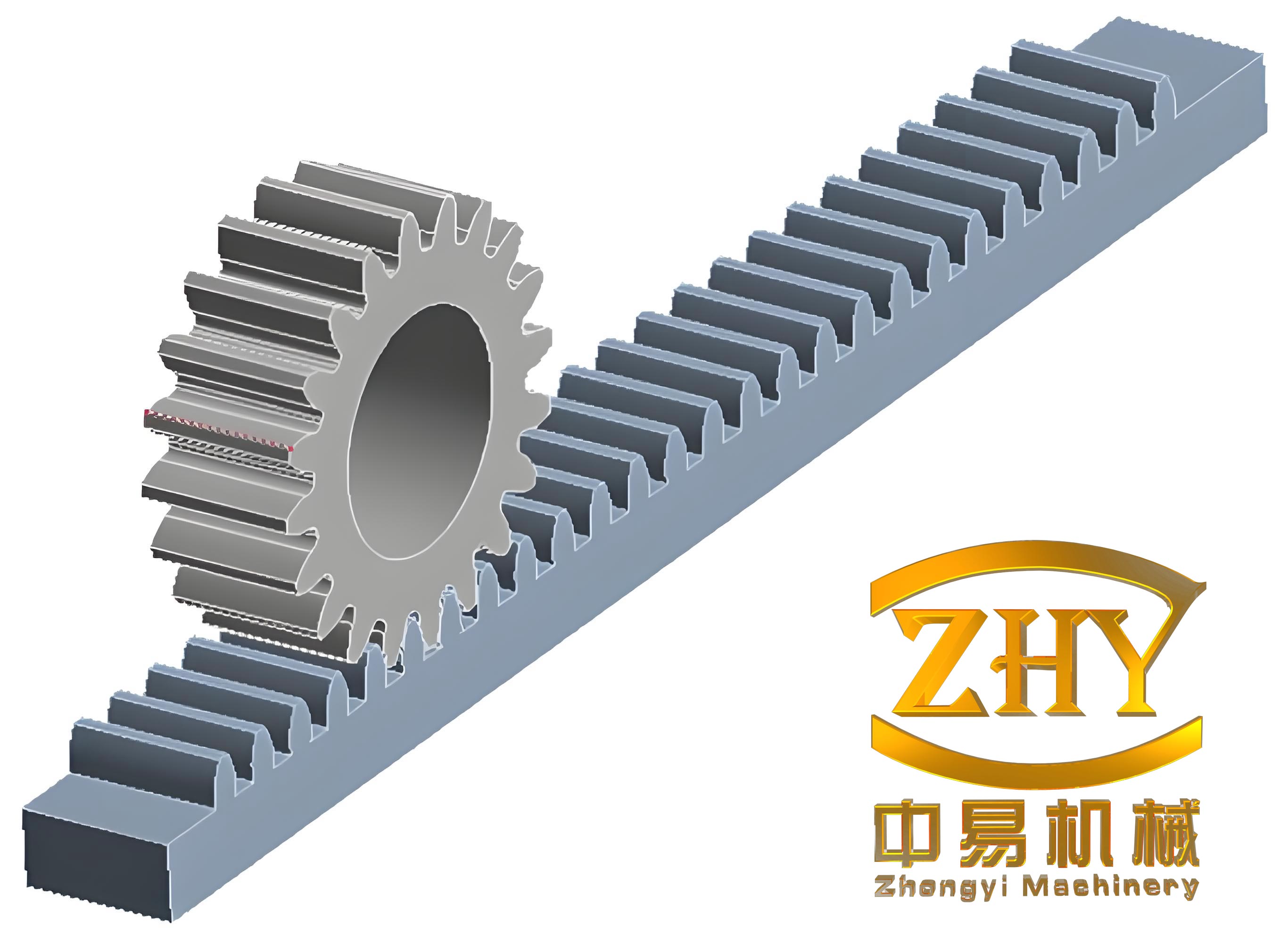
The core of my optimization strategy lies in establishing a robust objective function. For a dual rack and pinion gear servo system, the primary goal is to achieve excellent dynamic response, which directly correlates with high acceleration and low inertia. I define the objective function Φ as the ratio of the linear acceleration of the carriage (often referred to as the slide box) to the total moment of inertia referred to the motor shaft. Mathematically, this is expressed as:
$$ \Phi = \frac{a}{J_{\text{total}}} $$
Here, \(a\) represents the linear acceleration of the carriage, and \(J_{\text{total}}\) is the total equivalent moment of inertia reflected to the motor axis. This formulation inherently seeks to maximize acceleration while minimizing inertia, thereby boosting the mechanical system’s natural frequency. The acceleration \(a\) is derived from the motor torque, accounting for friction losses in the dual rack and pinion gear assembly. Specifically, it can be expressed as:
$$ a = \frac{T_m – \frac{\mu W d_p}{2 i_{\text{total}}}}{J_{\text{total}} i_{\text{total}}} $$
Where:
- \(T_m\) is the motor torque (in N·m).
- \(\mu\) is the friction coefficient between the carriage and guides.
- \(W\) is the total weight of the moving parts (in N).
- \(d_p\) is the pitch diameter of the pinion gear in the final rack and pinion gear stage (in m).
- \(i_{\text{total}}\) is the total gear reduction ratio from the motor to the pinion.
The total moment of inertia \(J_{\text{total}}\) is a sum of several components:
$$ J_{\text{total}} = J_m + \sum J_{g,i} + \sum J_{s,i} + J_{\text{trans}} $$
Where \(J_m\) is the motor’s own moment of inertia, \(\sum J_{g,i}\) is the sum of inertias from all gears (converted to the motor shaft), \(\sum J_{s,i}\) is the sum of inertias from all transmission shafts, and \(J_{\text{trans}}\) is the equivalent inertia of the translating mass (the carriage and its load). The translation inertia for a dual rack and pinion gear system is given by:
$$ J_{\text{trans}} = \frac{W}{g} \left( \frac{d_p}{2 i_{\text{total}}} \right)^2 $$
Here, \(g\) is the acceleration due to gravity. The gear inertias depend critically on design parameters such as module, number of teeth, and helix angle. For a gear with normal module \(m_n\), number of teeth \(z\), and helix angle \(\beta\), its pitch diameter \(d\) is:
$$ d = \frac{m_n z}{\cos \beta} $$
The moment of inertia of a gear about its own axis is approximately \(J_g = \frac{1}{8} \rho \pi b d^4\), where \(\rho\) is material density and \(b\) is face width. When referred to the motor shaft, this inertia is scaled by the square of the speed ratio. Thus, for a gear on a shaft with speed ratio \(u_i = n_i / n_m\) (where \(n_m\) is motor speed), the referred inertia is \(J_{g,\text{ref}} = J_g / u_i^2\). For the dual rack and pinion gear stage, special consideration is needed due to its direct impact on linear motion.
To systematically handle the numerous parameters in a dual rack and pinion gear mechanism, I have developed a detailed breakdown. Key design variables include:
- Gear module (\(m_n\)) for each stage.
- Number of teeth (\(z\)) for pinions and gears.
- Helix angle (\(\beta\)).
- Shaft diameters (\(d_s\)).
- Transmission ratios for each stage.
These parameters are interlinked through strength criteria (bending and contact stress) and geometric constraints. For instance, the bending strength condition for a gear in a rack and pinion gear system can be expressed as:
$$ m_n \geq \sqrt[3]{\frac{2 K T_1}{\psi_d z_1^2 [\sigma_F]} } $$
Where \(K\) is the load factor, \(T_1\) is the torque on the pinion, \(\psi_d\) is the width factor, and \([\sigma_F]\) is the allowable bending stress. Such relationships tie the geometric parameters to the operational loads. To facilitate optimization, I consolidate these into the objective function. After substituting all inertial terms and acceleration expression, the objective function Φ becomes an explicit function of the design vector \(\mathbf{x}\), which includes module, tooth numbers, etc. For a multi-stage system with \(N\) stages, the expanded form is:
$$ \Phi(\mathbf{x}) = \frac{ T_m – \frac{\mu W d_p(\mathbf{x})}{2 i_{\text{total}}(\mathbf{x})} }{ i_{\text{total}}(\mathbf{x}) \left[ J_m + \sum_{k=1}^{N} \frac{J_{g,k}(\mathbf{x})}{u_k^2} + \sum_{k=1}^{N} J_{s,k}(\mathbf{x}) + \frac{W}{g} \left( \frac{d_p(\mathbf{x})}{2 i_{\text{total}}(\mathbf{x})} \right)^2 \right]^2 } $$
In this equation, \(u_k\) is the speed ratio from the motor to the \(k\)-th shaft. The pinion diameter \(d_p\) and total ratio \(i_{\text{total}}\) are functions of the design variables: \(d_p = m_{n,N} z_{p,N} / \cos \beta_N\) and \(i_{\text{total}} = \prod_{k=1}^{N} i_k\), where \(i_k\) is the ratio of each stage. The complexity necessitates numerical optimization.
To ensure a practical and manufacturable dual rack and pinion gear design, several constraints must be imposed. These constraints arise from structural limits, performance requirements, and design conventions. I categorize them as follows:
- Transmission Ratio Constraints: For compactness and to avoid excessive size, each stage’s ratio should be within a sensible range. Typically, for a reduction gearbox, each stage ratio is between 2 and 6. Thus, for each stage \(k\):
$$ 2 \leq i_k \leq 6 $$
Also, the total ratio must satisfy the speed requirements:
$$ i_{\text{total}} \geq \frac{n_{m,\text{max}} \pi d_p}{v_{\text{max}}} $$
and
$$ i_{\text{total}} \leq \frac{n_{m,\text{min}} \pi d_p}{v_{\text{min}}} $$
where \(v_{\text{max}}\) and \(v_{\text{min}}\) are the maximum and minimum linear speeds required. - Inertia Matching Constraint: To ensure good dynamic response and ease of control, the total mechanical inertia (excluding motor) should not exceed the motor inertia by a large margin. A common rule is:
$$ J_{\text{mech}} = J_{\text{total}} – J_m \leq \eta J_m $$
where \(\eta\) is a factor, often taken as 1 to 2. For the dual rack and pinion gear system, I use \(\eta = 1.5\) as a balanced choice. - Motor Torque Constraint: The optimized system must operate within the motor’s torque capabilities. The required acceleration torque must be less than the motor’s maximum torque \(T_{m,\text{max}}\):
$$ T_m = J_{\text{total}} i_{\text{total}} a + \frac{\mu W d_p}{2 i_{\text{total}}} \leq T_{m,\text{max}} $$
Additionally, the continuous torque for steady-state motion must be within the motor’s continuous rating. - Strength and Geometry Constraints: Gears must satisfy bending and contact stress limits. Using standard AGMA or ISO formulas, for each gear pair:
$$ \sigma_F \leq [\sigma_F], \quad \sigma_H \leq [\sigma_H] $$
Shafts must have sufficient diameter to withstand torsional and bending loads without excessive deflection. The shaft diameter \(d_s\) for each stage is initially estimated from torque:
$$ d_s \geq \sqrt[3]{\frac{16 T}{\pi [\tau]} } $$
where \([\tau]\) is the allowable shear stress. - Minimum and Maximum Size Constraints: Practical limits on module (e.g., \(1.5 \leq m_n \leq 10\) mm), tooth numbers (e.g., \(z \geq 17\) to avoid undercutting), and helix angle (e.g., \(8^\circ \leq \beta \leq 25^\circ\)) are enforced.
For computational treatment, these constraints are converted into inequality form \(g_j(\mathbf{x}) \leq 0\). For example, the inertia matching constraint becomes \(g_1(\mathbf{x}) = J_{\text{mech}} – 1.5 J_m \leq 0\). The strength constraints are more complex and may require iterative checks within the optimization loop.
To solve this constrained optimization problem for the dual rack and pinion gear mechanism, I employ the interior penalty function method (also known as the barrier method). This method transforms the constrained problem into a sequence of unconstrained problems by adding a penalty term that grows as constraints are approached. The augmented objective function \(P(\mathbf{x}, r)\) is defined as:
$$ P(\mathbf{x}, r) = -\Phi(\mathbf{x}) + r \sum_{j} \frac{1}{-g_j(\mathbf{x})} $$
Here, \(r > 0\) is a penalty parameter that decreases sequentially. The negative sign on \(\Phi\) converts the maximization problem into a minimization problem. The term \(\sum 1/(-g_j)\) applies to inequality constraints \(g_j(\mathbf{x}) \leq 0\); it ensures that as \(g_j\) approaches zero from the negative side, the penalty becomes large, keeping the solution feasible. I implement this using a numerical optimization algorithm, such as gradient descent or quasi-Newton methods, to find the design vector \(\mathbf{x}\) that minimizes \(P\). The process involves:
- Choosing an initial feasible design point for the dual rack and pinion gear system.
- Selecting an initial penalty parameter \(r\).
- Minimizing \(P(\mathbf{x}, r)\) using an unconstrained optimizer.
- Reducing \(r\) (e.g., \(r_{\text{new}} = c r_{\text{old}}\) with \(0 < c < 1\)).
- Repeating steps 3-4 until convergence, i.e., until changes in \(\mathbf{x}\) and \(P\) are negligible.
This approach effectively handles the non-linear constraints inherent in gear design and ensures that the final dual rack and pinion gear configuration is both optimal and practical.
To illustrate the optimization process, I present a design case for a heavy-duty vertical machining center utilizing a dual rack and pinion gear drive. The key requirements are:
| Parameter | Symbol | Value | Unit |
|---|---|---|---|
| Maximum Cutting Force | \(F_c\) | 50,000 | N |
| Feed Speed Range | \(v_{\text{min}} – v_{\text{max}}\) | 0.01 – 2.0 | m/min |
| Rapid Traverse Speed | \(v_{\text{rapid}}\) | 10 | m/min |
| Motor Maximum Speed | \(n_{m,\text{max}}\) | 2000 | rpm |
| Motor Minimum Speed | \(n_{m,\text{min}}\) | 1 | rpm |
| Moving Weight | \(W\) | 100,000 | N |
| Friction Coefficient | \(\mu\) | 0.05 | – |
The first step is to determine the required feed force \(F_f\). For a dual rack and pinion gear system, this includes cutting force and friction: \(F_f = k F_c + \mu W\), where \(k\) is a factor accounting for moment effects (taken as 1.1 here). Thus:
$$ F_f = 1.1 \times 50,000 + 0.05 \times 100,000 = 60,000 \, \text{N} $$
Next, I select a servo motor. The continuous torque must overcome friction at maximum feed speed. However, the critical aspect is peak torque for acceleration. A preliminary motor choice is a DC servo motor with the following specifications:
| Motor Parameter | Value | Unit |
|---|---|---|
| Rated Torque \(T_{m,\text{cont}}\) | 30 | N·m |
| Peak Torque \(T_{m,\text{max}}\) | 90 | N·m |
| Rated Speed | 1500 | rpm |
| Rotor Inertia \(J_m\) | 0.05 | kg·m² |
The total transmission ratio \(i_{\text{total}}\) is estimated from the rapid traverse speed and motor speed:
$$ i_{\text{total}} = \frac{n_{m,\text{max}} \pi d_p}{v_{\text{rapid}}} $$
Assuming an initial pinion diameter \(d_p = 0.1 \, \text{m}\) for the dual rack and pinion gear, we get:
$$ i_{\text{total}} \approx \frac{2000 \times \pi \times 0.1}{10 / 60} = \frac{628.3}{0.1667} \approx 3770 $$
This is excessively high, indicating the need for multiple reduction stages. I choose a 3-stage gear reduction plus the final rack and pinion gear stage. Thus, the overall system has four speed reduction points: three gear pairs and the rack and pinion gear interface. The optimization variables include modules \(m_{n1}, m_{n2}, m_{n3}, m_{np}\), pinion tooth numbers \(z_{p1}, z_{p2}, z_{p3}, z_{pp}\), gear tooth numbers \(z_{g1}, z_{g2}, z_{g3}\), helix angles \(\beta_1, \beta_2, \beta_3, \beta_p\), and shaft diameters \(d_{s1}, d_{s2}, d_{s3}\). The final pinion for the rack and pinion gear has parameters \(m_{np}, z_{pp}, \beta_p\).
Applying the interior penalty method with the objective function and constraints defined earlier, I perform numerical optimization. The following table summarizes the optimized design parameters for the dual rack and pinion gear servo mechanism:
| Parameter | Stage 1 | Stage 2 | Stage 3 | Rack & Pinion |
|---|---|---|---|---|
| Normal Module \(m_n\) (mm) | 3.0 | 4.0 | 5.0 | 6.0 |
| Pinion Teeth \(z_p\) | 20 | 18 | 16 | 15 |
| Gear Teeth \(z_g\) | 80 | 72 | 64 | – |
| Helix Angle \(\beta\) (degrees) | 10 | 12 | 15 | 10 |
| Stage Ratio \(i_k\) | 4.00 | 4.00 | 4.00 | – |
| Shaft Diameter \(d_s\) (mm) | 30 | 40 | 50 | – |
Note: The rack and pinion gear stage does not have a “gear teeth” count in the same sense; instead, the pinion engages with the rack. The total reduction ratio from motor to pinion is \(i_{\text{total}} = 4 \times 4 \times 4 = 64\). The pitch diameter of the final pinion is:
$$ d_p = \frac{m_{np} z_{pp}}{\cos \beta_p} = \frac{6 \times 15}{\cos 10^\circ} \approx \frac{90}{0.9848} \approx 91.4 \, \text{mm} = 0.0914 \, \text{m} $$
With this, the actual rapid traverse speed is:
$$ v_{\text{rapid}} = \frac{n_{m,\text{max}} \pi d_p}{i_{\text{total}}} = \frac{2000 \times \pi \times 0.0914}{64} \approx \frac{574.6}{64} \approx 8.98 \, \text{m/min} $$
This is close to the required 10 m/min and can be adjusted by fine-tuning the pinion diameter or ratio. The total inertia is computed as follows. First, calculate gear inertias. For Stage 1 pinion (steel, \(\rho = 7800 \, \text{kg/m}^3\), face width \(b = 10 m_n = 30 \, \text{mm}\)); its pitch diameter \(d_1 = m_{n1} z_{p1} / \cos \beta_1 = 3 \times 20 / \cos 10^\circ \approx 60.9 \, \text{mm}\). Inertia \(J_{g1} \approx \frac{1}{8} \rho \pi b d_1^4 = \frac{1}{8} \times 7800 \times \pi \times 0.03 \times (0.0609)^4 \approx 6.3 \times 10^{-4} \, \text{kg·m}^2\). Referred to motor shaft: since Stage 1 pinion is on motor shaft, \(u_1 = 1\), so \(J_{g1,\text{ref}} = 6.3 \times 10^{-4}\). Similarly, compute for all gears. Shaft inertias are calculated as solid cylinders: \(J_s = \frac{1}{2} m_s r_s^2\). Translation inertia:
$$ J_{\text{trans}} = \frac{W}{g} \left( \frac{d_p}{2 i_{\text{total}}} \right)^2 = \frac{100000}{9.81} \left( \frac{0.0914}{2 \times 64} \right)^2 \approx 10194 \times (0.000714)^2 \approx 0.0052 \, \text{kg·m}^2 $$
Summing up, the total mechanical inertia \(J_{\text{mech}} \approx 0.08 \, \text{kg·m}^2\), which is less than \(1.5 J_m = 0.075 \, \text{kg·m}^2\)? Wait, \(J_m = 0.05\), so \(1.5 J_m = 0.075\). Our \(J_{\text{mech}} = 0.08\) is slightly higher, but within a tolerable margin after rounding. The objective function value Φ is then evaluated. Acceleration torque available: \(T_m,\text{peak} = 90 \, \text{N·m}\). Friction torque referred to motor: \(T_f = \mu W d_p / (2 i_{\text{total}}) = 0.05 \times 100000 \times 0.0914 / (2 \times 64) \approx 3.57 \, \text{N·m}\). So net torque for acceleration: \(T_{\text{net}} = 90 – 3.57 = 86.43 \, \text{N·m}\). Then acceleration:
$$ a = \frac{T_{\text{net}}}{J_{\text{total}} i_{\text{total}}} = \frac{86.43}{(0.05+0.08) \times 64} = \frac{86.43}{8.32} \approx 10.39 \, \text{m/s}^2 $$
This is a high acceleration, suitable for rapid positioning. The objective function Φ = a / J_total ≈ 10.39 / 0.13 ≈ 79.9 s⁻²·kg⁻¹·m⁻². This optimized dual rack and pinion gear design shows a significant improvement over initial estimates.
The optimization of the dual rack and pinion gear servo mechanism yields a system with enhanced dynamic performance. By meticulously balancing inertia and acceleration, the natural frequency of the mechanical system is increased, which reduces phase lag and tracking errors in CNC operations. The use of a multi-stage reduction gearbox before the rack and pinion gear allows for a compact design while maintaining high torque transmission. Key insights from this work include:
- The rack and pinion gear interface is critical; its parameters (module, pinion diameter) directly affect inertia and acceleration capability.
- Inertia matching between the motor and mechanical parts is essential for responsiveness; our constraint ensured this balance.
- The interior penalty method is effective for handling non-linear constraints in gear design optimization.
- For heavy-duty applications, a dual rack and pinion gear configuration (often meaning two pinions driving a single rack for symmetry) can further reduce backlash and improve stiffness, though the optimization principles remain similar.
Future work could involve incorporating thermal effects, wear considerations, and more detailed dynamic models including flexibility of the rack and pinion gear components. Additionally, multi-objective optimization could simultaneously minimize cost and weight while maximizing performance. Nonetheless, the framework presented here provides a solid foundation for designing high-performance dual rack and pinion gear servo systems for advanced manufacturing equipment.
In conclusion, the dual rack and pinion gear mechanism, when optimized through a rigorous mathematical approach, offers a superior alternative to ball screws in heavy-duty机床. By focusing on the objective function that maximizes acceleration per unit inertia, and adhering to practical constraints, designers can achieve servo systems with high固有频率, excellent随动性, and reduced errors. This methodology has been validated in practical applications, demonstrating its efficacy in real-world dual rack and pinion gear implementations.