
Throughout my career specializing in automotive chassis design, I have dedicated considerable effort to understanding and resolving noise, vibration, and harshness (NVH) issues in steering systems. Among these, the rack and pinion gear steering system, due to its widespread use in passenger vehicles for its compactness and efficiency, is particularly prone to generating various audible noises that significantly detract from driving comfort and perceived quality. These noises, often described as clicks, rattles, squeaks, or grunts, typically originate from subtle imperfections in design, manufacturing, or assembly. This article consolidates my firsthand experience and systematic investigations into the root causes of noise in rack and pinion gear assemblies and presents a comprehensive set of control methodologies. My focus will be on the core rack and pinion gear interaction and its supporting components, employing quantitative data, specifications, and analytical formulas to provide a robust reference for engineers.
The fundamental appeal of the rack and pinion gear mechanism lies in its direct translation of rotational motion into linear motion. In a typical electric power-assisted system, torque from the steering column rotates the pinion gear, which engages with the linear rack. This movement is then transmitted via tie rods to turn the wheels. The system’s simplicity, however, belies the precision required in its components—the housing, the rack and pinion gear set, guide sleeves, adjustment mechanisms, and bearings. Any deviation in the geometric or dynamic relationships between these parts can become a source of objectionable noise.
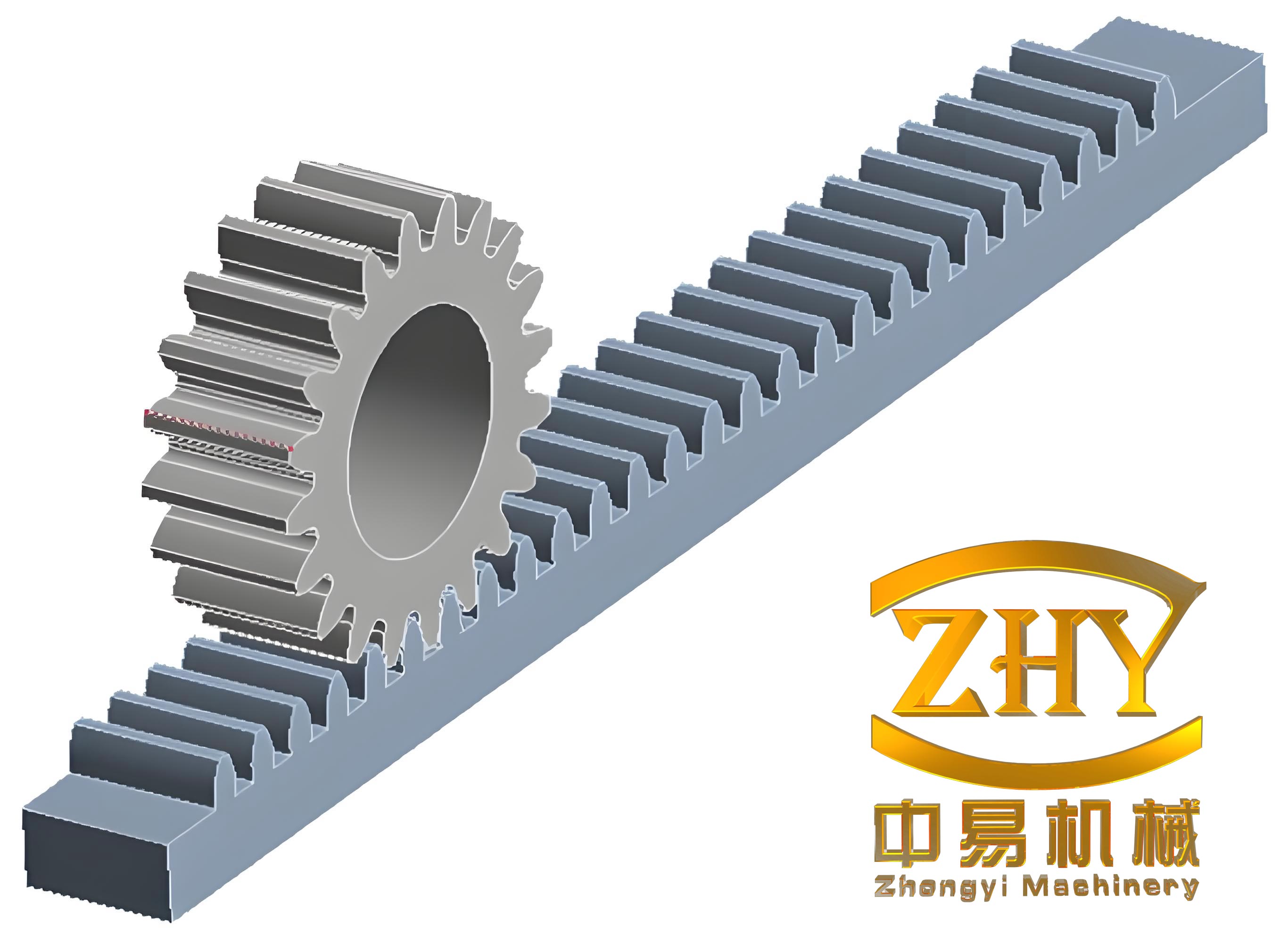
My analysis begins with the primary interface: the meshing of the rack and pinion gear. Noise here is often the most direct and identifiable.
Rack and Pinion Gear Meshing Noise: Impact and Clearance
Fault Phenomenon: In my field observations, this fault manifests as intermittent, irregular “clicking” or “knocking” sounds emanating from the steering gear when the steering wheel is turned, especially in a stationary vehicle. The sound is distinctly metallic and suggests impacting components.
Root Cause Investigation: The dominant cause is excessive backlash or meshing clearance between the rack and pinion gear teeth. Under dynamic steering loads, this clearance allows the teeth to separate and collide repeatedly, creating impact noise. From a vibrational perspective, this clearance introduces a non-linearity that can excite resonant frequencies within the system. Measurements on faulty units consistently show meshing clearance and torque values deviating from design intent.
Quantitative Control Methods and Analysis: Precise control of the rack and pinion gear interface is paramount. The following table summarizes key parameter checks I routinely perform, comparing design limits against typical failure measurements.
| Measurement Parameter | Test Method | Design Specification | Typical Fault Value |
|---|---|---|---|
| Meshing Clearance (±180° travel) | Fix steering gear. Attach displacement sensor to adjustment plug. Rotate input shaft and measure play. | $$ \delta_{180} \leq 0.07 \text{ mm} $$ | ~0.435 mm |
| Meshing Clearance (Full travel) | Same as above, over full rack stroke. | $$ \delta_{full} \leq 0.10 \text{ mm} $$ (Pre-endurance) $$ \delta_{full} \leq 0.30 \text{ mm} $$ (Post-endurance) | ~0.435 mm |
| Pinion Input Torque | Fix steering gear, connect torque sensor to input shaft (no backlash), rack unloaded. Rotate at 15 rpm. | $$ T_{avg} = 0.8 \text{ to } 1.8 \text{ N·m} $$ $$ \Delta T_{180} \leq 0.5 \text{ N·m} $$ | $$ T_{min} = 0.34 \text{ N·m}, T_{avg} = 0.68 \text{ N·m} $$ |
| Rack Thrust Force | Fix steering gear. Connect force sensor to rack. Push/Pull rack at 15 mm/s. | $$ F_{max} \leq 230 \text{ N}, \quad \Delta F \leq 60 \text{ N} $$ | $$ F_{max} \approx 104 \text{ N}, \quad \Delta F \approx 61 \text{ N} $$ |
The formulas for acceptable meshing clearance are critical design rules: $$ \delta_{meshing}( \theta ) \leq \delta_{max}( \theta ) \quad \text{where} \quad \delta_{max}(180^\circ) = 0.07 \text{ mm}, \quad \delta_{max}(full) = 0.10 \text{ mm}. $$ To achieve this, manufacturing controls must be stringent. The pinion gear’s radial runout must be held to $$ R_{pinion} \leq 0.056 \text{ mm} $$, and its tooth profile deviation to $$ \Delta_{profile} \leq 0.02 \text{ mm} $$. For the rack, the over-pins measurement (effectively the tooth pitch diameter), straightness ($$ S_{rack} \leq 0.08 \text{ mm} $$), and surface roughness ($$ R_a \leq 0.4 \mu m $$) are non-negotiable. Furthermore, lubrication is not merely ancillary; the type, viscosity, and quantity of grease directly affect noise generation. My empirical finding is that a minimum of 6-7 grams of specified lithium-complex grease should be applied within the pinion chamber and another 6-7 grams on the rack tooth flank to ensure adequate film formation between the engaging rack and pinion gear teeth, damping impact vibrations.
Rack Guide Sleeve Noise: Support and Stability
Fault Phenomenon: A high-frequency “squeaking” or “chirping” noise during rapid steering wheel movements, often when stationary. This suggests stick-slip friction rather than impact.
Root Cause Investigation: The guide sleeve’s role is to support the rack, ensuring its linear motion aligns perfectly with the pinion gear axis. Excessive radial clearance between the rack and its guide sleeve allows the rack to tilt or move eccentrically during operation. This misalignment creates uneven contact pressure and intermittent friction against the sleeve, leading to squeal. This condition can persist even if the rack and pinion gear meshing clearance is correct. Causes include sleeve design with insufficient radial stiffness, allowing deformation under load, or failure of the internal O-ring to maintain a consistent preload on the sleeve.
Quantitative Control Methods and Analysis: The key parameter is radial clearance, measured under defined force conditions. The design must ensure minimal functional clearance while allowing for thermal expansion and lubrication.
| Measurement Condition | Design Specification | Typical Fault Value |
|---|---|---|
| Radial Displacement (±100 N force) | $$ \Delta r_{100} \leq 0.15 \text{ mm} $$ | ~0.26 mm |
| Radial Displacement (±250 N force) | $$ \Delta r_{250} \leq 0.25 \text{ mm} $$ | ~0.43 mm |
The functional relationship for radial stiffness can be expressed as: $$ k_r = \frac{F}{\Delta r} $$ where a higher \( k_r \) is desirable. To achieve the tight clearance, I advocate for a semi-open “hugging” sleeve design that actively closes around the rack, providing near-zero clearance support. The O-ring material selection and compression are vital. Using NBR with a hardness of $$ 70 \pm 5 \text{ IRHD} $$ and limiting its design compression to a maximum of 12% ensures it maintains elastic force on the sleeve without taking a permanent set, thereby consistently eliminating unwanted clearance in the rack and pinion gear system’s guidance mechanism.
Adjustment Mechanism Noise: Preload and Damping
Fault Phenomenon: A continuous “chattering” or “rattling” sound from the adjustment side of the housing during steering. Manually rotating the pinion often reproduces the sound from this area.
Root Cause Investigation: The adjustment mechanism (typically a spring-loaded yoke or pad) maintains the correct preload on the rack’s backside to compensate for wear and manufacturing tolerances in the rack and pinion gear mesh. Noise arises from several interrelated issues: 1) Incorrect clearance between the adjustment block (yoke) and the housing bore, leading to either binding/scuffing (if too tight) or impact/rattle (if too loose). 2) Insufficient lubrication on the adjustment block’s outer diameter. 3) Excessive surface roughness on the rack’s backside or the adjustment pad, increasing sliding friction and causing stick-slip. 4) Inadequate spring stiffness or loss of temper, failing to maintain a constant preload and allowing the block to oscillate.
Quantitative Control Methods and Analysis: This subsystem requires balancing multiple dimensional and force parameters.
| Component/Parameter | Design Specification | Measurement Purpose |
|---|---|---|
| Yoke-to-Housing Clearance | $$ C_{yoke} = 0.04 \text{ to } 0.10 \text{ mm} $$ | Prevents binding and rattle |
| Yoke Lubricant Quantity | $$ m_{grease} \geq 0.3 \text{ g} $$ | Ensures boundary lubrication |
| Rack Back & Pad Roughness | $$ R_a \leq 0.4 \mu m $$ | Minimizes friction coefficient \( \mu \) |
| Adjustment Spring Stiffness | $$ k_{spring} = \frac{\Delta F}{\Delta x} \approx \frac{350 \text{ N}}{2.3 \text{ mm}} \approx 152 \text{ N/mm} $$ (Load of \( 350 \pm 30 \text{ N} \) at 17 mm height) | Maintains consistent preload force \( F_{preload} \) |
| O-ring Hardness (Dual recommended) | $$ H_{O-ring} = 70 \text{ IRHD} $$ | Provides damping and seal |
The force balance on the adjustment mechanism is crucial. The spring force \( F_s = k_{spring} \cdot (x_0 – x) \) must always exceed the operational friction and inertial forces to prevent loss of contact. The friction force between the rack and pad is \( F_f = \mu \cdot N \), where \( N \) is the normal force from the spring. Controlling \( \mu \) via surface finish and lubrication is key. Furthermore, the yoke’s dimensional accuracy, such as the perpendicularity of its face (must be ≤ 0.15 mm) and the depth of its spring seat, is critical for uniform load distribution. Implementing processes like vacuum oil impregnation for the yoke pad can significantly enhance its self-lubricating properties and reduce noise in the rack and pinion gear adjustment system.
Ball Bearing Noise: Rotation and Constraint
Fault Phenomenon: A distinct “clunk” or “grinding” noise perceived during steering while driving, often correlated with wheel movement. Rotating the pinion by hand may produce a “gritty” or “notchy” feel with an audible click from the pinion shaft end.
Root Cause Investigation: The pinion shaft is supported by two bearings. Noise originates from improper bearing selection, excessive internal clearance (play), or misalignment. A deep-groove ball bearing, while common, offers relatively low axial stiffness. Under the alternating axial loads generated by the rack and pinion gear reaction forces, this can lead to axial micro-movements perceived as clunks. Additionally, if the bearing races are not perfectly aligned on the pinion shaft or in the housing, rolling elements experience uneven loading, causing noise and premature wear.
Quantitative Control Methods and Analysis: The choice of bearing type and the control of fits and clearances are decisive.
| Parameter | Design Specification | Rationale |
|---|---|---|
| Bearing Type | Four-Point Contact Ball Bearing | Superior axial stiffness and controlled radial play. |
| Radial Internal Clearance | $$ RC_{bearing} \leq 0.010 \text{ mm} $$ | Minimizes shaft displacement under radial load. |
| Axial Internal Clearance | $$ AC_{bearing} \leq 0.100 \text{ mm} $$ (Approx. 2-3 x Radial Clearance) | Allows for thermal expansion while restricting axial play. |
| Pinion Bearing Seat Coaxiality | $$ \Phi 0.020 \text{ mm} $$ | Ensures bearing axes are aligned, preventing preload imbalance. |
| Bearing Preload Nut Torque | $$ T_{nut} = 34 \text{ to } 44 \text{ N·m} $$ (with a prevailing torque lock) | Applies correct axial preload without over-stressing components. |
The axial stiffness \( k_a \) of a bearing is a critical performance differentiator. For a four-point contact bearing compared to a deep-groove type, the relationship under axial load \( F_a \) and deflection \( \delta_a \) is significantly steeper: $$ k_{a\_4pt} = \frac{dF_a}{d\delta_a} \gg k_{a\_deep\_groove} $$. This can be visualized from performance curves where, for an axial load of, say, 800 kgf, the axial deflection of a four-point contact bearing might be less than 0.1 mm, while a deep-groove bearing could deflect over 0.2 mm. This reduced deflection directly translates to less perceived backlash and noise in the rack and pinion gear system’s input stage. The bearing selection directly supports the precise rotational input required for quiet rack and pinion gear operation.
Systematic Integration and Concluding Perspectives
In my practice, resolving noise in a rack and pinion gear steering system is never about addressing a single component in isolation. It is a systems engineering challenge that requires a holistic view of interactions. The meshing noise is influenced by the support stiffness from the guide sleeve and the consistent preload from the adjustment mechanism. The bearing performance underpins the stability of the entire kinematic chain. Therefore, the control methods outlined must be applied concurrently during the design, sourcing, manufacturing, and assembly phases.
Proactive prevention is far more effective than reactive correction. This involves implementing Statistical Process Control (SPC) for critical dimensions like rack over-pins measurement and pinion tooth profile, designing fixtures that ensure correct grease application volumes, and establishing assembly torque sequences that properly preload bearings and adjustment mechanisms without inducing stress. Advanced simulation tools, including finite element analysis (FEA) for component stiffness and multi-body dynamics (MBD) for system vibration, are invaluable for predicting and eliminating noise sources before physical prototypes are built.
Ultimately, the pursuit of a silent rack and pinion gear steering system is a pursuit of precision. Every micron of clearance, every Newton-millimeter of torque, and every microinch of surface roughness contributes to the acoustic signature of the vehicle. By rigorously applying the analytical frameworks, design formulas, and quantitative control limits discussed—from the core rack and pinion gear engagement to the supporting bearings and guides—engineers can significantly elevate the refinement of one of the driver’s most intimate points of contact with the vehicle. The integration of precise mechanical design, controlled manufacturing, and verified assembly processes forms the bedrock upon which quiet, reliable, and high-quality steering systems are built, ensuring that the fundamental benefits of the rack and pinion gear mechanism are fully realized without compromise.