
The prevailing method for artificial lift in oil production, the sucker rod pumping system, presents significant operational challenges in modern field development. As the industry increasingly exploits complex well architectures such as highly deviated and multi-lateral wells, the limitations of conventional rod-driven systems become pronounced. The primary issues include severe rod-on-tubing wear, high energy consumption due to numerous intermediate transmission links, low system efficiency, and frequent failures of the rod string. These problems directly impact the economic viability of oilfield operations. This article proposes and investigates an innovative solution: replacing the traditional sucker rod string with a mechanical rack and pinion gear drive mechanism. The core objective is to eliminate rod-tubing friction entirely by converting rotary motion downhole into linear reciprocating motion directly at the pump.
The proposed downhole rack and pinion gear system is subjected to continuous cyclic loading during its operational life. The meshing interface is particularly susceptible to failure modes such as pitting, spalling, and wear under these demanding conditions, which could lead to a complete system shutdown. Therefore, a comprehensive mechanical analysis is imperative to ensure reliable and stable long-term performance. This analysis employs a multi-faceted approach, integrating theoretical calculations, Finite Element Analysis (FEA) for static strength validation, and dynamic simulation using Multi-Body Dynamics (MBD) software. The goal is to rigorously evaluate the stress state, dynamic response, and overall feasibility of implementing a rack and pinion gear assembly in the constrained, harsh environment of an oil well.
System Configuration and Operational Principle
The proposed rodless artificial lift system is designed to function entirely within the wellbore. Power is transmitted from the surface to a submerged electric motor via a specialized downhole cable. This system integrates several key components to achieve the necessary motion conversion.
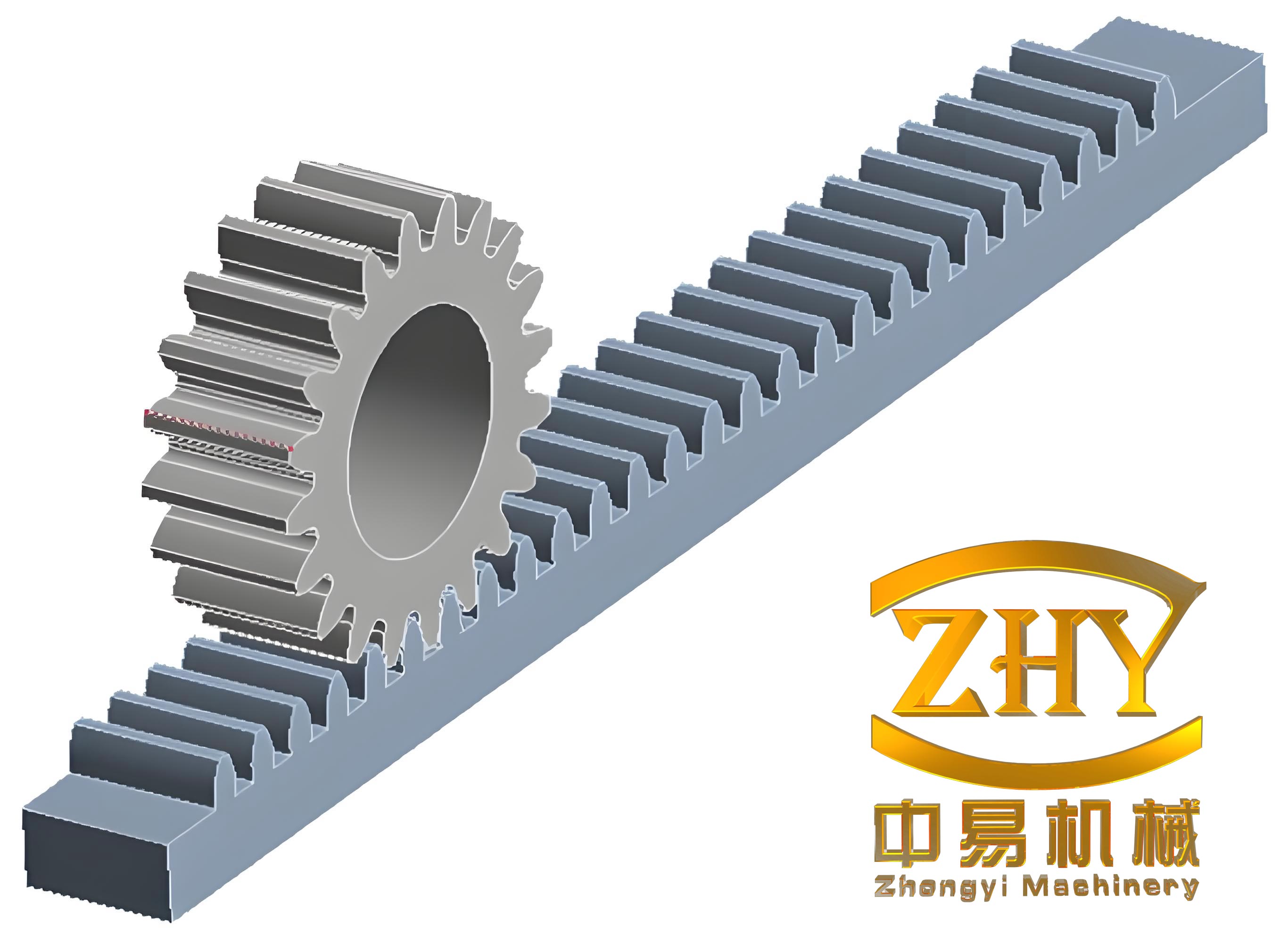
The core power train consists of the following sequence: a submersible electric motor (incorporating a protector) provides the initial rotary input. This rotation is fed into a speed reduction gearbox to achieve the desired torque and speed. The output from the gearbox drives a reversing mechanism, typically implemented using a pair of incomplete gears, which periodically changes the direction of rotation to facilitate the pump’s upstroke and downstroke. This bidirectional rotation is then transmitted through a bevel gear pair, which redirects the axis of rotation from the horizontal plane (as suited for the motor and reverser layout) to the vertical plane aligned with the wellbore. Finally, the vertical rotary motion engages the central rack and pinion gear assembly. The pinion’s rotation is transformed into precise linear reciprocation of the rack, which is directly connected to the plunger of a reciprocating subsurface pump. The entire assembly is housed within the production tubing, with centralizers ensuring alignment.
The key technical parameters for the pumping operation and the designed rack and pinion gear are summarized in Tables 1 and 2, respectively. The gears are designed as standard involute spur gears manufactured from forged 45-grade steel.
| Parameter | Value | Unit |
|---|---|---|
| Stroke Length, S | 1.4 | m |
| Pumping Speed, N | 2 | strokes/min |
| Plunger Diameter, D | 32 | mm |
| Pump Setting Depth, H | 1200 | m |
| Theoretical Daily Production | 2.3 | m³/d |
| Parameter | Value | Unit |
|---|---|---|
| Motor Power, P | 4 | kW |
| Module, m | 2 | mm |
| Pressure Angle, α | 20 | ° |
| Pinion Number of Teeth, z | 24 | – |
| Pinion Speed, n | 750 | rpm |
| Face Width, b | 20 | mm |
| Addendum Coefficient, h*a | 1 | – |
| Dedendum Coefficient, c* | 0.25 | – |
Static Strength Analysis of the Rack and Pinion Gear
The static analysis focuses on verifying the gear tooth strength under the maximum anticipated load, ensuring the design avoids premature failure modes like bending fatigue or contact fatigue.
Theoretical Contact Stress Calculation
For the hard-faced gear material used in this closed rack and pinion gear drive, contact fatigue strength is the primary design constraint. The fundamental condition is:
$$ \sigma_H \leq [\sigma_H] $$
where \( \sigma_H \) is the calculated contact stress and \( [\sigma_H] \) is the allowable contact stress, approximately equal to the endurance limit \( \sigma_{H\lim} = 523 \text{ MPa} \) for the selected material.
The formula for calculating the contact stress for a rack and pinion gear pair, where the gear ratio can be considered infinite, is derived from the standard gear contact formula:
$$ \sigma_H = \sqrt{ \frac{2 K_H T_1}{\phi_d d_1^3} } \cdot Z_H Z_E Z_\epsilon $$
Here, \( K_H \) is the load factor for contact stress, calculated as the product of the application factor \( K_A \), dynamic factor \( K_V \), transverse load factor \( K_{H\alpha} \), and face load factor \( K_{H\beta} \). \( T_1 \) is the pinion torque, \( \phi_d \) is the face width coefficient, \( d_1 \) is the pinion pitch diameter, \( Z_H \) is the zone factor, \( Z_E \) is the elasticity factor (189.8 \(\sqrt{\text{MPa}}\)), and \( Z_\epsilon \) is the contact ratio factor.
Using the parameters from Table 2 and appropriate values from mechanical design standards for the load factors, the calculated contact stress is:
$$ \sigma_H = 495.155 \text{ MPa} $$
This value is less than the allowable limit of 523 MPa, confirming the theoretical design adequacy of the rack and pinion gear teeth.
Finite Element Analysis for Contact Stress Validation
A three-dimensional model of the rack and pinion gear in mesh was created and analyzed using ANSYS Workbench Static Structural module to validate the theoretical stress calculation and visualize the stress distribution. The model was simplified, considering only the pinion and a segment of the rack with two teeth in contact (approximating a contact ratio < 2). A tetrahedral mesh with local refinement at the contact zones was applied, resulting in over 335,000 nodes and 217,000 elements.
Boundary conditions were applied as follows: the pinion bore was fixed in all degrees of freedom, a vertical load of 1000 N (simulating pump load) was applied to one end of the rack, and a frictionless support was defined at the rack’s base. The resulting contact stress distribution is shown in a subsequent figure, with the maximum value observed on the tooth flank.
The FEA yielded a maximum contact stress of approximately 478.94 MPa. The minor discrepancy with the theoretical result (495.155 MPa) is attributed to the idealized assumptions in the hand calculation versus the more realistic modeling in FEA, including precise geometry and contact definitions. Crucially, the FEA stress is also well below the material’s endurance limit. The analysis confirms that stress concentration at the tooth root is mitigated by the involute profile and appropriate fillet design, with the critical stress area being the contact surface on the flank, aligning with typical gear failure modes.
Dynamic Modeling and Simulation of the Rack and Pinion Gear Drive
The dynamic behavior is critical as it reveals vibration, impact loads, and transient responses not captured by static analysis, directly influencing system stability and longevity.
Development of the Dynamic Model
The rack and pinion gear transmission is modeled as a lumped-parameter, elastic mechanical system with the following assumptions: 1) Pinion and rack are linear elastic bodies. 2) Deformations of shafts and supports are negligible. 3) System damping is viscous. 4) Friction between teeth is ignored. The model accounts for the time-varying meshing stiffness \( k_{vi}(t) \) and profile error \( e_i(t) \) for the i-th tooth pair in contact.
The relative deflection \( \delta_i \) for a meshing tooth pair is:
$$ \delta_i = \theta r_{b1} – s – e_i $$
where \( \theta \) is the pinion angular displacement, \( r_{b1} \) is the pinion base circle radius, and \( s \) is the rack linear displacement.
The total dynamic meshing force \( F \) is the sum of forces from all contacting tooth pairs:
$$ F = \sum_i F_i = \sum_i \left( k_{vi} \delta_i + c_{vi} \dot{\delta_i} \right) = \sum_i \left[ k_{vi} (\theta r_{b1} – s – e_i) + c_{vi} (\dot{\theta} r_{b1} – \dot{s} – \dot{e}_i) \right] $$
The equations of motion for the pinion (rotational) and the rack (translational) are derived from force and moment balance:
$$
\begin{aligned}
J \ddot{\theta} &= T – r_{b1} F \\
m \ddot{s} &= -G + F \cos \alpha
\end{aligned}
$$
where \( J \) is the pinion’s mass moment of inertia, \( T \) is the input torque (which becomes alternating due to the reverser), \( m \) is the rack mass, \( G \) is the weight of the rack and pump plunger assembly, and \( \alpha \) is the pressure angle. Substituting the expression for \( F \) yields the coupled, time-varying differential equations governing the system dynamics, highlighting how periodic fluctuations in meshing stiffness excite vibrations.
Multi-Body Dynamics Simulation and Results
A dynamic simulation was performed using ADAMS software. The 3D CAD model of the rack and pinion gear assembly was imported. A revolute joint was applied to the pinion, a translational joint to the rack, and a gear joint constraint defined their interaction. An alternating torque (simulating the output from the downhole reverser mechanism) was applied to the pinion, and a constant vertical force representing the pump load was applied to the rack. Contact forces were calculated using the Impact function, which models stiffness and damping based on material properties and geometry:
$$
F_{\text{impact}} = K (q_0 – q)^e – C_{max} \cdot \dot{q} \cdot STEP(q, q_0 – d, 1, 0)
$$
The contact stiffness \( K \) is derived from Hertzian contact theory for two cylinders:
$$
K = \frac{4}{3} \left( \frac{R_1 R_2}{R_1 + R_2} \right)^{1/2} \cdot \frac{E_1 E_2}{(1-\nu_1^2)E_2 + (1-\nu_2^2)E_1}
$$
where \( R_1, R_2 \) are contact radii, \( E_1, E_2 \) are elastic moduli, and \( \nu_1, \nu_2 \) are Poisson’s ratios.
The simulation was run for a complete cycle (30 seconds). Key results are plotted and analyzed:
- Rack Acceleration: The acceleration curve shows oscillatory behavior superimposed on the overall trend. These oscillations correspond to the periodic meshing of gear teeth and the time-varying stiffness, confirming the dynamic model’s predictions of inherent vibration.
- Rack Velocity: The profile shows distinct phases: acceleration from start-up, steady-state motion, deceleration before reversal, and then a mirrored sequence in the opposite direction. This perfectly matches the intended reciprocating motion for pump operation.
- Rack Displacement: The maximum stroke length observed in simulation is approximately 1.3 m, which is close to the theoretical design target of 1.4 m, validating the kinematic design of the rack and pinion gear system.
- Dynamic Contact Force: The contact force between the pinion and rack exhibits significant periodic fluctuation. Sharp spikes occur at the instant of direction reversal, indicative of inertial load shock as the system momentum changes. Throughout the cycle, a regular vibration pattern is evident, correlated with the meshing frequency and stiffness variation.
| Output Parameter | Observation | Implication |
|---|---|---|
| Stroke Length | ~1.3 m per half-cycle | Validates kinematic design parameters. |
| Velocity Profile | Clean acceleration, steady-state, deceleration phases. | Confirms ability to produce controlled reciprocating motion. |
| Acceleration & Contact Force | Periodic oscillations and reversal shocks present. | Indicates sources of dynamic excitation (meshing, inertia) that must be managed. |
Conclusion and Feasibility Assessment
The comprehensive analysis demonstrates the technical feasibility of utilizing a rack and pinion gear mechanism as the core actuation system for a rodless downhole pump. The static strength analysis, both theoretical and via FEA, confirms that the contact stresses for the selected materials and geometry are within safe limits, preventing early surface fatigue failure. The dynamic simulation successfully proves the concept’s functionality, showing that the system can convert rotary input into the precise linear reciprocation required for pumping, achieving the design stroke length.
However, the dynamic analysis reveals critical challenges that must be addressed for reliable field deployment. The rack and pinion gear transmission exhibits inherent periodic vibration due to time-varying meshing stiffness and geometric errors. More significantly, the instantaneous reversal of motion induces inertial load shocks, which create high-magnitude, transient contact forces. These dynamic effects are primary drivers of noise, accelerated wear, and potential structural fatigue in the gear teeth and supporting components.
Therefore, while the rack and pinion gear system presents a fundamentally sound solution to eliminate rod-tubing wear, its practical implementation necessitates further research and development. Future work must focus on dynamic optimization, including strategies for vibration damping, the use of profile modifications (tip and root relief) to smooth engagement and mitigate shock, and potentially the exploration of helical gears for smoother meshing. The design of the reversing mechanism also requires optimization to minimize the inertial impact at stroke ends. By addressing these dynamic concerns, the robustness and service life of the downhole rack and pinion gear artificial lift system can be significantly enhanced, making it a viable and efficient alternative for challenging well environments.