
In the assembly of automotive steering gear transmission mechanisms, the meshing and assembly of the helical rack and pinion gear represents a significant challenge for automation. The process must ensure the final assembled position is accurate and the insertion is smooth, while simultaneously guaranteeing that the rack does not collide with or damage the pinion gear throughout the entire procedure. The feed speeds in two directions must maintain a specific relationship. Manual assembly suffers from low efficiency, high labor intensity, and difficulty in ensuring consistent quality, often requiring more than one operator. For mass production, manual methods are no longer viable. Therefore, leveraging the high repeatability of automated equipment becomes essential. In final assembly lines for rack and pinion steering gears, automation not only boosts productivity but also elevates the overall level of factory automation, replacing manual labor. However, current automated assembly processes frequently encounter issues such as excessive assembly force, low yield rates, and collisions damaging the pinion sensor or the rack teeth. Impacts on supporting bearings can also lead to excessive noise during transmission. Defective units require disassembly and part reclamation, incurring the risks associated with component reuse.
To address these shortcomings, a systematic analysis of the process is conducted. Based on the theoretical requirements for automatic assembly of helical rack and pinion gear systems, this paper details an automatic assembly process, continuously optimizing process parameters, mechanisms, and debugging protocols. This approach aims to improve the process capability index (Cpk) of the equipment and product yield, ensure assembly quality, and effectively reduce costs. The proposed automatic assembly process offers valuable insights for future automated assembly of similar rack and pinion gear systems.
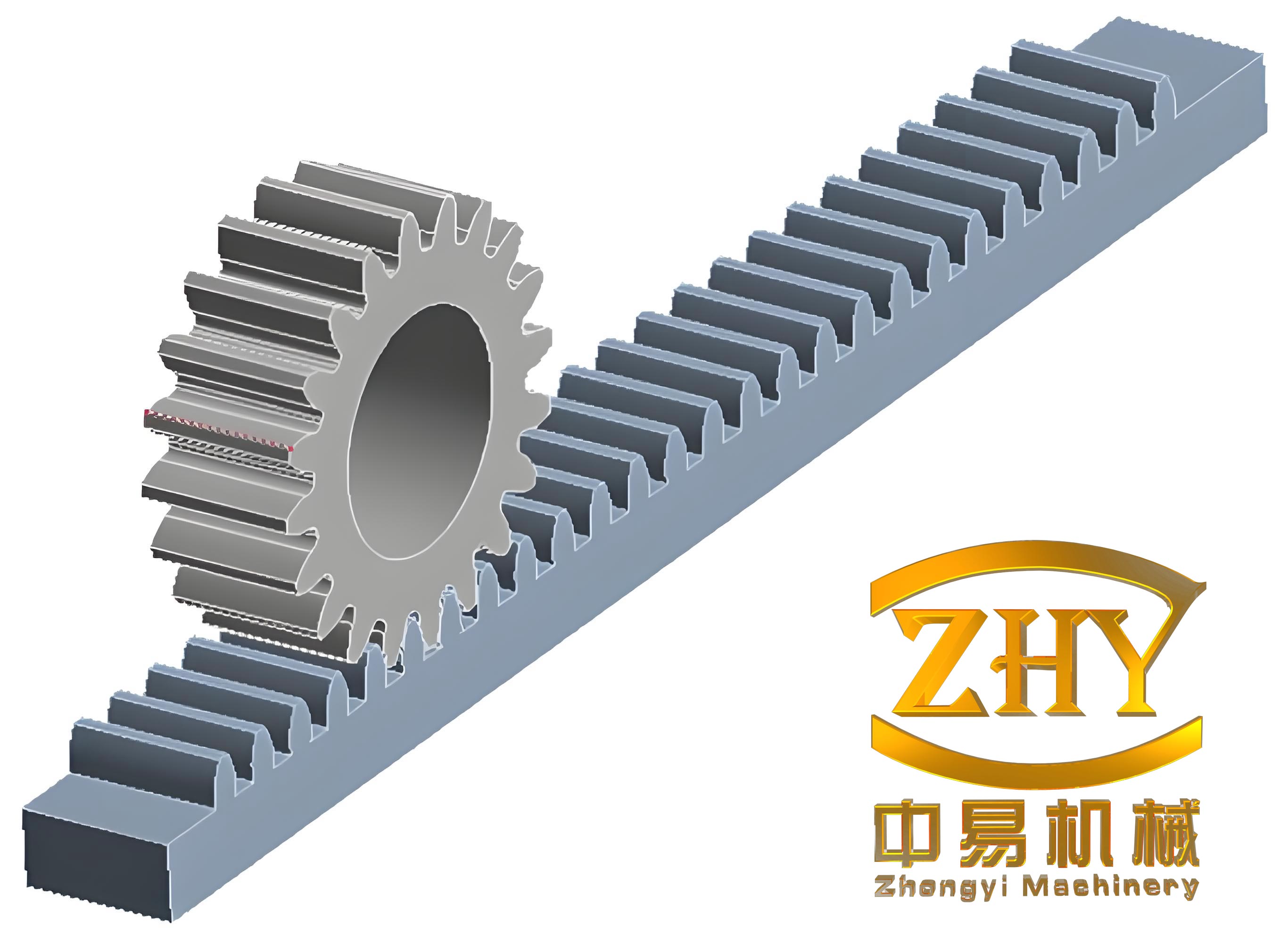
The core of the assembly involves the precise engagement of the helical pinion gear with the linear rack. After assembly is complete, the pinion gear sits flush against the upper face of the bearing inside the housing, and the rack is centered laterally. Each assembled steering gear must have a consistent final position to ensure a unique steering wheel angle when installed in the vehicle. Process analysis reveals that the pinion gear starts above the bearing and is fed vertically downward to its final position. Since rotating the gear drives the rack laterally, ensuring the rack’s final centered position requires the pinion gear to have a unique angular orientation and to be fed without rotation. Analyzing from the rack’s perspective: if the rack were fixed, a spur gear could theoretically be assembled perfectly via 3D simulation, but a helical gear would exhibit increasing interference as it feeds. Therefore, during the pinion’s vertical feed, the rack must also feed horizontally to match the pinion’s motion and avoid collision. Furthermore, simulation shows that as the pinion approaches the rack’s pitch circle radius during meshing, tooth profile interference still occurs. While analyzing interference from the pinion side is complex, from the rack side, the rack can rotate circumferentially to create spatial clearance. At this point, the angular position of the rack tooth flank becomes critical. As the pinion continues its downward feed, the circumferential rotation of the rack, initially for clearance, causes the tooth profile below the pitch radius to occupy the space meant for clearance. The solution requires the rack to rotate back to its theoretical position, eliminating the interference until the pinion is fully seated. Finally, the pinion shaft must be assembled into the deep groove ball bearing. According to specifications, the fit between the pinion shaft and the bearing is a clearance fit H7/g6, which presents a high precision challenge for automation. Any slight misalignment or minor collision during meshing can create resistance during shaft-to-bearing assembly, directly impacting quality. Thus, the general assembly process is as follows: load the rack horizontally into the housing with end-face positioning for repeatability; use displacement sensors to detect the rack tooth flank position via peaks and valleys, accurately locating it circumferentially; return both the rack and pinion to a critical assembly start position; synchronize the displacement of the pinion and rack drives; and insert the pinion assembly into the housing. Meshing and bearing fit, being clearance or transition fits, are managed through servo displacement and pressure control, with final checks determining process success. Typically, the rack and pinion gear mesh has a designed backlash. Once assembled, there is little room for adjustment between them. Only by ensuring correct meshing during assembly with repeatable consistency can subsequent processes adjust backlash and perform run-in tests to meet final steering gear specifications.
Rack Tooth Flank Positioning
For the helical rack and pinion gear meshing during assembly, the rack tooth flank must be held at a stable, known circumferential angle to provide insertion space for the pinion gear. The significant difference in distance from the rack axis between the tooth flank (a plane) and the tooth back (a cylindrical surface), exceeding 3 mm, allows differentiation using displacement sensors. However, the tooth flank itself consists of alternating tooth tips and valleys, with minor micro-variations. To reliably determine the angular position, contact sensing is required. Potentiometer-type displacement sensors, converting mechanical displacement into a proportional current signal (less susceptible to voltage fluctuations than voltage signals), are employed. Before the assembly station, the rack is loaded but at a random angle. Two contact displacement sensors on the equipment automatically locate the flank. The principle is illustrated in the following schematic.
The rack is rotated over 370°. Sensors A and B will inevitably detect a “valley”—a sequence where displacement decreases and then increases. This valley corresponds to the vertical position of the tooth flank. Returning to this valley position sets the required rack angle. Based on product requirements, the rack is then rotated an additional 5° to create sufficient space above for the pinion sensor unit to insert smoothly. This rotation is managed by a servo-driven mechanism.
Synchronous Assembly Start Position for Rack and Pinion Gear
The start point of the synchronized feed for the helical rack and pinion gear automatic assembly process is critical. An incorrect start leads to misalignment between the pinion gear tooth tip and the rack tooth space, causing collision during meshing. Using the rack’s pitch information—parallel pitch of 5.96885 mm and a helix angle of 5°49’12″—the horizontal pitch L2 is calculated as 6 mm. Before meshing begins, the rack must be retracted horizontally by several pitches from its theoretical final position. A horizontal servo drives the rack to the right during assembly, ending at the theoretical position upon completion. To prevent mis-meshing in practice, the start point must ensure the pinion gear tooth tip has entered the rack tooth space. This defines the start position, determining the distance L1 from the pinion gear end face to the bottom bearing, while the rack is retracted by the corresponding distance L2. The relationship between L1 and L2 is derived in the following section.
Process Analysis of Synchronous Rack and Pinion Gear Meshing Assembly
By simulating the assembly in 3D models and analyzing meshing contact points, the motion trajectories of the contact point on the pinion gear and the contact point on the rack are constructed. Using a kinematic approach, these trajectories are modeled mathematically. The displacement vector equation for an ideal point of contact is:
$$
\Delta \vec{r} = \Delta x \, \vec{i} + \Delta y \, \vec{j} + \Delta z \, \vec{k}
$$
Where $\Delta \vec{r}$ is the total displacement, and $\Delta x$, $\Delta y$, $\Delta z$ are displacements in the X (horizontal rack axis), Y, and Z (vertical pinion axis) directions respectively, with $\vec{i}, \vec{j}, \vec{k}$ being unit vectors.
Since there is no motion in the Y direction during assembly, $\Delta y = 0$, simplifying to:
$$
\Delta \vec{r} = \Delta x \, \vec{i} + \Delta z \, \vec{k}
$$
Here, $\Delta x$ corresponds to the rack’s horizontal displacement ($L_2$), and $\Delta z$ corresponds to the pinion’s vertical displacement ($L_1$). This can be transformed into trigonometric relationships based on the geometry of the helical rack and pinion gear system. Two primary configurations exist based on rack helix direction. For a system with a right-hand helix rack (Combination 1), the geometric model yields:
$$
L_2 = \frac{L_1 \sin(\alpha + \beta)}{\sin(90^\circ – \beta)} \quad \text{or} \quad \frac{L_1}{L_2} = \frac{\cos \beta}{\sin(\alpha + \beta)}
$$
For a system with a left-hand helix rack (Combination 2), the model yields:
$$
L_2 = L_1 \sin \alpha – L_1 \cos \alpha \tan \gamma \quad \text{or} \quad \frac{L_1}{L_2} = \frac{1}{\sin \alpha – \cos \alpha \tan \gamma}
$$
Where $\alpha$ is the angle between the pinion gear axis and the vertical direction, $\beta$ is the right-hand rack helix angle, and $\gamma$ is the left-hand rack helix angle. Any synchronous assembly of a helical rack and pinion gear system will conform to one of these parametric relationships.
A significant evolution is the use of a variable-angle rack to minimize backlash for higher steering precision in electric and autonomous vehicles. This rack’s helix angle changes progressively along its length, creating a “bulge” or “crowned” tooth profile that reduces clearance. While its basic helix direction often aligns with Combination 2, it introduces greater assembly difficulty. The positional tolerance of the rack end-face relative to the tooth center (±0.3 mm) must be accommodated, while local gear mesh clearance can be less than 0.1 mm. Standard assembly methods cause collisions, damaging components and increasing noise.
The assembly strategy for this variable-angle rack and pinion gear system begins with the rack held at a 5° rotated position for initial pinion tip entry. Synchronous feed then commences. After approximately 12 mm of pinion travel, when nearing the rack’s pitch line, the rack must be rotated back to 0° to prevent collision. From this point, the pinion engages the crowned tooth profile. The progressively reducing clearance creates higher assembly forces. Fault tree analysis pinpointed the cause: tight meshing conditions combined with tolerance stack-up from multiple fixturing points created misalignment, leading to high forces and ~2% scrap rates.
The solution involved allowing the pinion gear shaft a degree of passive rotational freedom at the assembly start point. The pinion shaft is held by a pneumatic collet, but the clamping force is reduced (20-50 N via reverse air pressure) just enough to prevent the shaft from falling under its own weight. During assembly, meshing forces (typically 100-150 N) overcome this clamping force, allowing the pinion gear to rotate slightly and passively align with the variable-angle rack tooth profile. This adaptive meshing reduced the scrap rate to under 0.3%, well within the required limit, significantly lowering cost.
Critical Guidance Function
During automatic assembly of the rack and pinion gear, the pinion shaft must be inserted into both a needle bearing and a deep groove ball bearing with high precision fits (e.g., H7/g6). The cumulative tolerances from multi-stage positioning and gripping mechanisms in the equipment can lead to misalignment, making it difficult to guarantee final assembly precision through machining alone. A secondary, product-centric alignment at the final stage is necessary. A guiding support mechanism is introduced, which centers on the pinion shaft end face and provides a guiding surface. It is passively pressed back during the assembly stroke, playing a crucial role in aligning the shaft with the bearing bore. This mechanism relaxes the required machining and assembly precision of the equipment itself, achieving the process goal while reducing cost and improving efficiency.
Displacement and Pressure Control
During the automatic assembly of the rack and pinion gear, the fit between the pinion shaft and bearings can be clearance, transition, or interference. Additionally, the risk of tooth collision exists. To ensure successful, non-damaging assembly, displacement and pressure control are implemented. Displacement control is managed by synchronized servo motors to meet positional tolerances. Pressure control is achieved via a load cell providing real-time feedback on assembly force, with parameters set according to the specific product’s assembly characteristics.
For a typical pinion shaft and bearing set, the fits are as follows. The shaft’s larger diameter ($\phi26$h5) fits into the needle bearing ($\phi26$H7) as a clearance fit. The shaft’s smaller diameter ($\phi17$g5) fits into the deep groove ball bearing ($\phi17$H7) as a transition fit, with a maximum possible interference of 0.002 mm under extreme tolerance conditions. The required press-fit force $F$ for this interference fit can be calculated to inform the force limits set in the machine’s Human-Machine Interface (HMI).
The maximum press-fit force $F$ is given by:
$$
F = P_{fmax} \cdot \pi \cdot d_f \cdot l_f \cdot \mu
$$
Where $P_{fmax}$ is the maximum contact pressure, $d_f$ is the nominal fit diameter, $l_f$ is the length of the fit, and $\mu$ is the coefficient of friction.
The maximum contact pressure for an interference fit is calculated as:
$$
P_{fmax} = \frac{\delta}{d_f \left( \frac{C_a}{E_a} + \frac{C_i}{E_i} \right) }
$$
Where $\delta$ is the maximum diametral interference, $E_a$ and $E_i$ are the elastic moduli of the housing (bearing) and shaft materials, and $C_a$ and $C_i$ are coefficients dependent on the diameter ratios and Poisson’s ratio $\nu$.
$$
C_a = \frac{1 + q_a^2}{1 – q_a^2} + \nu_a, \quad C_i = \frac{1 + q_i^2}{1 – q_i^2} – \nu_i, \quad q_a = \frac{d_f}{d_a}, \quad q_i = \frac{d_f}{d_i}
$$
Where $d_a$ is the outer diameter of the bearing inner ring and $d_i$ is the inner diameter of the shaft (0 for a solid shaft).
For a typical steel-on-steel, unlubricated press-fit, $\mu \approx 0.1$. Using material properties for carbon/alloy steel ($E_a = E_i = 200$ GPa, $\nu = 0.3$), and dimensions $d_f=17$ mm, $l_f=13$ mm, $d_a=29.8$ mm, $d_i=0$, $\delta=0.002$ mm, we calculate $q_a \approx 0.57$, $q_i = 0$, leading to $C_a \approx 2.214$ and $C_i = 0.7$. Substituting these values yields $P_{fmax} \approx 8.075$ MPa and consequently $F \approx 560$ N. This calculated force informs the pressure threshold set in the machine’s control system to distinguish a normal assembly from one experiencing abnormal resistance (e.g., due to collision).
| Parameter | Symbol | Value | Notes |
|---|---|---|---|
| Shaft Large Diameter | – | $\phi26$h5 (25.991 – 26.000 mm) | Fits needle bearing |
| Needle Bearing Bore | – | $\phi26$H7 (26.000 – 26.021 mm) | Clearance fit with shaft |
| Shaft Small Diameter | – | $\phi17$g5 (16.986 – 16.994 mm) | Fits deep groove ball bearing |
| Ball Bearing Bore | – | $\phi17$H7 (16.992 – 17.018 mm) | Transition fit with shaft |
| Max. Interference | $\delta$ | 0.002 mm | Worst-case tolerance scenario |
| Fit Length | $l_f$ | 13 mm | Engagement length in ball bearing |
| Coefficient of Friction | $\mu$ | 0.1 | Steel on steel, unlubricated |
| Bearing Inner Ring OD | $d_a$ | 29.8 mm | For calculating $q_a$ |
| Elastic Modulus (Shaft/Bearing) | $E_i, E_a$ | 200 GPa | Carbon/Alloy Steel |
| Poisson’s Ratio | $\nu$ | 0.3 | For steel |
| Calculated Press Force | $F$ | ~560 N | Based on max. interference |
| Diameter Ratio $q_a$ or $q_i$ | $C_a$ ($\nu=0.3$) | $C_i$ ($\nu=0.3$) |
|---|---|---|
| 0.00 | – | 0.7 |
| 0.50 | 1.967 | 1.367 |
| 0.56 | 2.214 | 1.614 |
| 0.57 | ~2.25* | ~1.65* |
| 0.60 | 2.425 | 1.825 |
* Values interpolated for $q_a = 0.57$.
Conclusion
Through the analysis of the automatic assembly process for the helical rack and pinion gear in automotive steering systems, the critical importance of rack tooth flank positioning and the synchronous assembly start point has been established, leading to a complete assembly logic. The analysis of fixed meshing parameters, assembly forces, and protective force limits ensures high repeatability and quality stability from the equipment, significantly improving product quality and production efficiency. This analysis provides a standardized control logic framework and reference for process parameters, facilitating setup and debugging for similar rack and pinion gear assembly equipment. It offers valuable guidance for the design, software control, and process debugging of automated assembly systems for analogous gear products.