
The evolution of steering technology has firmly established the Electric Power Steering (EPS) system as the superior alternative to traditional hydraulic systems, particularly in modern passenger vehicles. Among the various EPS architectures, the Pinion-type EPS (P-EPS) stands out for its compact packaging and direct application of assist torque at the steering gear. The core mechanical component responsible for converting rotational motion into linear displacement in this system is the rack and pinion gear set. Its design dictates critical vehicle attributes such as steering feel, effort, reliability, and overall system durability. This article delves into the detailed mechanical design, analysis, and calculation methodologies for the rack and pinion gear in a P-EPS system, leveraging first-hand engineering perspective and computational tools.
The fundamental operating principle of a P-EPS system is elegantly simple yet highly effective. Manual steering torque from the driver is transmitted through the steering column and input shaft directly to the pinion shaft. Concurrently, an electric motor provides assistive torque, which is geared down and amplified via a worm gear mechanism before being applied to the same pinion shaft. The summation of these two torque inputs acts on the pinion, which meshes with the rack. The rotational motion of the pinion is thereby converted into the lateral, linear motion of the rack, pushing or pulling the tie rods to steer the front wheels. The critical interface in this force translation is the precision-meshing rack and pinion gear.
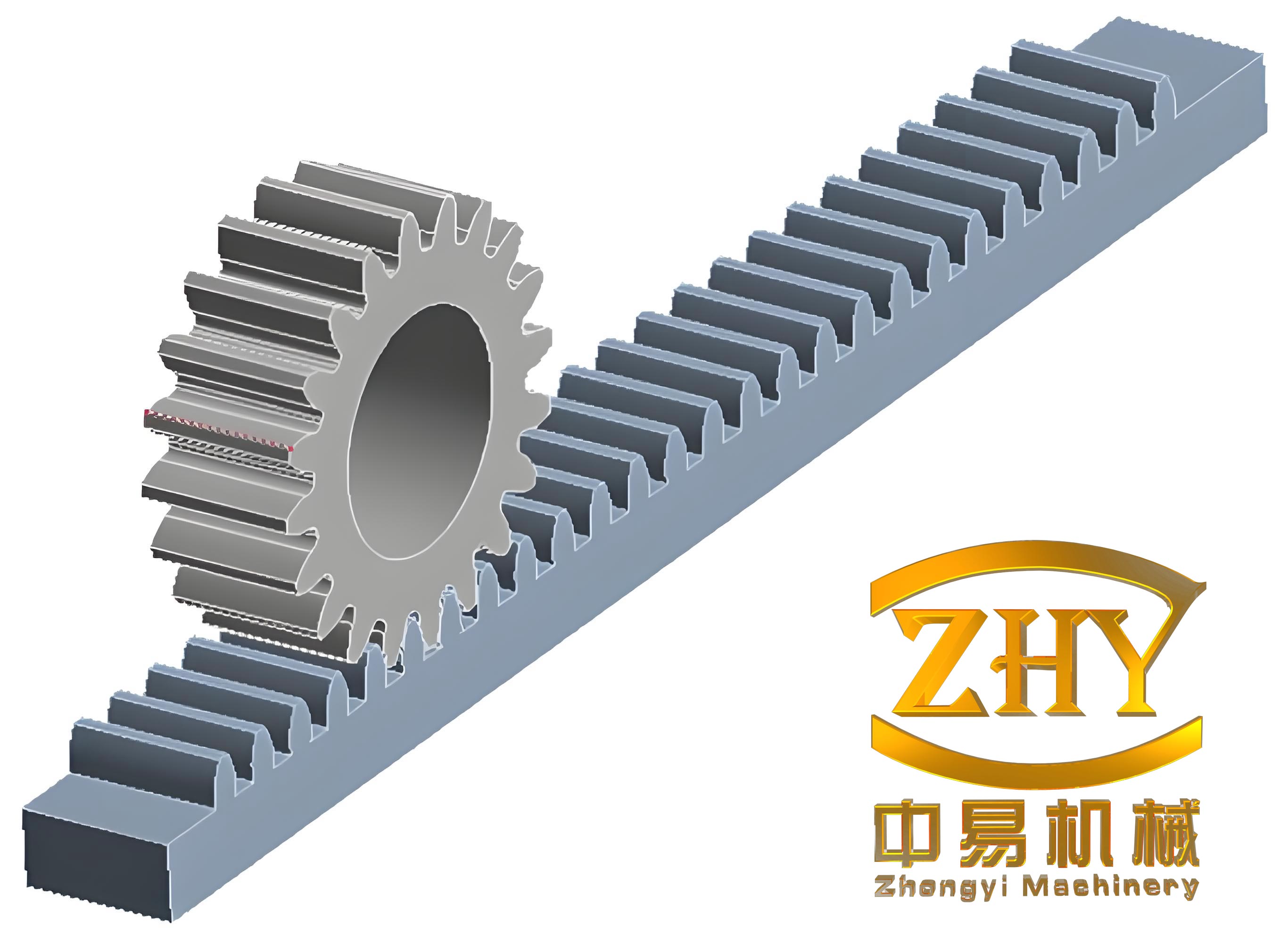
The primary functional elements of the rack and pinion gear assembly include the pinion shaft, the rack shaft, and the support bearings. The pinion is a helical or spur gear machined onto a shaft, supported by two bearings within the housing. The rack is a linear shaft with corresponding gear teeth, sliding within the housing bore. A critical sub-assembly is the rack support and preload mechanism, typically consisting of a spring-loaded backing pad. This mechanism applies a controlled preload force to the back of the rack, eliminating lash between the rack and pinion gear teeth, which is essential for minimizing noise, vibration, and harshness (NVH) while ensuring precise steering response.
Design Requirements and Steering Characteristics of the Rack and Pinion Gear
The design of the rack and pinion gear is governed by two paramount requirements: Steering Load Capacity and Steering Kinematic Characteristics.
1. Steering Load Capacity: This is determined by the vehicle’s front axle load and road conditions. The maximum force the rack and pinion gear must transmit originates from the tire-road interface during low-speed or static steering maneuvers. This load is calculated as an equivalent torque on the pinion shaft and forms the basis for all subsequent stress and fatigue calculations for the gear teeth, shafts, and bearings.
2. Steering Kinematic Characteristics: These are defined by the steering ratio and the number of steering wheel turns lock-to-lock. The linear travel of the rack for one full revolution of the steering wheel is termed the “linear transmission ratio” or “rack travel per pinion revolution” (s). It is the single most important geometric parameter of the rack and pinion gear set and is calculated as:
$$ s = \pi \cdot \frac{m_n \cdot Z_1}{\cos \beta_2} $$
Where:
$m_n$ = Normal module of the rack and pinion gear (mm)
$Z_1$ = Number of teeth on the pinion
$\beta_2$ = Helix angle of the rack (degrees)
The total steering wheel turns (N) is then simply the full rack travel (S) divided by (s). A smaller linear ratio (larger N) results in lighter steering effort but more wheel turns, while a larger ratio (smaller N) makes steering heavier but more direct. Therefore, the selection of $Z_1$ and $\beta_2$ is a primary tuning parameter for steering feel. The helix angle $\beta_2$ offers a fine-adjustment capability for achieving the exact target ratio after the pinion tooth count is chosen.
Determining the Design Load for the Rack and Pinion Gear System
A robust design starts with accurately estimating the worst-case operational load. For the rack and pinion gear, this is the torque required to overcome the maximum steering resistance when the vehicle is stationary on a high-friction surface. A widely accepted semi-empirical formula calculates the steering resistance moment $M_R$ at the wheels:
$$ M_R = \frac{f}{3000} \sqrt{\frac{(9.8 \cdot G_1)^3}{p}} $$
Where:
$f$ = Sliding friction coefficient between tire and road (typically 0.7-0.8 for asphalt/concrete)
$G_1$ = Vehicle front axle load (kg)
$p$ = Tire inflation pressure (MPa)
This moment $M_R$ is then reflected back through the steering linkage and gear ratio to find the equivalent torque $T_1$ acting on the pinion shaft of the rack and pinion gear:
$$ T_1 = \frac{M_R}{\eta \cdot i_w} $$
Where:
$\eta$ = Mechanical efficiency of the steering system (typically ~0.75)
$i_w$ = Angular steering ratio (ratio of steering wheel angle to road wheel angle)
$T_1$ is the fundamental input torque for all strength and durability calculations of the rack and pinion gear components.
Detailed Design Calculation of the Rack and Pinion Gear Geometry and Strength
The design process is iterative and involves selecting materials, calculating initial sizes based on strength, finalizing geometry based on kinematics and packaging, and finally performing rigorous verification checks. Using a specific vehicle case as an example clarifies this process. The primary design inputs are summarized in the table below.
| Parameter | Symbol | Value | Unit |
|---|---|---|---|
| Front Axle Load | $G_1$ | 810 | kg |
| Angular Steering Ratio | $i_w$ | 17.2 | – |
| Tire Pressure | $p$ | 0.22 | MPa |
| System Efficiency | $\eta$ | 0.75 | – |
| Friction Coefficient | $f$ | 0.70 | – |
| Target Rack Travel | $S$ | ±71.5 (143 total) | mm |
| Target Linear Ratio | $s$ | 44.15 | mm/rev |
| Center Distance (approx.) | $a$ | 16.5 | mm |
Modern design heavily relies on computational tools. An Excel-based calculation sheet is an efficient method to perform the sequential calculations, allowing for rapid iteration and “what-if” analysis. The following table outlines the complete calculation flow for the rack and pinion gear set, from load derivation to final geometry and verification.
| Calculation Step | Parameter / Formula | Symbol | Value / Equation | Notes |
|---|---|---|---|---|
| A. Load Calculation | Steering Resistance Moment | $M_R$ | $$ M_R = \frac{0.7}{3000} \sqrt{\frac{(9.8 \cdot 810)^3}{0.22}} \approx 351.8 $$ | N·m |
| Pinion Input Torque | $T_1$ | $$ T_1 = \frac{351.8}{0.75 \cdot 17.2} \approx 27.3 $$ | N·m | |
| B. Material & Allowable Stress | Pinion Material | – | 20CrMo, Case Hardened 56-62 HRC | |
| Rack Material | – | 45 Steel, Surface Hardened 56-62 HRC | ||
| Allowable Bending Stress | $\sigma_{Fp}$ | 435 MPa | Derived from material limits & safety factors. | |
| Allowable Contact Stress | $\sigma_{Hp}$ | 1980 MPa | ||
| C. Preliminary Sizing (Bending) | Normal Module (Estimate) | $m_n$ | $$ m_n \ge \sqrt[3]{\frac{2000 K_t T_1 \cos^2\beta \ Y_{\epsilon} Y_{\beta} Y_{FS}}{\phi_d Z_1^2 \sigma_{Fp}}} $$ | Based on pinion tooth bending strength. Initial $\beta=25°$, $Z_1=8$, $Y_{FS} \approx 3.8$. |
| Calculated $m_n \approx 1.44$ mm | ||||
| Normal Module (Selected) | $m_n$ | 1.75 mm | Rounded up to standard tooling size. | |
| D. Geometric Parameter Definition | Normal Circular Pitch | $p_n$ | $p_n = \pi m_n = 5.498$ mm | |
| Axial Pitch (from ratio $s$) | $p_t$ | $p_t = s / Z_1 = 44.15 / 8 = 5.519$ mm | Axial travel per pinion tooth. | |
| Rack Helix Angle (Calc.) | $\beta_1$ | $\beta_1 = \arccos(p_n / p_t) \approx 5.0°$ | Key parameter ensuring target linear ratio. | |
| Pinion Helix Angle | $\beta_2$ | $\beta_2 = \beta_1 + \text{Cross Angle (20°)} = 25.0°$ | Cross angle is the shaft intersection angle. | |
| Pinion Pitch Diameter | $d_1$ | $$ d_1 = \frac{m_n Z_1}{\cos \beta_2} = \frac{1.75 \cdot 8}{\cos 25°} \approx 15.45 $$ | mm | |
| Pinion Addendum Diameter | $d_{a1}$ | $d_{a1} = d_1 + 2(h_{a}^* + x)m_n = 20.52$ mm | With addendum coeff. $h_{a}^*=0.75$, profile shift $x=0.7$. | |
| Rack Pitch Line Radius | $r_c$ | $r_c = a – (d_1/2) – x m_n \approx 7.55$ mm | mm | |
| Rack Outer Diameter | $D$ | 24.0 mm | Defined by packaging and bending stiffness. | |
| E. Verification Checks | Contact Stress Check | $\sigma_H$ | $$ \sigma_H = Z_H Z_E Z_{\epsilon} Z_{\beta} \sqrt{\frac{2000 K T_1 (u+1)}{b d_1^2 u}} $$ | $u=1$ for rack & pinion. $b$ is facewidth. |
| Calculated $\sigma_H \approx 491$ MPa $ < \sigma_{Hp} = 1980$ MPa | PASS – Contact fatigue safety factor is high. | |||
| Bending Stress Check | $\sigma_F$ | Embedded in module calculation formula. | Module was selected based on this condition. | |
| Gear Forces | Tangential Force | $F_t = T_1 / (d_1/2) \approx 3.05$ kN | ||
| Radial Force | $F_r = F_t \tan\alpha_n / \cos\beta_2 \approx 1.57$ kN | $\alpha_n=25°$ (normal pressure angle). | ||
| Axial Force | $F_a = F_t \tan\beta_2 \approx 1.42$ kN | Plus preload from rack support spring. | ||
| Bearing Life Analysis | e.g., Pinion Bearings | $L_h = \frac{10^6}{60n} \left( \frac{C}{P} \right)^3$ | Using $F_r$, $F_a$ to calculate dynamic equivalent load $P$ for selected bearings (e.g., 6301, 6205). Life >> 12,000 hrs requirement. | |
| Transverse Contact Ratio | $\epsilon_{\alpha}$ | $$ \epsilon_{\alpha} = \frac{Z_1}{2\pi}(\tan\alpha_{at1}-\tan\alpha_{t1}) $$ | Calculates overlap of tooth engagement. | |
| Total Contact Ratio | $\epsilon_{\gamma}$ | $\epsilon_{\gamma} = \epsilon_{\alpha} + \epsilon_{\beta}$ where $\epsilon_{\beta} = \frac{b \sin\beta}{\pi m_n}$ | ||
| Calculated $\epsilon_{\gamma} \approx 2.30 > 2.0$ | PASS – Ensures smooth, continuous power transmission in the rack and pinion gear. |
The final determined parameters for this specific rack and pinion gear application are consolidated below:
| Component | Parameter | Value |
|---|---|---|
| Pinion | Normal Module, $m_n$ | 1.75 mm |
| Number of Teeth, $Z_1$ | 8 | |
| Pressure Angle, $\alpha_n$ | 25° | |
| Helix Angle, $\beta_2$ | 25° | |
| Pitch Diameter | ≈17.9 mm | |
| Rack | Normal Module, $m_n$ | 1.75 mm |
| Number of Teeth | 29 | |
| Pressure Angle, $\alpha_n$ | 25° | |
| Helix Angle, $\beta_1$ | 5° | |
| System | Linear Transmission Ratio, $s$ | 44.15 mm/rev |
| Total Rack Travel, $S$ | 143 mm | |
| Steering Wheel Turns (Lock-to-Lock) | ≈3.24 |
Guidelines for Module and Tooth Count Selection Across Vehicle Segments
A critical question during new product development is the initial sizing of the rack and pinion gear. Based on extensive design calculations and field validation for vehicles with different front axle loads, pragmatic guidelines for pinion tooth count ($Z_1$) and normal module ($m_n$) can be established. These guidelines provide a valuable starting point, accelerating the preliminary design phase. The selection must always be followed by the detailed verification calculations outlined previously.
| Pinion Teeth ($Z_1$) | Front Axle Load ≤ 650 kg | Front Axle Load ≤ 850 kg | Front Axle Load ≤ 1000 kg | Front Axle Load ≤ 1100 kg | Front Axle Load ≤ 1200 kg | Front Axle Load ≤ 1300 kg |
|---|---|---|---|---|---|---|
| 6 | 1.70 – 1.75 mm | – | – | – | – | – |
| 7 | 1.75 mm | 1.85 – 1.90 mm | – | – | – | – |
| 8 | 1.70 mm | 1.75 mm | 1.80 mm | 1.85 – 1.90 mm | 2.00 mm | – |
| 9 | 1.75 – 1.80 mm | – | – | – | – | – |
For instance, an 8-tooth pinion is highly versatile. Table 4 shows that a module of 1.75 mm can serve vehicles up to approximately 850 kg front axle load. As the load increases to 1200 kg, the required module for the same 8-tooth pinion increases to 2.00 mm to maintain adequate tooth root strength and contact fatigue life. A 7-tooth pinion with a slightly larger module (1.85-1.90 mm) can also be a solution for mid-range loads, offering a different linear ratio. The final choice among these combinations is made by concurrently satisfying the target steering ratio (from $s = \pi m_n Z_1 / \cos\beta_2$), packaging constraints, and the full suite of strength checks.
In summary, the engineering of the rack and pinion gear for a P-EPS system is a structured synthesis of kinematics, strength of materials, and manufacturing practicality. The process begins with defining system-level requirements—steering feel (ratio) and load capacity. A calculated maximum pinion torque, derived from vehicle parameters, drives the initial sizing via bending strength formulas to determine the gear module. The kinematic requirement then fixes the relationship between pinion tooth count, module, and rack helix angle. Subsequent detailed geometric development and rigorous verification of contact stress, bending stress, bearing life, and mesh quality are non-negotiable steps to ensure durability and performance. The provided computational framework and empirical guidelines for module selection serve as a powerful reference, significantly streamlining the development cycle for new and robust P-EPS systems. The rack and pinion gear remains the mechanical heart of the system, and its precise design is fundamental to delivering a safe, reliable, and satisfying steering experience.